


Overview
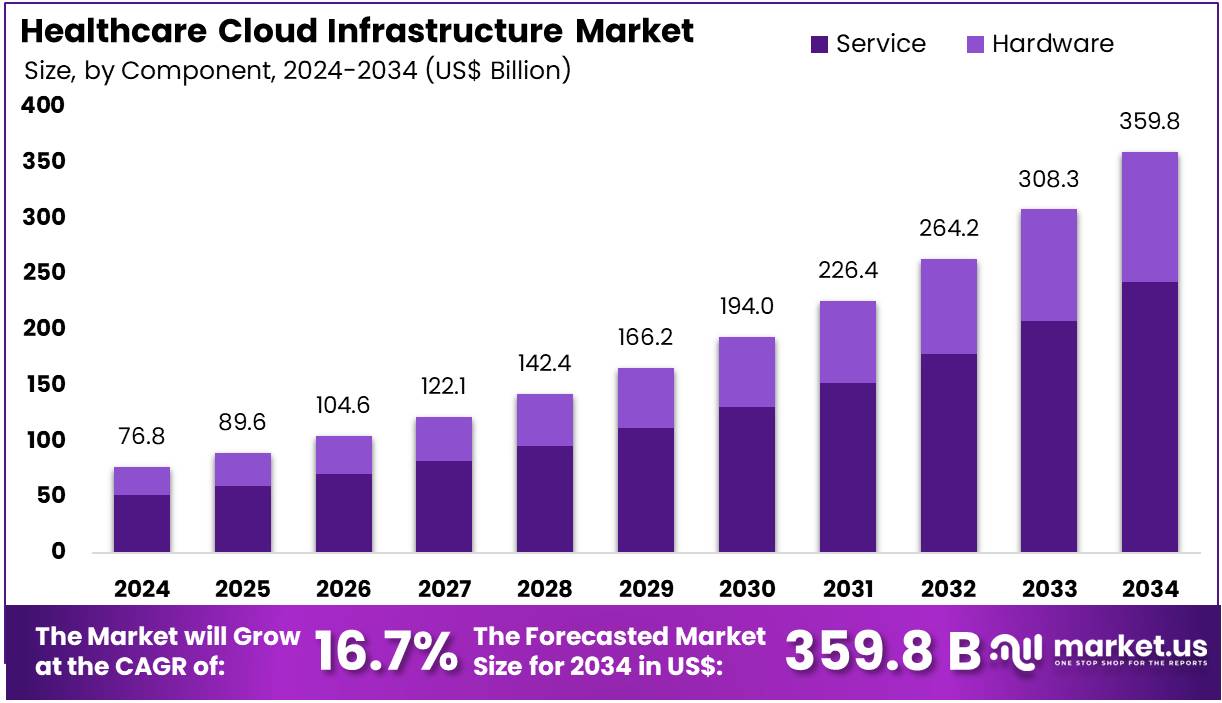
New York, NY – July 07, 2026 – The Healthcare Cloud Infrastructure Market Size is expected to be worth around US$ 359.8 billion by 2034 from US$ 76.8 billion in 2024, growing at a CAGR of 16.7% during the forecast period 2025 to 2034. North America held a dominant market position, capturing more than a 46.7% share and holds US$ 35.9 Billion market value for the year.
Healthcare Cloud Infrastructure refers to the use of cloud-based computing platforms, storage, networking, and software services to support healthcare organizations in managing clinical, administrative, and operational data. It enables hospitals, clinics, diagnostic laboratories, pharmaceutical companies, and research institutions to securely store, process, and access healthcare information while improving scalability, operational efficiency, and collaboration. The increasing adoption of electronic health records (EHRs), telehealth services, digital imaging, and data analytics has accelerated the demand for cloud infrastructure across the healthcare sector.
Healthcare cloud infrastructure supports various deployment models, including public, private, and hybrid clouds, allowing organizations to choose solutions that align with their security, compliance, and operational requirements. It also facilitates real-time data sharing, remote patient monitoring, disaster recovery, and interoperability among healthcare systems, contributing to enhanced patient care and streamlined workflows. Advanced technologies such as artificial intelligence, machine learning, and big data analytics are increasingly being integrated with cloud platforms to improve clinical decision-making and operational performance.
The market continues to benefit from rising investments in healthcare digital transformation, growing demand for cost-effective IT infrastructure, and increasing emphasis on data security and regulatory compliance. Cloud service providers are expanding their healthcare-specific offerings to address evolving industry needs while supporting innovation in personalized medicine, population health management, and precision healthcare. As healthcare organizations continue to modernize their IT environments, cloud infrastructure is expected to remain a fundamental component of future healthcare delivery and digital health ecosystems.
Key Takeaways
- The healthcare cloud infrastructure market was valued at US$ 76.8 billion in 2024 and is projected to reach US$ 359.8 billion by 2034, expanding at a CAGR of 16.7% during the forecast period.
- By component, the market is segmented into services and hardware, with the services segment accounting for the largest share of 67.5% in 2024.
- Based on end use, the market is categorized into healthcare providers and healthcare payers, with healthcare providers holding the dominant market share of 60.0% in 2024.
- North America emerged as the leading regional market, capturing 46.7% of the global healthcare cloud infrastructure market share in 2024.
Regional Analysis
North America Dominates the Healthcare Cloud Infrastructure Market
North America accounted for the largest share of the healthcare cloud infrastructure market in 2024, driven by the rapid digital transformation of healthcare systems, widespread adoption of electronic health records (EHRs), and increasing demand for secure, scalable cloud platforms.
Healthcare organizations across the region are investing in cloud technologies to improve data management, interoperability, operational efficiency, and patient care while complying with stringent data privacy regulations such as HIPAA. The transition toward value-based care and the growing use of digital health applications have further accelerated cloud adoption.
According to a September 2023 Global Healthcare Exchange (GHX) survey, nearly 70% of U.S. hospitals and health systems intend to implement cloud-based supply chain management solutions by 2026. In addition, leading cloud providers continue to strengthen the regional ecosystem through ongoing investments and platform enhancements. The strong presence of advanced healthcare infrastructure, favorable regulatory support, and continuous technological innovation is expected to sustain North America’s leadership in the healthcare cloud infrastructure market.
Emerging Trends
- Adoption of Hybrid and Multi-Cloud Strategies: Healthcare organizations are increasingly implementing hybrid and multi-cloud strategies to improve flexibility, optimize costs, and strengthen data security. These environments allow providers to distribute workloads across multiple cloud platforms, improving application performance, ensuring business continuity, and supporting scalable healthcare operations with greater efficiency.
- Enhanced Data Interoperability: Healthcare providers are prioritizing improved data interoperability to enable secure and seamless information exchange across hospitals, clinics, laboratories, and digital health platforms. Enhanced connectivity reduces administrative inefficiencies, supports coordinated patient care, improves clinical decision-making, and delivers a more unified healthcare experience.
- Integration of AI and Machine Learning: Artificial intelligence and machine learning are becoming core components of healthcare cloud infrastructure, supporting predictive analytics, medical imaging, clinical decision-making, and operational optimization. These technologies improve diagnostic accuracy, automate routine processes, and help healthcare providers deliver more personalized and efficient patient care.
- Focus on Regulatory Compliance: Healthcare organizations are increasingly adopting cloud platforms to strengthen regulatory compliance and safeguard sensitive patient information. Advanced cloud security features support adherence to healthcare regulations, improve data governance, reduce compliance risks, and ensure secure storage, access, and management of medical records.
- Increased Use of Containers: Container technologies are gaining widespread adoption within healthcare cloud environments because they simplify application deployment across multiple cloud platforms. Containers improve portability, consistency, scalability, and resource utilization while enabling healthcare organizations to efficiently manage applications without compromising operational flexibility or performance.
Use Cases
- Remote Patient Monitoring (RPM): Cloud infrastructure enables remote patient monitoring by securely collecting, storing, and analyzing health data from connected devices. Healthcare providers can continuously monitor patients, detect health issues earlier, reduce unnecessary hospital visits, and improve chronic disease management through timely clinical interventions and personalized care.
- Predictive Analytics in Patient Care: Cloud-based predictive analytics solutions analyze extensive patient datasets to identify health risks and forecast potential medical emergencies. These insights enable healthcare professionals to implement preventive treatments, improve emergency response, enhance patient outcomes, and optimize resource allocation across healthcare facilities and clinical departments.
- Streamlined Clinical Workflows: Cloud platforms integrate healthcare systems, electronic health records, and connected medical devices into centralized environments that simplify clinical workflows. Providers gain faster access to comprehensive patient information, reducing administrative burden, accelerating diagnosis, improving collaboration, and enhancing treatment planning across multidisciplinary healthcare teams.
- Enhancing Data Security and Privacy: Healthcare cloud infrastructure strengthens data security by implementing encryption, identity management, continuous monitoring, and regulatory compliance measures. These capabilities protect sensitive patient information from cyber threats, ensure privacy, maintain data integrity, and build greater trust among healthcare providers and patients alike.
- Facilitating Telehealth Services: Cloud infrastructure supports telehealth by enabling secure virtual consultations, remote follow-ups, and digital healthcare delivery. These platforms improve healthcare accessibility for patients in rural areas or with mobility limitations while reducing travel requirements and expanding access to timely medical expertise.
Frequently Asked Questions on Healthcare Cloud Infrastructure
- What are the key factors driving the Healthcare Cloud Infrastructure Market?
The market is primarily driven by the growing adoption of electronic health records, rising demand for telehealth services, increasing healthcare data volumes, and the need for secure, scalable IT infrastructure. Continuous advancements in cloud computing and artificial intelligence are also supporting market expansion. - Which organizations use healthcare cloud infrastructure?
Healthcare cloud infrastructure is widely used by hospitals, clinics, diagnostic laboratories, pharmaceutical companies, research organizations, health insurance providers, and government healthcare agencies. These organizations rely on cloud platforms to improve data accessibility, operational efficiency, collaboration, and patient care delivery. - What are the major deployment models in healthcare cloud infrastructure?
Healthcare cloud infrastructure is available through public, private, and hybrid cloud deployment models. Each model offers different levels of scalability, security, and flexibility, allowing healthcare organizations to select solutions that best meet their operational, compliance, and data protection requirements. - What are the benefits of healthcare cloud infrastructure?
Healthcare cloud infrastructure enhances data storage, enables secure information sharing, supports remote access, reduces IT infrastructure costs, and improves disaster recovery capabilities. It also facilitates interoperability between healthcare systems, helping organizations deliver more efficient and patient-centered healthcare services. - Which region leads the Healthcare Cloud Infrastructure Market?
North America leads the healthcare cloud infrastructure market due to its advanced healthcare IT ecosystem, widespread adoption of cloud technologies, supportive regulatory framework, and significant investments in digital healthcare transformation. The region also benefits from the presence of leading global cloud service providers. - What is the future outlook for the Healthcare Cloud Infrastructure Market?
The healthcare cloud infrastructure market is expected to witness strong long-term growth, supported by increasing digitalization, expanding telehealth services, growing healthcare data generation, and rising investments in cloud-enabled technologies. Continued innovation in artificial intelligence and analytics will further accelerate market development.
Conclusion
The healthcare cloud infrastructure market is expected to witness sustained growth as healthcare organizations continue to accelerate digital transformation and modernize their IT ecosystems. Rising adoption of electronic health records, telehealth, artificial intelligence, and data analytics is strengthening demand for secure, scalable, and interoperable cloud solutions.
Increasing focus on regulatory compliance, cybersecurity, and operational efficiency is further supporting market expansion across providers and payers. North America remains the leading regional market, while emerging economies present significant growth opportunities through expanding healthcare digitalization initiatives. Continuous technological innovation and investment are expected to position cloud infrastructure as a critical foundation for future healthcare delivery worldwide.
Discuss your needs with our analyst
Please share your requirements with more details so our analyst can check if they can solve your problem(s)




