


Overview
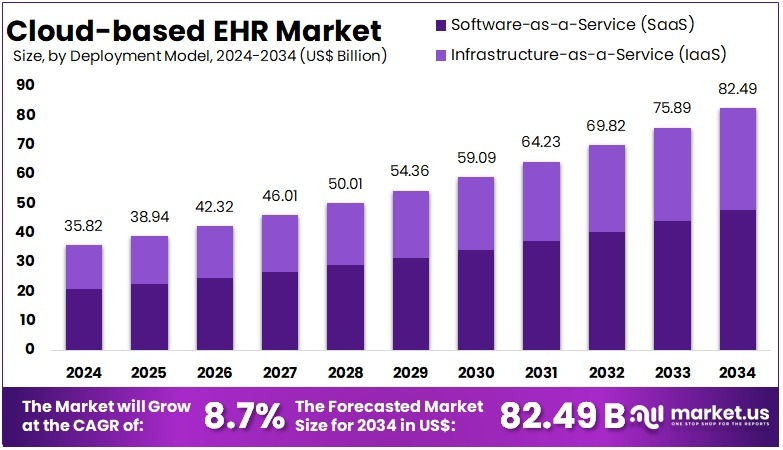
New York, NY – July 01, 2026 – The Cloud-based EHR Market Size is expected to be worth around US$ 82.49 billion by 2034 from US$ 35.82 billion in 2024, growing at a CAGR of 8.7% during the forecast period 2025 to 2034.
Cloud-based Electronic Health Record (EHR) systems are secure digital platforms that enable healthcare providers to store, access, manage, and share patient health information through the internet. Unlike traditional on-premise systems, cloud-based EHR solutions eliminate the need for extensive local IT infrastructure while providing real-time access to medical records from any authorized location. These systems support improved care coordination by allowing physicians, nurses, specialists, and other healthcare professionals to securely access up-to-date patient information, helping to enhance clinical decision-making and reduce administrative burden.
Cloud-based EHR platforms typically include features such as patient record management, e-prescribing, appointment scheduling, clinical documentation, billing integration, laboratory and imaging result management, and analytics. They are designed with advanced security measures, including data encryption, role-based access controls, automated backups, and compliance with healthcare data privacy regulations, ensuring the protection of sensitive patient information.
The growing adoption of cloud-based EHR solutions is being driven by the increasing digitalization of healthcare, rising demand for interoperable health information systems, and the need for cost-effective and scalable healthcare IT infrastructure. Healthcare organizations are increasingly investing in cloud technologies to improve operational efficiency, support telehealth services, and enhance patient engagement. As healthcare systems continue to modernize, cloud-based EHR solutions are expected to play an essential role in enabling data-driven care delivery, improving workflow efficiency, and supporting better patient outcomes across hospitals, clinics, and other healthcare settings.
Key Takeaways
- In 2024, the global Cloud-based EHR market was valued at US$ 35.82 billion and is projected to reach US$ 82.49 billion by 2034, expanding at a CAGR of 8.7% during the forecast period.
- Based on deployment model, the market is segmented into Software-as-a-Service (SaaS) and Infrastructure-as-a-Service (IaaS). The Software-as-a-Service (SaaS) segment accounted for the largest market share of 57.9%.
- By type, the market is categorized into Standalone and Integrated solutions. The Integrated segment dominated the market, capturing 62.3% of the total market share.
- Based on end user, the market is segmented into Hospitals, Ambulatory Surgical Centers, and Clinics and Specialty Centers. Among these, the Hospitals segment held the largest revenue share of 52.5%.
- North America emerged as the leading regional market, accounting for 43.8% of the global Cloud-based EHR market share.
Regional Analysis
North America holds the largest share of the cloud-based electronic health record (EHR) market, supported by advanced healthcare infrastructure, strong digital transformation initiatives, and favorable government policies. The widespread adoption of cloud-based EHR solutions has been significantly influenced by federal incentive programs, particularly the U.S. Meaningful Use program, which encouraged healthcare providers to implement certified EHR systems through financial incentives. These initiatives have accelerated the transition from paper-based records to digital platforms, improving healthcare delivery and operational efficiency.
Cloud-based EHR systems offer several advantages over traditional on-premise solutions. They reduce the need for costly IT infrastructure, lower maintenance expenses, enable automatic software updates, and provide scalable deployment options for healthcare organizations of all sizes. In addition, these systems enhance interoperability by enabling secure and seamless exchange of patient information among hospitals, clinics, laboratories, pharmacies, and other healthcare providers. Improved data accessibility supports better clinical decision-making, care coordination, and patient outcomes.
Despite these advantages, the market continues to face challenges related to cybersecurity risks, data privacy concerns, regulatory compliance, and the integration of cloud-based platforms with existing legacy healthcare systems. Nevertheless, ongoing investments in digital healthcare continue to strengthen market growth. For instance, in July 2023, Universal Health Services (UHS) expanded the deployment of Oracle EHR across its extensive network of behavioral health facilities, highlighting the region’s continued commitment to modernizing healthcare information systems.
Emerging Trends
- Shift Toward Interoperable Systems: Healthcare providers are increasingly adopting interoperable cloud-based EHR systems that enable secure patient data sharing across hospitals, clinics, laboratories, and pharmacies. Real-time access to medical records improves care coordination, minimizes duplicate testing, accelerates diagnoses, and supports efficient, patient-centered healthcare delivery.
- Increased Adoption by Small and Medium Clinics: Small and medium-sized healthcare practices are adopting cloud-based EHR solutions because of their affordability, subscription-based pricing, and minimal IT requirements. Easy deployment and maintenance allow independent clinics to digitize patient records while improving operational efficiency and healthcare service quality.
- Integration of Telehealth Features: Cloud-based EHR platforms increasingly integrate telehealth capabilities, enabling virtual consultations, e-prescriptions, and remote patient monitoring. Combining telemedicine with centralized patient records improves clinical workflows, enhances care continuity, and provides convenient healthcare access for patients regardless of their location.
- Use of AI and Analytics in EHR Systems: Artificial intelligence and advanced analytics are enhancing cloud-based EHR systems by supporting clinical decision-making, identifying health risks, predicting disease progression, and recommending treatments. These technologies improve diagnostic accuracy, streamline workflows, and enable proactive, data-driven patient care across healthcare organizations.
- Rising Focus on Data Security: Healthcare organizations are strengthening cloud-based EHR security through encryption, multi-factor authentication, secure backups, and regulatory compliance. Enhanced cybersecurity measures protect sensitive patient information, reduce data breach risks, strengthen user trust, and encourage broader adoption of cloud healthcare technologies.
- Mobile Access and User-Friendly Interfaces: Cloud-based EHR solutions provide mobile-friendly platforms that allow healthcare professionals to securely access patient records using smartphones and tablets. Intuitive interfaces improve workflow efficiency, enable faster decision-making, enhance communication, and support timely patient care across diverse clinical settings.
Use Cases
- Patient Record Management: Cloud-based EHR systems centralize patient medical histories, prescriptions, laboratory reports, imaging records, and physician notes into a single digital platform. This improves record accuracy, supports faster diagnosis, enhances treatment planning, and enables healthcare providers to deliver coordinated, high-quality patient care.
- Multi-location Access for Healthcare Chains: Healthcare organizations with multiple facilities use cloud-based EHR systems to provide seamless patient record access across locations. This ensures continuity of care, eliminates manual record transfers, improves collaboration among providers, and delivers consistent treatment regardless of where patients receive care.
- Remote Consultation and Virtual Care: Cloud-based EHR platforms support virtual consultations by providing clinicians with instant access to complete patient records during online appointments. This enables informed clinical decisions, improves healthcare accessibility for remote populations, reduces unnecessary hospital visits, and enhances continuity of patient care.
- Emergency Room (ER) Efficiency: Emergency departments utilize cloud-based EHR systems to instantly access critical patient information, including allergies, medications, and medical history. Rapid data availability supports faster clinical decisions, minimizes treatment errors, reduces unnecessary testing, and improves emergency care outcomes for patients.
- Collaboration Between Providers: Cloud-based EHR systems facilitate real-time collaboration among physicians, specialists, laboratories, and healthcare providers through shared patient records. Improved information exchange reduces communication gaps, prevents duplicate procedures, enhances treatment coordination, and ensures comprehensive patient management across multiple healthcare disciplines.
- Automated Billing and Insurance Claims: Cloud-based EHR platforms automate medical billing, insurance verification, and claims submission processes. Automation minimizes administrative errors, accelerates reimbursement cycles, improves revenue management, reduces paperwork, and streamlines financial operations while enhancing the overall efficiency of healthcare organizations.
Frequently Asked Questions on Cloud-based EHR
- How does a Cloud-based EHR differ from a traditional EHR system?
Unlike traditional EHR systems that require local servers and dedicated IT maintenance, cloud-based EHR solutions are hosted by third-party providers. They offer automatic software updates, remote accessibility, lower infrastructure costs, improved scalability, and simplified deployment, making them suitable for healthcare organizations of all sizes. - What factors are driving the growth of the Cloud-based EHR market?
The Cloud-based EHR market is expanding due to increasing digital transformation in healthcare, growing adoption of telemedicine, rising demand for interoperable health information systems, supportive government initiatives promoting electronic records, and the need for cost-effective healthcare IT infrastructure across hospitals and outpatient facilities. - What are the key benefits of adopting a Cloud-based EHR system?
Cloud-based EHR systems improve patient data accessibility, enhance collaboration among healthcare professionals, reduce operational expenses, strengthen disaster recovery capabilities, and enable real-time updates. These advantages contribute to improved patient outcomes, streamlined administrative processes, and higher efficiency across healthcare organizations. - Which healthcare facilities are the primary users of Cloud-based EHR solutions?
Cloud-based EHR solutions are widely adopted by hospitals, physician practices, ambulatory surgical centers, specialty clinics, diagnostic laboratories, and community healthcare providers. Their flexibility and subscription-based pricing models make them particularly attractive for both large healthcare networks and smaller independent medical practices. - Which regions are experiencing significant growth in the Cloud-based EHR market?
North America currently leads the Cloud-based EHR market due to advanced healthcare infrastructure and high digital adoption. Meanwhile, Asia-Pacific is expected to witness rapid growth, supported by increasing healthcare investments, expanding internet connectivity, government digital health initiatives, and rising healthcare expenditure. - How is artificial intelligence influencing Cloud-based EHR solutions?
Artificial intelligence is enhancing cloud-based EHR platforms by enabling predictive analytics, automated clinical documentation, intelligent decision support, and workflow automation. These capabilities help healthcare providers improve diagnostic accuracy, optimize treatment planning, reduce administrative burden, and deliver more personalized patient care. - Who are the major end users contributing to the Cloud-based EHR market demand?
Major end users include hospitals, multi-specialty clinics, ambulatory care centers, physician offices, academic medical institutions, and healthcare networks. Increasing demand for centralized patient records, regulatory compliance, and integrated healthcare delivery continues to support adoption across these healthcare settings. - What is the future outlook for the Cloud-based EHR market?
The future of the Cloud-based EHR market remains positive, supported by ongoing advancements in cloud computing, interoperability standards, artificial intelligence, and digital healthcare initiatives. Continued investments in healthcare IT and increasing emphasis on value-based care are expected to sustain long-term market expansion globally.
Conclusion
The global cloud-based Electronic Health Record (EHR) market is expected to witness sustained growth as healthcare organizations continue to prioritize digital transformation, interoperability, and patient-centered care. The adoption of cloud-based platforms is improving clinical workflows, enabling secure data sharing, supporting telehealth services, and reducing infrastructure costs for providers of all sizes.
Advancements in artificial intelligence, analytics, and cybersecurity are further enhancing the value of these solutions by improving decision-making and protecting sensitive patient information. Despite challenges related to data privacy and legacy system integration, continued investments in healthcare IT and supportive government initiatives are expected to drive long-term market expansion.
Discuss your needs with our analyst
Please share your requirements with more details so our analyst can check if they can solve your problem(s)




