


Overview
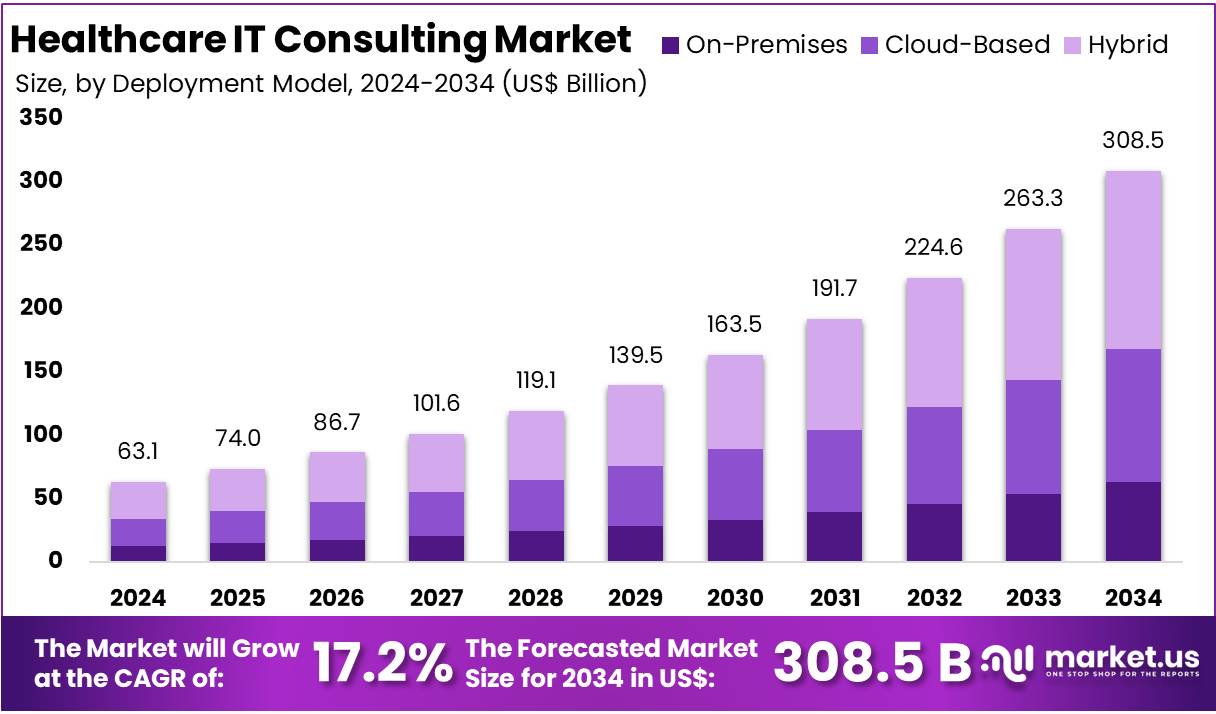
New York, NY – June 30, 2026 – The Healthcare IT Consulting Market Size is forecasted to be valued at US$ 308.5 billion by 2034 from US$ 63.1 billion in 2024, growing at a CAGR of 17.2% during the forecast period 2025 to 2034.
Healthcare IT consulting involves specialized advisory and implementation services that help healthcare organizations improve the planning, deployment, management, and optimization of digital technologies. These services support hospitals, clinics, diagnostic centers, payers, pharmaceutical companies, and other healthcare providers in adopting advanced IT solutions that enhance operational efficiency, regulatory compliance, and patient care. Healthcare IT consultants assist organizations in areas such as electronic health record (EHR) implementation, healthcare analytics, cybersecurity, cloud migration, telehealth integration, interoperability, and digital transformation strategies.
The increasing adoption of digital healthcare technologies, growing demand for data-driven clinical decision-making, and rising focus on improving patient outcomes are driving the demand for healthcare IT consulting services worldwide. In addition, evolving regulatory requirements, increasing investments in healthcare infrastructure, and the need to strengthen data security are encouraging healthcare organizations to seek expert consulting support. Consultants also help healthcare providers optimize workflows, reduce operational costs, and ensure seamless integration of emerging technologies across healthcare systems.
Healthcare IT consulting plays a critical role in enabling organizations to modernize their IT infrastructure while maintaining compliance with industry standards and protecting sensitive patient information. The growing adoption of artificial intelligence, cloud computing, big data analytics, and connected healthcare solutions is further expanding the scope of consulting services. As healthcare systems continue to prioritize digital innovation and value-based care, healthcare IT consulting is expected to remain an essential component of long-term technology and business transformation strategies across the global healthcare industry.
Key Takeaways
- The global healthcare IT consulting market was valued at US$ 63.1 billion in 2024 and is projected to reach US$ 308.5 billion by 2034, expanding at a CAGR of 17.2% during the forecast period.
- By type, the Healthcare Business Process Management segment accounted for the largest market share of 26.3% in 2024.
- Based on deployment model, the Hybrid segment dominated the market, capturing a 45.4% revenue share in 2024.
- By end user, Healthcare Providers emerged as the leading segment, representing 69.6% of the global market in 2024.
- North America led the global healthcare IT consulting market, holding the largest regional share of 39.8% in 2024.
Regional Analysis
North America dominated the global healthcare IT consulting market in 2024, accounting for 39.8% of the total market share. The region’s leadership is supported by advanced healthcare infrastructure, widespread adoption of digital health technologies, and stringent regulatory requirements. The increasing implementation of electronic health records (EHRs), telemedicine platforms, cloud-based healthcare systems, and artificial intelligence solutions has accelerated the demand for healthcare IT consulting services. Continuous investments in healthcare modernization, combined with the presence of leading healthcare technology companies, further strengthen the region’s market position.
Asia Pacific is projected to register the fastest CAGR during the forecast period. Market growth is driven by rising healthcare expenditure, government initiatives to digitize healthcare systems, expanding healthcare IT infrastructure, and increasing adoption of advanced technologies. Countries including China, India, Singapore, Indonesia, and Australia are actively investing in digital health and generative AI applications to improve patient care, streamline healthcare operations, enhance knowledge management, and expand access to quality healthcare services, supporting strong regional market growth.
Emerging Trends
- Increased Focus on Digital Transformation: Healthcare organizations are replacing paper-based processes with digital systems to improve efficiency, accuracy, and patient care. IT consultants support this transition by implementing electronic platforms, migrating data, integrating applications, and training employees, enabling providers to streamline operations while reducing administrative errors and improving healthcare delivery.
- Growing Demand for Cybersecurity Services: Healthcare providers increasingly require advanced cybersecurity solutions to protect sensitive patient information from cyberattacks and data breaches. IT consultants strengthen security through encryption, network protection, continuous monitoring, risk assessments, and employee training, ensuring healthcare systems remain secure, reliable, and compliant with regulatory requirements.
- Rising Adoption of Cloud-Based Solutions: Healthcare organizations are adopting cloud technologies to improve accessibility, scalability, and operational efficiency across multiple locations. IT consultants oversee secure cloud migration, protect sensitive information, optimize infrastructure, and ensure regulatory compliance, helping providers reduce IT costs while supporting flexible and efficient healthcare operations.
- Integration of AI and Data Analytics: Healthcare providers increasingly implement artificial intelligence and data analytics to improve clinical decisions, predict health risks, and optimize patient outcomes. IT consultants deploy suitable technologies, integrate data platforms, and train healthcare teams, enabling organizations to deliver faster, data-driven, and more personalized patient care.
- Shift Toward Patient-Centered Care: Healthcare organizations are prioritizing patient-centered care by introducing digital services that improve convenience and accessibility. IT consultants develop telehealth platforms, mobile applications, and online scheduling systems while ensuring usability, security, and regulatory compliance, enhancing patient engagement, satisfaction, and overall healthcare experiences.
- Support for Regulatory Compliance: Healthcare providers face strict regulatory requirements governing patient privacy, cybersecurity, and digital health records. IT consultants implement compliant technology solutions, conduct security assessments, monitor regulatory changes, prepare documentation, and train employees, helping organizations minimize compliance risks while maintaining operational efficiency and patient trust.
Use Cases
- Implementing Electronic Health Records (EHRs): A hospital replaces paper records with an electronic health record system to improve patient management. Healthcare IT consultants select suitable software, migrate patient information securely, integrate workflows, and train staff, ensuring a smooth implementation that enhances operational efficiency and continuity of patient care.
- Launching a Telemedicine Platform: A healthcare clinic introduces a telemedicine platform to provide remote consultations for patients. IT consultants design secure, user-friendly systems, ensure compliance with healthcare regulations, optimize device compatibility, and support deployment, enabling providers to expand healthcare access while maintaining patient privacy and service quality.
- Improving Workflow Efficiency in a Hospital: A hospital experiences delays caused by manual administrative processes and fragmented systems. Healthcare IT consultants analyze workflows, identify inefficiencies, automate patient registration and billing, integrate digital tools, and optimize operations, resulting in improved productivity, reduced errors, and enhanced patient and staff experiences.
- Data Integration After a Hospital Merger: Following a hospital merger, separate information systems create operational challenges and fragmented patient records. Healthcare IT consultants consolidate databases, integrate applications, standardize workflows, and train employees, enabling seamless collaboration, improved data accessibility, operational continuity, and consistent patient care across the merged organization.
- Strengthening Cybersecurity After a Data Breach: Following a cybersecurity breach, a healthcare organization hires IT consultants to restore system security. Consultants investigate vulnerabilities, implement stronger protection measures, encrypt sensitive data, improve access controls, and educate employees, reducing future cyber risks while restoring patient confidence and regulatory compliance.
- Cloud Migration for a Diagnostic Center: A diagnostic center migrates patient records and laboratory systems to a secure cloud environment. Healthcare IT consultants manage migration planning, protect sensitive information, minimize downtime, and optimize cloud infrastructure, enabling improved data accessibility, lower maintenance costs, and greater operational flexibility for healthcare services.
- Mobile App Development for Patient Engagement: A healthcare provider develops a mobile application that allows patients to schedule appointments, access medical records, and receive medication reminders. IT consultants design secure, user-friendly applications, ensure regulatory compliance, and optimize performance, improving patient engagement, convenience, satisfaction, and long-term healthcare relationships.
Frequently Asked Questions on Healthcare IT Consulting
- Why is Healthcare IT Consulting important for healthcare organizations?
Healthcare IT consulting is important because it enables healthcare providers to modernize technology systems, enhance patient care, strengthen cybersecurity, improve operational workflows, and ensure regulatory compliance. Consultants also assist organizations in adopting innovative digital solutions while minimizing implementation risks, reducing costs, and maximizing the value of healthcare technology investments. - What services are included in Healthcare IT Consulting?
Healthcare IT consulting includes services such as IT strategy development, electronic health record implementation, interoperability consulting, cloud migration, cybersecurity assessment, regulatory compliance support, data analytics, revenue cycle optimization, telehealth integration, IT infrastructure modernization, and digital transformation planning to improve healthcare delivery and operational performance. - What technologies are driving Healthcare IT Consulting?
Healthcare IT consulting is increasingly driven by technologies such as artificial intelligence, cloud computing, big data analytics, Internet of Things devices, blockchain, cybersecurity solutions, robotic process automation, and interoperable electronic health record systems. These technologies enable digital transformation and improve clinical and operational efficiency. - What factors are driving the Healthcare IT Consulting Market?
The Healthcare IT Consulting Market is primarily driven by increasing digital transformation initiatives, growing adoption of electronic health records, rising cybersecurity concerns, expanding telehealth services, regulatory compliance requirements, cloud computing adoption, and increasing investments in healthcare information technology infrastructure across developed and emerging economies. - Which regions dominate the Healthcare IT Consulting Market?
North America dominates the Healthcare IT Consulting Market due to advanced healthcare infrastructure, high healthcare IT spending, widespread electronic health record adoption, and stringent regulatory requirements. Europe follows closely, while the Asia-Pacific region is experiencing rapid growth owing to healthcare digitalization and expanding investments. - Who are the major clients in the Healthcare IT Consulting Market?
Major clients in the Healthcare IT Consulting Market include hospitals, healthcare systems, physician practices, ambulatory care centers, health insurance providers, pharmaceutical companies, biotechnology firms, government healthcare organizations, and research institutions seeking technology modernization and digital transformation services.
thcare infrastructure investments in developing economies worldwide. - Which technologies are shaping the Healthcare IT Consulting Market?
The Healthcare IT Consulting Market is being shaped by artificial intelligence, machine learning, cloud computing, blockchain, big data analytics, Internet of Things, robotic process automation, predictive analytics, and advanced cybersecurity technologies. These innovations enable healthcare organizations to improve efficiency, patient engagement, and decision-making.
Conclusion
The healthcare IT consulting market is experiencing strong growth as healthcare organizations accelerate digital transformation to improve operational efficiency, patient outcomes, and regulatory compliance. Rising adoption of electronic health records, cloud computing, artificial intelligence, telehealth, cybersecurity, and data analytics continues to expand the demand for specialized consulting services.
Healthcare IT consultants play a vital role in modernizing infrastructure, integrating advanced technologies, and optimizing clinical and administrative workflows while ensuring data security and interoperability. With increasing investments in healthcare digitalization across developed and emerging economies, the market is expected to witness sustained expansion, supporting innovation, resilience, and long-term transformation throughout the global healthcare ecosystem.
Discuss your needs with our analyst
Please share your requirements with more details so our analyst can check if they can solve your problem(s)




