


Overview
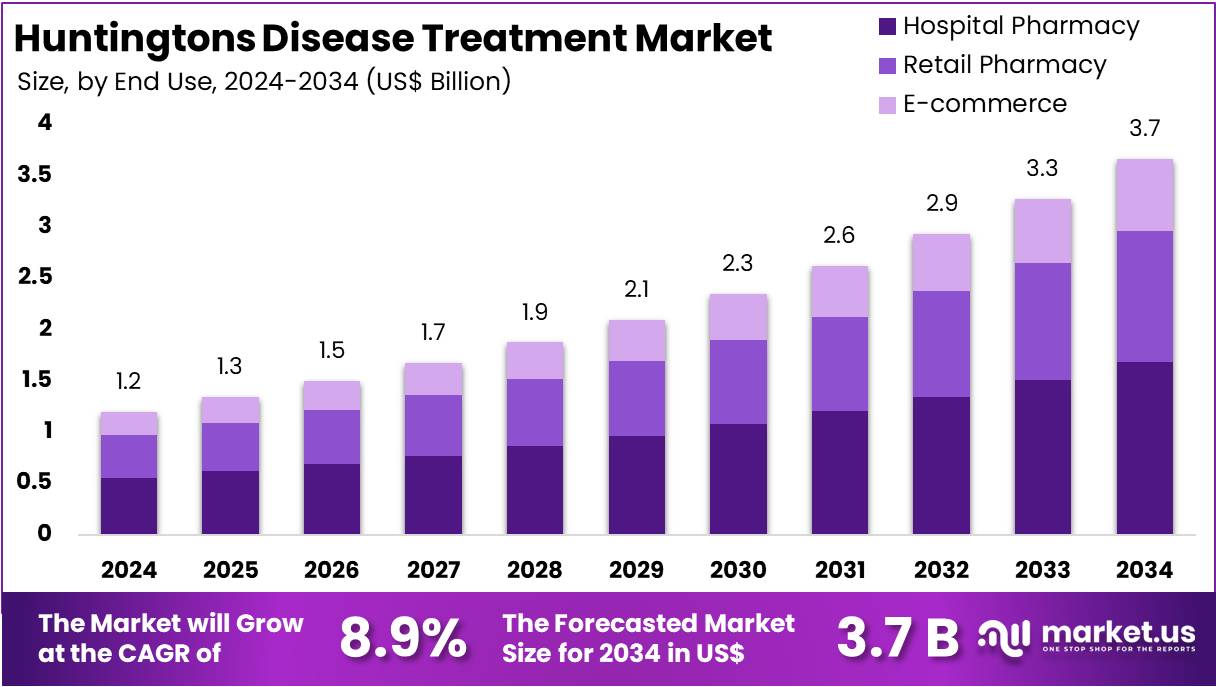
New York, NY – July 07, 2026 – The Global Huntingtons Disease Treatment Market size is expected to be worth around US$ 3.7 Billion by 2034, from US$ 1.2 Billion in 2024, growing at a CAGR of 8.9% during the forecast period from 2025 to 2034. North America held a dominant market position, capturing more than a 41.7% share and holds US$ 0.5 Million market value for the year.
Huntington’s disease treatment focuses on managing symptoms, improving quality of life, and slowing the impact of the disease, as there is currently no cure. Huntington’s disease is a rare, inherited neurodegenerative disorder caused by a mutation in the HTT gene, leading to the progressive breakdown of nerve cells in the brain. The condition affects movement, cognitive function, and mental health, with symptoms typically appearing between the ages of 30 and 50.
Current treatment approaches include medications to help control involuntary movements, depression, anxiety, mood changes, and other psychiatric symptoms. Physical therapy, occupational therapy, speech therapy, and nutritional support also play important roles in maintaining mobility, communication, and daily functioning. Comprehensive care provided by multidisciplinary healthcare teams is considered essential for effective disease management.
The treatment landscape is advancing through ongoing research focused on disease-modifying therapies. Emerging approaches such as gene-silencing therapies, RNA-targeted treatments, and other innovative technologies are being evaluated in clinical trials to address the underlying genetic cause of the disease. These developments have increased interest in next-generation therapeutic strategies aimed at slowing disease progression and improving long-term patient outcomes.
Growing investments in neuroscience research, expanding clinical trial activity, and continued collaboration among pharmaceutical companies, research institutions, and patient advocacy organizations are expected to support future advancements in Huntington’s disease treatment, offering renewed hope for patients and caregivers worldwide.
Key Takeaways
- The global Huntington’s Disease Treatment Market is expected to grow from USD 1.2 billion in 2024 to USD 3.7 billion by 2034, registering a CAGR of 8.9% during the forecast period.
- In 2024, the symptomatic treatments segment accounted for the largest share of the treatment market, representing over 82.3%, supported by its extensive use in symptom management.
- Hospital pharmacies emerged as the leading end-use segment in 2024, capturing more than 57.8% of the market, primarily due to the strong preference for hospital-based treatment and medication dispensing.
- North America maintained its leadership in the global market in 2024, holding a 41.7% revenue share, with the regional market valued at approximately USD 0.5 billion.
Regional Analysis
North America Leads the Huntington’s Disease Treatment Market While Asia Pacific Shows Strong Growth Potential
North America held the largest share of the Huntington’s disease treatment market in 2024, accounting for approximately 41.7% of global revenue. The region’s leadership is supported by a well-established healthcare infrastructure, advanced diagnostic capabilities, and strong investment in rare disease research. The United States plays a central role due to the presence of major pharmaceutical and biotechnology companies actively involved in developing innovative therapies and conducting clinical trials.
Regulatory support, particularly through streamlined review pathways and oversight of new treatments, has further strengthened the market. In addition, patient advocacy organizations continue to improve disease awareness, promote early diagnosis, and enhance access to treatment and support services, contributing to sustained market growth.
The Asia Pacific region is projected to register the fastest growth during the forecast period. Rising healthcare investments, improving diagnostic capabilities, and increasing awareness of rare neurological disorders are expected to support market expansion. However, challenges such as uneven healthcare infrastructure, varying regulatory standards, and limited access to advanced therapies remain in several countries.
Developed markets including Japan, South Korea, and Australia are leading regional research efforts, while emerging economies are gradually strengthening their healthcare systems. Continued collaboration among governments, research institutions, pharmaceutical companies, and patient organizations is expected to improve treatment accessibility and accelerate the adoption of innovative Huntington’s disease therapies across the region.
Emerging Trends
- Gene Silencing Therapies: Gene silencing therapies are advancing as disease-modifying treatments for Huntington’s disease by reducing production of the mutant huntingtin protein. Antisense oligonucleotides, including investigational therapies, continue to progress through clinical evaluation, reflecting growing efforts to slow disease progression instead of providing only symptomatic management.
- CRISPR-Based Gene Editing: CRISPR-based gene editing is emerging as a promising strategy to directly target the genetic mutation responsible for Huntington’s disease. Preclinical research has demonstrated encouraging outcomes, while preparations for human clinical studies highlight increasing interest in precision medicine and long-term therapeutic interventions.
- Stem Cell Therapies: Stem cell therapies are being investigated for their potential to regenerate damaged neurons and restore neurological function in Huntington’s disease patients. Early research findings suggest improvements in motor performance, supporting continued clinical development of regenerative medicine as a future treatment approach.
- Improved Drug Delivery Systems: Advanced drug delivery systems, including nanoparticles and lipid-based carriers, are improving the transport of therapeutic agents across the blood-brain barrier. These technologies are expected to enhance treatment effectiveness, minimize systemic side effects, and support the development of innovative neurological therapies.
- Digital Biomarkers and Remote Monitoring: Digital biomarkers and remote monitoring technologies are transforming Huntington’s disease management through wearable devices and smartphone applications. Continuous collection of movement, speech, and behavioral data enables earlier intervention, personalized treatment decisions, and improved long-term monitoring without frequent hospital visits.
Use Cases
- Symptom Management with Approved Drugs: Approved medications remain the primary treatment option for managing Huntington’s disease symptoms, including chorea and psychiatric disorders. Personalized drug therapy improves patient comfort, daily functioning, and quality of life, while regular clinical assessments ensure treatment effectiveness and appropriate dosage adjustments.
- Clinical Trial Participation: Clinical trial participation provides patients with access to investigational therapies while supporting the development of innovative Huntington’s disease treatments. Ongoing global studies evaluating gene therapies, RNA-based medicines, and novel drug candidates contribute valuable evidence for future therapeutic advancements and regulatory approvals.
- Genetic Counseling and Predictive Testing: Genetic counseling and predictive testing help individuals with a family history of Huntington’s disease understand inherited risk before symptom onset. Professional counseling supports informed healthcare decisions, family planning, emotional preparedness, and early intervention strategies while maintaining confidentiality throughout the testing process.
- Multidisciplinary Care Programs: Multidisciplinary care programs integrate neurologists, psychiatrists, rehabilitation specialists, nutritionists, and therapists to provide comprehensive Huntington’s disease management. Coordinated treatment plans improve symptom control, patient adherence, caregiver support, and overall quality of life across every stage of disease progression.
- Remote Cognitive Training and Therapy: Remote cognitive training platforms use mobile applications and digital programs to strengthen memory, attention, and cognitive performance in Huntington’s disease patients. Home-based therapy supports ongoing brain stimulation, increases patient engagement, and complements conventional treatment through accessible and personalized rehabilitation activities.
Frequently Asked Questions on Huntingtons Disease Treatment
- What medications are commonly used to treat Huntington’s disease?
Common medications for Huntington’s disease include drugs that help control involuntary movements, psychiatric symptoms, depression, anxiety, and mood disorders. Treatment plans are individualized according to disease severity, symptom progression, and patient response, often requiring regular adjustments throughout the course of the disease. - Can Huntington’s disease be cured?
Currently, Huntington’s disease cannot be cured because it is caused by an inherited genetic mutation. Existing therapies primarily aim to slow symptom progression, reduce complications, and enhance patient comfort. Ongoing research is exploring gene-targeted therapies and disease-modifying treatments for future clinical applications. - How is Huntington’s disease diagnosed before treatment begins?
Diagnosis typically involves neurological examinations, assessment of family history, genetic testing, brain imaging, and cognitive evaluations. Early and accurate diagnosis enables healthcare providers to develop personalized treatment strategies that address motor, cognitive, behavioral, and psychological symptoms more effectively. - Why is multidisciplinary care important in Huntington’s disease treatment?
Multidisciplinary care is essential because Huntington’s disease affects movement, cognition, mental health, and daily functioning simultaneously. Collaboration among neurologists, psychiatrists, therapists, nutritionists, and caregivers ensures comprehensive symptom management while improving patient outcomes and supporting long-term disease management. - What factors are driving the growth of the Huntington’s disease treatment market?
The market is driven by rising awareness of rare neurological disorders, increasing investments in genetic research, growing participation in clinical trials, supportive regulatory initiatives, and continuous advancements in precision medicine, gene therapy, and RNA-based therapeutic technologies. - Which treatment segment dominates the Huntington’s disease treatment market?
Symptomatic therapies currently represent the largest market segment because they are widely prescribed to manage movement disorders, psychiatric symptoms, and cognitive impairment. However, disease-modifying therapies under development are expected to create significant future market opportunities as clinical research advances. - Which region leads the Huntington’s disease treatment market?
North America leads the Huntington’s disease treatment market due to advanced healthcare infrastructure, high healthcare expenditure, strong biotechnology research, supportive regulatory pathways, and active participation in clinical trials. Europe also represents a significant market with continued investments in neurological disease research. - What is the future outlook for the Huntington’s disease treatment market?
The future outlook remains positive due to increasing investments in neuroscience research, expanding pipelines of disease-modifying therapies, favorable orphan drug incentives, and growing adoption of precision medicine. Continued innovation is expected to improve treatment options and support steady market expansion over the coming years.
Conclusion
The Huntington’s disease treatment market is witnessing steady progress, supported by advancements in neuroscience research, increasing clinical trial activity, and the development of innovative disease-modifying therapies. While current treatment strategies primarily focus on symptom management through medications and multidisciplinary care, emerging approaches such as gene silencing, CRISPR-based gene editing, stem cell therapies, and advanced drug delivery systems are expanding future therapeutic possibilities.
North America continues to lead the market, while Asia Pacific offers significant growth potential due to improving healthcare infrastructure and awareness. Continued collaboration among researchers, healthcare providers, pharmaceutical companies, and patient organizations is expected to accelerate innovation and improve long-term patient outcomes.
Discuss your needs with our analyst
Please share your requirements with more details so our analyst can check if they can solve your problem(s)




