


Overview
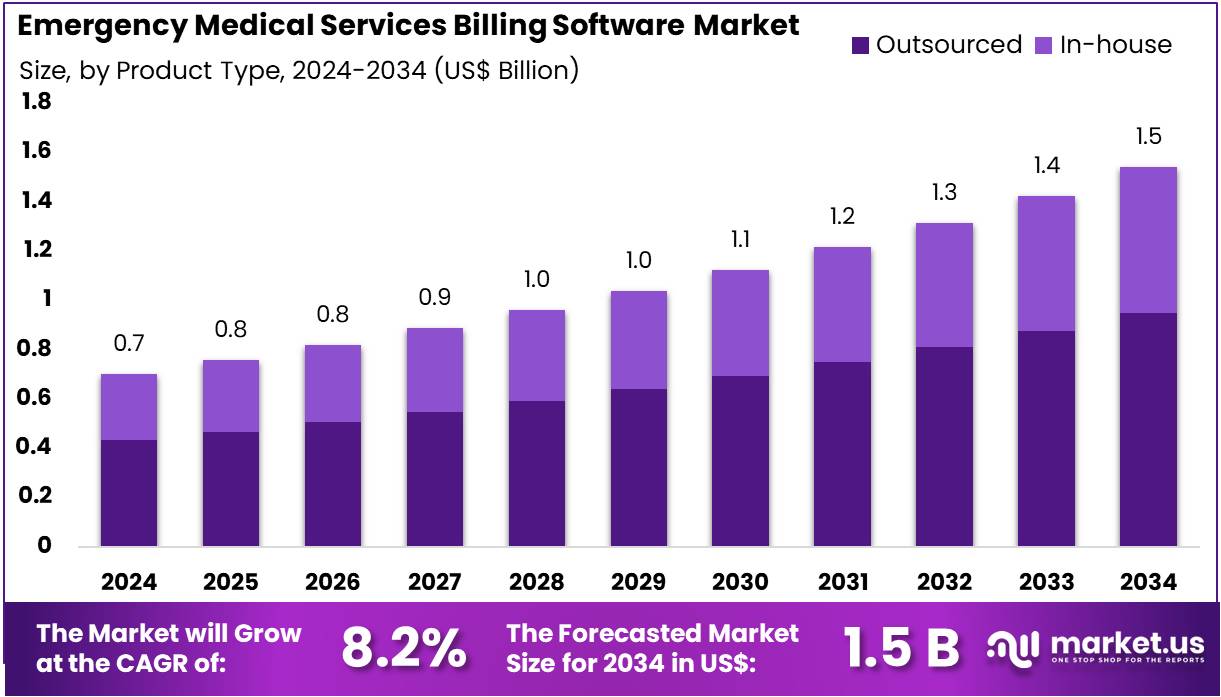
New York, NY – July 02, 2026 – The Emergency Medical Services Billing Software Market Size is expected to be worth around US$ 1.5 Billion by 2034 from US$ 0.7 Billion in 2024, growing at a CAGR of 8.2% during the forecast period 2025 to 2034.
Emergency Medical Services (EMS) Billing Software is a specialized digital solution designed to streamline and automate the billing process for ambulance providers, emergency medical service organizations, hospitals, and other healthcare transport agencies. The software manages patient billing, insurance claim generation, payment tracking, coding compliance, and reimbursement management while reducing administrative workload and billing errors.
The platform integrates with electronic patient care reporting (ePCR) systems, healthcare information systems, and insurance databases to ensure accurate documentation and faster claim submissions. Advanced EMS billing software supports compliance with healthcare regulations, including HIPAA requirements and standardized medical coding systems, helping organizations improve operational efficiency and maintain data security.
Key features typically include automated claim validation, denial management, revenue cycle management, real-time eligibility verification, customizable reporting, analytics dashboards, and secure patient payment portals. Cloud-based deployment options have gained significant adoption due to their scalability, remote accessibility, lower infrastructure costs, and automatic software updates.
The increasing demand for efficient emergency healthcare services, growing ambulance transportation volumes, and rising focus on reducing claim denials are supporting the adoption of EMS billing software across public and private healthcare organizations. Integration of artificial intelligence, automation, and predictive analytics is further enhancing billing accuracy, accelerating reimbursement cycles, and improving financial performance.
As healthcare providers continue to prioritize digital transformation and operational efficiency, EMS billing software is expected to play an increasingly important role in optimizing revenue management, ensuring regulatory compliance, and delivering a more streamlined billing experience for both providers and patients.
Key Takeaways
- The global Emergency Medical Services Billing Software market was valued at US$ 0.7 billion in 2024 and is projected to reach US$ 1.5 billion by 2034, expanding at a CAGR of 8.2% during the forecast period.
- Based on product type, the market is segmented into in-house and outsourced solutions. The outsourced segment dominated the market, accounting for a 61.6% share.
- By application, the market is categorized into land ambulance services, water ambulance services, and air ambulance services. Among these, land ambulance services emerged as the leading segment, holding a 58.7% market share.
- North America dominated the global Emergency Medical Services Billing Software market, capturing a 42.8% market share.
Regional Analysis
North America Leads the Emergency Medical Services Billing Software Market
North America accounted for the largest share of the Emergency Medical Services (EMS) Billing Software Market, representing 42.8% of global revenue. The region’s leadership is driven by rising emergency call volumes, increasing demand for operational efficiency, and evolving healthcare reimbursement regulations. In the United States, EMS incidents accounted for 65.2% of all fire department responses in 2023, highlighting the growing reliance on emergency medical services.
Similarly, Canada has experienced a steady increase in EMS demand, with Grey County responding to 15,796 emergency calls in 2024 and recording a 29.7% rise in paramedic patient volumes over the past five years. These trends have increased the need for automated billing solutions that simplify coding, claims submission, reimbursement management, and regulatory compliance while improving revenue collection. Continuous innovation by leading software providers further supports market growth.
Asia Pacific to Register the Fastest Growth
Asia Pacific is projected to witness the highest CAGR during the forecast period, supported by expanding healthcare infrastructure, increasing emergency care utilization, and rapid digital transformation. China reported more than 9 billion emergency outpatient visits in 2023, reflecting growing demand for efficient healthcare administration.
Government initiatives, including China’s investments in ambulance communication systems and India’s Ayushman Bharat Digital Mission, are accelerating healthcare digitalization and encouraging software adoption. These developments, combined with ongoing digital health initiatives across the region, are expected to significantly drive the adoption of EMS billing software throughout the forecast period.
Emerging Trends
- Automation Is Becoming the Standard: Emergency Medical Services billing software is increasingly replacing manual billing workflows with automated processes for claims generation, code validation, payment tracking, and reimbursement management. Automation minimizes human errors, accelerates claim approvals, improves operational efficiency, shortens billing cycles, and enables EMS staff to dedicate more time to delivering quality patient care.
- Cloud-Based Solutions Are Growing Fast: Cloud-based Emergency Medical Services billing software is gaining widespread adoption because it provides remote access, automatic software updates, secure data storage, and lower infrastructure costs. Its scalability supports expanding EMS operations while reducing maintenance requirements, improving collaboration, and ensuring uninterrupted access to billing information from multiple locations.
- Mobile Integration for Field Efficiency: Mobile-enabled Emergency Medical Services billing software allows field personnel to capture patient information, treatment details, and billing records directly from ambulances using smartphones or tablets. Real-time documentation improves billing accuracy, minimizes paperwork, accelerates claim submissions, reduces processing delays, and enhances overall operational productivity across emergency response teams.
- Compliance and Regulation-Focused Features: Modern Emergency Medical Services billing software incorporates automated compliance tools that support adherence to healthcare regulations, coding standards, HIPAA requirements, and reimbursement policies. Regular regulatory updates help reduce claim denials, minimize legal risks, ensure accurate documentation, and maintain consistent compliance throughout the billing process.
- Better Integration With Electronic Health Records (EHR): Emergency Medical Services billing software increasingly integrates with Electronic Health Record systems to facilitate seamless data sharing between ambulance providers and healthcare facilities. Integrated workflows reduce duplicate data entry, improve documentation accuracy, accelerate claims processing, strengthen care coordination, and enhance reimbursement efficiency across healthcare networks.
- Customizable Dashboards and Reporting Tools: Advanced Emergency Medical Services billing software provides customizable dashboards and reporting capabilities that offer real-time visibility into revenue performance, claim status, payment trends, and operational metrics. These analytical tools support informed decision-making, identify revenue opportunities, improve financial planning, and strengthen organizational performance management.
Use Cases
- Faster Claims Submission: Emergency Medical Services billing software automates claim preparation, coding verification, and electronic submission immediately after patient care documentation. Faster processing reduces administrative workload, minimizes paperwork, shortens reimbursement timelines, improves cash flow, decreases claim delays, and enhances overall revenue cycle performance for EMS organizations.
- Error Reduction in Billing: Emergency Medical Services billing software uses automated validation features to identify coding inaccuracies, duplicate records, incomplete documentation, and missing patient information before claim submission. These capabilities reduce billing errors, lower claim rejection rates, improve reimbursement accuracy, and increase administrative efficiency while maintaining regulatory compliance.
- Revenue Tracking and Forecasting: Emergency Medical Services billing software enables organizations to monitor billing performance, payment collections, outstanding balances, and reimbursement trends through centralized financial dashboards. Built-in forecasting tools analyze historical and current revenue data, supporting strategic budgeting, financial planning, operational improvements, and sustainable organizational growth.
- Improved Patient Communication: Emergency Medical Services billing software enhances patient engagement through secure online portals that provide access to billing statements, payment options, account balances, and communication tools. Greater transparency reduces billing disputes, improves customer satisfaction, encourages timely payments, and strengthens relationships between providers and patients.
- Field Data Collection: Emergency Medical Services billing software enables emergency responders to capture patient demographics, treatment details, and billing information directly at incident locations using mobile devices. Real-time documentation improves data accuracy, eliminates duplicate entry, accelerates claim preparation, reduces administrative tasks, and supports faster reimbursement processing.
- Handling Insurance and Payer Rules: Emergency Medical Services billing software automatically applies payer-specific billing requirements, coding standards, documentation guidelines, and insurance policy updates during claim preparation. This automation minimizes claim denials, improves first-pass acceptance rates, reduces administrative complexity, ensures regulatory compliance, and streamlines reimbursement management across multiple insurance providers.
Frequently Asked Questions on Emergency Medical Services Billing Software
- How does Emergency Medical Services Billing Software improve billing accuracy?
Emergency Medical Services Billing Software improves billing accuracy by automating claim generation, validating coding requirements, reducing manual data entry, and identifying missing documentation before claim submission. These capabilities minimize claim denials, improve reimbursement rates, and streamline financial operations for emergency medical service providers. - Who uses Emergency Medical Services Billing Software?
Emergency Medical Services Billing Software is primarily used by ambulance service providers, hospital-based emergency medical departments, fire departments with EMS operations, private ambulance companies, air ambulance providers, and third-party medical billing organizations seeking efficient reimbursement management and compliance. - Can Emergency Medical Services Billing Software integrate with other healthcare systems?
Yes, Emergency Medical Services Billing Software can integrate with electronic health records, computer-aided dispatch systems, patient care reporting platforms, accounting software, and insurance clearinghouses. These integrations improve operational efficiency, reduce duplicate data entry, and enable seamless information exchange. - How does Emergency Medical Services Billing Software benefit healthcare organizations?
The software helps healthcare organizations increase operational efficiency, accelerate reimbursement cycles, reduce administrative workloads, minimize billing errors, enhance financial visibility, improve compliance, and support better decision-making through comprehensive reporting and revenue cycle management tools. - Which regions are leading the Emergency Medical Services Billing Software Market?
North America leads the market due to advanced healthcare infrastructure, widespread digital technology adoption, and supportive reimbursement systems. Europe follows with strong healthcare modernization initiatives, while Asia-Pacific is experiencing rapid growth driven by expanding healthcare investments and digital transformation. - Who are the major customers in the Emergency Medical Services Billing Software Market?
Major customers include government emergency medical agencies, hospital networks, private ambulance companies, fire departments providing EMS services, air ambulance providers, and outsourced medical billing companies seeking efficient claims management and revenue optimization solutions. - How is cloud technology influencing the Emergency Medical Services Billing Software Market?
Cloud technology is transforming the market by enabling scalable deployments, reducing infrastructure costs, improving remote accessibility, simplifying software updates, strengthening collaboration across healthcare organizations, and supporting secure data management through modern cloud computing environments. - What is the future outlook for the Emergency Medical Services Billing Software Market?
The Emergency Medical Services Billing Software Market is expected to witness sustained growth due to increasing digital healthcare adoption, expanding emergency medical services, continuous advancements in billing automation technologies, and growing emphasis on operational efficiency and accurate reimbursement management across healthcare systems.
Conclusion
The Emergency Medical Services Billing Software market is experiencing steady growth as healthcare providers increasingly prioritize digital transformation, billing accuracy, and operational efficiency. Rising emergency medical service demand, expanding ambulance networks, and evolving reimbursement requirements are accelerating software adoption worldwide.
Automation, cloud deployment, mobile integration, regulatory compliance, and EHR connectivity are transforming billing workflows while improving revenue cycle management and reducing administrative burdens. North America remains the leading regional market, while Asia Pacific is expected to record the fastest growth due to healthcare modernization initiatives. Continued technological advancements and increasing investments in digital healthcare infrastructure are expected to sustain long-term market expansion.
Discuss your needs with our analyst
Please share your requirements with more details so our analyst can check if they can solve your problem(s)




