


Overview
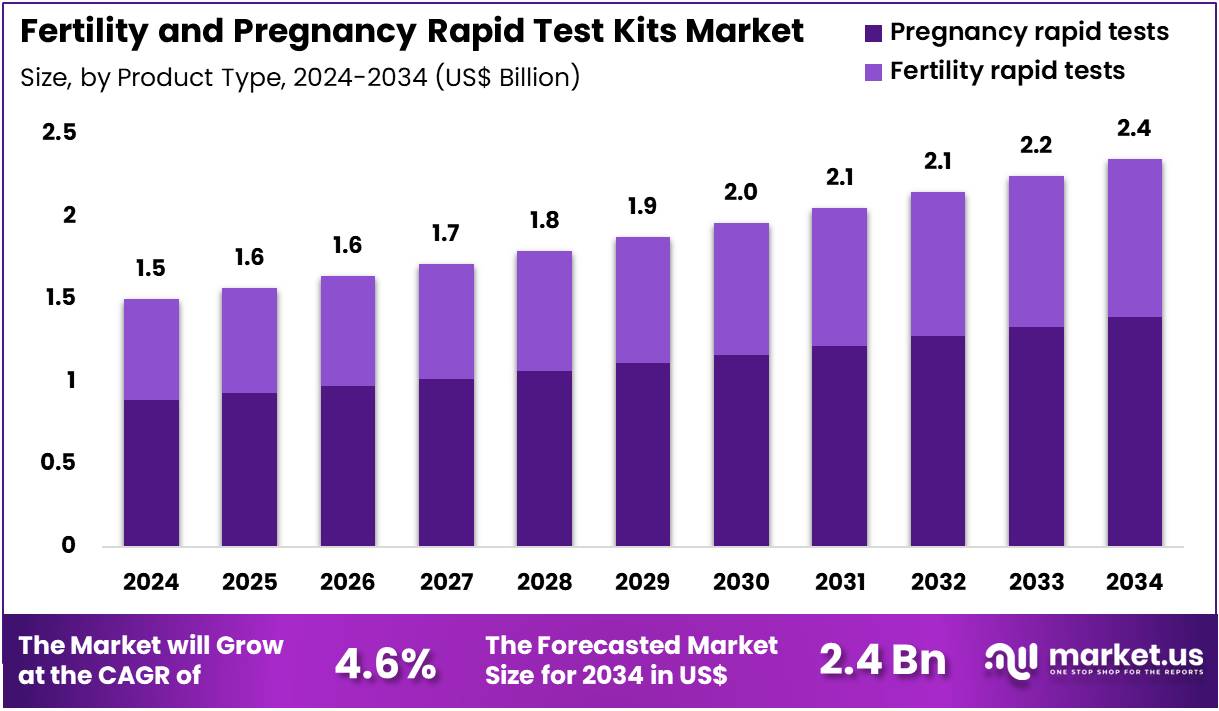
New York, NY – Aug 28, 2026 – The Global Fertility and Pregnancy Rapid Test Kits Market size is expected to be worth around US$2.4 billion by 2034 from US$1.5 billion in 2024, growing at a CAGR of 4.6% during the forecast period 2025 to 2034. In 2024, North America led the market, achieving over 38.7% share with a revenue of US$0.6 billion.
The global Fertility and Pregnancy Rapid Test Kits market is experiencing steady growth, driven by increasing awareness of reproductive health, rising demand for home-based diagnostic solutions, and continuous improvements in rapid testing technologies. These kits provide quick, reliable, and user-friendly results, enabling individuals to monitor pregnancy and fertility without visiting healthcare facilities.
Growing acceptance of self-testing, expanding e-commerce distribution, and higher healthcare spending are further supporting market expansion. According to the World Health Organization (WHO), approximately 1 in 6 adults worldwide experience infertility during their lifetime, highlighting the growing need for accessible fertility testing.
In addition, the United Nations recorded around 132 million births globally in 2025, sustaining strong demand for pregnancy detection products. Most modern pregnancy rapid test kits can detect human chorionic gonadotropin (hCG) levels as low as 10–25 mIU/mL, with claimed accuracy of over 99% when used from the expected day of menstruation. Fertility test kits that detect the luteinizing hormone (LH) surge typically identify ovulation 24–36 hours before egg release, improving family planning and conception tracking.
North America and Europe remain leading regional markets due to high consumer awareness, while Asia-Pacific is witnessing rapid growth supported by expanding healthcare access, increasing disposable income, and rising online retail penetration.
Continuous product innovation, including digital readers, smartphone-connected applications, and eco-friendly test materials, is expected to strengthen market growth and improve consumer convenience throughout the forecast period.
Key Takeaways
- In 2024, the global market was valued at US$1.5 billion and is projected to reach US$2.4 billion by 2034, expanding at a CAGR of 4.6% during the forecast period.
- By product type, the market is segmented into pregnancy rapid tests and fertility rapid tests. Pregnancy rapid tests dominated the market in 2023, accounting for a 59.3% share.
- Based on test type, the market includes hCG urine, LH urine, hCG blood, and FSH urine tests. Among these, hCG urine tests held the largest market share of 52.8% in 2023.
- By distribution channel, the market is categorized into pharmacies, hypermarkets & supermarkets, gynecology/fertility clinics, e-commerce, and drugstores. The pharmacy segment led the market with a 44.6% revenue share in 2023.
- North America emerged as the leading regional market, capturing a 38.7% market share in 2023.
Statistical Information
- FDA states that home pregnancy tests typically require only about 5 minutes to produce results after urine is applied.
- According to FDA guidance, urine hCG generally becomes detectable about 12–15 days after ovulation in women with a typical 28-day menstrual cycle.
- FDA reports that approximately 10–20 out of every 100 pregnant women (10–20%) may receive a negative result when testing on the first day of a missed menstrual period because hCG levels are still too low.
- FDA recommends repeating a home pregnancy test several days after an initial negative result because urinary hCG concentrations rise rapidly during early pregnancy, improving detection performance.
- FDA identifies home pregnancy rapid tests as qualitative assays that detect the presence or absence of human chorionic gonadotropin (hCG) in urine rather than providing a quantitative hormone concentration.
- WHO’s 2025 accessibility guidance includes pregnancy rapid tests among the priority self-test categories and emphasizes standardized usability and accessibility requirements across rapid diagnostic devices intended for home users.
Regional Analysis
North America dominated the Fertility and Pregnancy Rapid Test Kits Market in 2024, accounting for 38.7% of the global market. The region benefits from high awareness of reproductive health, widespread availability of over-the-counter (OTC) pregnancy and ovulation tests, and strong regulatory support for home-based diagnostics.
The U.S. Food and Drug Administration (FDA) continues to authorize and regulate reliable home-use LH and hCG test kits, while guidance from the American College of Obstetricians and Gynecologists (ACOG) encourages timely fertility evaluation and reproductive planning.
Rising maternal age, increasing infertility concerns, and growing consumer preference for digital health solutions have further accelerated adoption of rapid fertility and pregnancy tests across the United States and Canada.
Asia Pacific is projected to register the fastest CAGR during the forecast period, supported by declining fertility rates, expanding reproductive healthcare programs, and improving access to affordable self-testing products. Governments across the region are strengthening maternal and reproductive health services, while local manufacturers continue to introduce cost-effective rapid diagnostic kits.
Increasing smartphone penetration, telehealth integration, and greater public awareness of fertility planning are also encouraging demand for digital ovulation monitors and home pregnancy tests. Rising healthcare investments and expanding diagnostic distribution networks are expected to sustain long-term market growth across countries such as China, Japan, India, and South Korea.
Emerging Trends
- Growing Preference for Home-Based Fertility Testing: Consumers are increasingly choosing home-use fertility and pregnancy test kits because they are quick, private, and easy to use. The FDA recognizes home-use tests as cost-effective tools for early screening. In the U.S., 13.7% of women aged 20–49 had used fertility services, while 6.9% had undergone infertility testing, supporting demand for early self-testing solutions.
- Higher Adoption of LH-Based Ovulation Detection: Rapid ovulation kits based on luteinizing hormone (LH) detection are becoming the preferred choice for identifying fertile days. According to the FDA, the LH surge typically occurs 1–1.5 days before ovulation, enabling couples to better plan conception with simple urine-based rapid tests.
- Improved Early Pregnancy Detection Technologies: Manufacturers are improving hCG detection sensitivity, allowing pregnancy to be identified earlier than before. The FDA notes that urinary hCG can often be detected 12–15 days after ovulation in a typical 28-day menstrual cycle, encouraging demand for high-sensitivity rapid pregnancy kits.
- Expansion of FDA-Authorized OTC Rapid Test Kits: The number of over-the-counter fertility and pregnancy rapid tests continues to expand through FDA regulatory pathways. New FDA listings and authorizations issued during 2026 demonstrate ongoing product innovation, increasing consumer access to reliable home diagnostic kits across pharmacies and retail channels.
- Integration with Digital Fertility Monitoring: Rapid test kits are increasingly used alongside mobile applications and digital fertility tracking platforms. Users combine LH test results, menstrual cycle records, and symptom tracking to better identify fertile windows, improving cycle awareness while supporting healthcare provider consultations when needed.
Use Cases
- Ovulation Monitoring for Family Planning: Women use LH urine rapid tests to detect the fertile window before ovulation. The FDA states that LH levels rise approximately 24–36 hours before ovulation, helping users accurately identify the best time for conception through convenient home testing.
- Early Pregnancy Confirmation at Home: Pregnancy rapid test kits detect urinary human chorionic gonadotropin (hCG) shortly after implantation. According to the FDA, hCG can often be detected 12–15 days after ovulation, enabling women to confirm pregnancy quickly before scheduling clinical prenatal care.
- Support for Fertility Treatment Monitoring: Individuals undergoing fertility treatment frequently use ovulation rapid tests to monitor hormone changes between clinical appointments. CDC data show 4.5% of women aged 20–49 have used ovulation drugs, making home hormone monitoring an important complementary tool.
- Cycle Tracking for Reproductive Health Awareness: Healthcare professionals recommend combining rapid ovulation tests with menstrual cycle tracking to better understand reproductive health. Home testing provides additional biological information that helps users recognize hormonal patterns and discuss fertility concerns with clinicians.
- Accessible Testing in Low-Resource or Remote Areas: Rapid fertility and pregnancy kits provide affordable screening where laboratory testing is limited. The FDA highlights that home-use tests offer fast, confidential, and convenient testing, improving access to reproductive health information without requiring immediate laboratory visits.
Frequently Asked Questions on Fertility and Pregnancy Rapid Test Kits
- What factors are driving the growth of the Fertility and Pregnancy Rapid Test Kits Market?
Growing demand for convenient home-based testing, increasing fertility awareness, rising first-time pregnancy planning, and better access to pharmacies and e-commerce platforms are major growth drivers. Digital health integration and improved test accuracy are also encouraging wider consumer adoption worldwide. - Which types of products are included in the Fertility and Pregnancy Rapid Test Kits Market?
The market mainly includes pregnancy rapid test kits and fertility rapid test kits. Fertility products include ovulation prediction kits and fertility monitors, while pregnancy products include urine-based and digital pregnancy tests designed for quick, easy, and reliable home use. - Who are the main end users of Fertility and Pregnancy Rapid Test Kits?
Primary users include women planning pregnancy, couples monitoring fertility, hospitals, fertility clinics, diagnostic laboratories, and retail consumers. Healthcare professionals also recommend these kits for early screening, helping users decide when further medical consultation or confirmatory laboratory testing is needed. - What technologies are commonly used in Fertility and Pregnancy Rapid Test Kits?
Most rapid test kits use lateral flow immunoassay technology to detect hormones such as LH and hCG. Newer products increasingly feature digital displays, smartphone connectivity, enhanced sensitivity, and easy-to-read result indicators, improving user confidence and reducing interpretation errors. - Which regions have strong demand in the Fertility and Pregnancy Rapid Test Kits Market?
North America and Europe remain major markets because of high healthcare awareness and strong retail availability. Asia-Pacific is expanding rapidly due to increasing healthcare access, growing reproductive health awareness, urbanization, and rising demand for affordable home diagnostic products. - How are digital technologies influencing the Fertility and Pregnancy Rapid Test Kits Market?
Digital innovation is transforming the market through smartphone-connected fertility monitors, mobile health applications, result tracking, and personalized fertility insights. These features improve user engagement, simplify reproductive health monitoring, and support better planning throughout the fertility and pregnancy journey. - What is the future outlook for the Fertility and Pregnancy Rapid Test Kits Market?
The market is expected to experience steady long-term growth as consumers increasingly prefer convenient home diagnostics. Advances in biomarker detection, digital integration, higher test sensitivity, and expanding healthcare access are likely to create new opportunities for manufacturers and healthcare providers.
Conclusion
The Fertility and Pregnancy Rapid Test Kits Market is poised for sustained expansion, supported by increasing awareness of reproductive health, growing demand for self-testing solutions, and continuous advancements in rapid diagnostic technologies. The rising preference for accurate, easy-to-use, and private home testing products is encouraging manufacturers to introduce innovative kits with enhanced sensitivity and digital connectivity.
Expanding healthcare access, improving retail and online distribution networks, and supportive public health initiatives are also contributing to market growth. As fertility planning becomes more common and early pregnancy detection gains importance, the market is expected to maintain positive momentum, creating significant opportunities for product innovation and global market penetration over the coming decade.
Discuss your needs with our analyst
Please share your requirements with more details so our analyst can check if they can solve your problem(s)




