


Overview
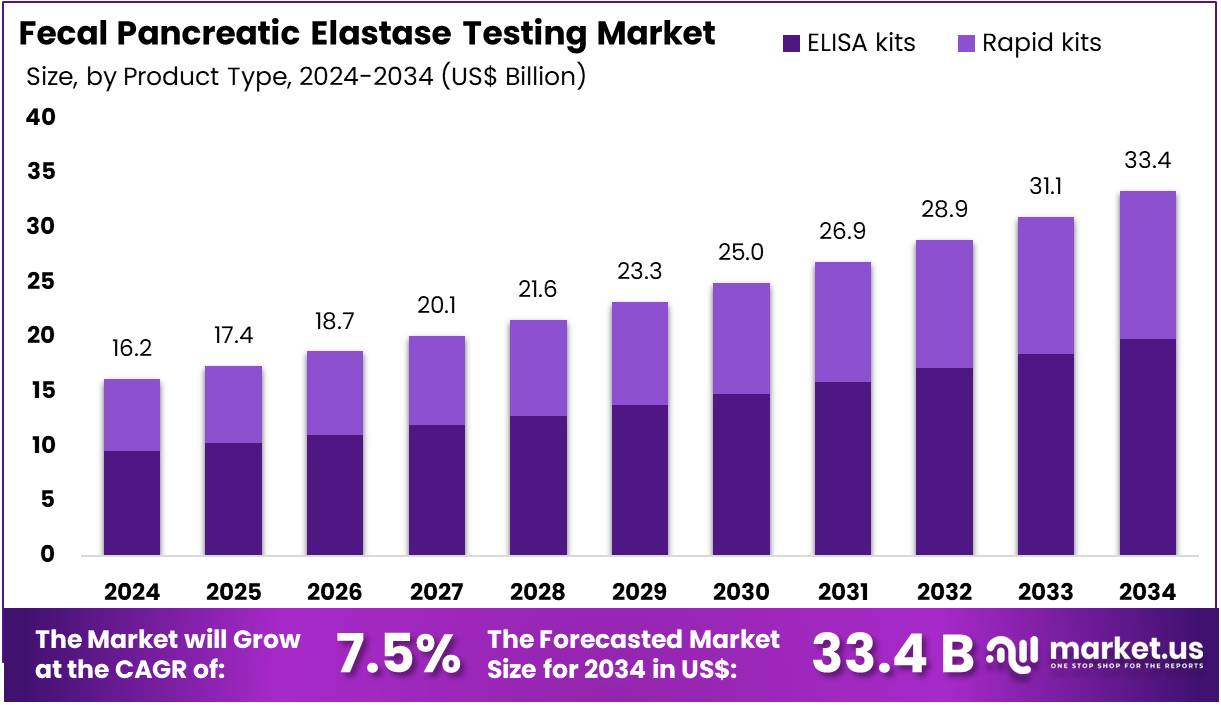
The Global Fecal Pancreatic Elastase Testing Market Size is expected to be worth around US$ 33.4 Billion by 2034 from US$ 16.2 Billion in 2024, growing at a CAGR of 7.5% during the forecast period 2025 to 2034. North America held a dominant market position, capturing more than a 38.5% share and holds US$ 6.2 Billion market value for the year.
Fecal pancreatic elastase testing is a non-invasive diagnostic method used to assess exocrine pancreatic function by measuring pancreatic elastase-1 levels in stool samples. Pancreatic elastase is a digestive enzyme produced by acinar cells of the pancreas and remains stable during intestinal passage, making it a reliable biomarker for detecting exocrine pancreatic insufficiency (EPI). The test is widely used for patients with chronic pancreatitis, cystic fibrosis, pancreatic cancer, and other disorders affecting pancreatic enzyme production.
The test generally requires a small stool sample and is performed using enzyme-linked immunosorbent assay (ELISA) technology. Elastase-1 levels above 200 µg/g of stool are considered normal, while levels between 100–200 µg/g indicate mild to moderate pancreatic insufficiency, and levels below 100 µg/g suggest severe insufficiency. The procedure typically provides results within 1–3 days, supporting faster clinical decision-making.
Growing awareness of digestive disorders and increasing diagnosis of chronic pancreatic conditions are driving demand for fecal pancreatic elastase testing. According to healthcare studies, chronic pancreatitis affects approximately 50–75 people per 100,000 population globally, while exocrine pancreatic insufficiency is reported in up to 30–90% of chronic pancreatitis patients, depending on disease severity and duration.
Advancements in automated laboratory testing, improved assay sensitivity, and rising adoption of non-invasive diagnostic approaches are strengthening the role of fecal pancreatic elastase testing in gastroenterology. The technology continues to support early detection, patient monitoring, and personalized management of pancreatic disorders worldwide.
Key Takeaways
- In 2024, the market generated revenue of US$ 16.2 billion and is projected to reach US$ 33.4 billion by 2034, expanding at a CAGR of 7.5% during the forecast period.
- Based on product type, the market is segmented into ELISA kits and rapid kits, with ELISA kits dominating in 2024 by capturing a 59.4% market share.
- By application, the market is categorized into chronic pancreatitis, cystic fibrosis, type 1 diabetes, and others, with chronic pancreatitis accounting for a significant 47.2% share in 2024.
- Based on end users, the market is divided into hospitals, specialty clinics, and diagnostic laboratories, where hospitals emerged as the leading segment with a 51.3% revenue share in 2024.
- Regionally, North America dominated the market in 2024, holding a 38.5% market share.
Statistical Information
- A 2025 systematic review and meta-analysis evaluated fecal elastase-1 testing using data from 13 studies involving 888 patients, providing a quantitative assessment of test performance for pancreatic exocrine insufficiency diagnosis.
- In 2025 analysis, fecal pancreatic elastase testing at the 200 μg/g cutoff demonstrated a pooled sensitivity of 94% and specificity of 69% for detecting pancreatic exocrine insufficiency.
- The 2025 meta-analysis reported that fecal elastase-1 testing at the 200 μg/g threshold achieved a diagnostic odds ratio (DOR) of 35.27, indicating measurable diagnostic effectiveness compared with reference methods.
- A 2025 clinical performance review found that reducing the fecal elastase cutoff from 200 μg/g to 100 μg/g increased specificity from 69% to 82%, while sensitivity decreased from 94% to 88%.
- In 2025 pooled subgroup analysis, fecal elastase testing showed 98% sensitivity for identifying pancreatic exocrine insufficiency in cystic fibrosis patients.
- The 2025 meta-analysis reported fecal elastase testing achieved 81% specificity in chronic pancreatitis patient groups, demonstrating improved disease-specific discrimination.
- A 2025 systematic review reported that fecal elastase-1 testing achieved an area under the summary receiver operating characteristic curve (SROC) of 0.89 at the 200 μg/g cutoff.
Regional Analysis
North America leads the Fecal Pancreatic Elastase Testing Market, supported by advanced diagnostic infrastructure, high healthcare expenditure, and increasing screening for pancreatic disorders. The region’s strong presence is driven by the rising burden of chronic pancreatitis, diabetes-related exocrine pancreatic insufficiency (EPI), and growing adoption of fecal elastase-1 assays for non-invasive pancreatic function assessment. Improved reimbursement policies, availability of pancreatic enzyme replacement therapy, and increased clinical awareness further strengthen market adoption.
Asia Pacific is projected to witness significant growth during the forecast period, driven by expanding healthcare access, rising diabetes prevalence, and increasing diagnosis of gastrointestinal disorders. Countries such as China, India, Japan, and South Korea are investing in advanced laboratory technologies, automated diagnostic platforms, and improved disease screening programs. Growing awareness among healthcare professionals and the adoption of ELISA-based testing methods are expected to accelerate regional market expansion.
Emerging Trends
- Increasing Adoption for Early Detection of Exocrine Pancreatic Insufficiency (EPI): Healthcare providers are increasingly using fecal elastase-1 testing as a first-line diagnostic method for EPI because it is non-invasive and requires only a stool sample. A fecal elastase level below 100 μg/g indicates strong evidence of EPI, while 100–200 μg/g requires further evaluation.
- Growing Screening in Chronic Pancreatitis and High-Risk Patients: Fecal pancreatic elastase testing is expanding among patients with chronic pancreatitis, pancreatic cancer, cystic fibrosis, and pancreatic surgeries. Government healthcare sources highlight that EPI can lead to malnutrition, vitamin deficiencies, and digestive problems, increasing demand for accurate enzyme-function assessment.
- Rising Use in Diabetes-Associated Pancreatic Dysfunction: Testing demand is increasing as healthcare professionals recognize links between diabetes and pancreatic enzyme insufficiency. Clinical guidance identifies longstanding diabetes as a moderate-risk condition for EPI evaluation, supporting wider use of fecal elastase testing in metabolic disease management.
- Shift Toward Non-Invasive and Patient-Friendly Diagnostic Solutions: Hospitals and laboratories are moving toward stool-based diagnostic methods because fecal elastase testing avoids invasive pancreatic function procedures. Traditional direct pancreatic function tests may require specialized centers and 30–60 minutes of pancreatic secretion measurement, making fecal testing a simpler alternative.
- Expansion Beyond Traditional Pancreatic Disorders: A growing trend is evaluating fecal elastase testing in patients with gastrointestinal disorders such as celiac disease, Crohn’s disease, and unexplained digestive symptoms. Research and clinical updates suggest EPI may occur in broader patient groups, increasing potential testing applications.
Use Cases
- Monitoring Patients Receiving Pancreatic Enzyme Replacement Therapy (PERT): Fecal elastase testing is being used alongside clinical assessment to support management of EPI patients receiving enzyme replacement therapy. The test can be performed even when patients are already using pancreatic enzyme treatments, improving long-term disease monitoring.
- Pediatric Applications in Cystic Fibrosis Management: Children with cystic fibrosis are an important use case for fecal pancreatic elastase testing because pancreatic enzyme deficiency is common in this population. Early identification helps healthcare teams manage digestion problems, nutrient absorption, and growth-related complications.
- Gastroenterology Clinics for Chronic Digestive Symptoms: Gastroenterology centers increasingly use fecal elastase tests for patients experiencing diarrhea, bloating, weight loss, and fatty stools. Since these symptoms overlap with multiple gastrointestinal diseases, the test helps identify possible pancreatic enzyme-related causes.
- Laboratory Automation and High-Throughput Testing: Clinical laboratories are adopting automated immunoassay-based fecal elastase platforms to improve workflow efficiency and support larger testing volumes. Increased awareness of EPI diagnosis is expected to drive demand for standardized laboratory testing solutions across hospitals and diagnostic centers.
- Integration With Personalized Digestive Health Management: Future use cases include combining fecal elastase results with patient history, imaging, nutritional markers, and digital health records. This approach may support personalized treatment decisions for patients with pancreatic disorders, improving early diagnosis and reducing complications linked to untreated EPI.
Frequently Asked Questions on Fecal Pancreatic Elastase Testing
- How is a Fecal Pancreatic Elastase Test performed?
The test is performed by collecting a stool sample from the patient and analyzing elastase-1 concentration using laboratory techniques such as ELISA. The procedure is simple, non-invasive, and does not require direct pancreatic stimulation. - What diseases are associated with low fecal pancreatic elastase levels?
Low fecal pancreatic elastase levels are commonly linked with chronic pancreatitis, cystic fibrosis, pancreatic cancer, pancreatic surgery complications, and diabetes-related pancreatic dysfunction. These conditions may reduce enzyme production and affect digestion, nutrient absorption, and overall gastrointestinal health. - What are the advantages of Fecal Pancreatic Elastase Testing?
The major advantages include non-invasive sample collection, stable enzyme measurement, convenient laboratory processing, and suitability for monitoring pancreatic function. Compared with invasive pancreatic function tests, it provides a simpler approach for evaluating exocrine pancreatic insufficiency. - What factors are driving the Fecal Pancreatic Elastase Testing Market growth?
The market is expanding due to increasing cases of pancreatic diseases, growing awareness about digestive disorders, rising demand for early diagnosis, and adoption of advanced laboratory testing methods. Healthcare providers are increasingly using non-invasive diagnostic solutions for pancreatic evaluation. - What are the major applications of Fecal Pancreatic Elastase Testing?
Major applications include diagnosis of exocrine pancreatic insufficiency, chronic pancreatitis evaluation, cystic fibrosis management, diabetes-associated pancreatic dysfunction assessment, and monitoring of patients receiving pancreatic enzyme replacement therapy in hospitals and specialized gastroenterology centers. - Which technologies are used in the Fecal Pancreatic Elastase Testing Market?
The market mainly uses enzyme-linked immunosorbent assay (ELISA) technology and automated immunoassay platforms. These technologies provide accurate enzyme detection, improved laboratory efficiency, standardized testing procedures, and faster reporting of pancreatic function results. - What challenges impact the Fecal Pancreatic Elastase Testing Market?
Market challenges include limited awareness regarding pancreatic insufficiency diagnosis, availability of alternative diagnostic techniques, varying healthcare access across regions, and difficulties in detecting mild cases of pancreatic dysfunction. These factors can influence adoption rates in developing healthcare systems. - What is the future outlook of the Fecal Pancreatic Elastase Testing Market?
The future of the fecal pancreatic elastase testing market is expected to grow with increasing pancreatic disorder prevalence, improvements in diagnostic technologies, and rising demand for non-invasive testing methods. Expanding healthcare infrastructure will further support global market adoption.
Conclusion
The fecal pancreatic elastase testing market is expected to grow steadily as awareness of exocrine pancreatic insufficiency (EPI), chronic pancreatitis, cystic fibrosis, and related digestive disorders increases. Fecal elastase-1 testing is becoming an important non-invasive diagnostic tool due to its convenience, accuracy, and clinical usefulness in evaluating pancreatic function.
Advancements in ELISA-based assays, improved laboratory capabilities, and rising demand for early disease detection are supporting market expansion. Healthcare providers are increasingly adopting these tests for screening and monitoring high-risk patients, creating new opportunities for diagnostic manufacturers and clinical laboratories worldwide.
Discuss your needs with our analyst
Please share your requirements with more details so our analyst can check if they can solve your problem(s)




