


Overview
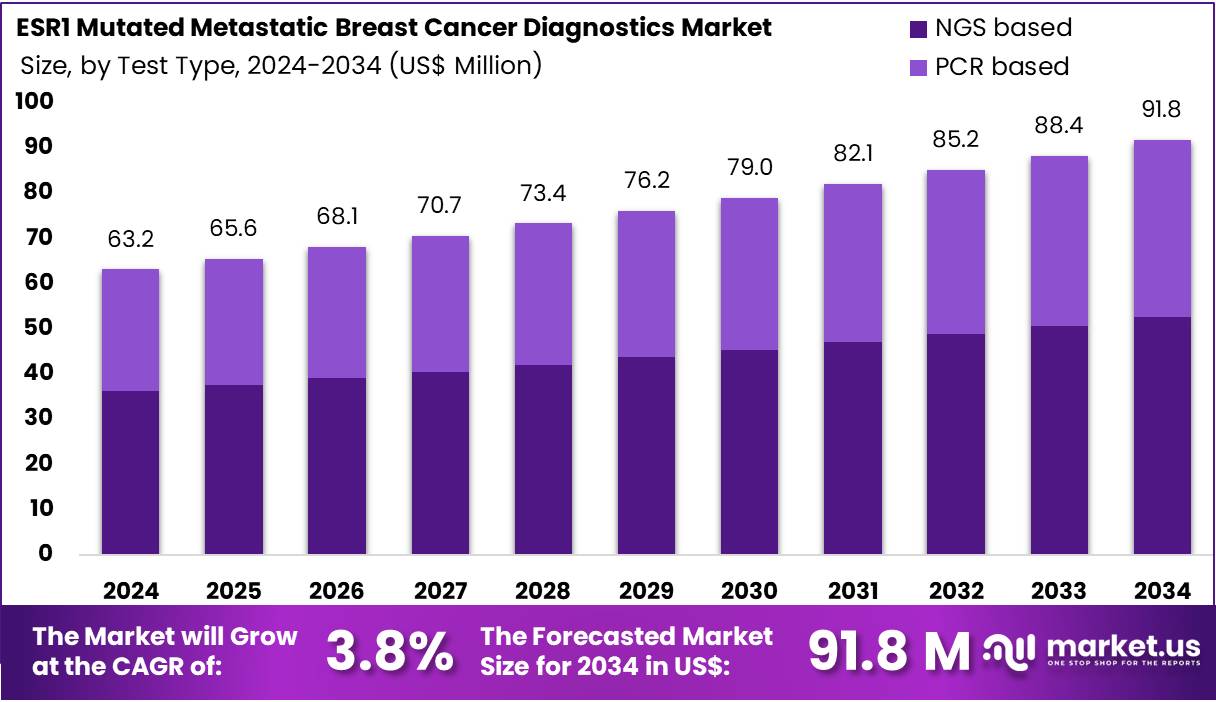
The ESR1 Mutated Metastatic Breast Cancer Diagnostics Market Size is expected to be worth around US$ 91.8 Million by 2034 from US$ 63.2 Million in 2024, growing at a CAGR of 3.8% during the forecast period 2025 to 2034. In 2024, North America held a dominant market position, capturing more than a 39.5% share and holding US$ 25 Million market value for the year.
The global ESR1 Mutated Metastatic Breast Cancer Diagnostics market is gaining strong momentum as healthcare providers increasingly adopt precision oncology and biomarker-based testing for advanced breast cancer. ESR1 mutations are commonly detected in hormone receptor-positive (HR+), HER2-negative metastatic breast cancer after endocrine therapy, making accurate molecular diagnostics essential for selecting targeted treatment strategies. The growing use of liquid biopsy and next-generation sequencing (NGS) technologies is improving mutation detection while reducing the need for invasive tissue biopsies.
Globally, breast cancer remains the most frequently diagnosed cancer, with over 2.3 million new cases reported annually, while metastatic disease accounts for a significant proportion of cancer-related deaths among women. Clinical studies indicate that ESR1 mutations are found in approximately 30% to 50% of patients with HR+/HER2− metastatic breast cancer following aromatase inhibitor treatment. These statistics have accelerated demand for companion diagnostics and genomic testing solutions.
Healthcare systems are investing in advanced molecular diagnostic infrastructure, supported by increasing regulatory approvals for targeted therapies that require ESR1 mutation testing before treatment selection. Liquid biopsy platforms can deliver clinically actionable results within 7 to 14 days, enabling faster therapeutic decisions.
North America currently leads market adoption due to strong genomic testing capabilities, while Europe and Asia-Pacific are witnessing increasing investments in precision medicine. Continuous innovation in PCR, digital PCR, and NGS-based assays, combined with expanding clinical guidelines, is expected to strengthen market growth and improve personalized care for metastatic breast cancer patients over the coming years.
Key Takeaways
- In 2024, the market generated a revenue of US$ 63.2 million, with a CAGR of 3.8%, and is expected to reach US$ 91.8 million by the year 2034.
- The test type segment is divided into NGS-based and PCR-based, with NGS-based taking the lead in 2023, holding a market share of 57.4%.
- Considering the sample type, the market is divided into plasma and tissue. Among these, plasma held a significant share of 61.8%.
- Furthermore, the market is segmented by end-user into hospital-associated labs, independent diagnostic laboratories, diagnostic imaging centers, and cancer research institutes. The hospital-associated labs sector stands out as the dominant player, holding the largest revenue share of 48.5% in the market.
- North America led the market by securing a market share of 39.5% in 2024.
Statistical Information
- A 2026 European multicentre analytical verification study reported a limit of detection (LoD) of 0.01%–0.07% variant allele frequency (VAF) for digital PCR (dPCR) assays used to detect ESR1 mutations in circulating tumor DNA (ctDNA).
- The same 2026 study found that NGS-based ESR1 liquid biopsy workflows achieved a LoD ranging from 0.01% to 0.10% VAF, demonstrating high analytical sensitivity for routine clinical diagnostics.
- The multicentre verification involved 6 referral laboratories, providing evidence that ESR1 liquid biopsy testing can be standardized across multiple institutions.
- Among those laboratories, 4 centers validated NGS-based assays alongside digital PCR workflows for ESR1 mutation detection.
- Validated digital PCR protocols in 2026 required only 10–30 ng of DNA input per reaction, supporting low-sample diagnostic workflows from plasma ctDNA.
- A 2025 clinical study evaluating routine liquid biopsy analyzed 162 plasma samples and compared them with 25 matched metastatic tissue samples for ESR1 and other actionable mutations.
- The 2026 analytical verification focused on the 2 most frequently tested ESR1 hotspot mutations (Y537S and D538G) to standardize diagnostic assay performance across laboratories.
- Results presented at the 2025 ASCO Annual Meeting showed that 3,256 patients underwent serial blood-based monitoring for ESR1 mutations using liquid biopsy in the SERENA-6 clinical trial.
- Within the same 2025 trial, 315 patients with newly detected ESR1 mutations were identified through ctDNA testing and randomized to treatment based on their liquid biopsy results.
Regional Analysis
North America Leads the ESR1 Mutated Metastatic Breast Cancer Diagnostics Market
North America accounted for 39.5% of the global ESR1 Mutated Metastatic Breast Cancer Diagnostics market in 2024, supported by advanced precision oncology infrastructure, widespread adoption of liquid biopsy testing, and strong public investment in cancer research. The National Cancer Institute (NCI) increased its cancer research budget from US$7.0 billion in FY2023 to US$7.2 billion in FY2024, strengthening biomarker-driven research for hormone receptor-positive breast cancer.
The U.S. Food and Drug Administration (FDA) has approved companion diagnostic tests, including Guardant360 CDx, for detecting ESR1 mutations in patients with ER-positive, HER2-negative metastatic breast cancer, accelerating clinical adoption of liquid biopsy. According to the Centers for Disease Control and Prevention (CDC), the United States reported 279,731 new female breast cancer cases in 2022, sustaining demand for molecular diagnostics.
Updated clinical recommendations from the American Society of Clinical Oncology (ASCO) and broader Medicare coverage for companion diagnostics have further integrated ESR1 mutation testing into routine oncology practice, reinforcing North America’s market leadership.
Asia Pacific is Expected to Register the Fastest Growth
Asia Pacific is projected to witness the highest growth during the forecast period due to expanding genomic medicine programs, rising breast cancer incidence, and increasing government investment in precision oncology. The Indian Council of Medical Research (ICMR) continues to strengthen genomic research through national breast cancer sequencing initiatives, supporting the identification of ESR1 mutations across diverse patient populations.
In China, the National Key Research and Development Program has increased funding for cancer genomics and liquid biopsy technologies, encouraging the development of advanced molecular diagnostics. Regional implementation of the World Health Organization’s Global Breast Cancer Initiative is improving early detection and molecular testing capabilities across several countries.
Growing collaborations among hospitals, research institutions, and biotechnology companies are expanding access to next-generation sequencing and circulating tumor DNA (ctDNA) testing, positioning Asia Pacific as a rapidly growing market for ESR1-mutated metastatic breast cancer diagnostics.
Emerging Trends
- Liquid biopsy is becoming the preferred testing method: Blood-based circulating tumor DNA (ctDNA) testing is increasingly replacing repeat tissue biopsies for ESR1 mutation detection. Recent oncology guidance recommends ctDNA because it detects acquired resistance mutations with higher sensitivity and allows testing at every metastatic disease progression.
- Serial ESR1 testing is moving into routine clinical practice: Instead of a one-time genomic test, clinicians are increasingly performing repeat ESR1 testing during treatment. Since ESR1 mutations commonly develop after endocrine therapy exposure, repeated molecular monitoring improves treatment selection and helps identify resistance earlier than conventional imaging.
- Companion diagnostics are expanding alongside targeted therapies: Regulatory approvals for ESR1-targeted therapies are increasing demand for validated companion diagnostic assays. New drug approvals require confirmation of ESR1 mutations before therapy, making molecular diagnostics a mandatory step in personalized metastatic breast cancer treatment.
- NGS panels are replacing single-gene testing: Hospitals are increasingly adopting multi-gene next-generation sequencing (NGS) panels that detect ESR1 together with other clinically important biomarkers in one workflow. This reduces repeat testing, conserves tissue samples, and improves laboratory efficiency for precision oncology programs.
- Focus is shifting toward earlier resistance detection: Clinical researchers are using molecular diagnostics to identify ESR1 mutations before obvious disease progression. Earlier genomic detection allows faster treatment adjustment, supporting precision medicine strategies that aim to delay disease advancement and improve patient management outcomes.
Use Cases
- Selecting endocrine therapy after disease progression: ESR1 mutation testing helps oncologists determine whether patients with ER-positive, HER2-negative metastatic breast cancer should switch from aromatase inhibitors to newer targeted endocrine therapies. Molecular testing supports more individualized treatment decisions and improves precision oncology workflows.
- Monitoring treatment response through blood samples: Hospitals increasingly use ctDNA blood tests to monitor tumor evolution during therapy. Regular liquid biopsy testing can detect newly emerging ESR1 mutations without invasive procedures, allowing physicians to modify treatment plans sooner when resistance develops.
- Supporting enrollment in precision oncology clinical trials: Many clinical studies now require confirmed ESR1 mutation status before patient enrollment. Molecular diagnostic testing identifies eligible participants faster, improving trial efficiency while accelerating evaluation of next-generation endocrine therapies targeting resistant breast cancer.
- Reducing repeat metastatic tissue biopsies: For patients with difficult-to-access metastatic lesions, blood-based ESR1 testing provides a less invasive alternative. This approach lowers procedural burden, shortens diagnostic timelines, and enables repeated molecular assessment throughout long-term cancer management.
- Improving molecular tumor board decisions: Cancer centers increasingly integrate ESR1 mutation reports into multidisciplinary tumor board discussions. Combining genomic findings with imaging and pathology enables more personalized treatment recommendations, supporting precision medicine for advanced hormone receptor-positive metastatic breast cancer.
Frequently Asked Questions on ESR1 Mutated Metastatic Breast Cancer Diagnostics
- Why is ESR1 mutation testing important in metastatic breast cancer?
ESR1 mutation testing is important because these genetic changes often develop after hormone therapy and may reduce treatment effectiveness. Detecting the mutation enables clinicians to modify therapy, improve disease management, and support precision medicine approaches for patients with advanced breast cancer. - Which diagnostic methods are commonly used to detect ESR1 mutations?
The most widely used diagnostic methods include next-generation sequencing (NGS), polymerase chain reaction (PCR), and liquid biopsy using circulating tumor DNA. These technologies provide high sensitivity, faster detection, and help monitor mutation status without requiring repeated invasive tissue biopsies. - What is the ESR1 Mutated Metastatic Breast Cancer Diagnostics Market?
The ESR1 Mutated Metastatic Breast Cancer Diagnostics Market includes companies developing molecular diagnostic tests, laboratory services, sequencing platforms, reagents, and related technologies for identifying ESR1 mutations. Market growth is supported by increasing adoption of precision oncology and biomarker-based treatment decisions worldwide. - What factors are driving the growth of the ESR1 Mutated Metastatic Breast Cancer Diagnostics Market?
The market is expanding due to rising metastatic breast cancer cases, growing use of liquid biopsy, increasing availability of targeted therapies, advances in genomic sequencing, and greater awareness of personalized medicine among healthcare providers, researchers, and regulatory agencies across global healthcare systems. - Which healthcare settings use ESR1 mutation diagnostic tests?
ESR1 mutation testing is mainly performed in hospitals, specialized cancer centers, molecular pathology laboratories, and reference diagnostic laboratories. These healthcare facilities use advanced genomic technologies to support treatment planning, disease monitoring, and personalized care for metastatic breast cancer patients. - What role does liquid biopsy play in ESR1 mutation detection?
Liquid biopsy enables clinicians to detect ESR1 mutations from a simple blood sample by analyzing circulating tumor DNA. This minimally invasive approach supports repeat testing during treatment, helps monitor disease progression, and reduces the need for repeated tissue biopsies. - Which regions are leading the ESR1 Mutated Metastatic Breast Cancer Diagnostics Market?
North America currently leads the market due to strong precision oncology programs, advanced molecular testing infrastructure, favorable reimbursement, and significant investments in cancer research. Europe also represents a major market, while Asia-Pacific is experiencing rapid adoption of genomic diagnostic technologies. - What is the future outlook for the ESR1 Mutated Metastatic Breast Cancer Diagnostics Market?
The market is expected to grow steadily as genomic medicine becomes more integrated into routine oncology practice. Continued technological innovation, broader use of companion diagnostics, expanding targeted therapy options, and increasing clinical evidence will support long-term market development and improved patient outcomes.
Conclusion
The ESR1 Mutated Metastatic Breast Cancer Diagnostics Market is expected to witness steady growth as precision oncology becomes a standard approach for managing hormone receptor-positive metastatic breast cancer. Rising adoption of liquid biopsy, next-generation sequencing (NGS), and PCR-based testing is improving the early detection of ESR1 mutations and supporting personalized treatment decisions.
Hospitals and diagnostic laboratories continue to expand molecular testing capabilities, while growing awareness of endocrine resistance further strengthens demand. North America remains the leading regional market due to advanced healthcare infrastructure and strong adoption of genomic diagnostics. Continued technological innovation, supportive clinical guidelines, and increasing integration of companion diagnostics are expected to sustain long-term market growth and improve patient outcomes worldwide.
Discuss your needs with our analyst
Please share your requirements with more details so our analyst can check if they can solve your problem(s)




