


Overview
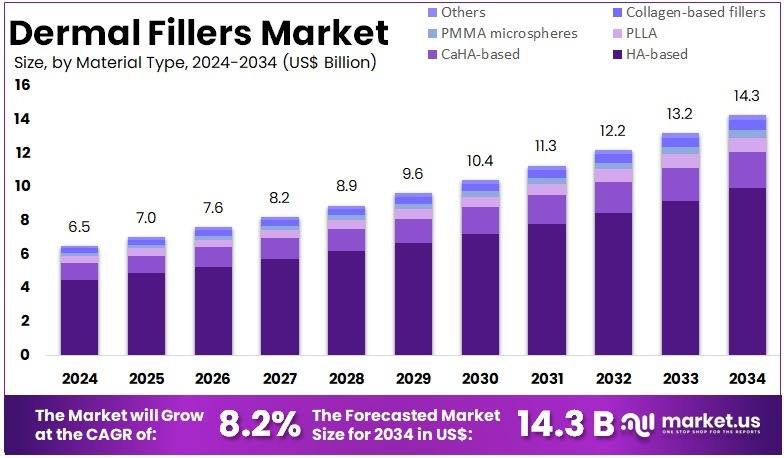
New York, NY – Aug 31, 2026 –The Global Dermal Fillers Market Size is expected to be worth around US$14.3 Billion by 2034, from US$ 6.5 Billion in 2024, growing at a CAGR of 8.2% during the forecast period from 2025 to 2034. North America held a dominant market position, capturing more than a 35.8% share and holds US$ 2.3 Billion market value for the year.
The global Dermal Fillers market is witnessing steady growth, driven by rising demand for minimally invasive aesthetic procedures, increasing awareness of facial rejuvenation, and continuous product innovation. Dermal fillers are widely used to restore facial volume, smooth wrinkles, enhance lips, and improve facial contours without surgery.
The growing aging population is a major growth driver, as people increasingly seek non-surgical treatments to reduce visible signs of aging. At the same time, younger consumers are opting for cosmetic enhancement procedures, further expanding the customer base.
Hyaluronic acid-based fillers continue to dominate the market due to their safety profile, reversibility, and natural-looking results. Technological advancements, including longer-lasting formulations and improved injection techniques, are also supporting market expansion.
North America remains the leading regional market, supported by high healthcare spending, widespread acceptance of cosmetic procedures, and the presence of major manufacturers. Meanwhile, the Asia-Pacific is expected to register the fastest growth due to rising disposable incomes, medical tourism, and growing demand for aesthetic treatments.
Increasing regulatory approvals, expanding dermatology clinics, and higher investments in research and development are expected to create additional opportunities. As consumer preference shifts toward quick, minimally invasive cosmetic procedures with limited recovery time, the dermal fillers market is expected to maintain strong long-term growth.
Key Takeaways
- The global dermal fillers market is expected to grow from US$ 6.5 billion in 2024 to approximately US$ 14.3 billion by 2034, expanding at a CAGR of 8.2% during the forecast period.
- In 2024, hyaluronic acid–based fillers dominated the material segment, capturing more than 69.4% of the global market share.
- Wrinkle and fold correction emerged as the leading application segment in 2024, accounting for over 34.6% of the total market.
- Temporary biodegradable fillers with a longevity of less than one year held the largest share in 2024, representing more than 45.7% of the market.
- Women remained the largest consumer group in 2024, contributing over 63.5% of the worldwide demand for dermal fillers.
- The 18–30 years age group accounted for the highest number of procedures in 2024, holding more than 34.3% of the overall market share.
- Dermatology clinics led the end-user segment in 2024, accounting for over 36.0% of the global dermal filler procedure volume.
- North America maintained its position as the leading regional market in 2024, capturing more than 35.8% of the global share and generating approximately US$ 2.3 billion in revenue.
Statistical Information
- A 2025 academic practice review reported 1,923 dermal filler patients, with 33 documented complications, representing an overall complication rate of approximately 1.7%.
- The 2025 report documented 3 confirmed infections following dermal filler treatment, including 2 Mycobacterium infections and 1 Staphylococcus infection. After contamination was identified, changing the icing technique eliminated this source of infection.
- One patient with a hyaluronic acid filler nodule required 4 hyaluronidase treatment sessions using 60, 75, 50, and 20 units, administered 2–5 days apart, demonstrating a quantified complication-management protocol.
- The International Society of Aesthetic Plastic Surgery (ISAPS) states in its current 2025 guidance that a standard facial filler procedure typically requires 10–20 minutes to complete under outpatient conditions.
- ISAPS reports that treatment results from currently used dermal fillers generally last between 2 and 18 months, depending on filler material and injection site.
- ISAPS notes that common post-treatment swelling and redness generally resolve within 24–48 hours, allowing most patients to resume normal daily activities immediately.
Regional Analysis
North America dominated the global dermal fillers market in 2024, accounting for more than 35.8% of total revenue and generating approximately US$ 2.3 billion. The region’s leadership is supported by the widespread acceptance of minimally invasive cosmetic procedures, strong healthcare infrastructure, and high awareness of facial aesthetic treatments.
According to the American Society of Plastic Surgeons, millions of minimally invasive cosmetic procedures are performed annually in the United States, with soft tissue fillers remaining among the most frequently chosen treatments.
Growing demand for hyaluronic acid-based fillers, supported by their established safety profile and temporary, reversible nature, continues to strengthen market growth. Regulatory oversight by the U.S. Food and Drug Administration ensures that approved dermal filler products meet safety and effectiveness standards, increasing patient confidence.
Rising disposable incomes, an aging population seeking facial rejuvenation, expanding medical spa networks, and the influence of social media on cosmetic awareness have further accelerated procedure adoption, enabling North America to maintain its leading position in the global dermal fillers market.
Emerging Trends
- Growing preference for hyaluronic acid fillers: Hyaluronic acid remains the leading filler material because it is naturally absorbed by the body over time and can be dissolved if needed. The FDA has approved numerous hyaluronic acid fillers for facial wrinkles, lips, cheeks, chin, and hands in adults aged 22 years and older.
- Higher demand for natural-looking facial enhancement: Consumers increasingly prefer subtle facial contouring instead of dramatic volume changes. Clinics are using smaller filler volumes across multiple treatment areas to achieve balanced results while reducing the need for invasive surgery and supporting faster recovery.
- Greater focus on patient safety and trained injectors: Healthcare providers are emphasizing treatments performed only by licensed professionals. The FDA advises against needle-free injection devices and self-injection because these products can cause severe injuries, including vision loss, stroke, and tissue damage.
- Expansion of regenerative aesthetic treatments: Clinics are combining dermal fillers with regenerative procedures such as skin boosters and collagen-stimulating therapies. These approaches aim to improve skin quality while maintaining facial volume, supporting longer-lasting and more personalized aesthetic outcomes.
- Increasing use of imaging for safer procedures: Advanced imaging, including facial ultrasound, is gaining attention for identifying blood vessels before injections. This technology helps improve injection accuracy, reduces vascular complications, and supports better management if filler-related adverse events occur.
Use Cases
- Correction of facial wrinkles and folds: Dermal fillers are widely used to treat moderate-to-severe facial wrinkles, including nasolabial folds and lines around the mouth. FDA-approved products provide temporary volume restoration and smoother skin with minimally invasive outpatient procedures.
- Lip, cheek, and chin enhancement: Approved fillers are increasingly used to enhance facial contours by adding volume to the lips, cheeks, and chin. These treatments offer immediate visible improvement, while most absorbable fillers gradually break down naturally over several months.
- Hand rejuvenation procedures: Dermal fillers are also approved for restoring volume on the back of the hands, reducing the appearance of tendons and veins. This expands filler applications beyond facial aesthetics and supports broader cosmetic treatment demand.
- Treatment of HIV-related facial lipoatrophy: FDA-approved dermal fillers are used to restore facial fat loss associated with HIV-related lipoatrophy. Volume replacement improves facial appearance and can positively influence patient confidence and overall quality of life.
- Correction of acne scars and contour defects: Permanent and temporary fillers are used to improve selected acne scars and facial contour deficiencies. These minimally invasive procedures help restore smoother skin texture while reducing the need for more extensive surgical interventions
Frequently Asked Questions on Dermal Fillers
- What factors are driving the growth of the dermal fillers market?
Market growth is driven by increasing aging populations, rising disposable incomes, greater acceptance of cosmetic procedures, and growing demand for non-surgical facial rejuvenation. Improvements in filler safety, longer-lasting formulations, and expanding medical aesthetic clinics also contribute to market expansion. - Which type of dermal filler is most commonly used?
Hyaluronic acid fillers are the most commonly used because they provide natural-looking results, are biodegradable, and can be reversed if necessary. They are widely used for lip enhancement, wrinkle correction, cheek augmentation, and facial contouring in cosmetic medicine. - Which regions lead the global dermal fillers market?
North America leads the dermal fillers market due to advanced healthcare infrastructure, high consumer awareness, experienced aesthetic practitioners, and strong demand for cosmetic procedures. Europe and Asia-Pacific also represent important markets, with Asia-Pacific experiencing particularly rapid growth in aesthetic treatments. - What are the major applications of dermal fillers?
Dermal fillers are widely used for wrinkle reduction, facial contouring, lip enhancement, cheek augmentation, chin reshaping, acne scar correction, and hand rejuvenation. They are also used in selected reconstructive procedures to restore facial volume lost due to aging or medical conditions. - How is technology influencing the dermal fillers market?
Technological advances have led to improved filler formulations with better durability, smoother consistency, and enhanced safety profiles. Digital facial imaging, ultrasound-guided injections, and personalized treatment planning are also improving precision, patient satisfaction, and overall clinical outcomes in aesthetic medicine. - What is the future outlook for the dermal fillers market?
The dermal fillers market is expected to experience continued growth as demand for minimally invasive cosmetic treatments increases globally. Ongoing product innovation, expanding indications, rising medical tourism, and greater awareness of facial aesthetics are likely to create new opportunities for manufacturers and healthcare providers.
Conclusion
The global dermal fillers market is expected to witness steady growth over the coming years, driven by rising demand for minimally invasive aesthetic procedures, an aging population, and increasing consumer awareness of facial rejuvenation treatments. Continuous advancements in filler materials, particularly hyaluronic acid-based products, are improving safety, durability, and treatment outcomes.
Expanding dermatology clinics, growing medical tourism, and higher spending on cosmetic procedures are further supporting market expansion. North America remains the leading regional market, while Asia-Pacific is emerging as a high-growth region due to rising disposable incomes and aesthetic awareness. Overall, innovation, broader accessibility, and evolving beauty preferences are expected to sustain long-term market growth.
Discuss your needs with our analyst
Please share your requirements with more details so our analyst can check if they can solve your problem(s)




