


Overview
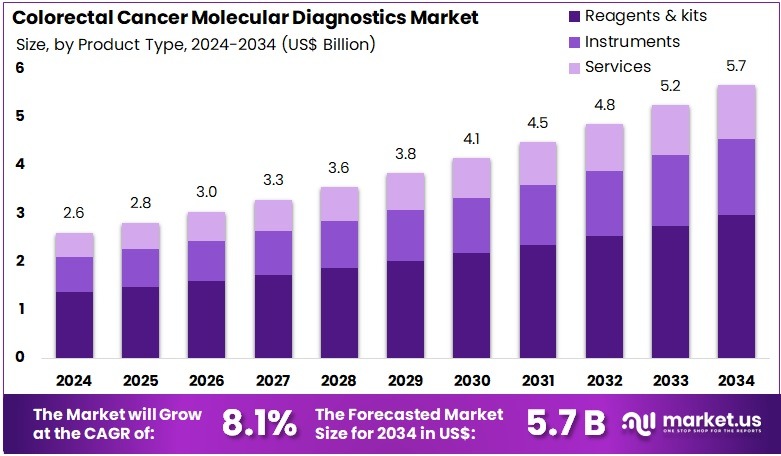
Global Colorectal Cancer Molecular Diagnostics Market size is expected to be worth around US$ 5.7 Billion by 2034 from US$ 2.6 Billion in 2024, growing at a CAGR of 8.1% during the forecast period 2025 to 2034. North America held a dominant market position, capturing more than a 38.7% share and holds US$ 1.0 Billion market value for the year.
Colorectal cancer molecular diagnostics refers to advanced laboratory techniques used to detect genetic, genomic, and molecular changes associated with colorectal cancer (CRC). These diagnostic tests help identify specific biomarkers, gene mutations, and molecular characteristics that support early diagnosis, prognosis, treatment selection, and disease monitoring. Common biomarkers evaluated include KRAS, NRAS, BRAF, MSI (Microsatellite Instability), MMR (Mismatch Repair) status, HER2 amplification, and NTRK gene fusions. Molecular diagnostics are increasingly integrated into routine clinical practice to enable personalized treatment strategies and improve patient outcomes.
The growing adoption of precision medicine, rising colorectal cancer incidence, and expanding use of companion diagnostics are driving demand for molecular testing worldwide. Technologies such as next-generation sequencing (NGS), polymerase chain reaction (PCR), fluorescence in situ hybridization (FISH), digital PCR, and immunohistochemistry (IHC) are widely used for comprehensive molecular profiling. These methods assist oncologists in selecting targeted therapies and immunotherapies while reducing unnecessary treatments.
Healthcare organizations increasingly recommend molecular testing for patients with advanced or metastatic colorectal cancer to guide therapeutic decisions. Advances in liquid biopsy technologies are also enabling minimally invasive detection of circulating tumor DNA (ctDNA), supporting disease monitoring and early detection of recurrence. Continuous research in cancer genomics, artificial intelligence-assisted diagnostics, and biomarker discovery is further expanding the capabilities of molecular diagnostics.
As healthcare systems emphasize precision oncology and personalized medicine, colorectal cancer molecular diagnostics is expected to remain a critical component of modern cancer care, improving diagnostic accuracy, optimizing treatment outcomes, and supporting the development of next-generation targeted therapies.
Key Takeaways
- In 2024, the global market was valued at US$ 2.6 billion and is projected to reach US$ 5.7 billion by 2034, expanding at a CAGR of 8.1% during the forecast period.
- By product type, the market is segmented into reagents & kits, instruments, and services. Among these, reagents & kits emerged as the leading segment, accounting for 52.4% of the total market share in 2024.
- Based on technology, the market comprises PCR-based, transcription-mediated amplification-based, sequencing-based, mass spectrometry-based, isothermal nucleic acid amplification, and chips & microarrays-based technologies. The PCR-based segment dominated the market with a 45.7% share in 2024.
- In terms of end users, the market is categorized into hospitals, diagnostic laboratories, and ambulatory surgical centers. Hospitals held the largest share, contributing 48.2% of the overall market revenue in 2024.
- North America emerged as the leading regional market, capturing 38.7% of the global market share in 2024.
Statistical Information
- Cologuard Plus achieved 95% sensitivity and 94% specificity for colorectal cancer detection in 2025.
The FDA-approved Cologuard Plus molecular stool DNA test demonstrated 95% sensitivity for detecting colorectal cancer and 94% specificity, making it one of the highest-performing non-invasive molecular diagnostics available in 2025. It also reduces unnecessary follow-up colonoscopies by up to 40% compared with the previous Cologuard version. - More than 19 million molecular screening tests have been performed using Cologuard technology.
When launching Cologuard Plus in 2025, Exact Sciences reported that the original Cologuard platform had already been used for over 19 million colorectal cancer molecular screening tests, demonstrating large-scale clinical adoption. - Guardant Shield V2 reported 84% sensitivity and 90% specificity in 2025.
Guardant Health announced that its updated Shield V2 blood-based molecular diagnostic algorithm achieved 84% sensitivity for colorectal cancer detection with 90% specificity in validation studies. - Shield V2 detected 62% of Stage I colorectal cancers in 2025.
The updated Shield molecular diagnostic algorithm demonstrated 62% sensitivity specifically for Stage I colorectal cancer, representing improved early-stage detection capability. - Natera validated its tissue-free MRD assay using 1,230 patient timepoints from 195 colorectal cancer patients.
In its 2026 clinical validation, Natera evaluated the Latitude tissue-free molecular residual disease assay using 1,230 longitudinal blood sample timepoints collected from 195 colorectal cancer patients in the GALAXY study. - Natera’s PROCEED-CRC study enrolled approximately 5,000 screening participants.
The prospective PROCEED-CRC trial evaluating Natera’s blood-based molecular screening technology enrolled approximately 5,000 average-risk asymptomatic individuals, providing one of the largest prospective datasets for colorectal cancer molecular diagnostics. - Natera reported 22.5% sensitivity and 91.5% specificity for advanced adenoma detection.
Results released in 2025 showed the molecular blood-based assay achieved 22.5% sensitivity while maintaining 91.5% specificity for detecting advanced adenomas, an important precancerous lesion. - One-third (about 33%) of eligible Americans remained unscreened in 2026.
The American Cancer Society reported in its 2026 colorectal cancer screening guideline update that approximately one-third of eligible U.S. adults had not undergone recommended colorectal cancer screening, highlighting continued demand for easier molecular diagnostic technologies. - Routine screening is recommended for adults aged 45–75 years.
The 2026 American Cancer Society guidance recommends molecular colorectal cancer screening beginning at 45 years and continuing through 75 years for average-risk adults with adequate life expectancy. - Exact Sciences’ next-generation MRD assay will monitor up to 5,000 patient-specific variants with a detection limit below 1 part per million (ppm).
In 2025, Exact Sciences announced that its next-generation molecular residual disease platform, planned for 2026, can track up to 5,000 tumor-specific variants while detecting circulating tumor DNA at concentrations below 1 ppm, substantially improving analytical sensitivity.
Regional Analysis
North America Dominates the Colorectal Cancer Molecular Diagnostics Market
North America held the largest share of the colorectal cancer molecular diagnostics market in 2024, supported by advanced healthcare infrastructure, widespread adoption of precision oncology, and strong government-backed cancer screening programs. The United States continues to expand colorectal cancer screening following the U.S. Preventive Services Task Force recommendation to begin routine screening at age 45 for average-risk adults, increasing demand for molecular diagnostic tests such as stool DNA, PCR, and next-generation sequencing (NGS).
The growing use of circulating tumor DNA (ctDNA) assays for minimal residual disease monitoring and recurrence detection is further strengthening the market. In addition, continued investments from the National Cancer Institute and research collaborations are accelerating biomarker discovery and companion diagnostics development. According to the American Cancer Society, an estimated 154,270 new colorectal cancer cases are expected in the United States in 2025, highlighting the ongoing need for accurate molecular diagnostic technologies. These factors continue to reinforce North America’s leadership in this market.
Asia-Pacific is Expected to Register the Fastest Growth
Asia-Pacific is projected to record the highest CAGR during the forecast period due to increasing colorectal cancer incidence, expanding healthcare infrastructure, and growing government investments in cancer screening and precision medicine. Countries including China, Japan, South Korea, Australia, and India are strengthening genomic testing capabilities through national cancer control programs and wider access to molecular diagnostics.
Hospitals and research institutes are increasingly adopting NGS, PCR, and liquid biopsy technologies to support early diagnosis and personalized treatment decisions. Rising public awareness, improved reimbursement policies in several countries, and collaborations between healthcare providers and biotechnology companies are also accelerating market growth.
According to the World Health Organization GLOBOCAN estimates, Eastern Asia accounted for more than 600,000 new colorectal cancer cases in 2022, demonstrating the region’s substantial disease burden and the growing need for advanced molecular diagnostic solutions.
Emerging Trends
- Growth of blood-based molecular screening tests: Blood-based molecular diagnostics are becoming an important screening option for average-risk adults. In 2026, the American Cancer Society added an FDA-approved blood test to its screening recommendations for adults aged 45–75, helping improve access for people who avoid colonoscopy while supporting earlier cancer detection.
- Expansion of stool DNA and RNA molecular testing
Advanced stool molecular diagnostics now combine DNA, RNA, and fecal hemoglobin biomarkers to improve colorectal cancer detection. FDA classifications highlight PCR-based RNA marker assays for adults 45 years and older, while DNA methylation assays support screening for colorectal cancer and advanced adenomas using non-invasive samples. - Increasing use of liquid biopsy and ctDNA technologies
Liquid biopsy using circulating tumor DNA (ctDNA) is expanding beyond recurrence monitoring to precision oncology. In 2026, researchers reported that broad genomic profiling through ctDNA helps identify actionable mutations, monitor treatment response, and detect drug resistance without repeated tissue biopsies. - Companion diagnostics supporting precision therapies
Companion molecular diagnostics are becoming standard in treatment selection. In 2025, the FDA approved the Idylla CDx MSI Test, which analyzes 7 microsatellite instability biomarkers in colorectal cancer tissue to identify patients eligible for specific immunotherapy options, strengthening personalized treatment strategies. - Greater focus on biomarker discovery for early detection
Government-funded research is accelerating biomarker development for colorectal cancer. In 2026, the U.S. National Cancer Institute highlighted molecular pathways linked to chronic inflammation and tumor development, while national workshops promoted next-generation biomarker technologies to improve early diagnosis and clinical adoption.
Use Cases
- Population screening for average-risk adults: Molecular diagnostic tests are increasingly used for routine colorectal cancer screening. Current recommendations target adults aged 45–75, using stool DNA/RNA tests and blood-based molecular assays to identify early cancers before symptoms develop and improve participation in national screening programs.
- Selecting patients for targeted immunotherapy
Hospitals use molecular diagnostics to determine microsatellite instability (MSI) status before treatment. FDA-approved companion diagnostics evaluate 7 genetic biomarkers, helping clinicians identify colorectal cancer patients who may benefit from immune checkpoint inhibitor therapies and improving personalized treatment decisions. - Monitoring treatment response and disease recurrence
Circulating tumor DNA (ctDNA) testing allows clinicians to monitor residual disease after surgery and evaluate therapy effectiveness. Repeated blood testing provides a less invasive method than tissue biopsy and enables earlier identification of recurrence or emerging treatment resistance. - Detection of advanced adenomas before cancer develops
Modern molecular stool tests identify genetic and epigenetic changes associated with advanced adenomas alongside occult blood detection. This enables earlier intervention through diagnostic colonoscopy, reducing the likelihood of progression from precancerous lesions to invasive colorectal cancer. - Supporting precision oncology through genomic profiling
Comprehensive molecular profiling using tissue and liquid biopsy helps identify clinically relevant genomic alterations that guide therapy selection. Broad genomic testing supports personalized treatment planning, improves clinical trial enrollment, and enables more effective management of advanced colorectal cancer patients.
Frequently Asked Questions on Colorectal Cancer Molecular Diagnostics
- Why is molecular testing important for colorectal cancer patients?
Molecular testing identifies biomarkers such as KRAS, NRAS, BRAF, MSI, and mismatch repair genes. The results help doctors select targeted therapies, determine immunotherapy eligibility, reduce ineffective treatments, and improve survival through personalized treatment strategies based on each patient’s tumor profile. - What are the major technologies used in colorectal cancer molecular diagnostics?
The market mainly uses polymerase chain reaction (PCR), next-generation sequencing (NGS), fluorescence in situ hybridization (FISH), and immunohistochemistry (IHC). These technologies provide accurate detection of genetic alterations and biomarkers, supporting early diagnosis, treatment planning, and disease monitoring. - What factors are driving the colorectal cancer molecular diagnostics market?
The market is expanding due to rising colorectal cancer incidence, growing awareness of early screening, increasing adoption of precision medicine, technological advancements in molecular testing, favorable reimbursement policies, and expanding use of companion diagnostics in oncology treatment decisions. - Which biomarkers are commonly analyzed in colorectal cancer molecular diagnostics?
Common biomarkers include KRAS, NRAS, BRAF, HER2, microsatellite instability (MSI), and mismatch repair (MMR) genes. Testing these biomarkers helps determine targeted therapy suitability, immunotherapy response, prognosis, and personalized treatment options for colorectal cancer patients. - Which end users contribute most to the colorectal cancer molecular diagnostics market?
Hospitals, diagnostic laboratories, cancer research institutes, pathology laboratories, and specialty oncology clinics are the primary end users. These organizations increasingly adopt advanced molecular testing technologies to improve diagnostic accuracy and optimize treatment selection for colorectal cancer patients. - Which region leads the colorectal cancer molecular diagnostics market?
North America currently leads the colorectal cancer molecular diagnostics market due to advanced healthcare infrastructure, widespread screening programs, strong adoption of genomic testing, supportive reimbursement systems, and continuous investments in cancer research, precision medicine, and molecular diagnostic innovation. - How does next-generation sequencing (NGS) benefit colorectal cancer diagnostics?
Next-generation sequencing enables simultaneous analysis of multiple cancer-related genes from a single sample. This comprehensive approach improves mutation detection, supports personalized treatment selection, reduces testing time, and enhances clinical decision-making compared with traditional single-gene testing methods. - What is the future outlook for the colorectal cancer molecular diagnostics market?
The market is expected to experience steady growth as precision oncology expands worldwide. Increasing biomarker discoveries, integration of artificial intelligence, wider adoption of liquid biopsy technologies, and greater investment in genomic medicine will continue driving innovation and market demand.
Conclusion
The colorectal cancer molecular diagnostics market is expected to witness steady growth as healthcare systems increasingly prioritize early cancer detection, precision medicine, and personalized treatment strategies. Rising adoption of PCR, next-generation sequencing (NGS), and liquid biopsy technologies is improving the accuracy of detecting genetic biomarkers such as KRAS, NRAS, BRAF, and MSI, helping clinicians make more informed treatment decisions. Continued expansion of screening programs, growing awareness of colorectal cancer prevention, and technological advancements in molecular testing are further supporting market demand.
Despite challenges such as high testing costs, reimbursement limitations, and regulatory requirements, ongoing investments in research, strategic collaborations, and the development of non-invasive diagnostic solutions are expected to strengthen the market over the coming years. As hospitals, diagnostic laboratories, and research institutions continue integrating advanced molecular diagnostics into routine clinical practice, the market is well positioned to improve patient outcomes while supporting the global shift toward precision oncology and earlier disease detection.
Discuss your needs with our analyst
Please share your requirements with more details so our analyst can check if they can solve your problem(s)




