


Overview
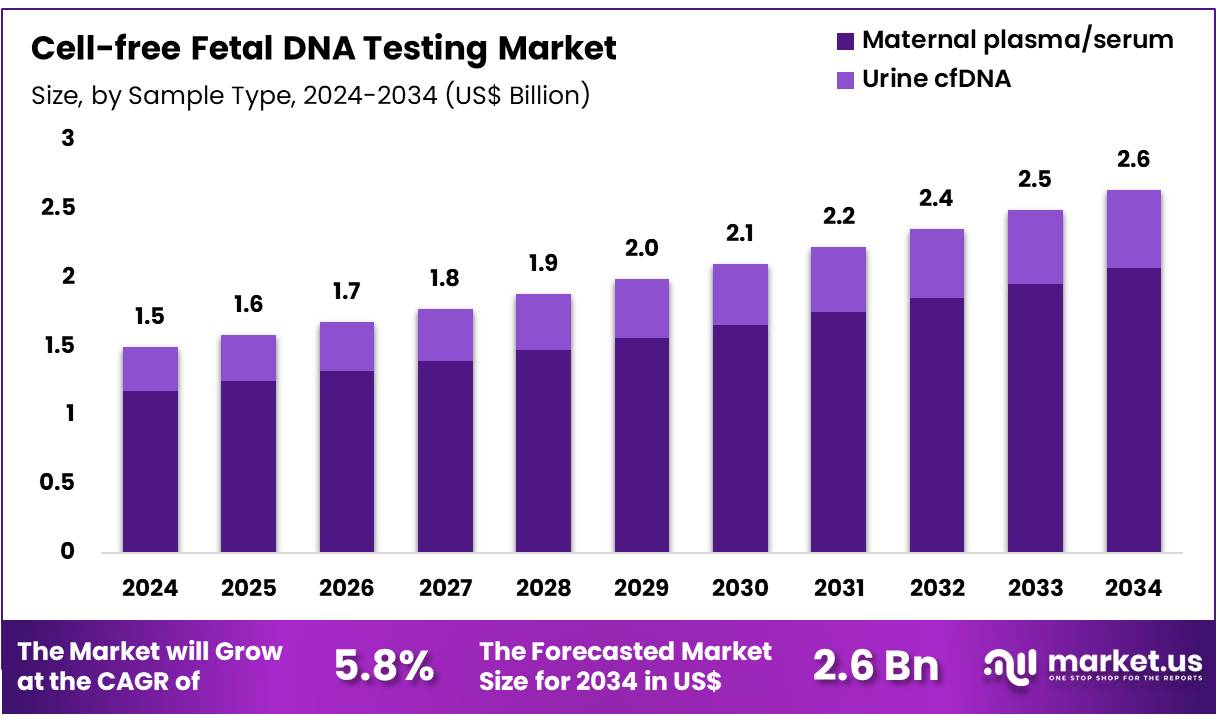
The Global Cell-free Fetal DNA Testing Market size is expected to be worth around US$ 2.6 Billion by 2034 from US$ 1.5 Billion in 2024, growing at a CAGR of 5.8% during the forecast period 2025 to 2034. In 2024, North America led the market, achieving over 41.1% share with a revenue of US$ 1.2 Billion.
The global cell-free fetal DNA (cfDNA) testing market is witnessing strong growth as healthcare providers increasingly adopt non-invasive prenatal testing (NIPT) for early detection of chromosomal abnormalities. cfDNA testing analyzes small fragments of fetal genetic material circulating in the mother’s blood and is generally performed from around 10 weeks of pregnancy, offering a safer alternative to invasive procedures such as amniocentesis.
The technology is primarily used for screening conditions including Down syndrome (trisomy 21), Edwards syndrome (trisomy 18), and Patau syndrome (trisomy 13). Clinical studies have reported that cfDNA-based screening can achieve detection rates of more than 99% for trisomy 21, with significantly lower false-positive rates compared with traditional screening methods. The increasing number of advanced maternal age pregnancies, rising awareness of prenatal diagnostics, and demand for non-invasive testing solutions are driving market expansion.
The adoption of cfDNA testing is supported by improvements in next-generation sequencing (NGS), bioinformatics platforms, and laboratory automation. More than 100 countries have incorporated NIPT services into prenatal healthcare pathways at different levels, reflecting growing global acceptance. The test requires only a small maternal blood sample, typically around 10 mL, reducing risks associated with invasive fetal diagnostic procedures.
Growing healthcare investment, expanding genetic counseling services, and increasing availability of advanced prenatal screening technologies are expected to accelerate the adoption of cell-free fetal DNA testing. The market continues to evolve with innovations focused on broader genetic screening panels, faster turnaround times, and improved accessibility.
Key Takeaways
- In 2024, the cell-free fetal DNA testing market generated revenue of US$ 1.5 billion and is projected to grow at a CAGR of 5.8%, reaching approximately US$ 2.6 billion by 2034.
- Based on product type, the market is segmented into cell-free DNA extraction & purification kits, PCR & qPCR-based cffDNA testing kits, and NGS-based cffDNA testing kits. Cell-free DNA extraction & purification kits dominated the segment in 2023, accounting for a 43.8% market share.
- By sample type, the market is categorized into maternal plasma/serum and urine cfDNA. Maternal plasma/serum emerged as the leading segment, capturing a significant market share of 78.6%.
- According to end-user segmentation, the market includes hospitals, maternity clinics, diagnostic laboratories, and academic & research institutions. Hospitals held the largest market position, contributing 46.9% of the total revenue share.
- Regionally, North America dominated the global cell-free fetal DNA testing market in 2024, accounting for a market share of 41.1%.
Statistical Information
- In a 2025 clinical evaluation of expanded cell-free fetal DNA testing (NIPT-plus), the study analyzed 6,220 pregnant women and reported 100% sensitivity for detecting targeted chromosomal abnormalities, with test specificity ranging from 99.69% to 99.87%.
- The same 2025 NIPT-plus study reported positive rates of 0.71% for common trisomies, 0.45% for sex chromosome abnormalities, 0.32% for rare autosomal aneuploidies, and 0.59% for copy number variations (CNVs).
- A 2025 study of expanded cell-free fetal DNA screening reported positive predictive values (PPVs) of 80.95% for common trisomies, 30.77% for sex chromosome abnormalities, 13.33% for rare autosomal aneuploidies, and 44.12% for CNVs.
- A 2025 cell-free fetal DNA enrichment study evaluated 71,986 pregnancies and found that enrichment increased fetal fraction to 18.87 ± 5.94%, improving the amount of fetal DNA available for analysis.
- In the 2025 fetal DNA enrichment study, the overall PPV for common trisomies increased to 88.46% in general-risk pregnancies and 91.11% in high-risk pregnancies after enrichment technology was applied.
- The same 2025 enrichment research showed CNV detection PPVs increased to 53.52% for general-risk pregnancies and 66.67% for high-risk pregnancies after fetal DNA enrichment.
- The fetal DNA enrichment approach reduced cfDNA screening failure rates to 0.01% in general-risk pregnancies and 0.08% in high-risk pregnancies in a 2025 clinical analysis.
- The 2025 NIPT-plus clinical study reported that screening for sex chromosome abnormalities achieved 100% sensitivity with specificity above 99%, demonstrating high analytical performance for this category of cfDNA testing.
Regional Analysis
North America maintained a leading position in the cell-free fetal DNA testing market, supported by strong adoption of noninvasive prenatal testing (NIPT), advanced healthcare infrastructure, and favorable clinical recommendations. Updated guidance from organizations such as the American College of Obstetricians and Gynecologists encouraged broader access to prenatal genetic screening. Growing demand for early detection of chromosomal abnormalities, including trisomy 21, 18, and 13, along with expanding use of next-generation sequencing (NGS) platforms, strengthened regional growth.
Asia Pacific is projected to register the fastest growth during the forecast period due to rising maternal age, increasing awareness of prenatal screening, and government initiatives supporting genetic testing. Countries including China, India, Japan, and South Korea are expanding genomic healthcare programs and improving access to advanced prenatal diagnostics. Growing investments in NGS-based testing, digital health integration, and affordable screening solutions are expected to accelerate market expansion across the region.
Emerging Trends
- Expansion of Universal Non-Invasive Prenatal Screening (NIPS): A major trend is the adoption of cell-free fetal DNA testing for all pregnant individuals rather than only high-risk pregnancies. In 2025–2026, clinical guidelines increasingly support offering cfDNA screening regardless of maternal age or risk factors. The test mainly evaluates trisomy 21, 18, and 13 through maternal blood samples.
- Increasing Use of Advanced Genomic Sequencing Technologies: Next-generation sequencing (NGS) is becoming a key technology trend in cfDNA testing because it enables analysis of millions of DNA fragments from maternal blood. Modern platforms improve detection capability for chromosomal abnormalities, with testing commonly performed from approximately 10 weeks of pregnancy using non-invasive blood collection methods.
- Growth in Screening Beyond Common Trisomies: The market is moving toward expanded cfDNA panels that evaluate additional genetic conditions, including sex chromosome abnormalities and selected microdeletions. Updated 2025 clinical discussions highlight the evolving role of cfDNA applications beyond traditional trisomy screening, increasing opportunities for broader prenatal genetic assessment.
- Rising Adoption in Twin and Multifetal Pregnancies: Cell-free fetal DNA testing is increasingly being evaluated for twin pregnancies and multifetal gestations. Healthcare providers are using cfDNA screening because it requires only a maternal blood sample and avoids invasive procedures. However, clinical guidance notes that performance varies for trisomy 18 and 13 due to limited affected-case data.
- Integration of Genetic Counseling With Digital Testing Workflows: A growing trend in the cfDNA testing market is combining laboratory testing with genetic counseling, electronic reporting, and patient education platforms. Positive screening results require counseling and confirmatory diagnostic procedures such as chorionic villus sampling (CVS) or amniocentesis, improving decision-making during pregnancy care.
Use Cases
- Early Detection of Chromosomal Abnormalities: The primary use case of cfDNA testing is early screening for fetal chromosomal abnormalities. The test analyzes fetal DNA fragments circulating in maternal blood and supports risk assessment for major conditions such as Down syndrome (trisomy 21), Edwards syndrome (trisomy 18), and Patau syndrome (trisomy 13).
- Reducing Dependence on Invasive Prenatal Procedures:cfDNA testing provides a non-invasive alternative to procedures such as amniocentesis and CVS, which require sampling of fetal-related tissues. Since the test uses a maternal blood sample, it eliminates procedure-related miscarriage risks associated with invasive diagnostic methods.
- Supporting Personalized Pregnancy Management: Healthcare providers use cfDNA results to personalize pregnancy monitoring plans. A positive screening outcome can lead to detailed ultrasound evaluation, genetic counseling, and confirmatory testing, helping families and clinicians make informed decisions during prenatal care.
- Expanding Prenatal Screening Access Globally: Government-supported screening programs are increasing access to NIPT services. For example, the NHS uses non-invasive prenatal testing pathways to screen for Down syndrome, Edwards syndrome, and Patau syndrome by analyzing cell-free fetal DNA from maternal blood samples.
- Improving Future Precision Medicine Applications: A developing use case is applying advanced cfDNA analysis methods for broader fetal genetic profiling. Research and clinical programs are exploring improved sequencing approaches, higher-resolution genomic analysis, and expanded screening capabilities that may support future precision prenatal healthcare models.
Frequently Asked Questions on Cell-free Fetal DNA Testing
- How does Cell-free Fetal DNA Testing work?
Cell-free fetal DNA testing works by collecting a maternal blood sample and separating fetal DNA fragments from maternal DNA. Advanced sequencing technologies analyze these fragments to detect genetic variations linked with fetal chromosomal conditions, usually after 10 weeks of pregnancy. - What conditions can Cell-free Fetal DNA Testing detect?
Cell-free fetal DNA testing primarily screens for common chromosomal abnormalities such as Down syndrome, Edwards syndrome, and Patau syndrome. Some advanced tests can also evaluate sex chromosome conditions and fetal sex determination based on specific genetic markers. - Is Cell-free Fetal DNA Testing safe for pregnant women?
Cell-free fetal DNA testing is considered a safe prenatal screening option because it requires only a maternal blood sample. Unlike invasive procedures such as amniocentesis, it does not involve inserting instruments into the uterus, reducing procedure-related risks. - What technologies are used in Cell-free Fetal DNA Testing?
Cell-free fetal DNA testing commonly uses next-generation sequencing (NGS), polymerase chain reaction (PCR), and microarray-based technologies. These platforms analyze millions of DNA fragments to identify chromosome-related changes and improve prenatal screening accuracy and efficiency. - What are the major applications of Cell-free Fetal DNA Testing?
Major applications of cell-free fetal DNA testing include screening for fetal aneuploidies, determining fetal sex, detecting sex chromosome abnormalities, and supporting high-risk pregnancy monitoring. The technology is increasingly used as part of routine prenatal care programs globally. - How is artificial intelligence influencing the Cell-free Fetal DNA Testing Market?
Artificial intelligence is improving cell-free fetal DNA testing by supporting genomic data interpretation, reducing analysis time, and identifying complex genetic patterns. AI-based solutions may enhance accuracy, workflow efficiency, and scalability of prenatal genetic screening services. - What are the future opportunities in the Cell-free Fetal DNA Testing Market?
Future opportunities include expansion into emerging markets, development of broader genetic screening panels, integration with digital healthcare platforms, and improved affordability. Research is also exploring applications beyond chromosomal screening, including pregnancy-related genetic risk assessment. - What is the difference between Cell-free Fetal DNA Testing and traditional prenatal screening?
Cell-free fetal DNA testing analyzes fetal DNA fragments directly from maternal blood, offering higher accuracy for certain chromosomal conditions compared with traditional screening methods. Conventional tests usually combine ultrasound and biochemical markers, which may have different sensitivity levels.
Conclusion
The cell-free fetal DNA testing market is progressing toward a more advanced, accessible, and data-driven future, supported by AI integration, expanded NIPT applications, and rising demand for early genetic insights. Increasing maternal age, improved healthcare infrastructure, and government-supported genomic initiatives are strengthening adoption worldwide.
North America continues to lead through regulatory support and advanced diagnostic capabilities, while Asia Pacific demonstrates strong growth potential through expanding prenatal screening programs. Despite reimbursement challenges, geopolitical uncertainties, and technology costs, continuous innovation by key players is expected to enhance accuracy, affordability, and integration of cfDNA testing into comprehensive prenatal healthcare systems.
Discuss your needs with our analyst
Please share your requirements with more details so our analyst can check if they can solve your problem(s)




