


Overview
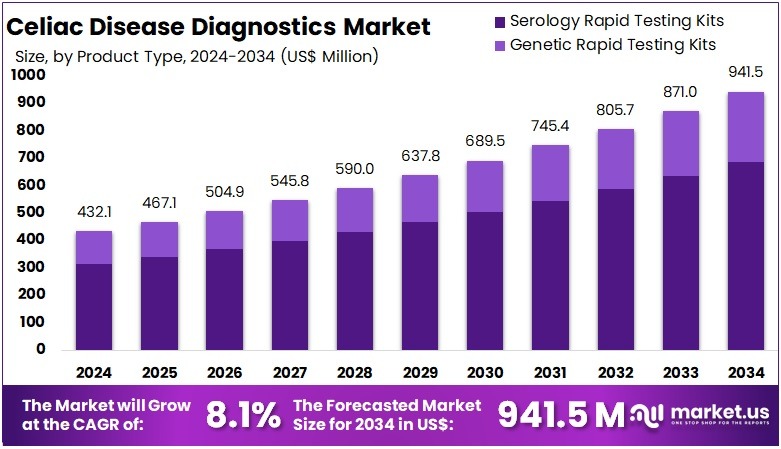
New York, NY – Sep 01, 2026 –The Celiac Disease Diagnostics Market Size is expected to be worth around US$ 941.5 Million by 2034 from US$ 432.1 million in 2024, growing at a CAGR of 8.1% during the forecast period 2025 to 2034. North America held a dominant market position, capturing more than a 36.7% share and holding US$158.6 million market value for the year.
The global Celiac Disease Diagnostics Market is experiencing steady growth as healthcare systems place greater emphasis on the early detection of autoimmune gastrointestinal disorders. Celiac disease affects nearly 1% of the global population, although many cases remain undiagnosed, creating significant opportunities for improved screening and diagnosis.
Blood-based serology tests, including tissue transglutaminase (tTG-IgA) and endomysial antibody (EMA) tests, remain the primary diagnostic tools due to their high clinical accuracy. Healthcare providers are also increasingly adopting HLA genetic testing and confirmatory intestinal biopsy in complex cases.
North America currently represents a leading regional market, supported by advanced healthcare infrastructure, strong laboratory networks, and high awareness among physicians and patients. Europe also maintains a significant market share due to established screening practices and favorable clinical guidelines. Meanwhile, the Asia-Pacific region is expected to witness the fastest growth as diagnostic capacity expands and awareness campaigns improve disease recognition.
Continuous technological advancements, automation in diagnostic laboratories, and growing investments in precision diagnostics are expected to further strengthen the Celiac Disease Diagnostics Market over the next decade.
Key Takeaways
- In 2024, the Celiac Disease Diagnostics Market was valued at US$ 432.1 million and is projected to reach US$ 941.5 million by 2034, growing at a CAGR of 8.1% during the forecast period.
- By Product Type, Serology Rapid Testing Kits dominated the market in 2024, accounting for a 72.9% share, ahead of Genetic Rapid Testing Kits.
- By Technique, ELISA emerged as the leading segment, capturing 66.6% of the market share in 2024, owing to its high accuracy and widespread clinical adoption.
- By Sample Type, Blood Serum held the largest market share of 78.9% in 2024, driven by its routine use in serological testing for celiac disease diagnosis.
- By End User, Hospitals accounted for the largest share of 41.2% in 2024, supported by higher patient volumes, advanced diagnostic facilities, and comprehensive testing services.
- North America dominated the global market in 2024, securing a 36.7% market share due to strong healthcare infrastructure, high disease awareness, and widespread availability of diagnostic testing.
Statistical Information
- The 2025 European Society for the Study of Coeliac Disease (ESsCD) guideline recommends a no-biopsy diagnosis for selected adults when IgA anti-tTG levels are ≥10× the upper limit of normal (ULN), provided the result is confirmed using a second blood sample.
- A 2025 meta-analysis cited in the ESsCD guideline found that an IgA anti-tTG level ≥10× ULN achieved 100% specificity (95% CI: 98–100%) for diagnosing celiac disease in adults.
- The same 2025 evidence review reported a 98% positive predictive value (PPV) for IgA anti-tTG values ≥10× ULN across 18 studies involving 12,103 participants from 15 countries.
- For the ≥10× ULN threshold, pooled diagnostic sensitivity was 51% (95% CI: 42–60%), showing that this high threshold maximizes diagnostic certainty rather than screening sensitivity.
- The 2025 ESsCD guideline recommends collecting at least 6 biopsy specimens during endoscopy—4 from the second part of the duodenum and 2 from the duodenal bulb—to improve diagnostic accuracy.
- The 2025 guideline reports that IgG anti-deamidated gliadin peptide (DGP) assays used in IgA-deficient patients show sensitivity ranging from 74.4% to 86.0%, with specificity between 97.3% and 99.3%.
- The 2025 ESsCD consensus achieved 100% expert agreement that at least four distal duodenal biopsies should be obtained for histopathological diagnosis, reflecting strong standardization of biopsy practice.
- The 2025 guideline reports 95% expert agreement supporting the conditional no-biopsy diagnostic pathway for adults meeting the ≥10× ULN IgA anti-tTG criterion with confirmatory repeat serology.
Regional Analysis
North America dominated the Celiac Disease Diagnostics Market in 2024, accounting for 36.7% of the global market. The region’s leadership is supported by advanced healthcare infrastructure, high awareness of celiac disease, and widespread access to serological and genetic diagnostic tests.
In the United States, celiac disease affects approximately 1 in 133 people, encouraging routine screening among high-risk populations, including individuals with autoimmune disorders and those with a family history of the disease.
Diagnostic laboratories and hospitals extensively use ELISA-based antibody testing, while insurance coverage for serology and confirmatory biopsy improves patient access. Strong support from healthcare organizations and patient advocacy groups has also increased early diagnosis and disease awareness.
Asia Pacific is projected to register the fastest growth during the forecast period. Rising healthcare spending, improved laboratory infrastructure, expanding availability of diagnostic technologies, and increasing awareness of gluten-related disorders are driving market expansion. Countries such as India, China, Japan, and South Korea are reporting higher diagnosis rates as access to specialized gastroenterology services and modern diagnostic testing continues to improve.
Emerging Trends
- Greater use of non-biopsy diagnosis in selected patients: Recent clinical recommendations support biopsy-free diagnosis in carefully selected patients with very high tissue transglutaminase (tTG-IgA) antibody levels. This trend reduces invasive procedures, shortens diagnosis time, and improves patient experience while maintaining diagnostic accuracy under established clinical guidelines.
- Expansion of genetic (HLA-DQ2/DQ8) testing: Healthcare providers are increasingly using HLA-DQ2 and HLA-DQ8 genetic tests to rule out celiac disease in uncertain cases. Since nearly all patients carry one of these genetic markers, genetic testing helps reduce unnecessary biopsies and improves diagnostic decision-making.
- Growing development of point-of-care and digital diagnostics: Government agencies are encouraging innovation in point-of-care and digitally connected diagnostic technologies. Digital reporting systems improve data collection, while portable testing solutions help expand access to diagnostics outside hospitals, supporting faster clinical decisions and broader patient coverage.
- Higher adoption of multi-marker serology panels: Clinical laboratories increasingly use combined antibody panels, including tTG-IgA, EMA-IgA, and DGP antibodies, instead of relying on a single marker. Multi-marker testing improves diagnostic confidence, especially in patients with IgA deficiency or uncertain clinical symptoms.
- AI-assisted biopsy interpretation is gaining attention: Artificial intelligence is being evaluated to improve the interpretation of intestinal biopsy images. Recent research achieved approximately 82.7% binary classification accuracy using 750 annotated biopsy images, showing potential to reduce workload and improve consistency in pathology laboratories.
Use Cases
- Screening people with autoimmune diseases: Celiac disease testing is increasingly recommended for patients with autoimmune disorders such as type 1 diabetes and thyroid disease. Early antibody screening enables quicker diagnosis, reducing long-term intestinal damage and supporting earlier dietary intervention in high-risk populations.
- Family screening for inherited risk: First-degree relatives of people diagnosed with celiac disease frequently undergo serology and genetic testing because inherited risk is significantly higher than in the general population. Early detection allows timely treatment before severe nutritional complications develop.
- Monitoring patients on a gluten-free diet: Healthcare providers regularly measure celiac-specific antibodies after diagnosis to monitor treatment success. Falling antibody levels indicate improved adherence to a gluten-free diet and help clinicians assess long-term disease management without repeated invasive procedures.
- Supporting diagnosis in pediatric care: Children with symptoms such as poor growth, chronic diarrhea, or unexplained anemia increasingly receive serological testing as the first diagnostic step. In selected pediatric cases, guideline-supported non-biopsy diagnosis can reduce the need for endoscopy while maintaining diagnostic reliability.
- Expanding access through home and community testing: Healthcare systems are supporting broader use of home-use and community-based diagnostic technologies where appropriate. Connected testing platforms improve access, encourage earlier screening, and allow diagnostic information to be shared securely with healthcare providers for follow-up care.
Frequently Asked Questions on Celiac Disease Diagnostics
- Which diagnostic tests are commonly used for celiac disease?
The most commonly used tests include tissue transglutaminase IgA (tTG-IgA), endomysial antibody (EMA), deamidated gliadin peptide (DGP) antibody tests, HLA-DQ2/DQ8 genetic testing, and small intestine biopsy. These methods help improve diagnostic accuracy and support appropriate clinical decision-making. - What factors are driving the growth of the Celiac Disease Diagnostics Market?
The market is expanding due to rising prevalence of autoimmune diseases, growing awareness of gluten-related disorders, improved laboratory technologies, increasing healthcare spending, and recommendations for early diagnosis by healthcare organizations to reduce long-term complications associated with untreated celiac disease. - Which region leads the Celiac Disease Diagnostics Market?
North America currently leads the Celiac Disease Diagnostics Market because of advanced healthcare systems, widespread access to diagnostic laboratories, strong reimbursement support, and higher awareness among healthcare professionals. Europe also represents a significant market due to established screening practices. - Who are the major end users in the Celiac Disease Diagnostics Market?
Hospitals, diagnostic laboratories, specialty clinics, academic research centers, and reference laboratories are the primary end users. These facilities perform antibody screening, genetic analysis, and confirmatory testing, ensuring accurate diagnosis and effective patient management across different healthcare settings. - How does technology influence the Celiac Disease Diagnostics Market?
Technological advancements such as automated immunoassays, multiplex testing platforms, digital laboratory workflows, and improved genetic analysis are increasing testing efficiency and diagnostic accuracy. These innovations help laboratories process more samples while reducing turnaround time and operational costs. - What opportunities exist in the Celiac Disease Diagnostics Market?
Growing demand for point-of-care testing, expanding healthcare access in emerging economies, increased pediatric screening, and continued investment in precision diagnostics create significant opportunities. New biomarker research and digital health integration are also expected to support future market growth. - What is the future outlook for the Celiac Disease Diagnostics Market?
The market is expected to experience steady growth over the coming years due to increasing awareness, greater adoption of early screening, continuous innovation in diagnostic technologies, and expanding government and healthcare initiatives focused on improving the detection and management of autoimmune diseases.
Conclusion
The Celiac Disease Diagnostics Market is expected to witness steady growth as healthcare systems increasingly prioritize early diagnosis, accurate screening, and improved patient management. Rising awareness of celiac disease, expanding use of serological and genetic testing, and advancements in ELISA and rapid diagnostic technologies are supporting market expansion.
Hospitals and diagnostic laboratories remain the primary end users, while home-based testing solutions are creating new growth opportunities. North America continues to lead due to strong healthcare infrastructure and high testing adoption. Overall, continuous innovation, wider access to diagnostics, and increasing disease recognition are expected to drive long-term market growth.
Discuss your needs with our analyst
Please share your requirements with more details so our analyst can check if they can solve your problem(s)




