


Overview
New York, NY – Sep 10, 2026 – The Global Cardiovascular Needle Market size is expected to be worth around US$ 190.0 Million by 2034 from US$ 98.4 Million in 2024, growing at a CAGR of 6.8% during the forecast period 2025 to 2034. In 2024, North America led the market, achieving over 38.8% share with a revenue of US$ 38.2 Million.
Cardiovascular Needle is experiencing steady growth, supported by the increasing burden of cardiovascular diseases, rising cardiac surgical procedures, and continuous advancements in surgical instruments. The market was valued at approximately USD 190–210 million in 2024 and is expected to surpass USD 320–350 million by 2032, expanding at a compound annual growth rate of around 6.0–6.8% during the forecast period.
Cardiovascular needles are critical components in procedures such as coronary artery bypass grafting, heart valve repair and replacement, congenital heart defect surgery, and vascular reconstruction, where precision suturing is essential for successful outcomes.
According to the World Health Organization (WHO), cardiovascular diseases cause 17.9 million deaths every year, accounting for 32% of all global deaths. The U.S. Centers for Disease Control and Prevention (CDC) reports that 805,000 people suffer a heart attack annually in the United States, while approximately 695,000 Americans die from heart disease each year, equivalent to 1 in every 5 deaths.
Furthermore, an estimated 340,000 coronary artery bypass graft (CABG) surgeries are performed each year globally, creating sustained demand for high-quality cardiovascular needles and suturing products.
Technological innovations, including precision-ground stainless steel needles, atraumatic tapered tips, laser-drilled needle eyes, and advanced silicone coatings, are improving needle penetration, reducing tissue trauma, and enhancing surgical efficiency.
North America accounts for over 38% of global market revenue, driven by advanced cardiac care infrastructure and high procedural volumes, while Asia-Pacific is projected to register the fastest growth with an expected CAGR above 7% through 2032 due to expanding healthcare investments, increasing access to cardiac surgery, and the growing prevalence of cardiovascular disorders.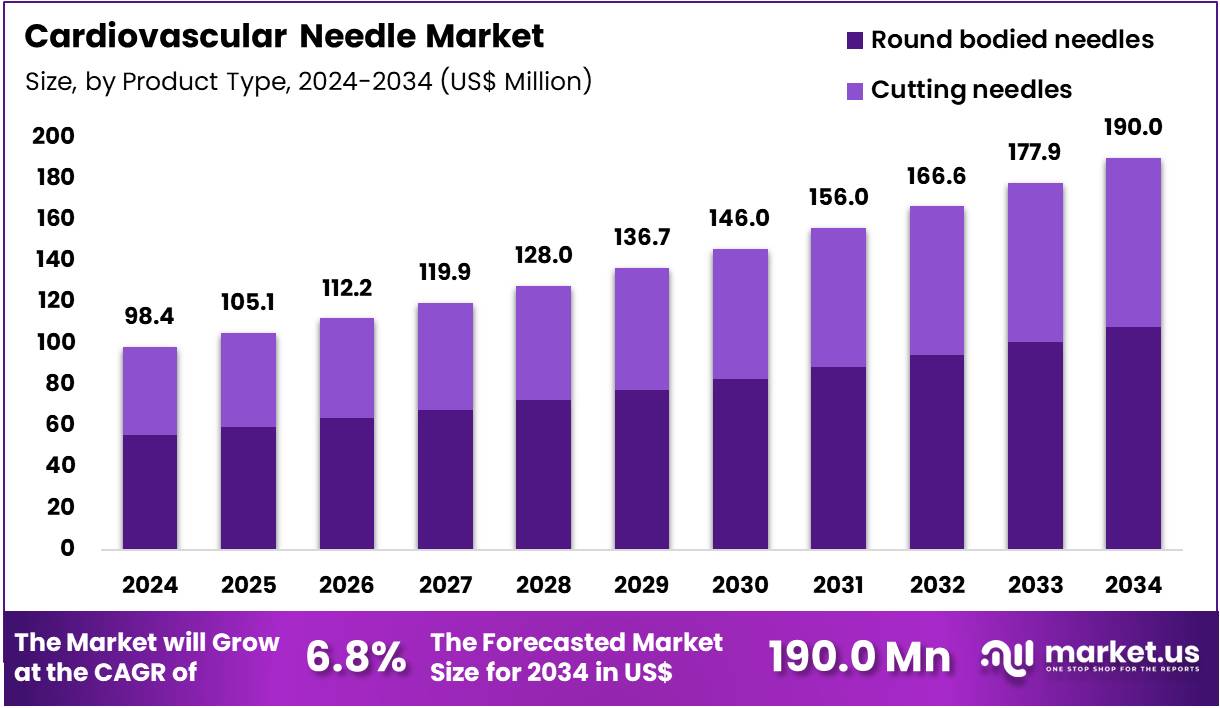
Key Takeaways
- In 2024, the Cardiovascular Needle Market generated US$ 98.4 million in revenue and is projected to reach US$ 190.0 million by 2034, growing at a CAGR of 6.8% during the forecast period.
- By Product Type, the market is segmented into Round Bodied Needles and Cutting Needles. Round Bodied Needles dominated the market in 2024, accounting for 56.8% of the total market share.
- By Usage, the market is categorized into Single-use and Multiple-use products. The Single-use segment held the largest share of 58.9% in 2024, driven by infection control and patient safety requirements.
- By Application, the market includes Open-heart Surgery, Coronary Artery Bypass Graft (CABG) Surgery, Cardiac Valve Procedures, Heart Transplant, and Others. Coronary Artery Bypass Graft (CABG) Surgery emerged as the leading application segment, capturing 41.2% of the market share in 2024.
- North America was the leading regional market in 2024, securing 38.8% of the global Cardiovascular Needle Market share, supported by advanced cardiac care infrastructure and a high volume of cardiovascular surgical procedures.
Statistical Information
- Global Burden of Cardiovascular Diseases Drives Demand for Cardiovascular Surgery: Cardiovascular diseases (CVDs) remain the leading cause of death worldwide, accounting for 17.9 million deaths every year, or 32% of all global deaths. This large disease burden continues to increase the demand for cardiac procedures such as coronary artery bypass grafting (CABG), valve replacement, and heart transplantation, all of which require high-precision cardiovascular needles.
- High Number of Heart Attacks Increases Cardiac Surgical Procedures: According to the U.S. CDC, approximately 805,000 people experience a heart attack every year, with one heart attack occurring every 40 seconds. Of these, 605,000 are first-time heart attacks, creating sustained demand for cardiovascular interventions and surgical consumables including cardiovascular needles.
- Coronary Artery Disease Supports Demand for CABG Procedures: The CDC reports that about 5% of U.S. adults aged 20 years and older have coronary artery disease (CAD). CAD is the most common form of heart disease and remains a major indication for coronary artery bypass graft (CABG) surgery, the leading application segment for cardiovascular needles.
- Hundreds of Thousands of CABG Surgeries Are Performed Annually: Company regulatory filings referencing global clinical data estimate that around 800,000 CABG surgeries are performed worldwide every year, including approximately 400,000 procedures in the United States. Every CABG operation requires multiple cardiovascular sutures and specialized surgical needles, supporting consistent product demand.
- Heart Disease Remains the Leading Cause of Death in the U.S.: The CDC states that 919,032 people died from cardiovascular disease in the United States during 2023, representing 1 in every 3 deaths. The high mortality burden continues to drive investment in advanced cardiovascular treatment and surgical technologies.
- Aging Population Increases the Need for Cardiac Surgery: The U.S. Census Bureau projects that all baby boomers will be age 65 or older by 2030, increasing the U.S. older adult population to more than 73 million people. Older adults have a higher incidence of coronary artery disease and valve disorders, contributing to greater demand for cardiovascular surgical procedures and specialized needles.
- Heart Valve Disease Becomes More Common With Age: According to the National Heart, Lung, and Blood Institute (NHLBI), about 2.5% of the U.S. population has heart valve disease, and the prevalence rises to approximately 13% among people aged 75 years and older. This supports the growing need for valve repair and replacement surgeries requiring precision cardiovascular needles.
- Hypertension Is a Major Driver of Cardiac Procedures: According to the CDC, nearly half (48.1%) of U.S. adults, or approximately 120 million people, have hypertension. High blood pressure is one of the leading causes of coronary artery disease, heart failure, and valve disorders that often require surgical intervention.
Regional Analysis
North America led the market by securing a market share of 38.8% in 2024.
North America led the Cardiovascular Needle Market, accounting for 38.8% of the global market in 2024. The region benefits from advanced cardiac care infrastructure, a high volume of cardiovascular surgeries, and widespread adoption of innovative surgical technologies.
According to the U.S. Centers for Disease Control and Prevention (CDC), approximately 805,000 people experience a heart attack each year in the United States, while heart disease remains the nation’s leading cause of death. These factors contribute to sustained demand for cardiovascular surgical instruments, including precision needles used in CABG, valve repair, and other cardiac procedures.
Asia-Pacific is expected to register the fastest growth during the forecast period due to expanding healthcare infrastructure, rising cardiovascular disease prevalence, and increased government investment in specialized cardiac care.
The World Health Organization (WHO) reports that cardiovascular diseases remain the leading cause of death globally, encouraging countries across Asia-Pacific to strengthen cardiac services. Growing adoption of minimally invasive surgery and improving access to advanced healthcare are expected to further accelerate regional market growth.
Emerging Trends
- Growing Adoption of Minimally Invasive Cardiac Surgery: Hospitals are increasingly adopting minimally invasive cardiac surgery because it reduces hospital stay, blood loss, and recovery time. The American Association for Thoracic Surgery reported that the international MIST trial enrolled 176 CABG patients across 7 cardiac centers, reflecting growing clinical interest in less invasive coronary bypass procedures that require precision cardiovascular needles.
- Increasing Use of Robotic-Assisted Cardiac Surgery: Robot-assisted surgery is expanding across cardiac procedures, creating demand for high-precision cardiovascular needles with improved control and flexibility. The U.S. FDA states that robotic surgical systems are cleared for multiple cardiac procedures, enabling surgeons to perform operations through small incisions while improving surgical accuracy.
- Rising Preference for Single-Use Surgical Devices: Healthcare facilities continue shifting toward single-use surgical products to lower infection risks. According to the CDC, 20–30% of U.S. hospitals previously reported reusing at least one type of single-use device, prompting stronger FDA regulations and increasing adoption of sterile disposable surgical products.
- High Cardiac Surgery Volumes Support Product Innovation: Continuous demand for cardiac procedures encourages manufacturers to improve cardiovascular needle performance. The CDC reports approximately 395,000 coronary artery bypass graft (CABG) procedures are performed in the United States, supporting development of stronger, finer, and atraumatic cardiovascular needles.
- Greater Focus on Advanced Coronary Bypass Techniques: Cardiac surgeons are increasingly using advanced arterial grafting and specialized suturing techniques to improve long-term outcomes. The STS Adult Cardiac Surgery Database indicates that more than 70% of cardiac surgery cases involve isolated CABG, encouraging innovation in cardiovascular needles and suturing materials.
Use Cases
- Coronary Artery Bypass Graft (CABG) Surgery: Cardiovascular needles are widely used during CABG to attach healthy blood vessels to blocked coronary arteries. The CDC reports approximately 395,000 CABG procedures are performed annually in the United States, making CABG one of the largest applications for these surgical needles.
- Heart Valve Repair and Replacement: Surgeons use precision cardiovascular needles to place delicate sutures during mitral and aortic valve repair or replacement. Minimally invasive valve surgery is expanding globally because it reduces recovery time and improves patient outcomes, increasing demand for specialized surgical needles.
- Congenital Heart Defect Surgery: Cardiovascular needles are essential for repairing congenital heart defects in infants and children because delicate tissues require accurate suturing. Specialized pediatric cardiac procedures rely on fine, atraumatic needles to reduce tissue injury and improve surgical precision.
- Congenital Heart Defect Surgery: Cardiovascular needles are essential for repairing congenital heart defects in infants and children because delicate tissues require accurate suturing. Specialized pediatric cardiac procedures rely on fine, atraumatic needles to reduce tissue injury and improve surgical precision.
- Cardiac Transplant and Complex Heart Reconstruction: Cardiovascular needles are used extensively during heart transplantation and complex reconstructive surgeries to create secure vascular and tissue connections. These procedures require high-strength, precision-engineered needles to ensure reliable suturing and reduce complications during lengthy cardiac operations.
Frequently Asked Questions on Cardiovascular Needle
- Why is the demand for cardiovascular needles increasing globally?
Demand is increasing because cardiovascular diseases remain the leading cause of death worldwide, resulting in more bypass surgeries, valve replacements, and vascular procedures. Improved healthcare infrastructure and better access to specialized cardiac treatment further support market growth. - Which product type dominates the Cardiovascular Needle Market?
Round-bodied needles dominate the market because they penetrate soft cardiovascular tissues smoothly without cutting them. Their design minimizes tissue damage and is widely preferred for delicate heart and vascular surgeries requiring precise suturing. - Why are single-use cardiovascular needles becoming more popular?
Single-use needles help prevent cross-contamination, reduce infection risks, and eliminate the need for sterilization. Hospitals increasingly adopt disposable products to comply with strict infection-control standards and improve patient safety during cardiovascular procedures. - Which application holds the largest share in the Cardiovascular Needle Market?
Coronary artery bypass graft (CABG) surgery accounts for the largest market share because it is one of the most commonly performed cardiac procedures. CABG requires multiple high-precision cardiovascular needles for secure vessel anastomosis and tissue closure. - Why does North America lead the Cardiovascular Needle Market?
North America leads due to its advanced healthcare infrastructure, high volume of cardiac surgeries, strong reimbursement systems, and rapid adoption of innovative cardiovascular surgical technologies. The region also has a large number of specialized cardiac centers. - Why is Asia-Pacific expected to witness the fastest market growth?
Asia-Pacific is expected to grow rapidly because of increasing cardiovascular disease cases, expanding healthcare infrastructure, rising healthcare spending, and greater government investment in advanced cardiac care services and specialized surgical facilities. - Who are the major end users of cardiovascular needles?
Hospitals, cardiac specialty centers, ambulatory surgical centers, and academic medical institutions are the primary end users. Hospitals account for the largest share because they perform the majority of complex cardiovascular surgical procedures. - What is the future outlook for the Cardiovascular Needle Market?
The market is expected to grow steadily over the coming years, supported by increasing cardiac surgery volumes, technological advancements, rising demand for minimally invasive procedures, and continuous investment in modern healthcare infrastructure worldwide.
Conclusion
The Cardiovascular Needle Market is expected to witness steady growth, driven by the rising prevalence of cardiovascular diseases, increasing numbers of cardiac surgeries, and continuous advancements in surgical technologies. Growing adoption of minimally invasive and robotic-assisted procedures is boosting demand for precision-engineered, single-use cardiovascular needles that enhance surgical accuracy and patient safety.
North America continues to lead the market due to its advanced healthcare infrastructure, while Asia-Pacific is emerging as the fastest-growing region with expanding cardiac care services. Ongoing innovation, supportive healthcare investments, and increasing awareness of infection prevention are expected to create long-term growth opportunities for manufacturers and healthcare providers worldwide.
Discuss your needs with our analyst
Please share your requirements with more details so our analyst can check if they can solve your problem(s)




