


Overview
New York, NY – Sep 21, 2026 – The Global Cancer-focused Genetic Testing Service Market size is expected to be worth around US$ 19.6 Billion by 2034 from US$ 8.5 Billion in 2024, growing at a CAGR of 8.7% during the forecast period 2025 to 2034. In 2024, North America led the market, achieving over 43.1% share with a revenue of US$ 3.7 Billion.
Cancer-focused Genetic Testing Service is gaining momentum as genetic testing becomes increasingly important for hereditary cancer screening, diagnosis, treatment selection, and personalized oncology. According to the National Cancer Institute (NCI), inherited genetic changes are associated with approximately 5%–10% of all cancers, demonstrating the growing clinical importance of cancer-focused genetic testing.
The global cancer burden provides a substantial addressable population. The World Health Organization (WHO) reported approximately 20 million new cancer cases and 9.7 million cancer deaths globally in 2022. WHO also projects that the annual number of new cancer cases could reach more than 35 million by 2050, representing an increase of approximately 77% compared with 2022 levels. This rising disease burden is expected to increase demand for genetic risk assessment and precision diagnostics.
Technological advancements are strengthening testing capabilities. Modern next-generation sequencing (NGS) panels can evaluate 50, 100, or even several hundred genes within a single test, while targeted hereditary cancer panels commonly assess genes including BRCA1, BRCA2, TP53, PALB2, MLH1, MSH2, MSH6, and PMS2. Inherited BRCA1/BRCA2 pathogenic variants are particularly important because they substantially increase the risk of breast and ovarian cancers.
Growing adoption of precision medicine, increasing genetic counseling, improved sequencing technologies, and greater awareness of family cancer history are expected to support demand across hospitals, oncology centers, diagnostic laboratories, and specialized genetic testing providers.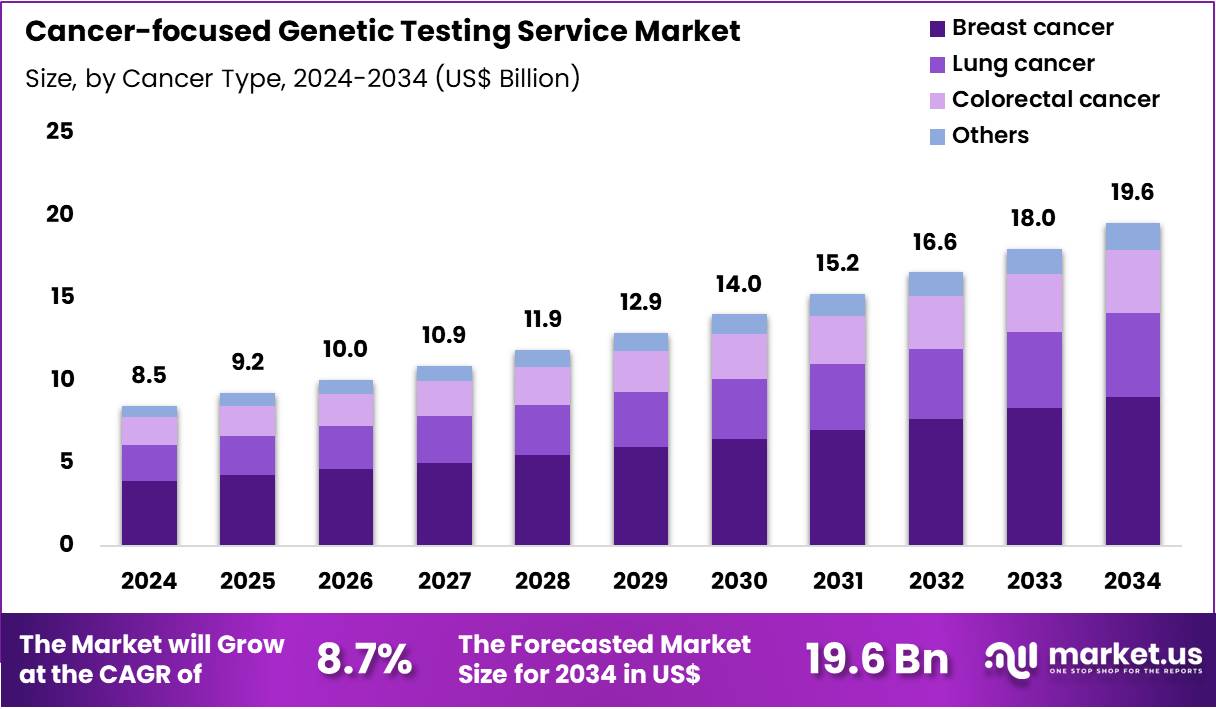
Key Takeaways
- In 2024, the Cancer-focused Genetic Testing Service Market generated revenue of US$ 8.5 Billion and is projected to expand at a CAGR of 8.7%, reaching approximately US$ 19.6 Billion by 2034.
- By test type, the market is segmented into DNA, chromosome, and biochemical testing. Among these, the DNA segment dominated in 2023, accounting for a market share of 52.8%.
- Based on cancer type, the market is categorized into breast cancer, lung cancer, colorectal cancer, and others. The breast cancer segment held the largest share, representing 46.2% of the market.
- By service provider, the market includes hospitals, diagnostic laboratories, specialty clinics, and specialized cancer institutes. Hospitals dominated the segment, accounting for the highest revenue share of 49.6%.
- Regionally, North America dominated the Cancer-focused Genetic Testing Service Market in 2024, capturing a significant market share of 43.1%.
Market Segmentation Overview
- Test Type Analysis: DNA testing, with a 52.8% market share, is expected to maintain its leading position due to its ability to identify hereditary mutations, including BRCA1 and BRCA2. Increasing awareness of hereditary cancer risks, advances in sequencing technologies, improved testing accuracy, declining costs, and growing adoption of personalized oncology are supporting wider utilization of DNA-based genetic testing services.
- Cancer Type Analysis: Breast cancer, accounting for 46.2%, is projected to remain the dominant cancer type due to the strong association between hereditary mutations and breast cancer risk. Increasing genetic screening among high-risk individuals, greater awareness of inherited cancer syndromes, enhanced surveillance strategies, and clinical integration of genetic testing are driving demand for breast cancer-focused genetic testing services.
- Service Provider Analysis: Hospitals, holding a 49.6% market share, are expected to remain the leading service provider due to integrated oncology departments, genetic counseling, and advanced diagnostic infrastructure. Hospitals provide multidisciplinary care and incorporate genetic results into treatment planning. Rising cancer incidence, expanding hospital-based cancer centers, and increasing investments in precision oncology are further strengthening hospital-based genetic testing services.
Statistical Information
- Cancer Germline Testing Reached Only Seven Per cent Uptake: Among more than 1.3 million U.S. adults diagnosed with cancer, approximately 93,000, or 6.8%, underwent germline genetic testing by March 2021. Men with breast cancer had the highest testing rate at 50%, while ovarian cancer testing reached approximately 38%. Low uptake indicates substantial unrealised demand for hereditary-cancer risk assessment, counselling, testing, interpretation, and family cascade-testing services.
- BRCA Variants Affect About One In Four Hundred People: The prevalence of harmful BRCA1 or BRCA2 variants in the general population is approximately 0.2%–0.3%, equal to around 1 in 400 people. For women with breast cancer diagnosed before age 40, BRCA pathogenic variants occur in approximately 1 in 10, or 10%. Among women with ovarian cancer, the estimated prevalence is 10%–15%, supporting broad demand for hereditary-cancer testing.
- Contralateral Breast Cancer Risk Reaches Forty Per cent for Carriers: Among breast-cancer survivors with inherited BRCA1 variants, approximately 30%–40% develop cancer in the opposite breast within 20 years of the first diagnosis. For BRCA2 carriers, the comparable risk is 25%. In contrast, contralateral breast-cancer risk in the general breast-cancer survivor population is approximately 8%. This risk difference supports post-diagnosis genetic testing, surveillance, and preventive-treatment decision services.
- FDA Authorised Seventy-Six Oncology Devices During 2024: FDA’s Centre for Devices and Radiological Health authorised 76 oncology devices in 2024. This included 27 in-vitro diagnostic devices, of which 4 were new IVDs carrying a total of 11 companion-diagnostic claims. FDA also authorised 9 expanded companion-diagnostic indications for 6 previously authorised IVDs. These approvals expand precision-oncology testing opportunities linked to targeted cancer therapies.
- Female Breast Cancer Testing Reached Only Twenty Six Percent: Among patients included in the NCI-reported study, germline genetic testing reached 26% of women with breast cancer, 38.6% of ovarian-cancer patients, and 7.5% of patients with multiple primary cancers. These rates remain well below universal testing levels. The gap indicates continued demand for oncology referral systems, hereditary-cancer panels, genetic counselling, results interpretation, and family cascade-testing services.
- Genetic Testing Uptake Studies Averaged Fifty Nine Percent Worldwide: A systematic review of 40 studies reported genetic-testing uptake rates ranging from 25% to 96%, with an average of 59%. The wide 71-percentage-point range indicates that testing access is heavily affected by counselling availability, insurance coverage, provider referral, patient education, family history, healthcare-system design, and use of mainstream testing pathways. This variation creates opportunities for decentralised and telehealth-enabled genetic-testing services.
- Companion Diagnostics Supported Thirty Six Percent Of Oncology Approvals: From 1998 through 2024, the FDA approved 217 new molecular entities for oncology or haematological malignancies. Of these, 78 drugs, or 36%, were linked to one or more companion diagnostics. Among the 78 companion-diagnostic-linked drugs, 52 or 67% were approved simultaneously with their tests, while 26 or 33% received diagnostics later through supplemental approval processes.
- BRCA One Ovarian Risk Reaches Sixty Per cent Lifetime: The average woman has approximately 1.6% lifetime ovarian-cancer risk. For women carrying BRCA1 pathogenic variants, lifetime risk is 40%–60%; for BRCA2 carriers, it is 20%–35%. The upper BRCA1 risk estimate is therefore 37.5 times the population baseline. These risk levels support cancer-focused genetic-testing services, enhanced surveillance, preventive surgery discussions, and family risk-management programmes.
Regional Analysis
North America led the market by securing a market share of 43.1% in 2024.
North America remains a key region for cancer-focused genetic testing, supported by advanced genomic infrastructure, precision-oncology programs, and expanding molecular diagnostics. The United States recorded 1,851,238 new cancer cases in 2022, highlighting the need for advanced diagnostic and genetic services.
The National Cancer Institute continues supporting cancer genomics research to improve biomarker discovery, diagnosis, and personalized treatment. Asia Pacific is also strengthening its genetic-testing capabilities through investments in genomic medicine and specialized healthcare infrastructure.
Japan has expanded its genomic-medicine network, including 13 core genomic-medicine hospitals, 32 genomic-medicine hospitals, and 258 affiliated hospitals as of August 2026. Government initiatives, increasing cancer incidence, sequencing technologies, and broader access to precision medicine are supporting genetic-testing adoption across the region.
These developments are improving cancer-risk assessment, treatment planning, and hereditary cancer screening while strengthening regional capabilities for personalized oncology and genomic healthcare services.
Business Opportunities
The Cancer-focused Genetic Testing Service Market presents significant business opportunities as healthcare systems expand precision oncology and hereditary cancer screening. Rising demand for BRCA1, BRCA2, Lynch syndrome, TP53, and multigene panel testing creates opportunities for diagnostic laboratories to develop comprehensive testing services. Next-generation sequencing can support simultaneous analysis of multiple cancer-associated genes, improving testing efficiency.
Companies can also expand genetic counseling, tele-genetic services, and home-based sample collection to improve accessibility for rural and underserved populations. Pharmaceutical and diagnostic partnerships offer opportunities to develop companion diagnostics that identify patients likely to benefit from targeted therapies. Artificial intelligence can further support variant interpretation, laboratory reporting, and clinical decision-making.
Opportunities also exist in population-specific genetic panels designed around regional variant patterns and disease risks. As healthcare providers increasingly integrate genomic information into treatment planning, businesses offering validated testing, secure genomic-data management, counseling, and interpretation services can strengthen their position while supporting personalized cancer care.
Emerging Trends
- Multigene Panel Testing: Multigene panels examine several cancer-related genes simultaneously, improving hereditary risk assessment. NCI estimates inherited genetic changes contribute to approximately 5%–10% of cancers.
- Next-Generation Sequencing: NGS enables laboratories to analyze numerous cancer-associated genes efficiently. FDA-authorized comprehensive oncology testing can evaluate up to 517 genes, supporting detailed genomic profiling.
- Companion Diagnostics: Genetic testing is increasingly connected with targeted cancer treatments. FDA-approved companion diagnostics help identify patients who may benefit from specific therapies based on genomic alterations.
- Hereditary Breast Cancer Screening: BRCA1 and BRCA2 testing remains important for hereditary breast cancer assessment. NCI estimates pathogenic inherited variants contribute approximately 5%–10% of breast cancers.
- Growing Genetic Counseling: Genetic counseling is becoming increasingly important for interpreting hereditary cancer results. In 2023, 31.6% of U.S. women aged 18+ with relevant family history discussed genetic testing.
Use Cases
- Hereditary Cancer Risk Assessment: Genetic testing identifies inherited cancer-risk variants, helping individuals understand susceptibility. NCI estimates 5%–0% of cancers are associated with inherited genetic changes, supporting targeted screening and preventive healthcare decisions.
- Treatment Selection: Tumor and germline testing can identify genetic alterations relevant to targeted therapies. FDA-recognized companion diagnostics help determine whether patients are likely to benefit from specific oncology treatments.
- Family Screening: When a pathogenic variant is identified, genetic testing can help evaluate relatives who may carry the same inherited change, supporting earlier surveillance and appropriate preventive care.
- Breast Cancer Management: BRCA1 and BRCA2 testing helps assess hereditary breast and ovarian cancer risk. NCI reports that approximately 5%–10% of breast cancers are linked to pathogenic variants in cancer-predisposition genes.
- Early Risk Identification: Genetic testing can identify inherited cancer susceptibility before symptoms develop, allowing high-risk individuals to discuss enhanced screening and preventive strategies with healthcare professionals.
Recent Development
- On April 16, 2026, NeoGenomics Laboratories, Inc. announced new research to be presented at the AACR Annual Meeting 2026, highlighting its Oncology Data Solutions platform and advances in precision oncology, including genomic profiling, biomarker analysis, and real-world clinical data applications.
- On March 18, 2026, Illumina, Inc. expanded its collaboration with Labcorp to advance precision oncology using next-generation sequencing. The collaboration includes developing comprehensive genomic profiling and whole-genome sequencing tests and expanding access to tissue and liquid-biopsy testing for cancer patients.
- On April 16, 2026, Danaher Corporation highlighted advances in genomic medicine, precision diagnostics, and AI-driven healthcare technologies. Its businesses are combining genomic, proteomic, clinical, and imaging data to support precision medicine and improve identification of patients likely to benefit from specific therapies.
- On June 29, 2026, F. Hoffmann-La Roche Ltd. launched the AXELIOS 1 next-generation sequencing platform based on sequencing-by-expansion technology. The system supports same-day whole-genome sequencing in research workflows and is designed to improve speed, scalability, accuracy, and cost efficiency for genomic applications.
- On June 1, 2026, Thermo Fisher Scientific, Inc. showcased expanded capabilities across research and applied testing. Its oncology portfolio includes NGS-based solutions capable of analyzing multiple biomarkers, supporting tumor profiling and precision-treatment decisions across different cancer applications.
- On April 16, 2026, QIAGEN N.V. showcased new oncology solutions at AACR 2026 covering automated sample preparation, single-cell analysis, genomic profiling, and data interpretation. The company also introduced the QIAGEN Discovery Platform to support AI applications and drug-discovery research.
Frequently Asked Questions on Cancer-focused Genetic Testing Service
- What is the Cancer-focused Genetic Testing Service Market?
The Cancer-focused Genetic Testing Service Market includes genetic testing, genomic analysis, counseling, and interpretation services used for cancer-related evaluation. Services are provided through hospitals, diagnostic laboratories, specialty clinics, and specialized cancer institutes to support personalized oncology. - What factors are driving the market?
Increasing cancer incidence, growing awareness of hereditary cancer risks, wider adoption of precision oncology, advances in next-generation sequencing, improved genetic counseling, and increasing availability of multigene testing are supporting demand for cancer-focused genetic testing services. - Why is breast cancer testing important?
Breast cancer is an important application of genetic testing because inherited pathogenic variants can increase cancer risk. Testing for genes such as BRCA1 and BRCA2 can help identify individuals who may require enhanced screening or preventive strategies. - What role does BRCA testing play?
BRCA1 and BRCA2 testing helps identify inherited variants associated with increased breast and ovarian cancer risks. Results can support personalized screening, treatment planning, and family risk assessment when testing is recommended based on clinical and family-history factors. - What is the role of genetic counseling?
Genetic counseling helps patients understand testing options, possible results, cancer risks, and implications for relatives. Counselors also support informed decision-making and help patients understand appropriate screening or follow-up strategies after receiving clinically significant genetic results. - Can genetic testing help family members?
Yes. When an inherited cancer-related variant is identified, relatives may undergo targeted testing to determine whether they carry the same variant. Identifying carriers can support appropriate surveillance, preventive care, and earlier clinical intervention when medically recommended. - What are the major opportunities in the market?
Major opportunities include multigene panels, hereditary cancer screening, companion diagnostics, liquid-biopsy testing, tele-genetic counseling, artificial-intelligence-supported genomic interpretation, and integrated testing platforms that connect laboratory findings with personalized oncology treatment and monitoring. - What are the emerging trends?
Important trends include broader multigene testing, advanced sequencing technologies, increasing use of companion diagnostics, growing hereditary cancer awareness, digital genetic counseling, and improved genomic-data interpretation. These developments are helping expand cancer-focused testing across clinical and diagnostic settings.
Conclusion
The Cancer-focused Genetic Testing Service Market is evolving rapidly as healthcare providers increasingly adopt genomic information for cancer-risk assessment, diagnosis, treatment selection, and personalized care. DNA testing remains an important approach, while breast cancer represents a major application due to hereditary risk associated with genes such as BRCA1 and BRCA2. Hospitals continue to play an important role by integrating genetic testing with oncology and counseling services.
Advances in next-generation sequencing, multigene panels, companion diagnostics, and genomic interpretation are creating new opportunities. Growing cancer incidence, increasing awareness of hereditary risks, improved testing technologies, and expanding precision-oncology programs are expected to further strengthen demand for cancer-focused genetic testing services.
Discuss your needs with our analyst
Please share your requirements with more details so our analyst can check if they can solve your problem(s)




