


Overview
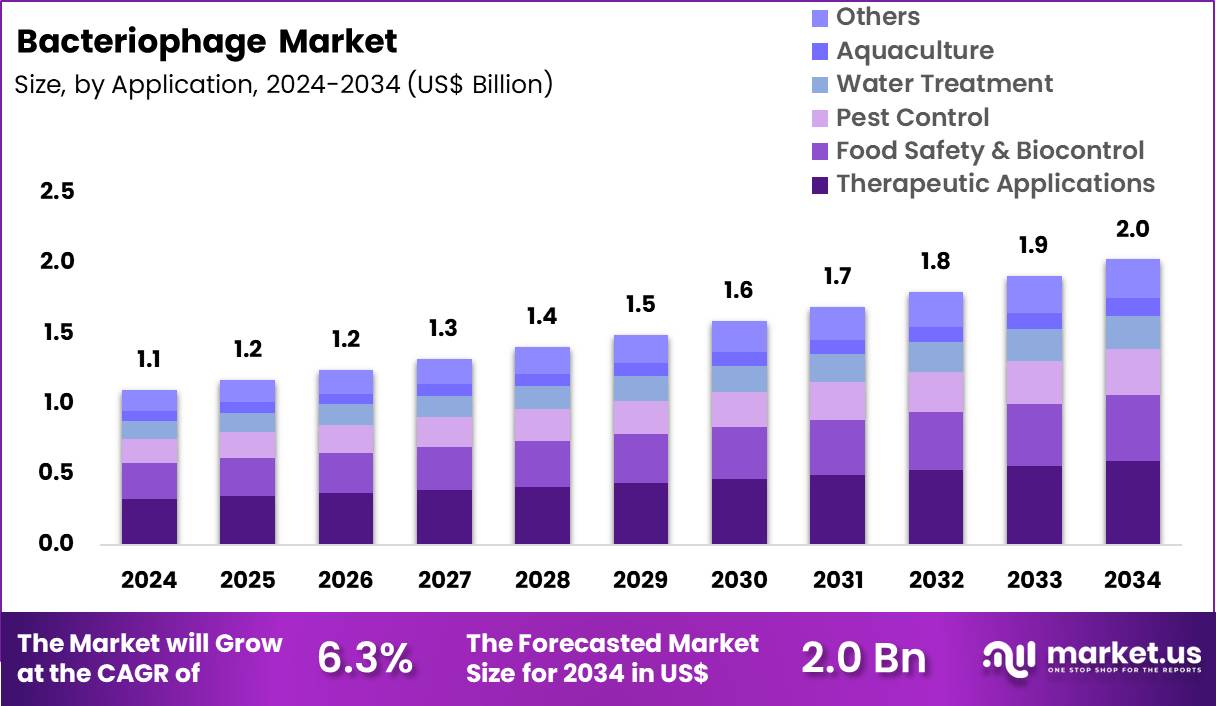
New York, NY – Sep 29, 2026 – The Global Bacteriophage Market size is expected to be worth around US$ 2.0 Billion by 2034 from US$ 1.1 Billion in 2024, growing at a CAGR of 6.3% during the forecast period 2025 to 2034. In 2024, North America led the market, achieving over 48.1% share with a revenue of US$ 529.1 Million.
Bacteriophages, commonly known as phages, are naturally occurring viruses that specifically infect and destroy bacteria. They are found in diverse environments, including soil, water, food, and the human microbiome. Unlike broad-spectrum antibiotics, bacteriophages generally target specific bacterial species or strains, making them an area of growing interest in precision approaches to bacterial control.
A typical bacteriophage attaches to a susceptible bacterial cell, introduces its genetic material, and uses the bacterial machinery to produce new phage particles. In the lytic cycle, the newly formed phages cause the bacterial cell to rupture, releasing additional phages that can infect nearby susceptible bacteria.
The increasing prevalence of antibiotic-resistant bacteria has accelerated research into bacteriophage-based applications. Phage therapy is being investigated as a potential option for managing difficult-to-treat bacterial infections, particularly where conventional antibiotic treatments may be less effective. Research is also exploring phage applications in food safety, agriculture, aquaculture, animal health, and biotechnology.
The bacteriophage market is being supported by advances in phage discovery, genetic engineering, formulation technologies, and diagnostic methods. However, challenges such as bacterial resistance to phages, host specificity, regulatory requirements, and manufacturing scalability remain important considerations. Continued research and clinical evaluation are expected to shape the future development and adoption of bacteriophage-based solutions.
Key Takeaways
- In 2024, the bacteriophage market generated US$ 1.1 billion in revenue and is projected to grow at a 6.3% CAGR, reaching US$ 2.0 billion by 2034.
- By type, the market is segmented into virulent (lytic), temperate (lysogenic), phage cocktails, phage-derived components, and genetically modified phages. Among these, virulent (lytic) phages dominated in 2024, accounting for 35.1% of the market.
- By application, the market is categorized into therapeutic applications, food safety & biocontrol, pest control, water treatment, aquaculture, and others. Therapeutic applications accounted for a significant 29.4% market share in 2024.
- By end-user industry, the market is segmented into healthcare, food processing, agriculture and crop protection, veterinary services and livestock farming, and biotechnology and laboratory research. The healthcare sector dominated the market, accounting for 34.5% of the total revenue share.
- North America dominated the global bacteriophage market in 2024, accounting for 48.1% of the market share.
Key Market Segments
- Type Analysis: Virulent or lytic bacteriophages held 35.1% of the market, supported by their targeted bacterial destruction and predictable activity. Their specificity, reduced risk of horizontal gene transfer, and growing relevance amid antimicrobial resistance continue to encourage research, clinical evaluation, and commercial development.
- Application Analysis: Therapeutic applications accounted for 29.4% of the bacteriophage market, driven by rising antimicrobial resistance and demand for targeted bacterial treatments. Growing clinical research, personalized phage therapy approaches, improved formulations, and increasing healthcare investment are supporting the adoption of bacteriophage-based therapeutic solutions.
- End-User Industry Analysis: Healthcare represented 34.5% of the bacteriophage market, supported by increasing demand for solutions against antibiotic-resistant infections. Clinical research, advanced bacterial diagnostics, hospital-based studies, and collaborations with biotechnology companies are strengthening phage therapy development and supporting broader adoption across healthcare settings.
Regional Analysis
North America dominated the global bacteriophage market in 2024, accounting for 48.1% of the market share. Regional growth has been supported by increasing antimicrobial resistance, expanding research into phage-based therapies, and favorable regulatory developments.
Applications across healthcare, food safety, animal health, and biotechnology are further strengthening market development. Collaborations between research institutions, biotechnology companies, and healthcare organizations are improving phage isolation, formulation, and production capabilities.
Asia Pacific is projected to register the highest CAGR during the forecast period, supported by the growing burden of antimicrobial resistance and increasing investments in healthcare research. Phage-based solutions are being explored for infectious diseases, aquaculture, agriculture, and food safety applications.
Government initiatives supporting local phage production and research are contributing to regional development. Biotechnology companies are also focusing on host-specific phages and phage-antibiotic combinations. Rising healthcare needs, expanding clinical research, and increasing awareness of alternative antimicrobial approaches are expected to create significant growth opportunities across the region.
Emerging Trends
- Increasing focus on phage therapy for antibiotic-resistant infections: The growing prevalence of drug-resistant bacteria is supporting research into bacteriophage-based treatments. Phages can specifically target bacteria, including some bacteria that no longer respond well to antibiotics. WHO identifies phage therapy as a potentially useful tool against AMR, although additional clinical evidence is still required for wider routine use.
- Shift toward personalized phage treatments: A major trend is the development of patient-specific or personalized phage therapy. Because phages are highly specific to their bacterial hosts, a patient’s bacterial strain may first need to be identified before a suitable phage or phage combination is selected. This approach is particularly relevant for difficult-to-treat and chronic infections. FDA also identifies individualized therapeutics as an emerging area requiring new approaches to manufacturing and clinical evidence.
- Growing development of phage cocktails: Instead of using a single phage, researchers and developers are increasingly examining phage cocktails, which contain multiple phages targeting the same or related bacterial pathogens. This approach can broaden bacterial coverage and may help address the problem of bacterial resistance to individual phages. WHO specifically identifies phage mixtures as an approach for targeting common infections.
- Greater regulatory and manufacturing focus: Regulatory frameworks for phage products are becoming more defined. The European Medicines Agency (EMA) has developed guidance covering the quality, manufacturing, control, characterization and stability of phage therapy medicinal products. EMA has also noted that phages have unique characteristics, including high specificity and the ability to evolve, which require specific regulatory considerations.
- Expansion from human healthcare toward One Health applications: The market is increasingly being considered beyond human medicine. WHO highlights potential applications across human health, veterinary medicine, agriculture, aquaculture and environmental management. This wider One Health approach could create additional commercial opportunities for phage-based products.
Use Cases
- Treatment of antibiotic-resistant human infections: Phage therapy is being investigated for infections caused by difficult-to-treat bacteria such as Staphylococcus aureus and Pseudomonas aeruginosa. It may be used alone or alongside antibiotics. Current use in many countries remains limited, with compassionate-use treatment being an important pathway while clinical evidence continues to develop.
- Chronic wounds and biofilm-related infections: Phages are being investigated for infections in which bacteria form biofilms, which can make conventional antibiotic treatment more difficult. This creates potential applications in chronic wounds and other persistent bacterial infections. Recent research has also examined phage therapy for diabetic foot ulcers, where resistant and biofilm-associated bacteria can be a major treatment challenge.
- Veterinary medicine: Phages can be used to target bacterial infections in livestock and companion animals. Their use could potentially reduce dependence on antibiotics in animal healthcare and thereby support efforts to control antimicrobial resistance. EMA has established specific guidance covering the quality, safety and efficacy of bacteriophages intended as veterinary medicines.
- Agriculture and food production: Phages can be applied to control bacterial pathogens affecting crops and food-producing animals. WHO identifies applications against bacteria such as Salmonella and E. coli in poultry and cattle, as well as bacterial diseases affecting crops such as tomatoes, peppers and potatoes. Phage-based approaches are therefore being explored as a way to reduce reliance on conventional chemical or antibiotic treatments.
- Aquaculture and environmental applications: In aquaculture, phages are being explored for controlling bacterial diseases and potentially reducing the use of antibiotics and chemicals. Other emerging applications include the potential use of phages for hospital-surface disinfection and wastewater treatment, although these areas remain less mature than therapeutic applications.
Frequently Asked Questions About Bacteriophage
- How do bacteriophages work?
Bacteriophages generally follow either lytic or lysogenic infection cycles. During the lytic cycle, phages replicate inside bacteria and eventually cause cell lysis. In the lysogenic cycle, phage genetic material integrates into the bacterial genome. - Are bacteriophages harmful to humans?
Bacteriophages primarily target bacteria and do not normally infect human cells. Their bacterial specificity has generated significant interest in therapeutic and biotechnology applications. However, their safety and effectiveness depend on the specific phage, formulation, administration route, and clinical context. - What are the major applications of bacteriophages?
Bacteriophages are being investigated and utilized across healthcare, food safety, agriculture, aquaculture, and biotechnology. Applications include targeted bacterial control, phage therapy, food preservation, pathogen detection, microbiome research, and development of phage-based antimicrobial products. - What are the limitations of bacteriophages?
Important limitations include narrow host range, bacterial resistance, challenges in formulation and manufacturing, immune responses, biological variability, and regulatory requirements. These factors can complicate standardization and clinical deployment, particularly when personalized phage selection is required. - What is driving the growth of the bacteriophage market?
Market growth is being supported by increasing antimicrobial resistance, rising research activity, demand for targeted antimicrobial solutions, expanding food safety applications, and growing pharmaceutical interest in phage-based therapies. Advancements in phage discovery and genetic engineering are also supporting commercialization. - How is antimicrobial resistance affecting the bacteriophage market?
Increasing antimicrobial resistance has intensified research into alternative and complementary antibacterial approaches. Bacteriophages are receiving attention because they can selectively target bacterial pathogens, including some drug-resistant strains, creating opportunities for therapeutic research and development. - What is the future outlook for the bacteriophage market?
The market outlook is supported by increasing antimicrobial resistance, expanding biotechnology research, growing interest in precision antimicrobials, and broader investigation across healthcare and non-healthcare applications. Future development is expected to depend substantially on clinical validation, regulatory progress, scalable manufacturing, and commercial adoption.
Conclusion
The bacteriophage market is positioned for steady growth, supported by rising antimicrobial resistance, increasing demand for targeted bacterial control, and expanding research across healthcare, food safety, agriculture, aquaculture, and biotechnology.
Virulent phages, therapeutic applications, and healthcare end users currently represent major market segments, while North America maintains a leading regional position. Advances in phage discovery, personalized therapies, phage cocktails, genetic engineering, and manufacturing are strengthening commercialization opportunities.
However, host specificity, phage resistance, regulatory complexity, and production scalability remain key challenges. Continued clinical validation, regulatory development, and technological innovation will be critical in determining the long-term adoption and commercial potential of bacteriophage-based solutions.
Discuss your needs with our analyst
Please share your requirements with more details so our analyst can check if they can solve your problem(s)




