


Overview
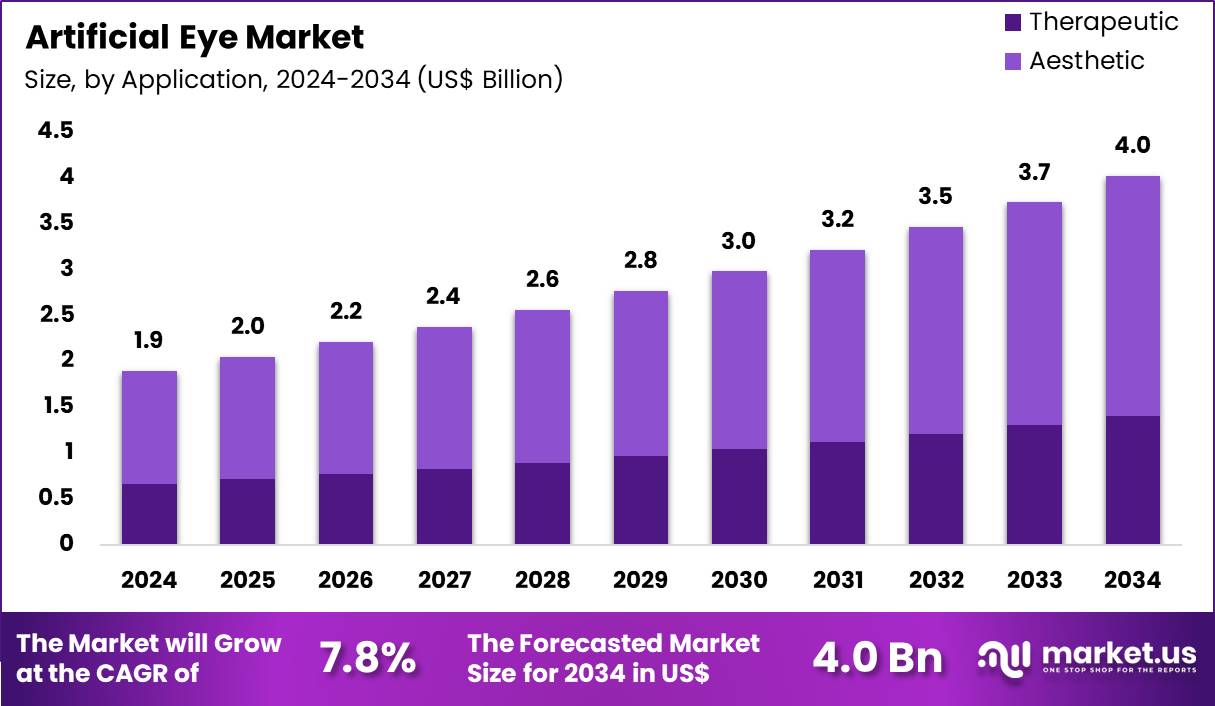
New York, NY – Sep 29, 2026 – The Global Artificial Eye Market size is expected to be worth around US$ 4.0 Billion by 2034 from US$ 1.9 Billion in 2024, growing at a CAGR of 7.8% during the forecast period 2025 to 2034. In 2024, North America led the market, achieving over 39.2% share with a revenue of US$ 744.8 Million.
The artificial eye market, also known as the ocular prosthesis market, is focused on devices designed to restore the appearance of an eye after eye loss, congenital conditions, trauma, or certain eye diseases. Artificial eyes are generally custom-fitted and are commonly manufactured from medical-grade acrylic, while glass options are also available. They are primarily intended for cosmetic and rehabilitative purposes and do not restore natural vision.
Demand for artificial eyes is supported by the need for facial rehabilitation following eye removal and by congenital conditions such as anophthalmia and microphthalmia. The National Eye Institute notes that children with these conditions may receive prosthetic eyes after the eye socket reaches an appropriate size, with replacement required as facial growth occurs.
A 2024 peer-reviewed study reported that approximately 0.1% of the global population wears a prosthetic eye, indicating a substantial patient population requiring ocular prosthetic services. Technology is becoming an important area of development.
Digital scanning, computer-aided design, image-based colour matching and 3D printing are being studied to improve personalization and reduce manufacturing time. In a 10-patient clinical demonstration, an automated 3D-printed approach required approximately five times less ocularist labour than the compared manual process.
Key Takeaways
- In 2024, the market generated US$ 1.9 billion in revenue and is projected to grow at a CAGR of 7.8%, reaching approximately US$ 4.0 billion by 2034.
- By type, the market is segmented into ocular prosthesis, prosthetic contact lens, scleral shell, conformer, and orbital prosthesis. Ocular prosthesis accounted for the largest share in 2024, representing 38.4% of the market.
- Based on application, the market is categorized into therapeutic and aesthetic applications. The therapeutic segment held a significant market share of 34.9% in 2024.
- By material, the market is segmented into acrylic/PMMA, silicone, and glass. Acrylic/PMMA dominated the market in 2024, accounting for the largest revenue share of 46.3%.
- By end user, the market is classified into hospitals, ophthalmology centers, and others. Hospitals represented the leading end-user segment, accounting for 54.7% of the market revenue in 2024.
- Regionally, North America dominated the market in 2024, accounting for the largest regional share of 39.2%.
Key Market Segments
- Type Analysis: Ocular prosthesis accounted for 38.4% of the Artificial Eye market, supported by its use after enucleation and evisceration procedures. Rising eye trauma, ocular tumors, and infections, along with improved customization, digital imaging, anatomical fitting, and rehabilitation awareness, continue to support segment growth.
- Application Analysis: Therapeutic applications represented 34.9% of the Artificial Eye market, supported by increasing demand for post-surgical care and ocular socket management. Artificial eye solutions assist recovery after eye removal procedures, while improved materials, clinical protocols, specialist training, and multidisciplinary care continue to strengthen adoption.
- Material Analysis: Acrylic or PMMA accounted for 46.3% of the Artificial Eye market, supported by its durability, lightweight properties, customization potential, and cost effectiveness. Strong polish retention, breakage resistance, stable appearance, and compatibility with manual and digital manufacturing processes further support its widespread clinical use.
- End-User Analysis: Hospitals held a 54.7% share of the Artificial Eye market, supported by their role in surgical eye care, prosthetic planning, and post-operative rehabilitation. Availability of ophthalmic specialists, diagnostic imaging, patient monitoring, and integrated treatment pathways contributes to continued hospital-based adoption.
Regional Analysis
North America
North America accounted for 39.2% of the global Artificial Eye market in 2024, supported by advanced ophthalmic care, growing awareness of ocular rehabilitation, and increasing demand for customized prostheses. Developments in biocompatible materials, digital imaging, 3D printing, and advanced prosthetic technologies are improving fitting, comfort, and cosmetic outcomes.
Strong healthcare infrastructure, specialist availability, research activities, and reimbursement support are also supporting market development. The region benefits from collaboration among hospitals, universities, and medical device companies, encouraging innovation in personalized ocular prosthetics and rehabilitation solutions.
Asia Pacific
The Asia Pacific Artificial Eye market is expected to register the highest CAGR during the forecast period, supported by increasing healthcare access, rising cases of vision loss, trauma, and diabetes-related eye conditions. Government initiatives, expanding ophthalmology services, and growing private healthcare investment are improving access to ocular prosthetics.
Manufacturers are increasingly focusing on affordable acrylic and silicone products, while training programs are strengthening specialist capabilities in fitting and rehabilitation. Rising healthcare expenditure and domestic manufacturing initiatives are expected to further support regional market expansion.
Emerging Trends
- 3D Printing and Digital Manufacturing: 3D printing is being developed to produce patient-specific ocular prostheses with greater consistency. Research has demonstrated automated design using eye imaging and 3D printing, potentially reducing manual production work.
- Personalized Eye Matching: Digital photographs and imaging are increasingly being used to reproduce the colour, iris pattern, sclera and shape of the patient’s healthy eye. This supports more individualized cosmetic results.
- Computer-Aided Design and Scanning: Digital scanning of the eye socket can support more accurate prosthesis design. This is gradually moving some parts of artificial-eye production from fully manual methods toward digital workflows.
- Advanced Materials: Medical-grade acrylic remains an established material for artificial eyes, while research is examining new polymers, silicone-based materials and other biocompatible materials for ocular and facial prosthetic applications.
- Greater Focus on Patient-Specific Rehabilitation: Artificial-eye services are increasingly being considered as part of broader reconstructive and psychological rehabilitation after eye loss. Comfort, appearance, movement and socket fit remain important factors in prosthetic design.
Use Cases
- Eye Loss After Surgery: Artificial eyes are used following procedures such as enucleation or evisceration, helping restore the visible appearance of the eye socket.
- Trauma-Related Eye Loss: Individuals who lose an eye because of accidents or other traumatic injuries may use an ocular prosthesis for cosmetic rehabilitation.
- Congenital Eye Conditions: Children with anophthalmia or microphthalmia may use prosthetic devices as part of orbital development and cosmetic rehabilitation.
- Eye Tumour Treatment: Eye removal can sometimes be required when an eye tumour cannot be treated conservatively. An artificial eye can subsequently be fitted after the socket has healed.
- Cosmetic Shell Applications: A cosmetic shell can be fitted over a damaged or smaller natural eye in selected patients, providing a more balanced external appearance.
Frequently Asked Questions About Artificial Eye
- Why is an artificial eye needed?
An artificial eye may be required after eye removal caused by trauma, disease, tumour or other medical conditions. It helps restore facial appearance and can support rehabilitation after eye loss by providing a carefully fitted replacement for the visible part of the eye. - What materials are used to make artificial eyes?
Artificial eyes are commonly manufactured from medical-grade acrylic. Some specialist centres also provide glass options. Modern research is examining additional polymers, silicone-based materials and digitally manufactured materials, with biocompatibility and surface safety remaining important considerations. - How long does an artificial eye last?
The replacement period varies according to age, socket condition, material, wear and individual circumstances. Children generally require more frequent replacement because their facial structures continue developing. The National Eye Institute notes that some children may need several replacements during childhood. - What is driving artificial eye market growth?
Market development is being supported by demand for cosmetic rehabilitation after eye loss, greater availability of specialist prosthetic services, advances in digital imaging and manufacturing, and research into customized 3D-printed prostheses. Eye trauma, congenital conditions and tumour-related eye removal also create clinical demand. - How is 3D printing changing the artificial eye market?
3D printing is introducing a more digital approach to artificial-eye production. Researchers have demonstrated workflows using imaging, automated design and full-colour printing to create customized prostheses. One 2024 study involving 10 patients reported substantially lower ocularist labour requirements compared with manual production. - Which technologies are emerging in artificial-eye manufacturing?
Emerging technologies include 3D scanning, optical coherence tomography, computer-aided design, automated shape modelling, colour-calibrated imaging and full-colour 3D printing. These technologies are being investigated to improve fit, appearance, production consistency and manufacturing efficiency while maintaining appropriate safety standards. - What healthcare sources support artificial-eye market analysis?
Reliable clinical information is available from organizations such as the National Eye Institute, National Artificial Eye Service and NHS specialist eye hospitals. Peer-reviewed research indexed through PubMed and available through PubMed Central also provides evidence on 3D printing, customization, materials and clinical applications.
Conclusion
The Artificial Eye market is expected to experience steady growth, supported by increasing demand for ocular rehabilitation, rising cases of eye trauma, congenital conditions, and surgical eye removal. Ocular prostheses remain the leading product segment, while therapeutic applications and acrylic/PMMA materials continue to hold significant market positions.
Hospitals represent the major end-user segment due to their established surgical and rehabilitation infrastructure. North America currently leads the global market, while Asia Pacific is expected to record strong growth during the forecast period.
Meanwhile, advances in 3D printing, digital imaging, computer-aided design, and customized prosthetic manufacturing are expected to improve fitting, personalization, production efficiency, and patient outcomes.
Discuss your needs with our analyst
Please share your requirements with more details so our analyst can check if they can solve your problem(s)




