


Overview
New York, NY – Sep 16, 2026 –The Global Advanced At-home Biomarker Testing Market size is expected to be worth around US$ 2.5 Billion by 2034 from US$ 1.2 Billion in 2024, growing at a CAGR of 7.6% during the forecast period 2025 to 2034. In 2024, North America led the market, achieving over 42.3% share with a revenue of US$ 0.5 Billion.
The Advanced At-home Biomarker Testing Market is rapidly developing as healthcare systems shift toward decentralized diagnostics, preventive care, and remote patient monitoring.
Advanced at-home biomarker tests allow users to measure biological indicators such as glucose, cholesterol, hormones, inflammatory markers, cardiac indicators, and genetic biomarkers without visiting hospitals or laboratories. Growing chronic disease prevalence and increasing consumer interest in self-monitoring are major factors supporting adoption.
According to the Centers for Disease Control and Prevention (CDC), approximately 38.4 million people in the United States had diabetes in 2021, representing about 11.6% of the total U.S. population, while around 97.6 million adults had prediabetes.
These high disease numbers are increasing demand for convenient glucose and metabolic biomarker monitoring solutions. The CDC also reports that more than 80% of people with prediabetes are unaware of their condition, highlighting the need for accessible early detection technologies.
The aging population is another major growth contributor. According to the United Nations, the global population aged 65 years and older reached 761 million in 2021 and is projected to increase to 1.6 billion by 2050, creating greater demand for continuous health monitoring and preventive diagnostics.
Digital health adoption is also supporting market expansion. The World Health Organization (WHO) states that noncommunicable diseases cause approximately 41 million deaths annually, accounting for nearly 74% of all global deaths, increasing the importance of early biomarker-based screening. Additionally, the NIH reports that wearable and remote monitoring technologies are increasingly being integrated into clinical research and chronic disease management.
Technological advancements in AI-based interpretation, smartphone-connected diagnostic devices, biosensors, and microfluidic platforms are improving test accuracy and accessibility. The global wearable device ecosystem has exceeded 1 billion connected devices, creating opportunities for integration with at-home biomarker monitoring platforms.
Rising healthcare costs, demand for personalized medicine, and consumer preference for home-based healthcare are expected to accelerate the adoption of advanced at-home biomarker testing solutions worldwide.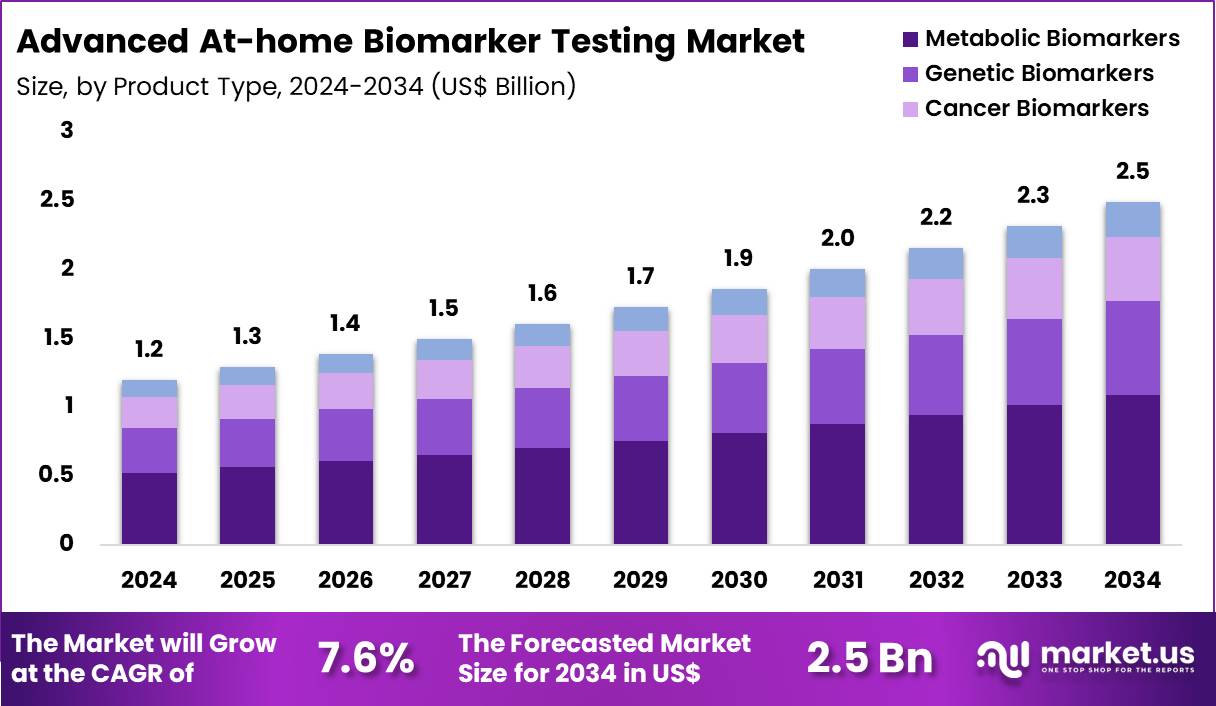
Key Takeaways
- In 2024, the Advanced At-home Biomarker Testing Market generated revenue of US$ 1.2 billion and is projected to grow at a CAGR of 7.6%, reaching approximately US$ 2.5 billion by 2034.
- Based on product type, the market is categorized into metabolic biomarkers, genetic biomarkers, cancer biomarkers, and hormonal biomarkers. Among these, metabolic biomarkers dominated in 2024, accounting for the largest market share of 43.7%.
- Based on technology, the market is segmented into immunoassays (ELISA), polymerase chain reaction (PCR), next-generation sequencing (NGS), and lateral flow assays (LFA). The immunoassays (ELISA) segment held a significant market share of 40.6% in 2024.
- Based on application, the market is divided into diabetes & metabolic disorders, cardiovascular diseases, cancer, and autoimmune diseases. The diabetes & metabolic disorders segment emerged as the leading application area, capturing the highest revenue share of 45.1%.
- Based on sample type, the market is segmented into blood, urine, saliva, and buccal swab samples. The blood sample segment dominated the market, accounting for a revenue share of 51.6% in 2024.
- Regionally, North America dominated the Advanced At-home Biomarker Testing Market in 2024, holding the largest market share of 42.3%.
Market Segmentation Overview
- Product Type Analysis: Metabolic biomarkers accounted for 43.7% of the market in 2024 and are expected to maintain dominance due to rising cases of obesity, diabetes, and hypertension. Increasing demand for preventive healthcare, regular monitoring, and early disease detection is driving adoption. At-home tests for glucose, lipid profiles, and insulin levels offer convenience, supporting continued growth of this segment.
- Technology Analysis: Immunoassays (ELISA) held a 40.6% market share in 2024 and are projected to remain a leading technology due to their high sensitivity, accuracy, and ability to detect multiple biomarkers. Growing adoption of affordable home diagnostic kits for metabolic, cancer, and autoimmune testing, along with improved user-friendly ELISA platforms, is strengthening market demand.
- Application Analysis: Diabetes & metabolic disorders dominated with a 45.1% revenue share in 2024 due to increasing prevalence of type 2 diabetes, obesity, and metabolic syndrome. Rising demand for regular glucose, cholesterol, and health monitoring solutions is encouraging home-based testing. Growing focus on personalized healthcare and chronic disease management further supports segment expansion.
- Sample Type Analysis: Blood samples accounted for 51.6% of the market share in 2024, making them the leading sample type due to their accuracy and ability to measure multiple biomarkers. Increasing adoption of minimally invasive blood collection methods and continuous glucose monitoring devices is driving growth. Blood-based testing remains preferred for metabolic and cardiovascular health monitoring applications.
Statistical Information
- Diabetes Prevalence Is Driving Demand for At-home Metabolic Biomarker Testing: The growing burden of diabetes is increasing demand for at-home metabolic biomarker testing, particularly for blood glucose and HbA1c monitoring. According to the CDC, 40.1 million people in the United States (12.0% of the population) had diabetes in 2023, while 11.0 million adults were living with undiagnosed diabetes, creating a strong need for convenient home-based diagnostic solutions.
- More Than 115 Million U.S. Adults Have Prediabetes: Early detection is a major opportunity for advanced at-home biomarker testing. The CDC reports that 115.2 million U.S. adults have prediabetes, and 8 in 10 adults are unaware of their condition, highlighting the importance of accessible metabolic biomarker screening outside traditional healthcare settings.
- Telemedicine Adoption Supports At-home Biomarker Testing: Remote healthcare is accelerating home diagnostics. A CDC study found that 52.8% of adults with diagnosed diabetes and 47.6% of adults with diagnosed prediabetes used telemedicine during the previous 12 months, supporting greater integration of at-home biomarker testing with virtual care.
- Diabetes Risk Increases Significantly With Age: The CDC reports that 31.3 million Americans aged 65 years and older have prediabetes, representing 52.1% of that age group. This aging population is expected to increase demand for routine at-home biomarker monitoring and chronic disease management.
- Most People With Prediabetes Can Prevent Disease Progression: The CDC states that participation in the National Diabetes Prevention Program can reduce the risk of developing type 2 diabetes by 58%, and by 71% among adults aged over 60 years, reinforcing the value of early biomarker testing and preventive monitoring.
- Total Diabetes Prevalence Continues to Increase: According to the CDC National Center for Health Statistics, 15.8% of U.S. adults had total diabetes during August 2021–August 2023, including 11.3% diagnosed diabetes and 4.5% undiagnosed diabetes, increasing demand for accurate home-based diagnostic technologies.
- WHO Estimates One in Eight People Worldwide Lives With Obesity: According to the World Health Organization, 1 in 8 people globally were living with obesity in 2022, with over 2.5 billion adults aged 18 years and older classified as overweight, including 890 million adults with obesity. This trend is increasing demand for metabolic biomarker testing.
Regional Analysis
North America led the market by securing a market share of 42.3% in 2024.
North America accounted for 42.3% of the Advanced At-home Biomarker Testing Market in 2024, driven by strong healthcare infrastructure, increasing adoption of digital health technologies, and a high burden of chronic diseases.
According to the Centers for Disease Control and Prevention (CDC), 40.1 million Americans (12.0% of the population) had diabetes in 2023, while 115.2 million adults had prediabetes, increasing demand for regular at-home biomarker monitoring. The region has also witnessed rapid expansion of telehealth and remote patient monitoring, encouraging the use of home diagnostic kits.
The U.S. Food and Drug Administration (FDA) continues to authorize innovative home-use diagnostic devices, improving access to reliable testing solutions. Rising consumer awareness of preventive healthcare, growing adoption of wearable health technologies, favorable reimbursement policies, and the presence of leading diagnostics companies continue to strengthen the regional market. These factors collectively maintain North America’s leadership in the Advanced At-home Biomarker Testing Market.
Business Opportunities
The Advanced At-home Biomarker Testing Market offers significant business opportunities as healthcare increasingly shifts toward preventive, personalized, and remote care. Companies can expand their portfolios by developing AI-powered diagnostic platforms, smartphone-connected testing kits, and multi-biomarker panels capable of detecting metabolic, cardiovascular, hormonal, and cancer-related conditions from a single sample.
Growing adoption of telehealth creates opportunities for integrating home test results with electronic health records and virtual consultations. Subscription-based wellness monitoring services and recurring test programs can generate stable revenue streams while improving customer retention. Expanding regulatory approvals for home-use diagnostics and increasing consumer preference for convenient healthcare solutions support market entry for innovative manufacturers.
Partnerships between diagnostic companies, healthcare providers, pharmacies, insurers, and digital health platforms can accelerate commercialization and distribution. In addition, rising demand across aging populations and chronic disease patients presents opportunities to introduce affordable, easy-to-use testing solutions, while expansion into emerging economies with improving healthcare infrastructure offers long-term growth potential.
Emerging Trends
- Expansion of FDA-Authorized Home Diagnostics: The U.S. FDA continues to authorize more home-use diagnostic devices for chronic and infectious diseases, increasing access to convenient testing. These approvals are expanding the availability of accurate at-home biomarker testing for millions of consumers.
- Growing Adoption of Wearable Health Technologies: According to the NIH, advanced wearable sensors can generate over 250,000 physiological measurements per person each day, supporting continuous monitoring of biomarkers such as heart rate, temperature, and activity for personalized healthcare.
- Increasing Use of AI in Home Diagnostics: The FDA is supporting AI-enabled diagnostic technologies that improve result interpretation, automate data analysis, and connect home test results with healthcare providers, making biomarker testing faster and more reliable.
- Rising Demand for Multi-Biomarker Testing: The U.S. Department of Health and Human Services (HHS) is investing in technologies capable of measuring multiple biomarkers from a single blood, saliva, or sweat sample, reducing testing time and improving disease screening efficiency.
- Growth of Remote Patient Monitoring: According to the CDC, 40.1 million Americans had diabetes in 2023, increasing demand for connected home biomarker testing integrated with telehealth and remote patient monitoring platforms for chronic disease management.
Use Cases
- Diabetes Monitoring at Home: According to the CDC, 40.1 million Americans (12.0% of the population) had diabetes in 2023. At-home biomarker testing enables regular monitoring of glucose and HbA1c levels, helping patients manage diabetes and reduce unnecessary hospital visits.
- Cardiovascular Risk Assessment: The CDC reports that 48.1% of U.S. adults (about 120 million people) have hypertension. Home biomarker tests measuring cholesterol and other cardiovascular indicators support early detection and continuous monitoring of heart health.
- Cancer Screening and Monitoring: According to the National Cancer Institute (NIH), an estimated 2,001,140 new cancer cases were expected in the United States in 2024. Advanced at-home biomarker tests can assist in early detection and post-treatment monitoring under healthcare provider guidance.
- Remote Monitoring for Older Adults: The National Institute on Aging (NIH) estimates that 6.9 million Americans aged 65 and older were living with Alzheimer’s disease in 2024. At-home biomarker testing supports regular health monitoring, reducing the need for frequent clinic visits.
- Personalized Preventive Healthcare: The WHO reports that 41 million people die from noncommunicable diseases every year, accounting for 74% of global deaths. Home biomarker testing helps individuals track health indicators early, supporting preventive care and personalized wellness management.
Recent Development
- In 2026, Abbott Laboratories continued expanding its FreeStyle Libre digital ecosystem by strengthening connectivity features for remote patient monitoring and diabetes management. The company also advanced integration of continuous glucose monitoring with digital health platforms to support personalized at-home biomarker testing.
- In 2026, Roche Diagnostics expanded deployment of its cobas® Mass Spectrometry (i 601) platform, targeting an installed base of 100 systems by the end of 2026 while increasing its menu of high-value analytes to improve precision diagnostics and biomarker testing capabilities.
- In 2026, Thermo Fisher Scientific, Inc. continued investing in advanced molecular diagnostics, laboratory automation, and precision medicine solutions, enhancing decentralized testing capabilities and supporting faster biomarker analysis across clinical and research laboratories.
- In 2026, bioMérieux SA strengthened its in vitro diagnostics portfolio by expanding automated diagnostic solutions and digital laboratory technologies, supporting faster infectious disease detection and improving efficiency in clinical biomarker testing workflows.
- In 2026, DiaSorin S.p.A. showcased its expanded diagnostics portfolio at ADLM 2026, highlighting 200+ biomarkers across clinical chemistry, molecular diagnostics, and OEM reagents to strengthen laboratory and precision diagnostic capabilities.
- In 2026, Becton Dickinson & Co. (BD) continued expanding its diagnostics and specimen management portfolio by introducing workflow improvements designed to increase laboratory efficiency and support decentralized healthcare testing initiatives.
Frequently Asked Questions on Advanced At-home Biomarker Testing
- What factors are driving the growth of the Advanced At-home Biomarker Testing Market?
The market is growing due to the increasing prevalence of chronic diseases, rising demand for preventive healthcare, technological advancements in digital diagnostics, expanding telehealth services, and growing consumer preference for convenient home-based testing that enables continuous health monitoring and early disease detection. - Which technology dominates the Advanced At-home Biomarker Testing Market?
Immunoassays (ELISA) held the largest technology share of 40.6% in 2024. Their high sensitivity, accuracy, affordability, and ability to detect multiple biomarkers make them widely used in at-home diagnostic kits for metabolic, autoimmune, infectious, and hormonal disease testing. - Which application segment holds the largest market share?
Diabetes and metabolic disorders represent the largest application segment, accounting for 45.1% of market revenue in 2024. Increasing cases of diabetes, obesity, and metabolic syndrome are encouraging consumers to adopt at-home biomarker testing for routine disease monitoring and management. - Which sample type is most commonly used in the market?
Blood is the leading sample type, holding 51.6% of the market in 2024. Blood-based testing provides accurate measurement of glucose, cholesterol, hormones, and other biomarkers, making it the preferred choice for chronic disease monitoring and preventive healthcare. - Which region leads the Advanced At-home Biomarker Testing Market?
North America led the market with a 42.3% share in 2024. The region benefits from advanced healthcare infrastructure, widespread adoption of digital health technologies, increasing chronic disease prevalence, strong reimbursement policies, and high consumer awareness of preventive healthcare. - Who are the major players in the Advanced At-home Biomarker Testing Market?
Key companies operating in the market include Abbott Laboratories, Roche Diagnostics, Thermo Fisher Scientific, Inc., bioMérieux SA, DiaSorin S.p.A., Becton Dickinson & Co. (BD), Bio-Rad Laboratories, Inc., and Ortho Clinical Diagnostics, all focusing on innovation in home diagnostics and biomarker technologies. - What are the future opportunities in the Advanced At-home Biomarker Testing Market?
Future opportunities include AI-enabled diagnostic platforms, multi-biomarker testing panels, wearable-integrated health monitoring, telehealth connectivity, subscription-based wellness testing, and expansion into emerging healthcare markets, supported by increasing demand for personalized and decentralized healthcare solutions.
Conclusion
The Advanced At-home Biomarker Testing Market is positioned for steady growth as healthcare continues shifting toward preventive, personalized, and decentralized care. Rising cases of chronic diseases, increasing consumer awareness of health monitoring, and advancements in digital diagnostics are driving adoption of reliable home-based testing solutions. Innovations in AI, wearable technologies, and connected diagnostic platforms are improving test accuracy, convenience, and accessibility.
North America remains the leading regional market, while Asia Pacific is expected to witness the fastest growth due to expanding healthcare infrastructure and digital health adoption. Continuous product innovation and supportive regulatory developments are expected to create significant long-term opportunities for market participants.
Discuss your needs with our analyst
Please share your requirements with more details so our analyst can check if they can solve your problem(s)




