


Overview
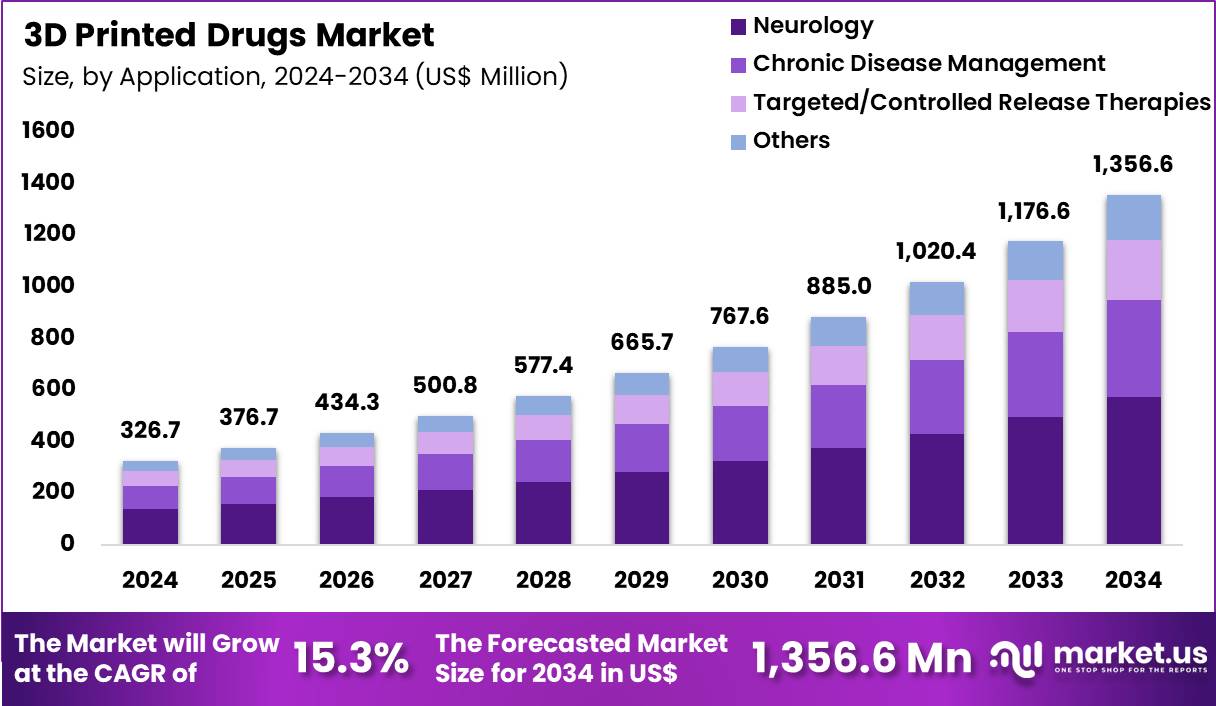
New York, NY – Sep 28, 2026 – The Global 3D Printed Drugs Market size is expected to be worth around US$ 1356.6 Million by 2034 from US$ 326.7 Million in 2024, growing at a CAGR of 15.3% during the forecast period 2025 to 2034. In 2024, North America led the market, achieving over 38.1% share with a revenue of US$ 124.5 Million.
3D printed drugs are pharmaceutical products manufactured using additive manufacturing technology, in which medicines are built layer by layer from a digital design. Unlike conventional mass production, 3D printing can provide greater flexibility in drug dose, shape, size, structure and release pattern. This makes the technology particularly relevant to personalized medicine and patient-specific treatment.
The first FDA-approved 3D-printed medicine was Spritam (levetiracetam), approved in 2015. FDA documents describe the product as using a novel 3D-printing process to manufacture highly porous tablets designed for rapid dispersion in the mouth.
The technology is now being studied for personalized doses, multi-drug tablets, controlled-release medicines, pediatric and geriatric formulations, and point-of-care manufacturing. Recent research also focuses on 3D-printed polypills that can contain several active pharmaceutical ingredients in one dosage form.
Regulatory interest is also increasing. In March 2026, the European Medicines Agency published questions and answers on implementing 3D-printing technology for solid oral dosage forms, highlighting its potential for patient-centered and personalized medicines.
Key Takeaways
- In 2024, the market generated US$ 326.7 million in revenue and is projected to grow at a CAGR of 15.3%, reaching approximately US$ 1,356.6 million by 2034.
- By technology, the market is segmented into binder jet/inkjet printing, extrusion-based printing, powder-bed fusion/laser-based methods, stereolithography (SLA)/photopolymerisation, and others. Binder jet/inkjet printing dominated in 2024, accounting for 34.5% of the market.
- Based on application, the market is categorized into neurology, chronic disease management, targeted/controlled release therapies, and others. The neurology segment held the largest share in 2024, accounting for 42.2%.
- By end user, the market is segmented into pharmaceutical manufacturers, hospitals & clinics, and others. Pharmaceutical manufacturers accounted for the leading 48.8% revenue share in 2024.
- Regionally, North America dominated the global market in 2024, accounting for 38.1% of the total market share.
Key Market Segments
- Technology Analysis: Binder jet or inkjet printing held a 34.5% market share in 2024, supported by precise drug deposition, controlled dosing, and efficient material use. Its suitability for heat-sensitive ingredients, formulation flexibility, and potential for scalable production makes it increasingly relevant for personalized and complex drug formulations.
- Application Analysis: Neurology accounted for 42.2% of the market in 2024, supported by the need for precise dosing and customized drug-release profiles. Growing research into epilepsy, Parkinson’s disease, and other neurological disorders is increasing interest in personalized 3D-printed medicines and advanced drug-delivery solutions.
- End-User Analysis: Pharmaceutical manufacturers held a 48.8% market share in 2024, driven by investments in drug development, personalized formulations, and controlled-release technologies. Their strong research capabilities, manufacturing resources, regulatory expertise, and partnerships with technology providers support continued adoption of 3D printing across pharmaceutical development and production.
Regional Analysis
North America accounted for 38.1% of the global 3D Printed Drugs market in 2024, supported by advanced pharmaceutical research, strong regulatory capabilities, and increasing interest in personalized medicine. Pharmaceutical companies and research institutions are developing 3D-printed formulations for precise dosing, controlled drug release, and multi-drug therapies.
Growing investments in advanced manufacturing and digital pharmaceutical technologies are also supporting market development. In addition, collaborations between technology providers, pharmaceutical companies, and academic institutions are accelerating product innovation. Triastek obtained four FDA IND clearances for 3D-printed drugs between 2022 and 2024, highlighting increasing regulatory activity in the region.
Asia Pacific is expected to register the highest CAGR during the forecast period, driven by pharmaceutical innovation, expanding healthcare infrastructure, and increasing demand for personalized medicines. Countries such as China are strengthening research and manufacturing capabilities through investments in advanced drug-delivery technologies.
Partnerships between universities, pharmaceutical companies, and technology providers are supporting the development of 3D-printed formulations. Triastek reported that China’s NMPA had granted five IND clearances for 3D-printed products by March 2023, reflecting growing regulatory activity in the region.
Emerging Trends
- Growing Focus on Personalized Medicines: 3D printing is increasingly being researched for producing medicines according to individual patient requirements. Dose strength, tablet shape, size and drug-release characteristics can potentially be adjusted using digital designs, supporting the broader shift toward personalized healthcare.
- Development of 3D-Printed Polypills: A major emerging trend is the development of polypills, where multiple medicines are incorporated into one tablet. Different layers or compartments can be designed to provide immediate, delayed or sustained release, potentially simplifying complex treatment schedules.
- Integration of Artificial Intelligence: Artificial intelligence and computational methods are increasingly being investigated alongside 3D printing. These technologies can help optimize formulation parameters, predict drug-release behavior, assess printability and support quality-control processes.
- Movement Toward Point-of-Care Manufacturing: Research is examining the possibility of producing personalized medicines closer to the patient, including in hospitals and pharmacies. Recent research has also demonstrated approaches for rapid, non-destructive verification of personalized 3D-printed medicines in hospital environments.
- Increasing Regulatory Attention: Regulatory frameworks are becoming an important market-development factor. The EMA published dedicated 3D-printing questions and answers in March 2026, while the FDA has established a broader Advanced Manufacturing Technologies Designation Program for innovative pharmaceutical manufacturing technologies.
Use Cases
- Personalized Dosage: 3D printing can be used to manufacture drug products with different strengths and physical characteristics. This may support patients requiring doses that are difficult to obtain through standard commercially manufactured tablets.
- Multi-Drug Polypills: Multiple active pharmaceutical ingredients can potentially be incorporated into one printed dosage form. Separate compartments and layers can also be designed to provide different release rates, which is particularly relevant to patients taking several medicines.
- Pediatric Medicines: Children can have different dosing and swallowing requirements compared with adults. 3D printing provides the flexibility to investigate customized doses, shapes and sizes that may be better suited to pediatric patients.
- Controlled and Sustained Drug Release: The internal geometry, porosity and material structure of a printed dosage form can be modified to influence how quickly a drug is released. This capability is being studied for immediate, delayed and sustained drug-delivery systems.
- Hospital and Pharmacy-Based Production: Future applications may include localized production of patient-specific medicines in hospitals or pharmacies. Such models could support individualized formulations and on-demand production, although regulatory, quality-control and manufacturing requirements remain important considerations.
Frequently Asked Questions About 3D Printed Drugs
- What was the first FDA-approved 3D printed drug?
Spritam, a levetiracetam medicine manufactured by Aprecia Pharmaceuticals, became the first FDA-approved 3D printed drug. FDA review documents describe its highly porous tablet structure, which was designed to disperse rapidly in the mouth when taken. - How are drugs produced using 3D printing?
3D printed medicines are generally produced from a digital design using techniques such as inkjet printing, binder jetting, fused deposition modeling, stereolithography and related processes. The selected technique depends on drug properties, materials, dosage form and required release characteristics. - Can 3D printing produce personalized drug doses?
Yes. One major research application is personalized dosing. Digital manufacturing can potentially adjust drug loading, tablet dimensions and formulation structure according to patient requirements. However, personalized production must still meet appropriate pharmaceutical quality, safety and regulatory requirements. - Can multiple medicines be included in one 3D printed tablet?
Yes. Research has demonstrated 3D-printed polypills containing multiple active ingredients in different layers or compartments. These structures can potentially provide different release patterns within one dosage form and may help simplify complex medication schedules. - What are the major technologies used in 3D printed drugs?
Important technologies include fused deposition modeling, inkjet printing, binder jetting, selective laser sintering and stereolithography. Each technology offers different capabilities related to material selection, drug loading, resolution, manufacturing temperature and control over the final dosage form. - What are the main market opportunities?
Major opportunities include personalized medicines, pediatric and geriatric formulations, multi-drug polypills, controlled-release products and point-of-care manufacturing. These applications address limitations of conventional standardized dosage forms by providing greater flexibility in formulation and product design. - What role will regulations play in market development?
Regulation will remain important because pharmaceutical 3D printing must demonstrate product quality, safety, performance and manufacturing control. The EMA’s March 2026 guidance-related Q&A shows increasing regulatory attention toward implementing 3D printing for solid oral dosage forms. - Which patient groups could benefit from 3D printed medicines?
Potentially relevant groups include pediatric and geriatric patients, people requiring customized doses, and patients taking multiple medicines. Research indicates that individualized dosage, tablet dimensions, drug combinations and release profiles could address some challenges associated with complex treatment regimens.
Conclusion
The 3D Printed Drugs market is positioned for strong growth, supported by increasing demand for personalized medicines, precise dosing, controlled drug release, and multi-drug formulations. The market is projected to expand from US$326.7 million in 2024 to US$1,356.6 million by 2034, reflecting a 15.3% CAGR.
Binder jet or inkjet printing, neurology applications, and pharmaceutical manufacturers represented leading market segments in 2024. North America currently holds a significant market position, while Asia Pacific is expected to record the fastest growth. Continued technological development, regulatory progress, pharmaceutical investments, and adoption of patient-centric manufacturing are expected to support future market expansion.
Discuss your needs with our analyst
Please share your requirements with more details so our analyst can check if they can solve your problem(s)




