


Overview
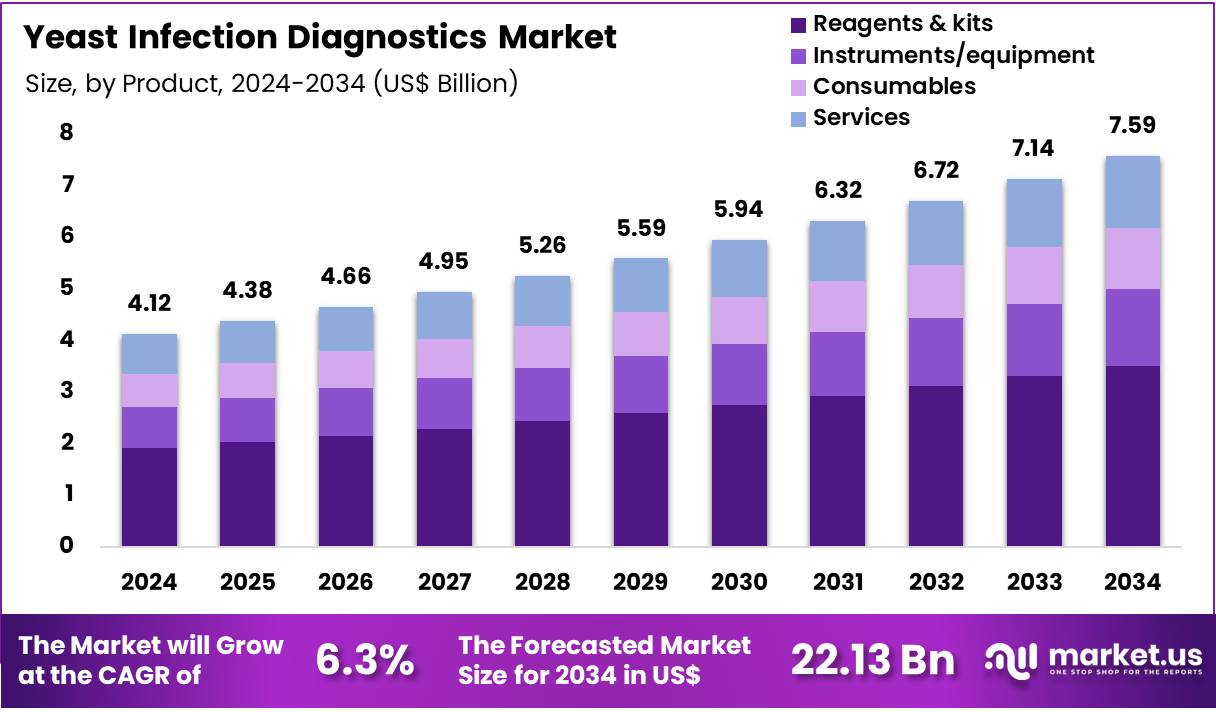
New York, NY – Sep 01, 2026 –Global Yeast Infection Diagnostics Market size is expected to be worth around US$ 7.59 Billion by 2034 from US$ 4.12 Billion in 2024, growing at a CAGR of 6.3% during the forecast period 2025 to 2034. In 2024, North America led the market, achieving over 41.5% share with a revenue of US$ 1.71 billion.
The global Yeast Infection Diagnostics market is witnessing steady growth as healthcare providers increasingly focus on early and accurate diagnosis of fungal infections. Rising cases of vaginal candidiasis, oral thrush, invasive candidiasis, and hospital-acquired fungal infections are driving demand for advanced diagnostic technologies.
Growing awareness of antimicrobial resistance and the increasing number of immunocompromised patients have accelerated the adoption of rapid molecular diagnostics, polymerase chain reaction (PCR)-based assays, fungal culture techniques, microscopy, and antigen detection tests. Hospitals and diagnostic laboratories continue to invest in automated diagnostic platforms that reduce turnaround time and improve diagnostic accuracy.
Yeast infections affect millions of people each year. According to the U.S. Centers for Disease Control and Prevention (CDC), approximately 1.4 million people worldwide develop invasive candidiasis annually, while the mortality rate ranges between 30% and 60% in severe bloodstream infections despite treatment. In addition, nearly 75% of women experience at least one vaginal yeast infection during their lifetime, and about 40%–45% experience two or more episodes.
Continuous technological innovations, increasing healthcare expenditure, and supportive public health initiatives are expected to strengthen market expansion over the coming decade. As demand for rapid, reliable, and cost-effective fungal diagnostics grows, manufacturers are focusing on developing highly sensitive diagnostic solutions that enable timely treatment decisions and improve patient outcomes worldwide.
Key Takeaways
- In 2024, the Yeast Infection Diagnostics market generated US$ 4.12 billion in revenue and is projected to reach US$ 7.59 billion by 2034, expanding at a CAGR of 6.3% during the forecast period.
- By Product, the market is segmented into Reagents & Kits, Instruments/Equipment, Consumables, and Services. Reagents & Kits dominated the segment in 2024, accounting for 46.3% of the market share
- By Test Type, the market includes Culture-based Diagnostics, Molecular Diagnostics, Immunological Diagnostics, and Point-of-Care Tests. Culture-based Diagnostics held the largest share at 36.9% in 2024.
- By Indication, the market is categorized into Vulvovaginal Candidiasis, Trichomoniasis, Chlamydia, Gonorrhea, and Bacterial Vaginosis. Vulvovaginal Candidiasis emerged as the leading segment with a 55.2% market share in 2024.
- Based on the pathogen, the market is segmented into Candida albicans, Candida glabrata, Candida rugosa, and Others. Candida albicans dominated the market, capturing 71.4% of the total market share in 2024.
- By End User, the market comprises Hospitals, Diagnostic Laboratories, Clinics & Ambulatory Care Centers, and Point-of-Care Settings. Hospitals led the segment with a 43.7% market share in 2024.
- North America emerged as the leading regional market, accounting for 41.5% of the global Yeast Infection Diagnostics market in 2024.
Market Segmentation Analysis
- Product Analysis: Reagents & kits led the product segment with 46.3% market share in 2024. Their dominance comes from routine use in culture, molecular, and immunological testing. Continuous consumption, standardized diagnostic workflows, and new high-sensitivity Candida detection kits continue to strengthen demand across hospitals and diagnostic laboratories.
- Test Type Analysis: Culture-based diagnostics accounted for 36.9% of the market in 2024. They remain the preferred method because they enable species identification and antifungal susceptibility testing. Their affordability, widespread availability, and strong support in clinical guidelines sustain their leading position in yeast infection diagnosis.
- Indication Analysis: Vulvovaginal candidiasis captured 55.2% of the market due to its high prevalence among women. Frequent recurrent infections, increasing awareness, routine gynecological testing, and growing use of multipathogen vaginitis panels continue to drive strong demand for accurate Candida diagnostic testing worldwide.
- Pathogen Analysis: Candida albicans dominated the pathogen segment with 71.4% market share in 2024. It remains the most commonly detected species because it causes most mucosal yeast infections. Established diagnostic methods, predictable treatment response, and widespread clinical occurrence continue supporting its market leadership.
- End-User Analysis: Hospitals held the largest end-user share at 43.7% in 2024. They perform high volumes of yeast infection testing, from routine vulvovaginal cases to invasive candidiasis. Advanced laboratory infrastructure, larger patient populations, and antimicrobial stewardship programs reinforce their dominant position in diagnostics.
Statistical Information
- Molecular PCR assay achieved 94.8% sensitivity for detecting Candida auris colonization in a multicenter clinical evaluation published in 2026.
- The same multicenter study reported 98.7% specificity, demonstrating a very low false-positive rate for the molecular diagnostic assay.
- Overall diagnostic accuracy of the Simplexa Candida auris Direct assay reached 98.6% during prospective clinical testing.
- The molecular assay produced diagnostic results in less than 2 hours, substantially reducing turnaround time compared with conventional culture methods.
- The assay demonstrated a 127 CFU/mL limit of detection for Candida auris Clade I isolates.
- For Clade IV isolates, the same assay achieved a 260 CFU/mL analytical limit of detection.
- Discordant diagnostic results occurred in only 1.4% of tested specimens, indicating strong agreement with conventional laboratory methods.
Regional Analysis
North America leads the Yeast Infection Diagnostics Market due to its well-established healthcare infrastructure, widespread availability of advanced laboratory testing, and high awareness of fungal infections among healthcare professionals and patients. The region benefits from strong adoption of molecular diagnostics, rapid antigen tests, and automated laboratory systems that enable faster and more accurate detection of yeast infections.
A robust reimbursement framework and continuous investment in diagnostic research further support market growth. In 2025, the World Health Organization highlighted the global shortage of diagnostic tools for invasive fungal diseases, reinforcing the importance of innovation in fungal diagnostics. Rising cases of candidiasis, particularly among immunocompromised individuals, continue to drive demand across hospitals and diagnostic laboratories.
Asia-Pacific is expected to register the fastest growth during the forecast period. Expanding healthcare infrastructure, increasing diagnostic accessibility, improving awareness of fungal infections, and the growing prevalence of diabetes, cancer, and other immunocompromising conditions are accelerating demand.
Large underdiagnosed patient populations and ongoing investments in healthcare modernization create significant opportunities for yeast infection diagnostic manufacturers across emerging economies such as China and India.
Business Opportunities
The Yeast Infection Diagnostics Market presents strong business opportunities as healthcare providers increasingly prioritize early, accurate, and rapid fungal infection detection. One major opportunity lies in developing rapid molecular diagnostic kits, particularly PCR-based assays, as the World Health Organization (WHO) highlighted in 2025 that many countries still lack access to reliable fungal diagnostic testing, creating demand for affordable and point-of-care solutions.
Another promising area is antifungal susceptibility testing, driven by the U.S. Centers for Disease Control and Prevention (CDC), which reports that over 90% of Candida auris isolates are resistant to fluconazole, increasing the need for laboratories to guide targeted therapy.
Companies can also expand AI-enabled diagnostic platforms that improve laboratory efficiency and diagnostic accuracy, especially as the CDC recorded 6,304 clinical Candida auris cases in 2024. In addition, manufacturers have opportunities to supply low-cost diagnostic systems for emerging economies where fungal diagnostic capacity remains limited.
Finally, growing hospital infection-control programs and surveillance initiatives, supported by the CDC’s estimate of 25,000 candidemia cases annually in the United States, are creating sustained demand for screening, monitoring, and laboratory diagnostic solutions across healthcare facilities.
Emerging Trends
- Growing demand for antifungal resistance testing: Healthcare laboratories are increasingly performing species identification and antifungal susceptibility testing because drug-resistant Candida infections are rising. According to the CDC (2025), over 90% of Candida auris isolates are resistant to fluconazole, making accurate diagnostic testing essential before selecting treatment.
- Higher adoption of molecular diagnostic methods: Hospitals are expanding the use of PCR and other molecular diagnostic tools because traditional laboratory methods can misidentify Candida auris. The CDC reported 6,304 clinical C. auris cases in 2024, increasing demand for rapid and highly accurate molecular identification in healthcare facilities.
- Increased surveillance in healthcare settings: Healthcare systems are strengthening routine screening and laboratory surveillance for high-risk patients. CDC surveillance shows approximately 25,000 candidemia cases occur annually in the United States, encouraging hospitals to improve diagnostic capacity and infection monitoring programs.
- Greater focus on diagnosing non-albicans Candida species: Diagnostic laboratories are increasingly identifying non-albicans Candida species because treatment responses vary. CDC data indicate that about two-thirds of bloodstream Candida infections are caused by non-albicans species, encouraging broader species-level testing instead of relying only on conventional culture identification.
- Integration of diagnostic stewardship with antimicrobial stewardship: Hospitals are linking laboratory diagnostics with antifungal stewardship programs to reduce inappropriate therapy. The CDC recommends diagnostic testing and susceptibility testing because approximately 5% of invasive Candida glabrata infections already show resistance to one or more antifungal drugs.
Use Cases
- Diagnosis of recurrent vaginal yeast infections: Clinicians increasingly use laboratory testing to confirm recurrent vulvovaginal candidiasis instead of relying only on symptoms. CDC estimates 75% of women experience at least one infection during their lifetime, while 40–45% experience two or more episodes.
- Rapid identification of hospital-acquired Candida infections: Hospitals use rapid diagnostic tests to identify bloodstream Candida infections in critically ill patients, enabling earlier treatment decisions. CDC estimates around 25,000 candidemia cases each year in the United States, making timely laboratory diagnosis a clinical priority.
- Screening patients for Candida auris outbreaks: Healthcare facilities screen patients who are transferred between hospitals or long-term care centers to prevent outbreaks. CDC reported 6,304 clinical C. auris cases during 2024, highlighting the importance of routine laboratory screening in infection-control programs.
- Selecting effective antifungal therapy: Clinical laboratories perform antifungal susceptibility testing to help physicians choose the most effective medicine. According to the CDC, less than 1% of Candida auris isolates are resistant to echinocandins, supporting their use as first-line therapy in many confirmed infections.
- Species identification for precision diagnosis: Modern diagnostic platforms identify the exact Candida species because treatment differs between organisms. CDC data show up to 95% of Candida bloodstream infections are caused by five major species, making species-level identification valuable for improving clinical outcomes.
Recent Developments
- In January 2025, Abbott Laboratories received additional regulatory clearances and expanded its Alinity molecular and infectious disease testing portfolio, improving laboratory efficiency and supporting faster pathogen detection in clinical microbiology laboratories.
- In February 2025, Thermo Fisher Scientific Inc. announced the acquisition of Solventum’s Purification & Filtration business for approximately US$4.1 billion, strengthening its bioprocessing and life science portfolio that supports diagnostic and microbiology workflows.
- In 2025, Siemens Healthineers AG continued expanding its Atellica laboratory diagnostics portfolio with new assay availability and automation enhancements, helping laboratories improve infectious disease testing throughput and workflow integration.
- In April 2025, bioMérieux SA launched new microbiology and antimicrobial susceptibility testing solutions that enhance fungal and microbial identification workflows used in hospital laboratories.
Frequently Asked Questions Yeast Infection Diagnostics
- Why is the yeast infection diagnostics market growing?
The yeast infection diagnostics market is expanding because of the increasing number of fungal infections, rising awareness about early diagnosis, growing use of rapid molecular testing, and continuous improvements in laboratory technologies that provide faster and more accurate diagnostic results. - Which diagnostic methods are commonly used for yeast infections?
Healthcare providers commonly use microscopic examination, fungal culture, PCR-based molecular testing, MALDI-TOF mass spectrometry, and antifungal susceptibility testing. The choice of method depends on the infection site, patient condition, laboratory capability, and the need for rapid identification. - Which patients are most likely to require yeast infection diagnostics?
People with weakened immune systems, diabetes, prolonged antibiotic use, cancer treatment, organ transplants, or recurrent vaginal yeast infections are more likely to require diagnostic testing. Hospitalized patients with suspected invasive fungal infections also frequently undergo laboratory confirmation. - Which region leads the yeast infection diagnostics market?
North America currently leads the yeast infection diagnostics market due to its advanced healthcare infrastructure, widespread adoption of molecular diagnostic technologies, high awareness of fungal diseases, strong research funding, and favorable regulatory support for innovative diagnostic products. - What technologies are shaping the future of yeast infection diagnostics?
Emerging technologies include real-time PCR, multiplex molecular panels, next-generation sequencing, automated microbiology systems, MALDI-TOF identification, artificial intelligence-assisted laboratory workflows, and rapid point-of-care testing, all helping laboratories improve diagnostic speed, sensitivity, and efficiency. - How does early diagnosis improve patient outcomes?
Early diagnosis enables physicians to begin targeted antifungal therapy sooner, reducing disease progression, hospitalization time, treatment costs, and complications. Accurate identification also helps prevent unnecessary medication use and supports better antimicrobial stewardship in healthcare settings. - What are the future opportunities in the yeast infection diagnostics market?
Future opportunities include expanding molecular diagnostic adoption, developing affordable point-of-care tests, integrating laboratory automation and digital health platforms, improving rapid antifungal resistance detection, and increasing diagnostic availability across emerging healthcare markets with growing infectious disease burdens.
Conclusion
The yeast infection diagnostics market is expected to witness steady growth as healthcare providers increasingly emphasize early and accurate detection of fungal infections. Rising cases of candidiasis, expanding awareness of antimicrobial resistance, and greater adoption of molecular diagnostics and point-of-care testing are driving market demand.
Reagents and kits remain the leading product segment due to their frequent use in routine diagnostic workflows, while hospitals continue to be the primary end users because of their advanced laboratory capabilities.
North America maintains market leadership with strong healthcare infrastructure and high diagnostic adoption, whereas Asia-Pacific is projected to register the fastest growth due to improving healthcare access and increasing investments in diagnostic services.
Continuous product innovation, automation, and rapid identification technologies are expected to improve diagnostic accuracy and turnaround times. Overall, the market offers significant opportunities for companies developing cost-effective, rapid, and highly sensitive diagnostic solutions to address the growing global burden of yeast infections.
Discuss your needs with our analyst
Please share your requirements with more details so our analyst can check if they can solve your problem(s)




