


Overview
New York, NY – Sep 11, 2026 – The Global Wet Wipes Canister Market size is expected to be worth around US$ 5.06 Billion by 2034 from US$ 2.85 Billion in 2024, growing at a CAGR of 5.9% during the forecast period 2025 to 2034. In 2024, North America led the market, achieving over 38.4% share with a revenue of US$ 1.09 Billion.
The global Wet Wipes Canister Market is expanding due to rising hygiene awareness, increasing healthcare requirements, and growing demand for convenient cleaning solutions. Wet wipes packaged in canisters provide better moisture protection, controlled dispensing, and longer shelf life, making them widely used in households, hospitals, commercial facilities, and personal care applications. The market is supported by increased adoption of disinfectant and cleansing products after the COVID-19 pandemic, with hygiene becoming a regular consumer priority.
According to the World Health Organization (WHO), effective hygiene practices, including proper cleaning and disinfection, play a critical role in preventing infections. Healthcare-associated infections affect millions of patients globally each year, increasing the need for reliable cleaning products in hospitals and clinical environments. The global healthcare sector includes more than 270,000 hospitals and healthcare facilities, creating significant demand for medical-grade wipes and infection-control products.
The rising global population is another key growth factor. The United Nations (UN) estimates that the world population reached approximately 8.1 billion people in 2024, increasing demand for personal care and household hygiene products. Urbanization is also accelerating product adoption, with more than 4.5 billion people living in urban areas worldwide in 2024, supporting demand for convenient hygiene solutions.
Manufacturers are increasingly focusing on sustainable canister designs, including recyclable packaging and biodegradable wipe materials. Environmental concerns are influencing product innovation, as consumers and businesses seek alternatives to traditional plastic-based hygiene products.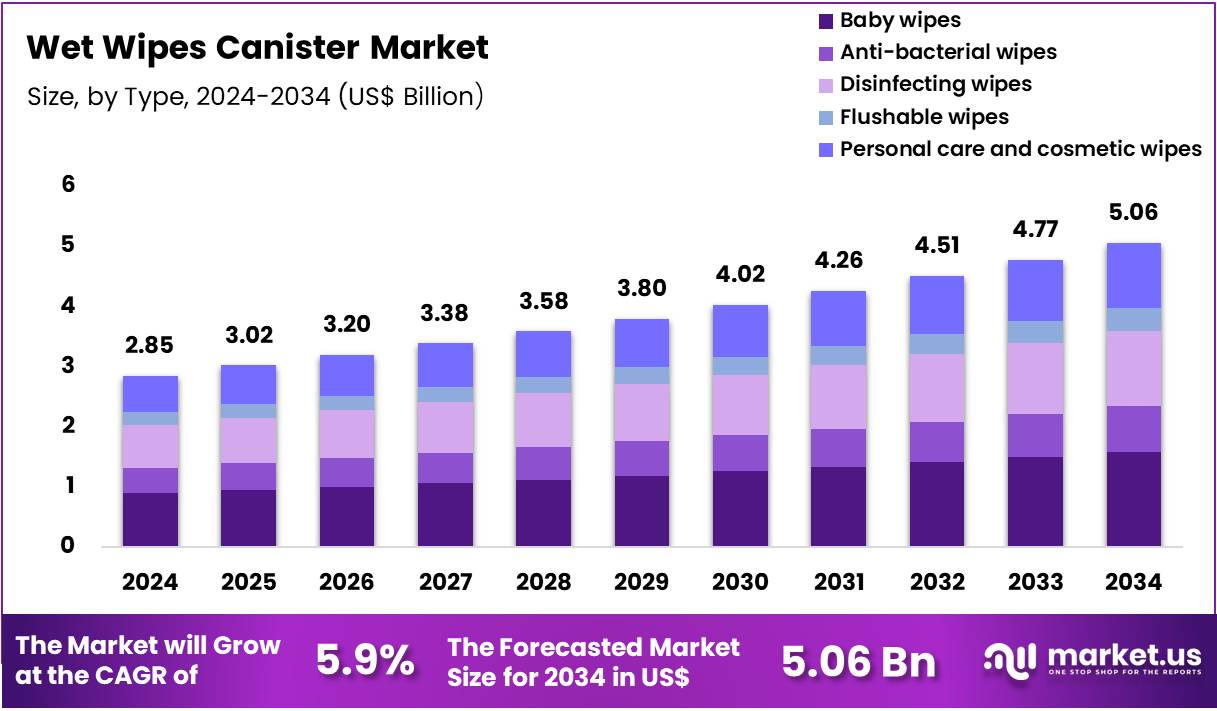
Key Takeaways
- In 2024, the Wet Wipes Canister Market generated revenue of US$ 2.85 billion and is projected to grow at a CAGR of 5.9%, reaching approximately US$ 5.06 billion by 2034.
- The Type segment includes Baby wipes, Anti-bacterial wipes, Disinfecting wipes, Flushable wipes, and Personal care and cosmetic wipes. Among these, Baby wipes dominated the market in 2024, accounting for a 31.2% market share.
- The Material Type segment comprises Non-woven fabrics, Woven fabrics, and Cross-fold materials. Non-woven fabrics held the leading position in 2024, capturing a market share of 71.2% due to their durability, softness, and high absorbency.
- The Distribution Channel segment is categorized into Supermarkets, Online stores, Convenience stores, and Pharmacies. Supermarkets emerged as the leading distribution channel in 2024, representing 44.2% of the market share.
- North America dominated the Wet Wipes Canister Market in 2024, holding a 38.4% market share, supported by high consumer awareness, strong retail networks, and increasing demand for hygiene products.
Statistical Information
- Baby Wipes Demand Supported by Continuous Births and Infant Care Requirements: The Baby wipes segment remains one of the largest applications in wet wipes due to regular infant hygiene needs. In the United States, the CDC reported 3,596,017 births in 2023, representing a birth rate of 10.7 births per 1,000 population. The continuous number of newborns supports demand for baby wipes used for diaper changes, skin cleaning, and daily infant care.
- Healthcare-Associated Infection Prevention Driving Disinfecting Wipe Adoption: Hospitals and healthcare facilities are increasing the use of disinfecting wipes due to the ongoing need for infection control. The CDC reports that approximately 1 in 31 hospitalized patients develops at least one healthcare-associated infection (HAI) on any given day. Earlier CDC surveillance estimated approximately 687,000 HAIs occurred in U.S. acute-care hospitals, resulting in about 72,000 patient deaths during hospitalization, highlighting the importance of surface disinfection solutions.
- Supermarkets Continue to Influence Hygiene Product Purchasing Behavior: Supermarkets remain a major distribution channel for wet wipes because consumers prefer immediate availability of household and personal care products. According to the U.S. Census Bureau, U.S. retail e-commerce sales represented 15.9% of total retail sales in Q1 2024, meaning approximately 84.1% of retail sales occurred through non-e-commerce channels, including supermarkets, pharmacies, and physical stores.
- Online Distribution Channels Expanding for Wet Wipes and Personal Care Products: Online purchasing is becoming an important channel for hygiene products due to convenience, subscription services, and home delivery options. During the first four months of 2024, U.S. consumers spent approximately US$331.6 billion through online retail channels, representing a 7% year-over-year increase, demonstrating continued growth in digital shopping behavior.
- Urban Population Growth Supporting Demand for Convenient Hygiene Products: Urbanization is increasing demand for portable and easy-to-use hygiene products such as wet wipes. According to United Nations population data, more than 4.5 billion people worldwide live in urban areas, representing over 55% of the global population. Higher urban lifestyles, smaller living spaces, and convenience-focused consumption patterns are supporting adoption of disposable hygiene products.
- Growing Elderly Population Supporting Adult Care Wipes Demand: The aging population is increasing the need for adult hygiene products, including cleansing wipes used in elderly care. According to the United Nations, the global population aged 65 years and older reached approximately 800 million people in 2024 and is projected to exceed 1.6 billion by 2050. This demographic shift is increasing demand for healthcare and personal hygiene products.
- Healthcare Expenditure Growth Supporting Medical Wipe Demand: Higher healthcare spending is increasing investments in infection prevention products, including medical disinfectant wipes. According to the Centers for Medicare & Medicaid Services (CMS), U.S. national healthcare expenditure reached approximately US$4.9 trillion in 2023, accounting for nearly 17.6% of GDP. Growing healthcare investments support demand for hospital hygiene products.
- Increasing Hospital Admissions Supporting Demand for Medical Cleaning Wipes: Growing hospital activity is increasing the requirement for infection-control products, including disinfecting wet wipes. According to the American Hospital Association (AHA), hospitals in the United States recorded approximately 33.4 million inpatient admissions in 2022 across more than 6,100 hospitals, creating continuous demand for healthcare cleaning and sanitation products.
- Increasing Pet Ownership Supporting Pet Cleaning Wipe Demand: Rising pet ownership is creating new applications for wet wipes in animal care and cleaning. According to the American Veterinary Medical Association (AVMA), approximately 66% of U.S. households owned a pet in 2024, representing about 86.9 million households and supporting demand for pet hygiene products.
- Rising Global Travel Supporting Portable Wet Wipes Demand: Growth in passenger travel is increasing demand for convenient hygiene products such as travel-size wet wipes. According to the International Civil Aviation Organization (ICAO), global scheduled air passenger traffic reached approximately 4.7 billion passengers in 2024, representing a 7.9% increase compared with 2023. Increased travel activity supports demand for portable personal hygiene solutions
Regional Analysis
North America led the market by securing a market share of 38.4% in 2024.
North America remains a major market for wet wipes canisters due to strong consumer adoption, advanced healthcare infrastructure, and strict hygiene practices across hospitals, schools, workplaces, and public facilities. The CDC recommends regular cleaning and disinfection of frequently touched surfaces to reduce the spread of infectious pathogens, supporting demand for disinfecting wipes.
The region also benefits from established personal care and household product manufacturers investing in sustainable materials, biodegradable fibers, and improved packaging solutions. Rising demand for eco-friendly wipes and convenient hygiene formats continues to support market expansion. Asia Pacific is expected to witness strong growth due to increasing urbanization, improving healthcare facilities, rising hygiene awareness, and expanding consumer spending on personal care products.
The United Nations reports that Asia has some of the world’s largest urban populations, increasing demand for convenient hygiene solutions. Growth in childcare, hospitality, healthcare, and retail sectors is further supporting adoption of baby wipes, cosmetic wipes, and household cleaning wipes.
Emerging Trends
- Growth of Sustainable and Biodegradable Wet Wipes Canisters: Manufacturers are increasingly developing eco-friendly wet wipes using plant-based fibers, recyclable containers, and plastic-free materials. Environmental concerns are influencing product innovation as governments focus on reducing plastic waste. In the UK, more than 30 billion wet wipes were placed on the market in 2021, with around 26 billion containing plastic materials, increasing demand for sustainable alternatives.
- Rising Demand for Disinfecting Wipes After Hygiene Awareness Growth: Consumer preference for disinfecting wet wipes remains strong due to increased awareness of infection prevention in homes, offices, schools, and healthcare facilities. Government health agencies continue recommending proper cleaning and disinfection practices, supporting demand for convenient canister-based wipe solutions with easy access and controlled dispensing.
- Expansion of Plant-Based Non-Woven Materials: The wet wipes industry is shifting from synthetic fibers toward cellulose-based and renewable materials such as viscose and wood-pulp fibers. Research highlights that traditional wipes commonly use petroleum-based fibers, encouraging manufacturers to adopt bio-based materials to reduce environmental impact and improve sustainability performance.
- Increasing Adoption of Refillable and Recyclable Canister Packaging: Brands are investing in refill packs and recyclable canister designs to reduce packaging waste. Consumers are showing greater interest in products with lower environmental impact, while regulatory pressure against single-use plastics is accelerating packaging improvements. In 2025, UK government regulations targeted plastic-containing wet wipes due to pollution concerns.
- Growing Use of Wet Wipes in Healthcare and Institutional Cleaning: Hospitals, clinics, laboratories, and public facilities increasingly use pre-moistened wipes in canisters for surface cleaning and infection control. Healthcare environments require fast, disposable cleaning solutions to maintain hygiene standards, especially for frequently touched surfaces and patient-care areas. Research continues evaluating wipe materials and contamination risks.
Use Cases
- Baby Care and Infant Hygiene Applications: Baby wipes represent a major consumer application because parents prefer convenient, skin-friendly, and portable hygiene products. Wet wipes canisters provide controlled dispensing, moisture retention, and easy storage at homes and childcare facilities. Demand is increasing for fragrance-free, sensitive-skin, and plant-based baby wipe products.
- Household Surface Cleaning and Disinfection: Wet wipes canisters are widely used for kitchen counters, electronics, bathrooms, and high-contact household surfaces. During and after the COVID-19 period, consumers increased focus on routine sanitation. Government hygiene guidance emphasizes regular cleaning of frequently touched surfaces to reduce exposure to harmful microorganisms.
- Personal Care and Cosmetic Applications: Cosmetic wipes stored in canisters are increasingly used for makeup removal, facial cleansing, and personal hygiene. Consumers are shifting toward products containing gentle ingredients, alcohol-free formulas, and sustainable fibers. The beauty industry is also focusing on recyclable packaging and reduced environmental impact solutions.
- Commercial and Workplace Hygiene Solutions: Offices, gyms, hotels, restaurants, and educational institutions use wet wipe canisters for quick cleaning of shared equipment and surfaces. Growing workplace hygiene requirements support adoption of easy-access dispensers. Environmental agencies reported that waste concerns are encouraging businesses to shift toward plastic-free wipe alternatives.
- Travel and On-the-Go Hygiene Applications: Compact wet wipe canisters are increasingly used by travelers due to convenience, portability, and multipurpose cleaning benefits. Products designed for outdoor activities, transportation, and personal hygiene provide quick sanitation solutions. Consumer demand is rising for lightweight packaging combined with recyclable materials and longer shelf stability.
Frequently Asked Questions on Wet Wipes Canister
- What materials are commonly used for wet wipes production?
Wet wipes are mainly produced using non-woven fabrics such as polypropylene, polyester, viscose, and cellulose fibers. Non-woven materials are preferred due to their softness, absorbency, strength, and cost-effectiveness, while sustainable fibers are gaining popularity due to environmental concerns. - What factors are driving growth of the Wet Wipes Canister Market?
Growth is supported by increasing hygiene awareness, rising demand for convenient cleaning products, expanding baby care needs, and wider usage in healthcare and commercial facilities. The shift toward biodegradable materials and sustainable packaging is also encouraging product innovation. - How is sustainability impacting the Wet Wipes Canister Market?
Sustainability is influencing manufacturers to develop biodegradable wipes, recyclable canisters, and plastic-free alternatives. Environmental regulations and consumer awareness about waste reduction are encouraging companies to adopt renewable materials and improve packaging designs for lower environmental impact. - Which distribution channels are important for wet wipes canisters?
Major distribution channels include supermarkets, online stores, convenience stores, and pharmacies. Supermarkets provide strong product visibility and bulk purchasing options, while online platforms are growing due to convenience, subscription services, wider product choices, and home delivery options. - What are the major applications of wet wipes canisters?
Wet wipes canisters are used in baby care, household cleaning, healthcare, personal care, hospitality, offices, and travel sectors. Their convenient dispensing system and moisture protection make them suitable for environments requiring quick and efficient hygiene solutions. - Why is North America a significant region for the Wet Wipes Canister Market?
North America has strong demand due to high hygiene awareness, advanced retail infrastructure, healthcare cleaning requirements, and consumer preference for convenient products. The region also supports innovation in disinfecting wipes, biodegradable materials, and sustainable packaging solutions. - Are biodegradable wet wipes replacing traditional wipes?
Biodegradable wet wipes are gaining popularity as consumers and companies focus on sustainability. Manufacturers are replacing plastic-based fibers with plant-derived materials such as cellulose and bamboo. However, factors such as cost, durability, performance, and disposal methods influence adoption. - What role does e-commerce play in wet wipes canister sales?
E-commerce channels are expanding market access by offering multiple brands, subscription purchasing options, and convenient delivery services. Consumers can easily compare products, purchase specialized wipes, and access sustainable alternatives through online retail platforms.
Conclusion
The Wet Wipes Canister Market is experiencing steady growth due to increasing hygiene awareness, rising demand for convenient cleaning solutions, and expanding applications across baby care, healthcare, personal care, and household sectors. Sustainable innovation, including biodegradable fibers, recyclable canisters, and eco-friendly materials, is becoming a major focus among manufacturers.
North America remains a key market due to strong consumer adoption and hygiene standards, while Asia Pacific shows significant growth potential. Future market expansion will be supported by product innovation, changing consumer preferences, e-commerce growth, and increasing demand for effective and environmentally responsible hygiene products.
Discuss your needs with our analyst
Please share your requirements with more details so our analyst can check if they can solve your problem(s)




