


Overview
New York, NY – Sep 04, 2026 – The Viral RNA Extraction Kit Market Size is expected to be worth around US$ 460.6 Million by 2034 from US$ 240.8 Million in 2024, growing at a CAGR of 6.7% during the forecast period 2025 to 2034. North America held a dominant market position, capturing more than a 39.3% share and holding US$ 94.6 Million market value for the year.
The global Viral RNA Extraction Kit market is witnessing strong demand as molecular diagnostics, infectious disease surveillance, and research laboratories increasingly rely on high-quality RNA isolation for accurate testing.
Viral RNA extraction kits play a critical role in preparing clinical and environmental samples for downstream applications such as RT-PCR, real-time PCR, next-generation sequencing (NGS), and other nucleic acid-based diagnostic techniques. Their widespread use in detecting respiratory viruses, hepatitis viruses, influenza, dengue, and other viral infections continues to support market expansion.
The market is benefiting from rising investments in molecular diagnostics, expanding laboratory infrastructure, and the growing adoption of automated extraction platforms that improve workflow efficiency and minimize contamination risks. Healthcare institutions, diagnostic laboratories, pharmaceutical companies, and research organizations are also increasing the use of magnetic bead-based and column-based extraction technologies to achieve higher RNA purity and recovery rates.
Numerically, more than 70% of molecular diagnostic workflows require a nucleic acid extraction step before amplification, while real-time RT-PCR remains the gold-standard method for viral RNA detection across clinical laboratories worldwide. Automated extraction systems can process 24 to 96 samples per run, significantly reducing turnaround time compared with manual methods.
Furthermore, the increasing number of molecular testing laboratories and expanding genomic surveillance programs are expected to create sustained demand for advanced Viral RNA Extraction Kits. Continuous product innovation, improved reagent stability, and integration with automated diagnostic platforms are expected to strengthen market growth throughout the coming years.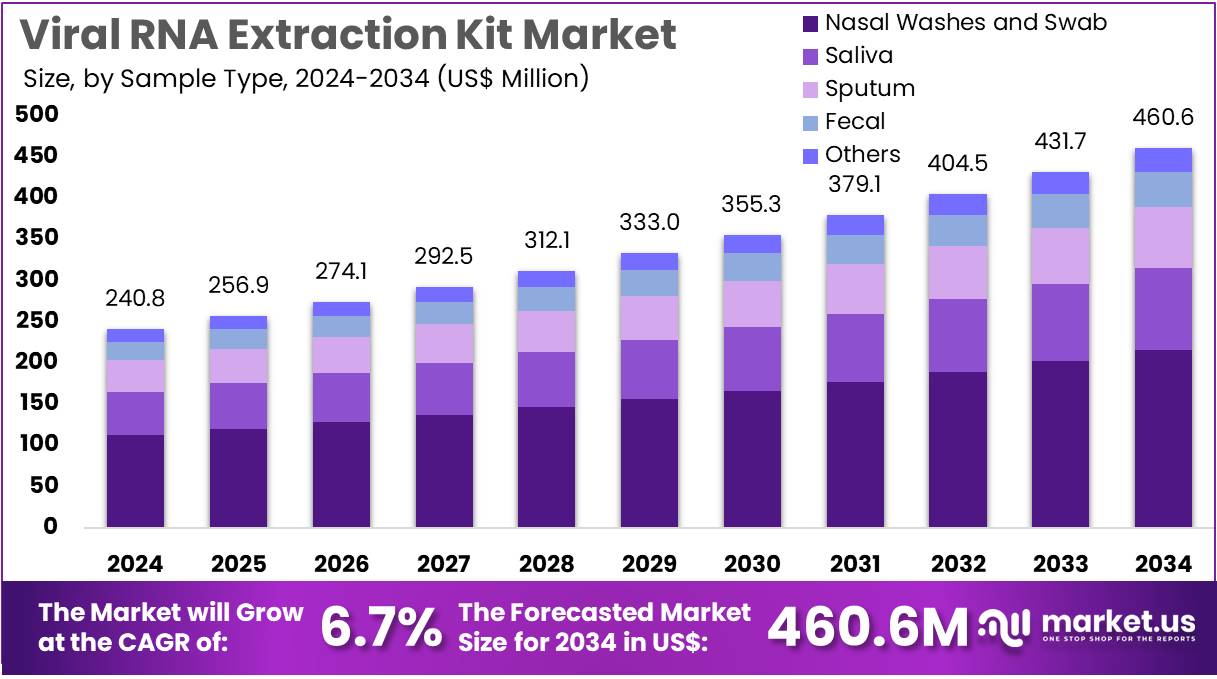
Key Takeaways
- The global Viral RNA Extraction Kit market was valued at US$ 240.8 million in 2024 and is projected to reach US$ 460.6 million by 2034, expanding at a CAGR of 6.7% during the forecast period.
- By sample type, the market is segmented into nasal washes & swab, saliva, sputum, fecal, and others. Among these, the nasal washes & swab segment dominated the market in 2024, accounting for a 46.8% share.
- Based on application, the market is categorized into disease diagnosis, drug discovery, cDNA library, cancer research, and others. The disease diagnosis segment emerged as the leading application, capturing 53.1% of the market in 2024.
- In terms of end users, the market comprises hospitals, pharmaceutical & biotechnology companies, forensic laboratories, diagnostic laboratories, clinical research organizations, and academic & research institutes. Hospitals held the largest market share, representing 41.5% of the total revenue in 2024.
- North America dominated the global Viral RNA Extraction Kit market in 2024, securing the largest regional share of 39.3%.
Market Segmentation
- Product Type Analysis: The nasal washes & swab segment accounted for 46.8% of the market in 2024, driven by its high viral RNA recovery and widespread use in respiratory infection testing. These samples support accurate molecular diagnostics, automated extraction workflows, and large-scale disease surveillance, making them the preferred choice across hospitals, laboratories, and public health programs.
- Application Analysis: The disease diagnosis segment held 53.1% of the market in 2024 due to growing demand for rapid and accurate viral detection. Viral RNA extraction kits are essential for PCR and sequencing workflows, enabling early diagnosis of infectious diseases. Expanding molecular testing, outbreak preparedness, and automation continue to strengthen segment growth.
- End-User Analysis: The hospitals segment captured 41.5% of the market in 2024, supported by high volumes of viral diagnostic testing across emergency, inpatient, and outpatient settings. Hospitals increasingly adopt automated RNA extraction systems to improve testing efficiency, accelerate clinical decision-making, and strengthen infection control during seasonal outbreaks and public health emergencies.
Statistical Information
- Beckman Coulter’s viral RNA extraction workflow supports automated processing in a 96-well format, enabling high-throughput laboratory operations.
- Beckman Coulter provides workflow configurations capable of processing 24, 96, or 192 RNA extractions per run depending on laboratory automation setup.
- EpigenTek’s EpiMag 96-Well Viral RNA Extraction Kit can process 96 samples simultaneously within 30 minutes, supporting rapid high-throughput molecular testing.
- Thermo Fisher’s PureLink Viral RNA/DNA Mini Kit accepts sample input volumes of up to 500 µL and can elute purified nucleic acid in volumes as low as 10 µL.
- The PureLink Pro 96 Viral RNA/DNA Kit operates with centrifugation speeds as low as 2,250 × g, reducing equipment requirements for laboratories.
- QIAGEN’s QIAamp Viral RNA Mini Kit achieves more than 90% RNA recovery while completing a purification run in approximately 20–40 minutes.
- QIAGEN’s standard protocol uses 140 µL sample input and produces an RNA elution volume of 50 µL, while the 96-well version elutes in 80 µL.
- Promega’s Maxwell HT Viral TNA Kit is supplied in a 4 × 96-preparation format and is compatible with multiple automated liquid-handling platforms for large-scale viral RNA extraction.
- New England Biolabs’ Monarch Mag Viral DNA/RNA Extraction Kit is available in 100-, 600-, and 1,800-preparation formats and supports both manual processing and 96-well automated workflows.
Regional Analysis
North America Regional Analysis
North America dominated the Viral RNA Extraction Kit market in 2024, accounting for 39.3% of global revenue. The region’s leadership is supported by advanced molecular diagnostics infrastructure, widespread automation, and strong public health surveillance programs.
The U.S. Centers for Disease Control and Prevention (CDC) continues to expand the National Wastewater Surveillance System (NWSS), where viral RNA extraction is a critical step for detecting SARS-CoV-2, influenza, RSV, measles, H5 avian influenza, and other emerging pathogens from wastewater samples.
The CDC also recommends high-purity RNA extraction protocols to improve molecular detection accuracy and reduce assay inhibition in complex environmental samples. In addition, hospitals, reference laboratories, and biotechnology companies across the U.S. and Canada continue investing in automated RNA extraction platforms to support high-throughput PCR and sequencing workflows.
Growing research activities in infectious diseases, vaccine development, and genomic surveillance, combined with continued government funding for laboratory preparedness, are expected to sustain North America’s leading position in the Viral RNA Extraction Kit market.
Asia Pacific Regional Analysis
Asia Pacific is projected to register the fastest growth in the Viral RNA Extraction Kit market due to expanding molecular diagnostic capacity, rising infectious disease surveillance, and increasing investments in biotechnology research. Countries including China, Japan, South Korea, India, and Australia are strengthening genomic surveillance networks and expanding laboratory infrastructure to improve early pathogen detection.
Government initiatives promoting precision medicine, infectious disease monitoring, and public health preparedness continue to increase demand for reliable viral RNA extraction technologies. Regional pharmaceutical and biotechnology companies are also accelerating vaccine research, clinical studies, and next-generation sequencing projects, driving the adoption of automated RNA purification systems.
Furthermore, the expansion of hospital diagnostic laboratories and academic research institutions, together with growing access to molecular testing technologies, is supporting higher consumption of viral RNA extraction kits. Increasing local manufacturing capabilities and improved availability of advanced extraction reagents are expected to further strengthen market growth across the Asia Pacific region during the forecast period.
Business opportunities
The Viral RNA Extraction Kit market presents significant business opportunities as molecular diagnostics, genomic surveillance, and infectious disease monitoring continue to expand worldwide. Increasing adoption of automated extraction platforms in hospitals, diagnostic laboratories, and research institutes is driving demand for high-throughput and contamination-free RNA isolation solutions.
The growing use of multiplex PCR, next-generation sequencing (NGS), and point-of-care molecular testing is encouraging manufacturers to develop faster, more efficient, and automation-compatible extraction kits. Rising investments in vaccine development, antiviral research, and precision medicine are creating additional opportunities for suppliers of high-quality RNA purification technologies.
Furthermore, expanding wastewater surveillance programs and public health initiatives for early pathogen detection are increasing the need for specialized extraction kits capable of processing complex samples. Emerging economies in Asia-Pacific, Latin America, and the Middle East are investing heavily in laboratory infrastructure, creating opportunities for cost-effective and locally manufactured products.
Strategic collaborations between diagnostic companies, biotechnology firms, and healthcare institutions are also accelerating innovation, enabling integrated sample-to-result workflows that improve laboratory efficiency and strengthen the long-term growth potential of the Viral RNA Extraction Kit market.
Emerging Trends
- Expansion of Laboratory Automation: Public health and clinical laboratories are increasingly adopting automated RNA extraction systems to improve testing efficiency. According to the Association of Public Health Laboratories (APHL), 70% of laboratories reported using automated nucleic acid extraction workflows in 2025, supporting higher throughput and standardized results.
- Growth of Wastewater Surveillance: The U.S. CDC expanded its National Wastewater Surveillance System (NWSS) to approximately 1,500 monitoring sites in 2025, increasing demand for reliable viral RNA extraction kits used to detect respiratory and emerging viral pathogens from wastewater samples.
- High-Throughput Molecular Testing: Healthcare laboratories are increasingly deploying extraction platforms capable of processing 96 samples per run, enabling faster turnaround for influenza, RSV, SARS-CoV-2, and other viral testing while reducing manual handling and laboratory bottlenecks.
- Improved Magnetic Bead Technologies: A 2025 peer-reviewed study demonstrated that advanced magnetic bead-based RNA extraction methods produced the highest viral RNA recovery and lowest Cq values, improving molecular detection performance in environmental and clinical testing applications.
- Standardization of Surveillance Workflows: In 2025, the CDC updated its wastewater viral activity methodology using 24 months of surveillance data, encouraging laboratories to adopt standardized viral RNA extraction procedures that improve consistency and comparability across testing networks.
Use Cases
- Clinical Diagnosis of Viral Infections: Viral RNA extraction kits are routinely used before RT-PCR testing for respiratory viruses, including influenza, RSV, and SARS-CoV-2. High-quality RNA isolation improves diagnostic accuracy and supports rapid patient management in hospitals and diagnostic laboratories.
- Wastewater-Based Epidemiology: The CDC currently monitors six major viruses through its wastewater surveillance program, including COVID-19, Influenza A, RSV, measles, H5 avian influenza, and mpox. Viral RNA extraction is an essential first step before molecular detection and viral quantification.
- Large-Scale Public Health Screening: Public health laboratories use automated extraction systems capable of processing 96 or more samples in one workflow, allowing rapid outbreak investigations, disease surveillance, and emergency testing during infectious disease events.
- Genomic Surveillance Programs: Extracted viral RNA is used for next-generation sequencing (NGS) to identify viral mutations and monitor circulating variants. Reliable RNA extraction improves sequencing quality and supports national infectious disease surveillance programs worldwide.
- Vaccine and Antiviral Research: Biotechnology companies and research institutions use viral RNA extraction kits during vaccine development and antiviral studies. High-purity RNA supports gene expression analysis, viral genome characterization, and molecular research for developing new therapeutic strategies.
Recent Development
- In February 2025, Thermo Fisher Scientific Inc. announced the acquisition of Solventum’s Purification & Filtration business for approximately US$4.1 billion. The acquisition strengthens Thermo Fisher’s bioprocessing portfolio, including purification technologies that support nucleic acid and biologics manufacturing workflows.
- In July 2025, Thermo Fisher Scientific Inc. acquired Sanofi’s sterile fill-finish manufacturing facility in Ridgefield, New Jersey, expanding its pharmaceutical manufacturing capabilities to support biologics and advanced life science production.
- In January 2025, Thermo Fisher Scientific Inc. partnered with the UK Biobank Pharma Proteomics Project, supporting one of the world’s largest human proteomics initiatives using the Olink platform to accelerate biomarker discovery relevant to molecular diagnostics.
Frequently Asked Questions on Viral RNA Extraction Kit
- What factors are driving the Viral RNA Extraction Kit Market?
The market is growing due to increasing demand for molecular diagnostics, expanding infectious disease surveillance, rising adoption of automated laboratory systems, and greater investment in genomic research. Growing applications in clinical diagnostics and vaccine development also support sustained market expansion. - Which sample types are commonly used with Viral RNA Extraction Kits?
Viral RNA Extraction Kits are compatible with various sample types, including nasal swabs, saliva, sputum, blood, plasma, serum, and wastewater. The choice depends on the target virus, diagnostic method, and laboratory testing requirements for accurate RNA isolation. - Which end-user segment dominates the Viral RNA Extraction Kit Market?
Hospitals represent the leading end-user segment because they perform high volumes of molecular diagnostic testing for infectious diseases. Diagnostic laboratories, research institutes, and pharmaceutical companies also contribute significantly through clinical research, surveillance, and drug development activities. - What technologies are widely used in Viral RNA Extraction Kits?
Most modern Viral RNA Extraction Kits use magnetic bead-based or spin column-based purification technologies. These methods provide high RNA purity, efficient recovery, compatibility with automation, and reliable performance for downstream molecular diagnostic and sequencing applications. - Why is automation important in the Viral RNA Extraction Kit Market?
Automation improves laboratory efficiency by reducing manual processing, minimizing contamination risks, increasing sample throughput, and delivering consistent RNA extraction results. It also supports high-volume testing required during disease outbreaks and large-scale public health surveillance programs. - Which region leads the Viral RNA Extraction Kit Market?
North America currently leads the Viral RNA Extraction Kit Market due to its advanced healthcare infrastructure, strong molecular diagnostics adoption, extensive genomic surveillance programs, and continuous investments in biotechnology research and automated laboratory technologies. - What opportunities exist in the Viral RNA Extraction Kit Market?
The market offers opportunities in automated extraction systems, point-of-care molecular diagnostics, wastewater surveillance, next-generation sequencing, vaccine research, and expanding laboratory infrastructure across emerging economies with increasing investments in molecular testing technologies
Conclusion
The Viral RNA Extraction Kit market is expected to witness steady growth as molecular diagnostics become increasingly important for detecting infectious diseases and supporting genomic research. Rising adoption of automated extraction systems, magnetic bead-based technologies, and high-throughput laboratory workflows is improving testing efficiency and RNA purity.
Growing applications in RT-PCR, next-generation sequencing, wastewater surveillance, and vaccine research continue to expand the use of viral RNA extraction kits across hospitals, diagnostic laboratories, and research institutions.
North America remains the leading regional market due to its advanced healthcare infrastructure and strong investment in molecular diagnostics, while Asia-Pacific is emerging as a high-growth region driven by expanding laboratory capacity and infectious disease surveillance.
Continuous product innovation, increasing public health preparedness, and greater investments in precision medicine are expected to create new opportunities for manufacturers. As demand for rapid, accurate, and scalable nucleic acid extraction solutions increases, the Viral RNA Extraction Kit market is well-positioned for sustained long-term development and technological advancement.
Discuss your needs with our analyst
Please share your requirements with more details so our analyst can check if they can solve your problem(s)




