


Overview
New York, NY – Sep 10, 2026 – The Global Vacuum Blood Collection Device Market size is expected to be worth around US$ 4.31 Billion by 2034 from US$ 2.36 Billion in 2024, growing at a CAGR of 6.2% during the forecast period 2025 to 2034. In 2024, North America led the market, achieving over 41.5% share with a revenue of US$ 979.4 Million.
Vacuum Blood Collection Device is experiencing strong growth, driven by the rising demand for accurate laboratory diagnostics, expanding healthcare infrastructure, and increasing awareness of preventive healthcare.
Vacuum blood collection devices are widely used in hospitals, diagnostic laboratories, ambulatory surgical centers, and blood banks because they provide standardized blood collection, reduce contamination, and improve patient safety. According to the World Health Organization (WHO), approximately 118.5 million blood donations are collected each year globally, creating significant demand for reliable blood collection products.
The U.S. Centers for Disease Control and Prevention (CDC) reports that nearly 96 million U.S. adults have prediabetes, while over 38 million are living with diabetes, resulting in millions of routine blood glucose and laboratory monitoring tests annually.
Additionally, the Global Cancer Observatory (GLOBOCAN) estimated around 20 million new cancer cases and 9.7 million cancer-related deaths worldwide in 2022, increasing the need for repeated blood testing during diagnosis and treatment. The World Health Organization also estimates that 1 in 6 people globally will be aged 60 years or older by 2030, expanding the patient population requiring regular diagnostic monitoring.
Technological advancements, including safety-engineered blood collection needles, vacuum tubes with advanced additives, barcode-based specimen identification, and automated pre-analytical laboratory systems, are improving workflow efficiency and reducing sample handling errors.
North America remains a leading regional market due to advanced laboratory infrastructure and high healthcare spending, while Asia-Pacific is witnessing rapid expansion supported by growing diagnostic laboratory networks, rising healthcare investments, and improving access to medical services.
With increasing chronic disease prevalence, aging populations, and growing demand for early disease detection, the Vacuum Blood Collection Device Market is expected to witness sustained long-term growth, supported by continuous product innovation, expanding diagnostic testing volumes, and stricter patient safety regulations worldwide.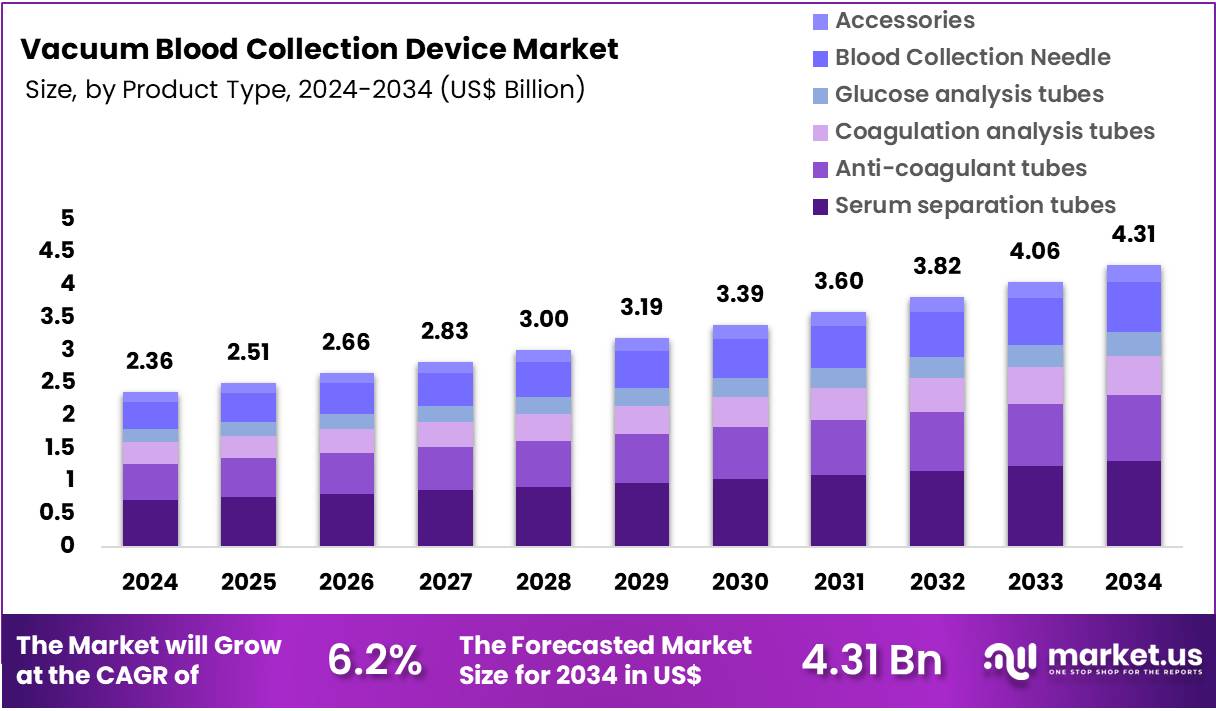
Key Takeaways
- In 2024, the Vacuum Blood Collection Device Market generated US$ 2.36 billion in revenue and is projected to reach US$ 4.31 billion by 2034, expanding at a CAGR of 6.2% during the forecast period.
- By Product Type, the market is segmented into Serum Separation Tubes, Anti-coagulant Tubes, Coagulation Analysis Tubes, and Glucose Tubes. Serum Separation Tubes dominated the segment in 2024, accounting for 30.5% of the total market share.
- By Material, the market is categorized into Plastic/PET/Polymer Tubes and Glass Tubes. Plastic/PET/Polymer Tubes held the largest share of 62.3% in 2024, driven by their durability, lightweight nature, and lower risk of breakage.
- By Application, the market includes Serology & Immunology Testing, General Diagnostics, Coagulation Tests, Genetic Testing, and Glucose Testing. General Diagnostics emerged as the leading application segment, capturing 44.1% of the market share in 2024.
- By End User, the market is segmented into Hospitals & Clinics, Diagnostic and Pathology Laboratories, Blood Banks, Research & Academic Institutes, and Others. Diagnostic and Pathology Laboratories led the segment with a 43.2% market share in 2024.
- North America remained the leading regional market, accounting for 41.5% of the global Vacuum Blood Collection Device Market share in 2024.
Statistical Information
- Global Blood Donations Create Strong Demand for Blood Collection Devices: According to the World Health Organization (WHO), approximately 120.4 million blood donations are collected globally every year. Additionally, 36% of all donations are collected in high-income countries, although they account for only 15% of the global population. This large volume of blood collection directly increases the demand for vacuum blood collection tubes, needles, and related devices used in hospitals and blood banks.
- Voluntary Blood Donation Continues to Increase Worldwide: WHO reports that global blood collections increased by nearly 19% between 2013 and 2023. More than 85% of approximately 120 million blood donations now come from voluntary unpaid donors, reflecting greater public participation in blood donation programs and increasing the use of standardized blood collection systems.
- Blood Screening Requires Millions of Collection Tubes Every Year: WHO recommends that 100% of donated blood be screened for HIV, Hepatitis B, Hepatitis C, and Syphilis before transfusion. According to WHO, 63% of blood-screening laboratories worldwide participate in external quality assessment programs, while 92% of laboratories in high-income countries are enrolled in these quality systems. Each screening process requires vacuum blood collection tubes and specimen handling devices.
- National Blood Safety Programs Support Market Growth: WHO data show that 133 of 168 countries (79%) have adopted a national blood policy, while 120 of 168 countries (71%) have legislation covering blood safety and quality. These government regulations require standardized blood collection procedures, supporting the adoption of vacuum blood collection devices worldwide.
- Blood Component Processing Drives Higher Demand for Collection Tubes: WHO reports that 98% of donated blood in high-income countries is separated into blood components such as red cells, plasma, and platelets, compared with 94% in upper-middle-income countries, 81% in lower-middle-income countries, and 52% in low-income countries. This advanced processing increases the requirement for specialized vacuum blood collection tubes.
- High-Income Countries Perform Significantly More Blood Collections: According to WHO, the blood donation rate reaches 28.9 donations per 1,000 population in high-income countries, compared with 18.2 in upper-middle-income countries, 8.5 in lower-middle-income countries, and 4.5 in low-income countries. Higher testing volumes directly support increased consumption of vacuum blood collection devices.
- Plasma Collection Continues to Expand: WHO reports that approximately 21.5 million liters of plasma were fractionated for plasma-derived medicinal products from 36 reporting countries. The volume of plasma collected ranged from 0.3 to 55.4 liters per 1,000 population, with a median of 5.4 liters, demonstrating the growing need for reliable blood collection systems.
- Hospitals Continue Expanding Blood Safety Monitoring: WHO reports that 129 countries have national clinical guidelines for blood use, 68% of hospitals performing transfusions have systems for reporting adverse transfusion events, and 88 countries operate national haemovigilance systems. These quality initiatives increase demand for standardized vacuum blood collection products.
Regional Analysis
North America led the market by securing a market share of 41.5% in 2024.
North America dominated the Vacuum Blood Collection Device Market in 2024 with a 41.5% market share, supported by advanced healthcare infrastructure, high laboratory testing volumes, and strict regulatory standards. According to the U.S. Centers for Disease Control and Prevention (CDC), more than 14 billion laboratory tests are performed annually in the United States through over 266,000 CLIA-certified laboratories, creating strong demand for vacuum blood collection tubes.
The CDC also reports that over 40 million Americans have diabetes and 115 million adults have prediabetes, increasing routine blood testing requirements. Meanwhile, Asia Pacific is projected to record the fastest growth due to expanding healthcare access and rising chronic disease prevalence.
The International Diabetes Federation (IDF) estimates that the Western Pacific and South-East Asia regions together have more than 300 million adults living with diabetes, driving demand for blood collection devices. Government investments in laboratory modernization, infectious disease surveillance, and automated diagnostics are further accelerating regional market growth.
Emerging Trends
- Growing Adoption of Safety-Engineered Blood Collection Devices: Healthcare providers are increasingly adopting safety-engineered vacuum blood collection devices to reduce needlestick injuries among healthcare workers. The WHO reports 120.4 million blood donations are collected globally each year, while 133 of 168 countries (79%) have national blood policies promoting safe blood collection and handling, encouraging the use of advanced collection systems.
- Expansion of Automated Diagnostic Laboratories: Automation is increasing the use of vacuum blood collection tubes compatible with high-throughput analyzers. The WHO states that diagnostic results influence around 70% of healthcare decisions, yet diagnostics account for only 3–5% of healthcare spending, driving investments in efficient laboratory workflows and automated specimen processing.
- Increasing Standardization of Blood Screening Programs: Countries continue strengthening blood safety through standardized screening protocols. WHO recommends 100% screening of donated blood for HIV, Hepatitis B, Hepatitis C, and syphilis, while 63% of blood-screening laboratories worldwide participate in external quality assessment programs, increasing demand for reliable vacuum blood collection tubes.
- Rising Use of Polymer Blood Collection Tubes: Healthcare facilities are increasingly replacing glass tubes with polymer-based vacuum tubes because they reduce breakage and improve user safety. WHO guidance recommends sterile glass or plastic vacuum blood collection tubes for safe specimen collection, supporting wider adoption of lightweight polymer products in clinical laboratories.
- Strong Focus on Blood Quality and Haemovigilance Systems: Healthcare systems are expanding haemovigilance programs to improve transfusion safety. According to WHO, 88 countries operate national haemovigilance systems, while 68% of hospitals performing transfusions report adverse transfusion events, increasing demand for standardized and traceable blood collection devices.
Use Cases
- Routine Clinical Diagnostic Testing: Vacuum blood collection devices are widely used for complete blood counts, lipid profiles, liver function tests, kidney function tests, and glucose monitoring. The CDC notes that approximately 14 billion laboratory tests are performed annually in the United States, making blood collection one of the most frequently performed clinical procedures.
- Blood Donation and Transfusion Services: Blood banks use vacuum blood collection devices to safely collect donor blood before infectious disease screening. WHO reports 120.4 million blood donations are collected each year globally, supporting transfusions for surgery, trauma, cancer care, and maternal health services.
- Chronic Disease Monitoring: Patients with diabetes, cardiovascular diseases, kidney disorders, and cancer require repeated blood testing throughout treatment. Regular collection of blood samples using vacuum systems supports disease diagnosis, therapy monitoring, and preventive healthcare while improving sample consistency and laboratory efficiency.
- Infectious Disease Surveillance Programs: Public health laboratories use vacuum blood collection devices for surveillance and diagnosis of infectious diseases. According to the CDC, every donated blood unit is tested for pathogens including HIV, Hepatitis B, Hepatitis C, West Nile virus, and Zika virus, increasing demand for standardized specimen collection.
- Emergency and Critical Care Applications: Emergency departments and intensive care units rely on vacuum blood collection devices for rapid laboratory testing. The CDC reports the U.S. healthcare system requires approximately 29,000 units of red blood cells, 5,000 platelet units, and 6,500 plasma units every day, highlighting the importance of efficient blood collection for timely patient care.
Frequently Asked Questions on Vacuum Blood Collection Device
- Which product segment dominates the Vacuum Blood Collection Device Market?
Serum separation tubes hold the largest market share because they are widely used for routine clinical chemistry, immunology, and diagnostic testing across hospitals and pathology laboratories. - Why are plastic blood collection tubes preferred over glass tubes?
Plastic or PET tubes are lightweight, durable, resistant to breakage, and compatible with automated laboratory systems, making them safer and more efficient than traditional glass tubes. - Which application accounts for the highest demand?
General diagnostic testing generates the highest demand due to the increasing number of routine health screenings, disease diagnosis, and chronic disease monitoring requiring frequent blood sample collection. - Which end-user segment leads the market?
Diagnostic and pathology laboratories lead the market because they process large volumes of blood samples daily using standardized vacuum blood collection systems. - Why is North America the leading regional market?
North America leads due to advanced healthcare infrastructure, high laboratory testing volumes, strict safety regulations, and the strong presence of major diagnostic laboratories. - What technological advancements are shaping the market?
Innovations such as polymer collection tubes, automated specimen handling, barcode tracking, improved tube additives, and safety needles are enhancing laboratory efficiency and sample quality. - How do chronic diseases influence market demand?
Increasing cases of diabetes, cardiovascular diseases, cancer, and kidney disorders require frequent blood testing, significantly boosting demand for vacuum blood collection devices. - What role do blood banks play in this market?
Blood banks use vacuum blood collection devices to safely collect, store, and test donated blood before transfusion, ensuring high-quality and safe blood products.
Conclusion
The Vacuum Blood Collection Device Market is expected to witness steady growth over the coming years, supported by the increasing demand for diagnostic testing, expanding healthcare infrastructure, and rising prevalence of chronic and infectious diseases. Growing adoption of safety-engineered blood collection systems, automation in clinical laboratories, and improvements in specimen management continue to enhance testing efficiency and patient safety.
North America maintains market leadership due to advanced laboratory capabilities, while Asia-Pacific offers significant growth opportunities through healthcare investments and expanding screening programs. Continuous technological innovation, supportive government initiatives, and increasing awareness of preventive healthcare will further strengthen the long-term demand for vacuum blood collection devices worldwide.
Discuss your needs with our analyst
Please share your requirements with more details so our analyst can check if they can solve your problem(s)




