


Overview
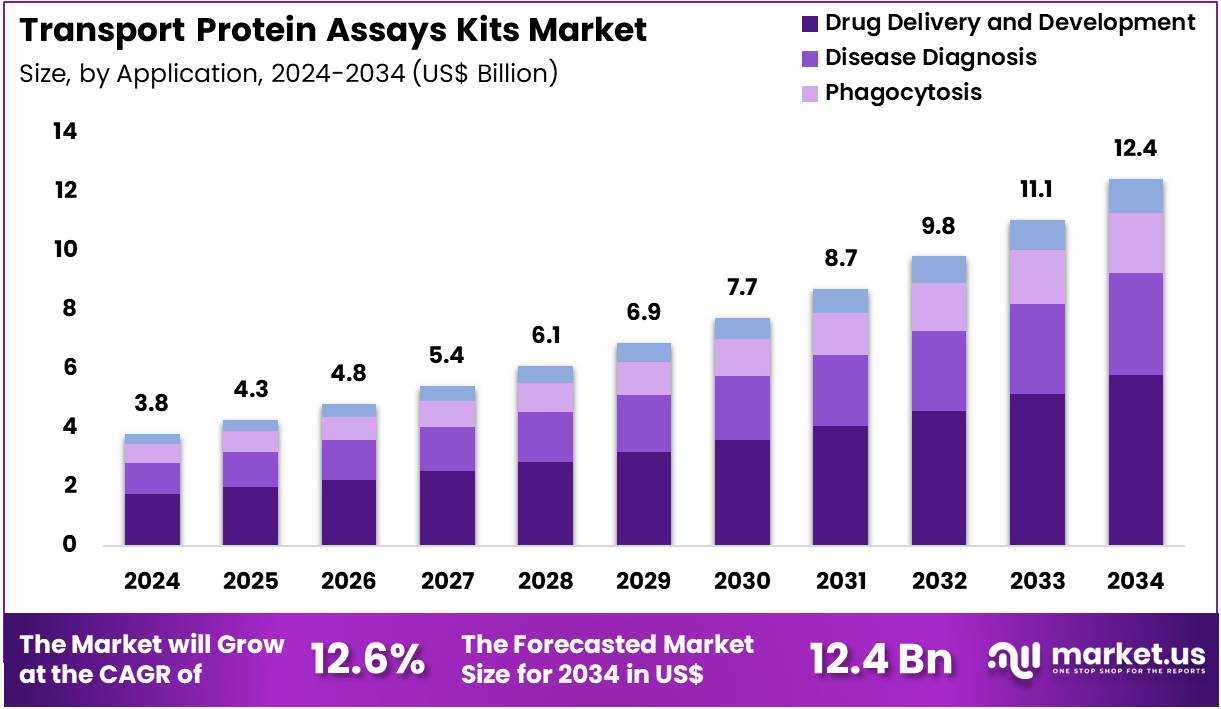
New York, NY – Sep 08, 2026 – Global Transport Protein Assays Kits Market size is expected to be worth around US$ 12.4 Billion by 2034 from US$ 3.8 Billion in 2024, growing at a CAGR of 12.6% during the forecast period 2025 to 2034. In 2024, North America led the market, achieving over 40.1% share with a revenue of US$ 1.5 Billion.
The Transport Protein Assays Kits Market is gaining importance as pharmaceutical, biotechnology, and academic laboratories increasingly focus on understanding how transport proteins influence drug movement, absorption, distribution, and elimination.
Transport protein assay kits provide laboratory researchers with tools to evaluate transporter activity, interactions, inhibition, and substrate behavior using membrane-based or cell-based experimental systems. These products are used in drug discovery, pharmacokinetic studies, toxicology research, and transporter-mediated drug–drug interaction assessment.
Transporter testing has become an important part of modern drug development. The U.S. Food and Drug Administration (FDA) states that transporter-mediated drug interactions are evaluated as part of the broader assessment of investigational medicines, while its 2024 M12 guidance provides recommendations for evaluating enzyme- and transporter-mediated pharmacokinetic drug interactions.
The research significance of these assays is also supported by the National Institutes of Health (NIH), which notes that approximately 10% of the human genome encodes small-molecule and micromineral transmembrane transport proteins, including solute carrier and ATP-binding cassette families.
Key applications include screening compounds for transporter inhibition, identifying potential drug–drug interactions, and improving understanding of pharmacokinetic behavior. Advances in transfected cells, complex cell models, organoids, and microphysiological systems are also expanding the scope of transporter research and creating opportunities for more sophisticated assay solutions.
Key Takeaways
- In 2024, the market generated revenue of US$ 3.8 Billion, growing at a CAGR of 12.6%, and is projected to reach US$ 12.4 Billion by 2034.
- By product type, the market is segmented into kits, reagents, and consumables, with kits leading in 2024 with a 49.2% market share.
- Based on application, the market is categorized into drug delivery & development, disease diagnosis, phagocytosis, and others, with drug delivery & development accounting for a significant 46.5% share.
- By end user, the market is segmented into pharmaceutical companies, biotechnological companies, hospitals, and others, with pharmaceutical companies dominating the market with a 48.7% revenue share.
- North America dominated the market in 2024, accounting for a 40.1% market share.
Statistical Information
- Human Transporter Protein Landscape: The Human Protein Atlas currently lists 2,138 transporter proteins, including 597 transporter channels and pores, 461 electrochemical potential-driven transporters, and 195 primary active transporters. This broad target landscape supports demand for assay kits capable of characterizing diverse transport-related proteins and biological functions.
- Transporter Testing in Drug Development: A 2024 review by a U.S. FDA researcher reported that determining whether new drugs are substrates, inhibitors, or inducers of uptake and efflux transporters has become a routine part of drug discovery and development, supporting continued use of transporter-focused in-vitro assay technologies.
- Regulatory Focus on Transporter-Mediated Interactions: The European Medicines Agency’s implementation of ICH M12 provides a harmonized framework for evaluating enzyme- and transporter-mediated drug-drug interactions through in-vitro and clinical studies, strengthening the regulatory relevance of transporter assay testing in pharmaceutical development.
- Nine Transporter Biomarkers in Multiplex Assay: A 2024 Pfizer research publication described development of an LC-MS/MS assay capable of multiplexed quantitation of 9 human drug-transporter biomarkers. This demonstrates growing laboratory interest in measuring multiple transporter-related biomarkers within integrated analytical workflows.
- High-Throughput Assay Performance: Researchers developing assays for the SLC1A1, SLC1A2, and SLC1A3 transporter family reported Z’ factors above 0.7, a commonly used indicator of robust high-throughput screening performance. The work combined acoustic droplet ejection mass spectrometry with electrophysiological testing.
- Eight-Drug Transporter Cocktail: A 2025 study investigating OCT1 used a multisubstrate cocktail containing 8 victim drugs to simultaneously examine drug-drug interaction behavior. The approach highlights the increasing need for assay platforms capable of evaluating transporter activity across multiple substrates and compounds.
- Fluorescent Substrate Screening: A 2025 study evaluating URAT1 inhibitor screening assessed 10 potential fluorescent substrates and identified 2 specific substrates, dibromofluorescein and diiodofluorescein, as useful alternatives for non-radioactive transporter testing. Such developments expand options for convenient assay workflows.
Regional Analysis
North America is leading the Transport Protein Assays Kits Market.
North America held a 40.1% market share in 2024, supported by strong pharmaceutical and biotechnology research activity and growing attention to transporter-mediated drug–drug interactions. The U.S. FDA’s 2024 M12 guidance provides recommendations for evaluating enzyme- and transporter-mediated pharmacokinetic interactions during drug development, reinforcing the importance of transporter assessments in preclinical and clinical programs.
In addition, the FDA approved 55 novel drugs in 2023, reflecting continued drug-development activity that can increase demand for transporter characterization and ADME testing. These regulatory developments, combined with advanced research infrastructure and growing use of in-vitro testing, are expected to sustain regional demand for transport protein assay kits.
Asia Pacific is projected to witness the fastest growth as pharmaceutical R&D, biotechnology investment, and drug-discovery activities expand across major markets. Increasing focus on pharmacokinetics, ADME studies, and transporter-mediated drug interactions is expected to support adoption of specialized assay platforms.
Japan’s regulatory ecosystem also demonstrates active pharmaceutical development, with PMDA maintaining official records of new-drug approvals for fiscal year 2023. Growing research capabilities, expanding laboratory infrastructure, and rising demand for advanced preclinical testing are likely to strengthen the region’s position in the transport protein assays kits market.
Emerging Trends
- Greater Focus on Transporter-Mediated Drug Interactions: Transporter assays are increasingly used to identify whether new drugs inhibit, induce, or interact with proteins such as P-gp, BCRP, OATP, OAT, and OCT. FDA’s M12 guidance highlights the importance of transporter-mediated interaction studies during drug development and regulatory evaluation.
- Wider Use in Early-Stage Drug Discovery: Pharmaceutical researchers are moving transporter testing earlier in the discovery process to remove unsuitable drug candidates before expensive clinical development. FDA-authored research notes that determining whether compounds are transporter substrates, inhibitors, or inducers is now an important part of drug development.
- Rising Demand for Standardized and Validated Assays: Assay reproducibility is becoming a key priority as laboratories seek reliable results across drug development programs. Optimized and validated in-vitro transporter assays can improve confidence when identifying transporter substrates or inhibitors, supporting more consistent decisions on candidate selection and pharmacokinetic risks.
- Integration with Computational and PBPK Modeling: A growing trend is combining transporter assay results with physiologically based pharmacokinetic (PBPK) models to predict drug exposure and interaction risks. ICH M12 guidance supports model-based evaluation and drug-drug interaction predictions, strengthening the connection between laboratory data and clinical forecasting.
- Expansion Across Multiple Transporter Protein Families: Research increasingly examines several transporter systems instead of focusing on one protein. FDA guidance covers systems including P-gp, BCRP, OATP1B1/1B3, OAT1/3, and OCT2/MATE, encouraging broader assay portfolios for evaluating potential drug interaction risks.
Use Cases
- Drug-Drug Interaction Assessment: Transport protein assay kits help researchers evaluate whether one medicine may affect the absorption, distribution, metabolism, or elimination of another. This testing supports the identification of transporter-based drug-drug interactions before clinical use and helps developers determine whether additional clinical interaction studies may be necessary.
- Drug Candidate Screening: During early drug discovery, assay kits are used to screen compounds for transporter activity and identify molecules with potentially unfavorable pharmacokinetic characteristics. This allows research teams to prioritize promising candidates and reduce investment in compounds that may show poor absorption or unwanted transporter interactions.
- Pharmacokinetic and Exposure Prediction: Transporter assay data can be incorporated into pharmacokinetic studies to understand how drugs move through the body. Researchers use these results alongside computational models to estimate changes in drug exposure, supporting dose selection and improving predictions of possible clinical outcomes.
- Regulatory Drug Development Support: Transporter studies provide experimental evidence that can support regulatory submissions and drug interaction assessments. By generating data on transporter substrates, inhibitors, and inducers, pharmaceutical companies can better address regulatory expectations and strengthen the safety assessment of new drug candidates.
- Personalized Medicine and Patient Safety Research: Transporter activity can vary because of genetics, disease conditions, and co-administered medicines. Assay-based research helps scientists investigate these differences and understand their potential effects on drug response. This creates opportunities for safer treatment strategies and more individualized approaches to medication management.
Frequently Asked Questions on Transport Protein Assays Kits
- What are Transport Protein Assays Kits used for?
These kits are mainly used in drug discovery, pharmacokinetic studies, toxicology research, and transporter interaction testing. Researchers use them to evaluate how specific compounds interact with transport proteins and to support safer, more effective drug development. - Why are Transport Protein Assays Kits important in drug development?
Transport Protein Assays Kits help researchers understand how drugs move through biological membranes and interact with transporters. This information supports the evaluation of drug absorption, distribution, metabolism, and excretion, helping identify potential safety concerns and improve candidate selection. - What types of transport proteins are studied using these kits?
Commonly studied transport proteins include P-glycoprotein, BCRP, OAT, OCT, OATP, and other uptake or efflux transporters. These proteins influence how drugs and other compounds move across cell membranes and are important in pharmacokinetic and drug interaction research. - Who uses Transport Protein Assays Kits?
These kits are used by pharmaceutical companies, biotechnology firms, academic research institutions, contract research organizations, and specialized laboratories. Their applications cover drug discovery, transporter biology, pharmacology, toxicology, and regulatory studies related to drug development. - What factors are driving the Transport Protein Assays Kits Market?
The market is supported by increasing pharmaceutical research, growing drug discovery activities, rising interest in transporter-mediated drug interactions, and greater demand for reliable laboratory testing. Advances in cell-based assays and automated research workflows are also supporting market development.
Conclusion
The Transport Protein Assays Kits Market is poised for strong growth, supported by expanding pharmaceutical and biotechnology research, rising drug discovery activities, and increasing regulatory emphasis on transporter-mediated drug interactions. The growing use of transporter assays in drug candidate screening, pharmacokinetic studies, safety assessment, and personalized medicine is creating broader application opportunities.
Technological advances in cell-based models, high-throughput screening, multiplex assays, organoids, and computational modeling are further improving research capabilities. North America currently leads the market, while Asia Pacific is expected to experience rapid expansion. Overall, increasing demand for reliable transporter characterization is expected to sustain market growth through 2034.
Discuss your needs with our analyst
Please share your requirements with more details so our analyst can check if they can solve your problem(s)




