


Overview
New York, NY – Aug 17, 2026 – The Global Surgical Mask Market size is expected to be worth around US$ 6.47 Billion by 2034 from US$ 2.45 Billion in 2024, growing at a CAGR of 10.2% during the forecast period from 2025 to 2034. In 2024, Europe led the market, achieving over 34.5% share with a revenue of US$ 845.5 Million.
The global surgical mask market continues to grow steadily, supported by stricter infection-control regulations, rising surgical volumes, expanding healthcare infrastructure, and government investments in emergency preparedness. Surgical masks remain an essential part of routine medical practice across hospitals, outpatient clinics, diagnostic centers, and ambulatory surgical facilities. Their consistent use in patient care and surgical procedures ensures stable demand even outside public health emergencies.
According to the World Health Organization (WHO), effective infection prevention and control (IPC) programs can reduce healthcare-associated infections (HAIs) by up to 70%, while 1 in 10 patients worldwide is affected by an HAI during healthcare delivery. In 2023, WHO continued recommending medical masks for healthcare workers in high-risk clinical settings, reinforcing routine procurement across healthcare facilities.
The Organisation for Economic Co-operation and Development (OECD) estimates that its member countries perform more than 100 million inpatient surgical procedures annually, creating sustained demand for surgical masks.
Additionally, the International Society of Aesthetic Plastic Surgery (ISAPS) reported over 34.9 million aesthetic procedures globally in 2023, including 15.8 million surgical procedures. Government preparedness initiatives further support market growth. The U.S. Strategic National Stockpile (SNS) continues replenishing personal protective equipment reserves, while the U.S. Food and Drug Administration (FDA) recognizes ASTM F2100-23 standards for surgical masks to ensure quality and safety.
Furthermore, WHO projects a global shortage of nearly 10 million health workers by 2030, encouraging continued investment in protective equipment and strengthening long-term demand for high-quality surgical masks worldwide.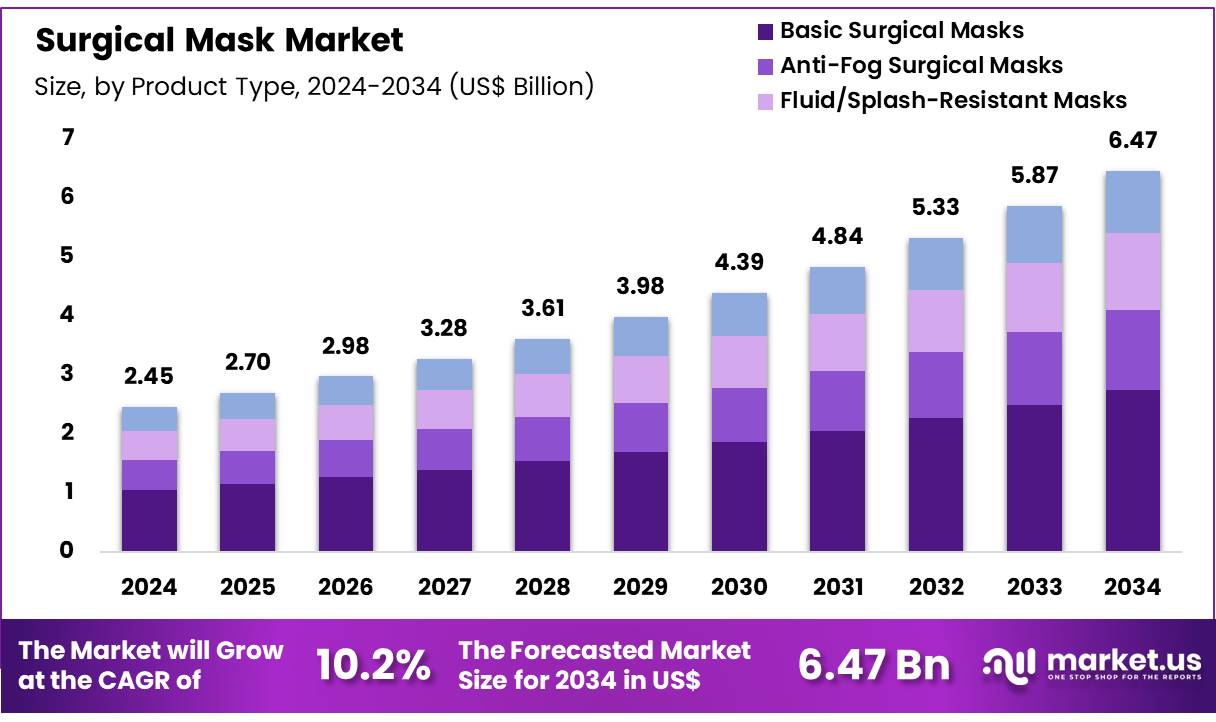
Key Takeaways
- Market Size: The global surgical mask market is projected to grow from US$ 2.45 billion in 2024 to approximately US$ 6.47 billion by 2034.
- Market Growth: The market is anticipated to expand at a compound annual growth rate (CAGR) of 10.2% during the forecast period 2025 to 2034.
- Product Type Analysis: Basic surgical masks emerged as the leading product category, accounting for 42.5% of the global market share in 2024.
- Material Type Analysis: Polypropylene (PP) remained the dominant material segment, representing 38.2% of the total surgical mask market share in 2024.
- Usage Type Analysis: Disposable surgical masks held the largest share among usage types, contributing 38.2% of the global market in 2024.
- Distribution Channel Analysis: Online distribution channels dominated the market, capturing 70.4% of the overall market share in 2024.
- Regional Analysis: Europe led the global surgical mask market in 2024, accounting for over 34.5% of the market and generating approximately US$ 845.5 million in revenue.
Statistical Information
- Healthcare-Associated Sepsis Has a High Mortality Rate: According to WHO, more than 24% of patients with healthcare-associated sepsis die annually, while mortality rises to 52.3% among intensive care unit (ICU) patients affected by healthcare-associated sepsis. These statistics reinforce the importance of infection prevention measures, including surgical masks.
- Only 15.2% of Healthcare Facilities Met WHO Minimum IPC Requirements: WHO’s global survey found that only 15.2% of healthcare facilities met all minimum infection prevention and control (IPC) requirements. This indicates continued investments by hospitals in infection-control products such as surgical masks.
- Only 3.8% of Countries Met All National IPC Requirements: WHO reported that among 106 assessed countries, only 4 countries (3.8%) met all minimum national infection prevention and control requirements. Governments continue strengthening IPC programs, supporting sustained demand for surgical masks.
- Surgical Site Infection Prevention Includes 29 WHO Recommendations: WHO’s Global Guidelines for the Prevention of Surgical Site Infection include 29 evidence-based recommendations covering 23 clinical topics aimed at reducing surgical infections. Compliance with these infection-control practices supports ongoing use of surgical masks in operating rooms.
- Healthcare-Associated Infections (HAIs) Continue to Drive Surgical Mask Demand: Healthcare-associated infections remain a major challenge worldwide. According to the World Health Organization (WHO), 7 out of every 100 patients in acute-care hospitals in high-income countries and 15 out of every 100 patients in low- and middle-income countries acquire at least one healthcare-associated infection during their hospital stay. These infection risks support continuous demand for surgical masks in hospitals.
- Glove Compliance Reaches 98% During High-Risk Procedures: The CDC reported glove-use compliance reached 98% during resuscitation procedures and 92% during arterial blood gas collection, demonstrating that healthcare professionals adopt full PPE, including surgical masks, during high-risk patient care.
- Major Surgery Mortality Ranges from 0.5% to 5%: According to WHO, the crude mortality rate following major surgery ranges from 0.5% to 5% globally. Infection prevention measures such as sterile surgical masks are standard components of surgical safety protocols.
- Around 1 in 10 Patients Experiences Harm During Healthcare: WHO reports that around 10% of patients receiving healthcare experience preventable harm, resulting in more than 3 million deaths annually worldwide. Infection-control products such as surgical masks remain essential for reducing healthcare-associated risks.
- Four Out of Ten Patients Experience Harm in Primary Care: WHO estimates that 4 out of every 10 patients are harmed in primary and ambulatory healthcare settings, while 23.6% to 85% of this harm is considered avoidable through improved healthcare practices.
- Global Healthcare Systems Need About 28 Million Surgical Masks Per Day for Healthcare Workers Alone: According to the OECD, assuming one-third of healthcare workers require masks and each uses two surgical masks daily, healthcare systems need approximately 28 million surgical masks every day for healthcare workers alone. Including caregivers and patients raises demand by another 12 million masks daily, for a total of roughly 40 million surgical masks per day.
- China Increased Mask Production by 10 Times During Peak Demand: According to the OECD, China increased its face mask manufacturing capacity from 20 million masks per day in January 2020 to 116 million masks per day by the end of February 2020, and production was estimated to reach 200 million masks per day by the end of March 2020.
- Healthcare Systems Require Around 40 Million Surgical Masks Daily: OECD estimated global demand of approximately 28 million surgical masks per day for healthcare workers. Including caregivers and suspected patients increases demand by another 12 million masks daily, totaling approximately 40 million surgical masks every day.
Regional Analysis
Europe led the market, achieving over 34.5% share
North America accounted for the largest share of the global surgical mask market in 2024, supported by its advanced healthcare infrastructure, stringent infection prevention standards, and high adoption of personal protective equipment (PPE). The United States and Canada maintain well-established hospital networks where surgical masks are routinely used during patient care, surgical procedures, and infection-control practices.
The U.S. Centers for Disease Control and Prevention (CDC) recommends FDA-cleared surgical masks for healthcare personnel to protect against respiratory secretions, blood, and body fluid exposure during clinical procedures. Additionally, the U.S. Food and Drug Administration (FDA) regulates surgical masks as Class II medical devices, ensuring consistent quality and safety standards.
Strong healthcare spending, expanding outpatient services, and increasing surgical volumes continue to support product demand. Government preparedness initiatives and strategic stockpiles further strengthen procurement stability. The region also benefits from a robust domestic manufacturing base, efficient distribution networks, and widespread availability of certified medical products, supporting sustained market leadership.
Emerging Trends
- Stronger Infection Prevention Standards in Hospitals: Healthcare providers are strengthening infection prevention programs, increasing the routine use of surgical masks. WHO reports that effective infection prevention and control (IPC) programs can reduce healthcare-associated infections by up to 70%, encouraging hospitals to maintain higher PPE inventories and standardized mask usage across clinical departments.
- Rising Surgical Volumes Increase Mask Consumption: Growing numbers of surgical procedures continue to support surgical mask demand. WHO estimates that more than 300 million major surgical procedures are performed globally each year. Every surgery requires sterile protective equipment, making disposable surgical masks an essential product in operating rooms worldwide.
- Higher Focus on Certified Medical-Grade Masks: Healthcare facilities increasingly prefer FDA-cleared surgical masks that meet strict performance requirements. According to CDC, surgical masks are Class II medical devices tested for bacterial filtration, particulate filtration, fluid resistance, flammability, and biocompatibility, improving product quality and regulatory compliance.
- Expansion of Strategic PPE Stockpiles: Many governments and healthcare systems continue maintaining emergency PPE reserves after the COVID-19 pandemic. OECD estimated healthcare systems alone require around 40 million surgical masks per day, highlighting the importance of strategic stockpiles to improve preparedness for future public health emergencies.
- Greater Adoption Across Outpatient and Ambulatory Care: The expansion of outpatient surgery centers and ambulatory healthcare services is increasing surgical mask usage beyond traditional hospitals. CDC continues recommending masks during procedures involving splashes or respiratory secretions, supporting wider adoption across multiple healthcare settings.
Use Cases
- Infection Control During Surgical Procedures: Surgical masks are routinely used by surgeons, nurses, and operating-room staff to maintain sterile environments. WHO has published 29 evidence-based recommendations covering 23 infection-prevention topics, making surgical masks a standard component of safe surgical practice worldwide.
- Protection During High-Risk Clinical Procedures: CDC recommends surgical masks with eye protection during procedures involving blood, body fluids, or respiratory secretions. These include bronchoscopy, endotracheal suctioning, and vascular procedures, where PPE helps reduce exposure risks for healthcare professionals.
- Preventing Surgical Site Infections (SSI): WHO reports that 11% of surgical patients in low- and middle-income countries develop surgical site infections, while these infections add more than 400,000 extra hospital days and approximately US$ 900 million in costs annually in the United States. Surgical masks remain an important part of SSI prevention protocols.
- Daily Protection for Healthcare Workers: OECD estimates there are approximately 43 million healthcare workers worldwide, creating continuous demand for surgical masks during patient examinations, inpatient care, emergency treatment, and outpatient services to reduce exposure to infectious materials.
- Patient Source Control in Healthcare Facilities: CDC recommends placing surgical masks on patients with respiratory symptoms to reduce the spread of infectious droplets within healthcare facilities. This routine practice helps protect healthcare workers, visitors, and other patients while supporting broader infection-control strategies.
Frequently Asked Questions on Surgical Mask
- What is driving the growth of the Global Surgical Mask Market?
The market is growing due to increasing surgical procedures, rising healthcare-associated infections (HAIs), stronger infection-control regulations, expanding healthcare infrastructure, and higher adoption of personal protective equipment (PPE) across healthcare facilities worldwide. - Which region dominates the Global Surgical Mask Market?
North America leads the global market due to its advanced healthcare infrastructure, strict regulatory standards, high surgical volumes, strong domestic manufacturing capacity, and widespread use of personal protective equipment in healthcare settings. - What regulations apply to surgical masks?
Surgical masks must comply with medical safety and quality standards, including bacterial filtration efficiency, fluid resistance, breathability, and biocompatibility. In the United States, they are regulated by the FDA as Class II medical devices. - How do healthcare-associated infections affect demand for surgical masks?
Rising concerns about healthcare-associated infections encourage hospitals and clinics to strengthen infection prevention programs, increasing the routine use of surgical masks to protect healthcare workers and patients during medical procedures. - What future opportunities are expected in the Global Surgical Mask Market?
Market growth is expected to be supported by expanding healthcare infrastructure, increasing outpatient surgeries, government emergency preparedness programs, greater hospital safety investments, and continued demand for certified, high-quality medical protective equipment. - What are the major applications of surgical masks?
Surgical masks are primarily used during surgical procedures, patient examinations, dental treatments, emergency care, isolation wards, and diagnostic procedures. They help reduce the transmission of infectious droplets and protect both healthcare professionals and patients. - Who are the primary end users in the Global Surgical Mask Market?
The major end users include hospitals, ambulatory surgical centers, specialty clinics, dental clinics, diagnostic laboratories, nursing homes, and other healthcare facilities that require routine infection prevention and personal protective equipment. - How do government infection-control policies support the market?
Government agencies such as the WHO, CDC, and FDA recommend or regulate the use of surgical masks in healthcare settings. These guidelines encourage consistent procurement and usage to reduce healthcare-associated infections and improve patient safety.
Conclusion
The global surgical mask market is expected to witness steady growth, supported by rising surgical procedures, increasing healthcare-associated infection concerns, and stricter infection prevention regulations across healthcare systems. Continuous adoption of personal protective equipment in hospitals, clinics, and ambulatory care centers remains a key demand driver.
Government preparedness initiatives, expanding healthcare infrastructure, and growing investments in patient safety further strengthen market prospects. Technological improvements in filtration performance, comfort, and material quality are enhancing product adoption. With strong regulatory oversight, increasing healthcare expenditure, and sustained focus on infection control, the surgical mask market is positioned for stable and long-term growth worldwide.
Discuss your needs with our analyst
Please share your requirements with more details so our analyst can check if they can solve your problem(s)




