


Overview
New York, NY – Aug 18, 2026 – The Global Spinal Cord Stimulation Devices Market size is expected to be worth around US$ 7.79 Billion by 2034 from US$ 3.54 Billion in 2024, growing at a CAGR of 8.2% during the forecast period from 2025 to 2034. In 2024, North America led the market, achieving over 32.5% share with a revenue of US$ 1.15 Billion.
The global spinal cord stimulation (SCS) devices sector is growing steadily due to the increasing burden of chronic pain, ageing populations, and rising demand for non-opioid pain management solutions. According to the World Health Organization (WHO), low back pain affected approximately 619 million people in 2020 and is expected to increase to 843 million cases by 2050, creating significant demand for advanced neuromodulation therapies.
The ageing population is a key growth driver for SCS adoption. WHO estimates that the global population aged 60 years and above will rise from 1 billion in 2020 to 1.4 billion by 2030 and 2.1 billion by 2050. Older adults are more vulnerable to spinal disorders, failed back surgery syndrome, and neuropathic pain, increasing the need for implantable pain management devices.
Diabetes-related complications are also expanding the potential patient pool. WHO reported that global diabetes cases increased to approximately 830 million in 2022, compared with 108 million in 1980, contributing to a higher prevalence of painful diabetic neuropathy, a major indication for SCS therapy. In the United States, the CDC reported that 24.3% of adults experienced chronic pain in 2023, while 8.5% suffered from high-impact chronic pain.
Growing concerns regarding opioid dependence are encouraging healthcare providers to adopt alternative treatments. Regulatory support from agencies such as the FDA, reimbursement coverage through Medicare, and recommendations from NICE are further supporting market growth. Advances in rechargeable batteries, MRI-compatible systems, and personalized stimulation technologies are expected to accelerate SCS device adoption globally.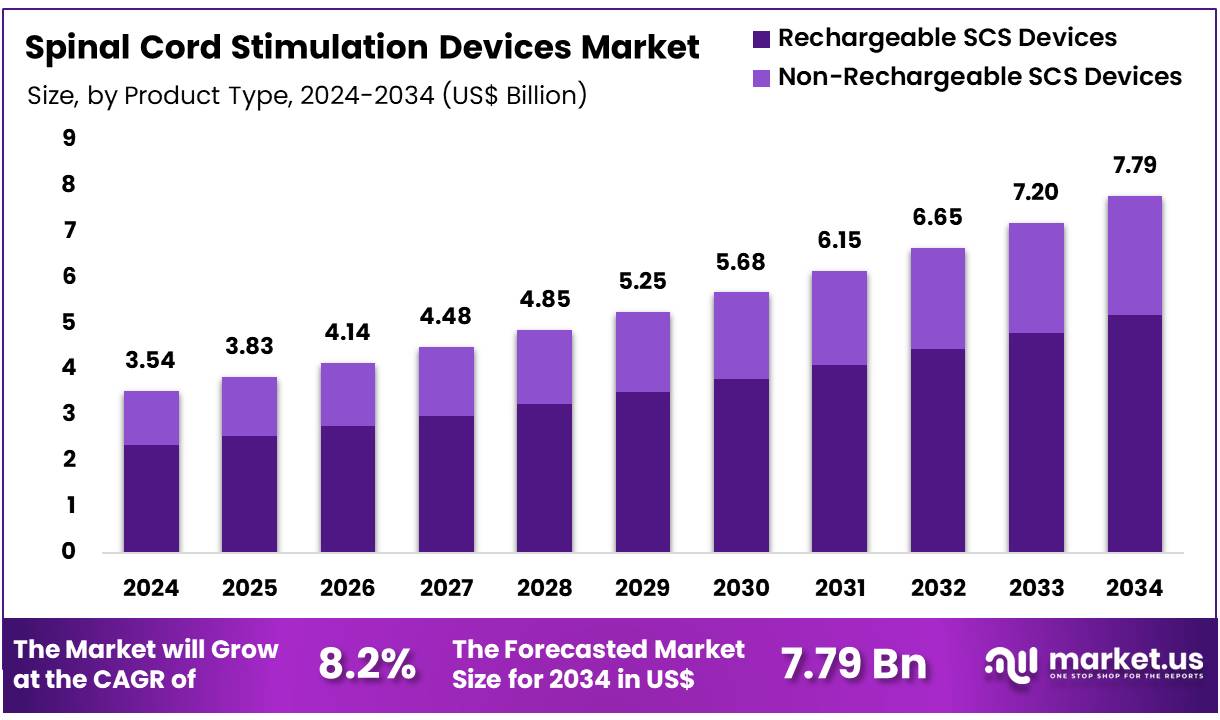
Key Takeaways
- Market Size: The global spinal cord stimulation devices market is projected to reach approximately US$ 7.79 billion by 2034, increasing from US$ 3.54 billion in 2024.
- Market Growth: The market is expected to expand at a CAGR of 8.2% from 2025 to 2034, driven by rising chronic pain cases, technological advancements, and increasing adoption of neuromodulation therapies.
- Product Analysis: Rechargeable SCS devices held the leading position in 2024, accounting for 66.7% of the total market share due to their longer lifespan and reduced need for replacement procedures.
- Application Analysis: Failed Back Surgery Syndrome (FBSS) was the largest application segment in 2024, capturing 31.3% market share, supported by increasing demand for effective pain management solutions.
- End-Use Analysis: Hospitals dominated the end-use segment in 2024 with a 55.6% market share, owing to their role in performing advanced implantation procedures and providing specialized pain care.
- Regional Analysis: North America led the global spinal cord stimulation devices market in 2024, accounting for more than a 32.5% share with a market revenue of approximately US$ 1.15 billion, supported by advanced healthcare infrastructure and favorable reimbursement policies.
Statistical Information
- Chronic Pain Burden Driving Demand for Spinal Cord Stimulation (SCS) Devices: The growing prevalence of chronic pain is one of the major factors supporting the adoption of spinal cord stimulation devices. According to the World Health Organization (WHO), low back pain affected approximately 619 million people globally in 2020, and cases are projected to increase to 843 million by 2050 due to population growth and ageing. WHO also identified low back pain as the leading cause of disability worldwide, increasing the need for advanced pain management options.
- Rising Ageing Population Increasing SCS Treatment Demand: Age-related spinal disorders and neuropathic pain conditions are increasing the need for implantable pain therapies. WHO reported that the global population aged 60 years and older reached 1 billion in 2020 and is expected to grow to 1.4 billion by 2030 and 2.1 billion by 2050. Older adults have a higher incidence of degenerative spine diseases, creating a larger patient pool for SCS procedures.
- Diabetes Growth Expanding the Patient Base for Neuropathic Pain Treatment: The increasing prevalence of diabetes is contributing to higher demand for SCS devices used in painful diabetic neuropathy management. WHO reported that the number of people living with diabetes increased from 200 million in 1990 to 830 million in 2022. Diabetes-related nerve complications continue to increase the requirement for advanced neuromodulation therapies for treatment-resistant pain.
- Chronic Pain Statistics Supporting Alternative Pain Therapies: Chronic pain remains a significant healthcare challenge, especially in developed countries. The U.S. Centers for Disease Control and Prevention (CDC) reported that 24.3% of U.S. adults experienced chronic pain in 2023, while 8.5% experienced high-impact chronic pain that limited daily activities or work. These statistics highlight the growing requirement for non-opioid pain management solutions such as SCS.
- Growing Diabetes Population Increasing Painful Diabetic Neuropathy Cases: Diabetes-related nerve complications are expanding the potential patient pool for SCS devices. The World Health Organization (WHO) reported that the number of people living with diabetes increased to approximately 830 million in 2022, compared with 108 million in 1980. A growing diabetes population increases the prevalence of painful diabetic neuropathy, one of the established applications of SCS therapy.
- Increasing Number of People Living With Low Back Pain Creating SCS Demand: Low back pain remains the largest contributor to disability worldwide and is a major indication area for spinal cord stimulation devices. The World Health Organization (WHO) reported that 619 million people experienced low back pain in 2020, and the number is expected to increase to 843 million by 2050 due to population growth and ageing. WHO also reported that low back pain was the leading cause of disability globally, highlighting the need for advanced treatment approaches.
- Growing Chronic Pain Population Supporting Non-Opioid Treatment Adoption: The increasing prevalence of chronic pain is encouraging healthcare providers to consider alternative therapies such as SCS. According to the CDC National Center for Health Statistics, 24.3% of U.S. adults experienced chronic pain in 2023, while 8.5% experienced high-impact chronic pain that affected daily activities or work ability. This large patient population is increasing demand for long-term interventional pain management solutions.
- Age-Related Spine Disorders Increasing Need for Implantable Pain Devices: The ageing population is increasing the prevalence of spinal degeneration, nerve compression, and chronic musculoskeletal pain. According to WHO, the global population aged 60 years and older will increase from 1 billion in 2020 to 1.4 billion by 2030 and 2.1 billion by 2050. Older adults represent a key patient group for SCS due to higher rates of persistent back and neuropathic pain conditions.
- Diabetes-Related Nerve Damage Increasing SCS Application Opportunities: Diabetic neuropathy is a major application area for spinal cord stimulation. WHO reported that global diabetes cases increased from 108 million in 1980 to approximately 830 million in 2022. As diabetes-related nerve complications increase, more patients may require advanced pain control methods when conventional medication-based treatments provide insufficient relief.
Regional Analysis
North America led the market, achieving over 32.5% share
North America remains a leading region for spinal cord stimulation (SCS) adoption due to the high prevalence of chronic pain conditions, advanced healthcare infrastructure, and increasing availability of neuromodulation therapies. According to the U.S. Centers for Disease Control and Prevention (CDC), approximately 24.3% of U.S. adults experienced chronic pain in 2023, creating significant demand for advanced pain management solutions.
The region benefits from a strong network of hospitals, specialized pain centers, and reimbursement support systems that improve patient access to SCS procedures. The Centers for Medicare & Medicaid Services (CMS) provides coverage policies for medically necessary spinal cord stimulation procedures, supporting treatment adoption among eligible patients.
Technological innovation from leading device manufacturers, including rechargeable, MRI-compatible, and closed-loop stimulation systems, is further strengthening regional growth. Europe also shows strong adoption, supported by healthcare guidelines from organizations such as NICE, while Asia-Pacific is experiencing increasing demand due to improving healthcare access and rising awareness of chronic pain treatments
Emerging Trends
- Growing Adoption of Closed-Loop SCS Technology: Closed-loop spinal cord stimulation systems are becoming an important trend as they provide real-time adjustment of stimulation levels based on patient feedback. The FDA approved the Saluda Medical Evoke SCS System in 2022, supporting the use of adaptive stimulation technology for chronic pain management.
- Increasing Demand for Rechargeable SCS Devices: Rechargeable SCS systems are gaining popularity due to longer device life, reduced replacement procedures, and improved patient convenience. The FDA approved multiple rechargeable SCS platforms, including Nevro’s Senza system in 2021, for patients with chronic pain conditions that are difficult to manage with conventional treatments.
- Expansion of SCS Use in Chronic Low Back Pain: Rising cases of low back pain are increasing the need for advanced neuromodulation solutions. WHO reported that low back pain affected approximately 619 million people in 2020 and is expected to reach 843 million by 2050, creating demand for long-term pain management therapies.
- Increasing Application in Painful Diabetic Neuropathy: Growing diabetes prevalence is expanding the use of SCS devices for nerve-related pain management. WHO reported that global diabetes cases increased to approximately 830 million people in 2022, compared with 108 million in 1980, increasing the population at risk of painful diabetic neuropathy.
- Development of MRI-Compatible SCS Systems: MRI compatibility is becoming a key product feature as chronic pain patients may require diagnostic imaging after implantation. FDA-approved SCS devices now include MRI-compatible designs, improving long-term patient usability and supporting wider clinical adoption.
Use Cases
- Chronic Low Back Pain Management: Spinal cord stimulation is widely used for patients suffering from chronic low back pain who do not achieve sufficient relief from medications, physical therapy, or other treatments. WHO reported that low back pain affected 619 million people globally in 2020, making it a major application area for SCS therapy.
- Failed Back Surgery Syndrome (FBSS) Treatment: SCS is commonly used for patients who continue experiencing pain after spinal surgery. The therapy helps manage persistent neuropathic pain associated with failed back surgery syndrome, providing an alternative option for patients with limited response to conventional treatments.
- Painful Diabetic Neuropathy Management: SCS devices are increasingly used for treating painful diabetic neuropathy, especially in patients with chronic nerve pain that does not respond adequately to medication. WHO reported that global diabetes cases reached approximately 830 million in 2022, increasing the need for advanced neuropathic pain therapies.
- Chronic Neuropathic Pain Treatment: SCS provides pain relief for various neuropathic conditions caused by nerve damage, spinal injuries, and neurological disorders. The National Institutes of Health (NIH) estimates that neuropathic pain affects approximately 7%–10% of the global population, creating demand for neuromodulation therapies.
- Complex Regional Pain Syndrome (CRPS) Management: SCS is used for selected patients with complex regional pain syndrome, a condition involving chronic nerve pain, sensitivity, and functional limitations. Neuromodulation can help reduce pain intensity and improve quality of life in treatment-resistant cases.
Frequently Asked Questions on Spinal Cord Stimulation Devices
- What factors are driving the growth of the spinal cord stimulation devices market?
The market growth is driven by increasing chronic pain cases, ageing populations, rising diabetes-related neuropathy, growing demand for non-opioid treatments, technological advancements, and improved reimbursement policies supporting neuromodulation therapies worldwide. - What are the major applications of spinal cord stimulation devices?
Major applications include failed back surgery syndrome, chronic low back pain, painful diabetic neuropathy, complex regional pain syndrome, and other chronic neuropathic pain conditions where conventional medications and therapies fail to provide sufficient patient relief. - What role does technology play in the SCS devices market?
Technological advancements such as rechargeable batteries, MRI-compatible systems, wireless programming, and closed-loop stimulation are improving device performance. These innovations enhance patient comfort, provide personalized therapy, and support wider adoption among healthcare professionals. - Why are rechargeable SCS devices becoming popular?
Rechargeable SCS devices are gaining popularity because they provide longer operational life, reduce replacement surgeries, and improve convenience for patients requiring long-term pain management. These systems are increasingly preferred for chronic conditions requiring continuous stimulation therapy. - What is the importance of FDA approval for SCS devices?
FDA approval ensures that spinal cord stimulation devices meet safety and effectiveness standards before clinical use. Regulatory clearances encourage healthcare provider confidence, support innovation, and improve patient access to advanced neuromodulation technologies. - Which healthcare facilities use spinal cord stimulation devices?
Hospitals, specialty pain clinics, ambulatory surgical centers, and neurosurgical facilities commonly perform SCS procedures. These centers provide patient evaluation, trial stimulation, implantation services, and follow-up management through multidisciplinary healthcare teams. - Which regions show strong adoption of spinal cord stimulation devices?
North America shows strong adoption due to advanced healthcare infrastructure, reimbursement support, and high prevalence of chronic pain. Europe also demonstrates significant usage, while Asia-Pacific is experiencing increasing adoption due to improving healthcare access and awareness. - How are SCS devices different from traditional pain treatments?
Unlike medications that primarily manage symptoms, SCS devices directly modify pain signaling pathways through electrical stimulation. They provide a long-term treatment option for selected patients who do not achieve adequate relief from conventional therapies.
Conclusion
The spinal cord stimulation devices market is experiencing steady growth due to the rising global burden of chronic pain, increasing ageing population, growing diabetes prevalence, and demand for non-opioid pain management solutions. Advancements in rechargeable systems, MRI-compatible devices, and closed-loop stimulation technologies are improving treatment outcomes and expanding clinical applications.
Government support, regulatory approvals, and reimbursement frameworks are further strengthening adoption across hospitals and specialized pain centers. With increasing cases of neuropathic pain, failed back surgery syndrome, and spinal disorders, SCS devices are expected to play an important role in providing personalized and long-term pain management solutions worldwide.
Discuss your needs with our analyst
Please share your requirements with more details so our analyst can check if they can solve your problem(s)




