
Overview
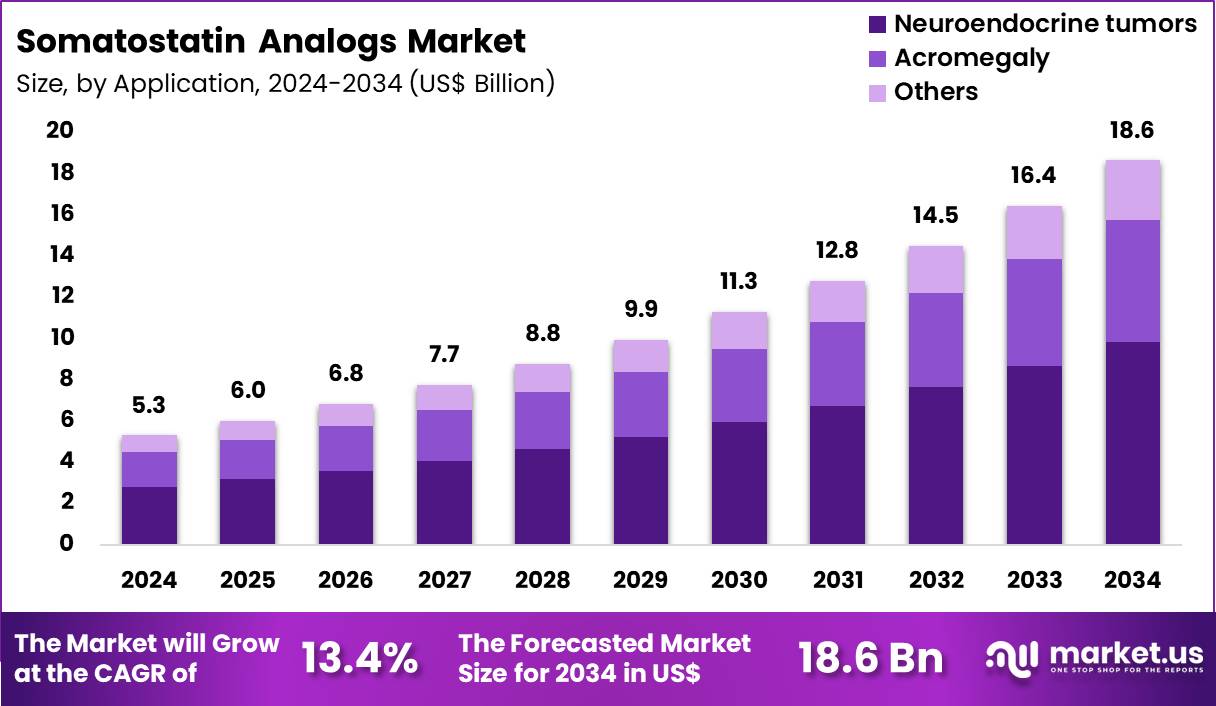
New York, NY – Oct 16, 2026 – Global Somatostatin Analogs Market size is expected to be worth around US$ 18.6 Billion by 2034 from US$ 5.3 Billion in 2024, growing at a CAGR of 13.4% during the forecast period 2025 to 2034. In 2024, North America led the market, achieving over 43.2% share with a revenue of US$ 2.3 Billion.
Somatostatin analogs are synthetic compounds designed to mimic the action of somatostatin, a naturally occurring hormone that regulates the release of several hormones in the body. These drugs are primarily used to manage hormone-related disorders and certain types of neuroendocrine tumors. Key products in this category include octreotide, lanreotide, and pasireotide.
The Somatostatin Analogs Market is supported by the growing prevalence of neuroendocrine tumors, acromegaly, and other hormone-related disorders. These therapies help control excessive hormone secretion, manage disease-related symptoms, and improve clinical outcomes in eligible patients. Long-acting formulations have also improved treatment convenience by reducing the frequency of administration.
Pharmaceutical companies are focusing on product innovation, improved drug delivery systems, and the development of advanced treatment options to strengthen their market presence. Increasing awareness of rare endocrine disorders, improvements in diagnostic capabilities, and expanding access to specialized healthcare services are also expected to support market development.
However, high treatment costs, potential side effects, and limited access to specialist care may restrict market growth in certain regions. North America and Europe remain important markets due to established healthcare infrastructure and access to advanced therapies, while improving healthcare access in emerging economies may create additional opportunities.
Overall, the market outlook remains promising, supported by continued research, expanding therapeutic applications, and growing demand for effective long-term management of hormone-related conditions.
Key Takeaways
- In 2024, the Somatostatin Analogs Market was valued at US$ 5.3 billion and is projected to grow at a CAGR of 13.4%, reaching US$ 18.6 billion by 2034.
- By product type, the market is segmented into octreotide, pasireotide, lanreotide, and others. Octreotide dominated the segment, accounting for 44.7% of the market share.
- Based on application, the market is categorized into neuroendocrine tumors, acromegaly, and others. Neuroendocrine tumors held the largest share, accounting for 52.8% of the market.
- By end user, the market is divided into hospitals, clinics, and others. Hospitals emerged as the leading segment, capturing 58.9% of the total market revenue.
- North America dominated the global market, accounting for 43.2% of the market share.
Key Market Segments
- Product Type Analysis: Octreotide dominated the product type segment with a 44.7% market share, supported by its established clinical use in managing acromegaly and neuroendocrine tumor symptoms. Long-acting formulations, physician familiarity, established safety profiles, and improved treatment accessibility continue to support segment growth.
- Application Analysis: Neuroendocrine tumors accounted for 52.8% of the application segment, driven by increasing diagnosis rates and demand for long-term symptom management. Advances in diagnostic imaging, biomarker testing, and guideline-based treatment approaches are supporting the adoption of somatostatin analogs among patients.
- End-User Analysis: Hospitals dominated the end-user segment with a 58.9% market share, supported by specialized oncology and endocrinology services, advanced diagnostic facilities, and supervised drug administration. Increasing patient volumes, multidisciplinary care, and established treatment protocols continue to strengthen hospital-based utilization of somatostatin analogs.
Regional Analysis
North America Dominates the Somatostatin Analogs Market
North America accounted for 43.2% of the Somatostatin Analogs Market in 2024, supported by strong demand for treatments targeting acromegaly and neuroendocrine tumors. Early diagnosis, established healthcare infrastructure, and specialist-led disease management have supported the adoption of long-acting injectable therapies. Hospital networks and specialty pharmacies have further improved access to depot formulations.
According to JAMA Network Open, the United States had an estimated 20-year limited-duration prevalence of 248,546 neuroendocrine neoplasm patients as of January 1, 2021, supporting demand for long-term disease management.
Asia Pacific Expected to Register the Highest CAGR
Asia Pacific is expected to record the highest CAGR during the forecast period, driven by improving diagnostic capabilities, expanding oncology and endocrinology services, and increasing awareness of neuroendocrine tumors.
Government investments in cancer-care infrastructure and improved access to long-acting formulations are expected to support treatment adoption. Japan’s growing registered neuroendocrine tumor patient population, alongside stronger distribution networks and wider adoption of clinical guidelines, is expected to further support regional market expansion.
Emerging Trends
- Growing preference for long-acting formulations: Long-acting injections help maintain treatment effects over longer periods and reduce the need for frequent dosing. These formulations can improve treatment convenience for patients who require ongoing care, supporting continued demand for depot medicines such as octreotide and lanreotide.
- Wider use in neuroendocrine tumor management: SSAs are established treatments for many well-differentiated NETs. Their ability to control hormone-related symptoms and delay tumor progression supports their role in treatment plans, including for selected gastrointestinal and pancreatic NET patients.
- Development of new drug candidates and formulations: Research is exploring non-peptide somatostatin receptor medicines and improved formulations of existing treatments. Candidates such as paltusotine and CAM2029 illustrate efforts to improve administration and treatment options, although development-stage products should not be considered approved therapies without confirmation.
- Greater integration with targeted radiopharmaceutical treatment: Somatostatin-related compounds are being used to deliver radioactive substances to receptor-positive tumors. Peptide receptor radionuclide therapy (PRRT), including lutetium-177 dotatate, expands the treatment pathway for eligible patients whose disease requires additional intervention.
- Continued focus on endocrine disorders beyond cancer: Acromegaly remains an important application because excessive growth hormone production can cause serious health problems. Treatment demand is also influenced by patients who cannot achieve adequate disease control through surgery or other treatment approaches.
Use Cases
- Treatment of neuroendocrine tumors (NETs): Octreotide and lanreotide are used to manage selected NETs. Treatment can reduce symptoms caused by excessive hormone release and help slow tumor growth in eligible patients. This remains a key clinical application for the market.
- Management of acromegaly: These medicines help reduce excess growth hormone and insulin-like growth factor 1 (IGF-1) in patients with acromegaly. They may be prescribed when surgery or other treatments have not provided sufficient control or are unsuitable.
- Control of carcinoid syndrome symptoms: In patients with certain hormone-secreting tumors, octreotide can help reduce diarrhea and flushing. Symptom control can improve daily functioning and quality of life, making this an important supportive treatment use.
- Management of selected cases of Cushing disease: Certain somatostatin receptor-targeting medicines, particularly pasireotide, can be used in selected patients with Cushing disease. This application extends the treatment category into disorders involving excessive cortisol production.
- Management of severe hormone-related episodes: Short-acting octreotide is used in clinical settings to manage carcinoid crisis, a potentially life-threatening episode associated with certain NETs. This creates a separate use case from routine long-term injections and ongoing disease management.
Frequently Asked Questions About Somatostatin Analogs
- What are the major types of somatostatin analogs?
The major somatostatin analogs include octreotide, lanreotide, and pasireotide. These medicines differ in their receptor activity, approved uses, and formulations. Treatment selection depends on the patient’s condition, response, and medical requirements. - How do somatostatin analogs work?
Somatostatin analogs bind to specific receptors on cells and reduce the release of certain hormones. In selected neuroendocrine tumors, they can also slow tumor progression, helping control symptoms and support long-term disease management. - What are the common side effects of somatostatin analogs?
Common side effects can include diarrhea, abdominal discomfort, nausea, and changes in blood glucose levels. Gallbladder problems may also occur during treatment. The risks vary by medicine and patient, requiring appropriate medical monitoring. - What factors are driving the somatostatin analogs market?
Market growth is supported by demand for long-term hormone management, established use in selected neuroendocrine tumors, and improvements in drug formulations. Research into new candidates may also expand treatment options, subject to successful trials and regulatory approval. - Which product types are important in the somatostatin analogs market?
Octreotide, lanreotide, and pasireotide are important products in this market. Their commercial positions depend on approved indications, treatment effectiveness, dosing schedules, pricing, and competition. Octreotide is a major product in published commercial market estimates. - Which applications contribute to market demand?
Neuroendocrine tumors and acromegaly are major applications for somatostatin analogs. Demand is influenced by diagnosis rates, the number of patients requiring ongoing therapy, treatment guidelines, and access to specialist healthcare services in different regions. - What challenges affect the somatostatin analogs market?
Market challenges include high treatment costs, reimbursement restrictions, injection-related inconvenience, and potential adverse effects. Competition from alternative treatments and the need for clinical evidence can also affect product adoption, market access, and commercial performance across regions. - What opportunities exist for manufacturers in this market?
Manufacturers may find opportunities in improved drug delivery, longer-acting formulations, new receptor-targeting medicines, and broader patient access. Success will depend on clinical benefits, regulatory approval, manufacturing capabilities, pricing strategies, and the ability to meet unmet treatment needs.
Conclusion
The Somatostatin Analogs Market is expected to witness strong growth, supported by the increasing need for effective treatments for neuroendocrine tumors, acromegaly, and other hormone-related disorders. Established products such as octreotide, lanreotide, and pasireotide continue to support clinical demand, while long-acting formulations improve treatment convenience.
Ongoing research, improved diagnostic capabilities, and advances in drug delivery are expected to create further growth opportunities. North America remains a leading regional market, while Asia Pacific offers significant expansion potential. However, high treatment costs, side effects, and limited specialist access may challenge adoption. Overall, innovation and improved healthcare access will shape future market development.
Discuss your needs with our analyst
Please share your requirements with more details so our analyst can check if they can solve your problem(s)