


Overview
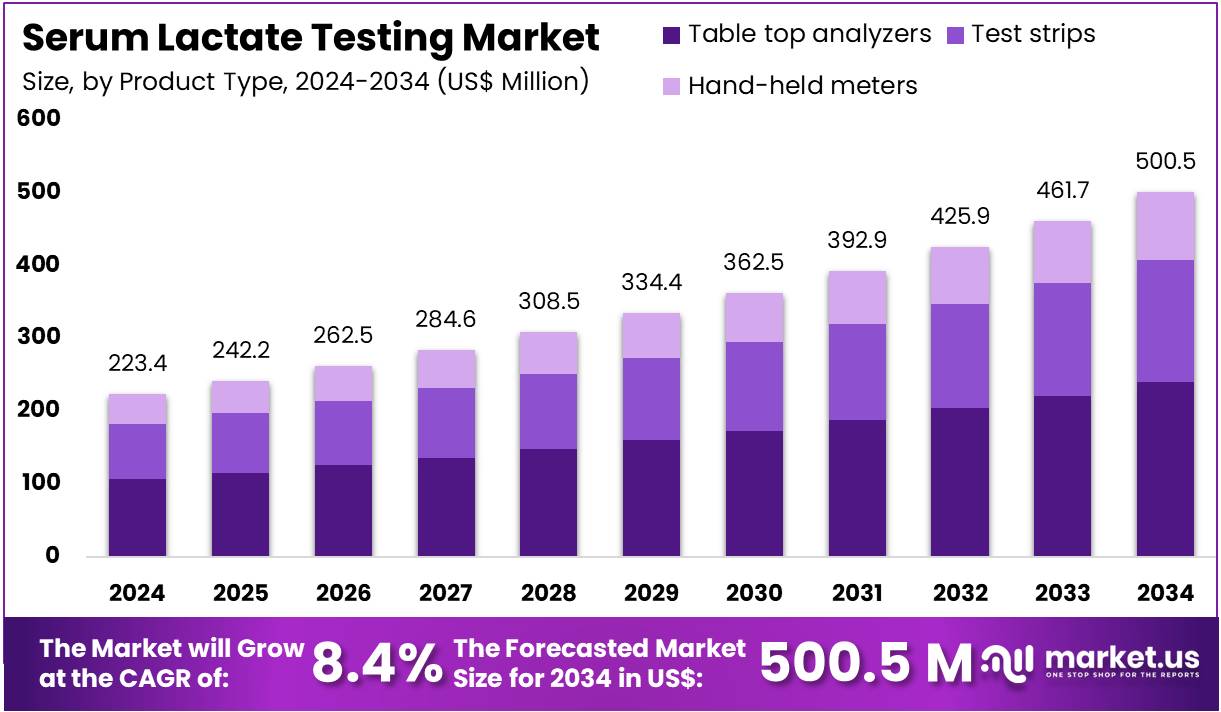
The Serum Lactate Testing Market Size is expected to be worth around US$ 500.5 Million by 2034 from US$ 223.4 Million in 2024, growing at a CAGR of 8.4% during the forecast period 2025 to 2034. North America held a dominant market position, capturing more than a 37.6% share and holds US$ 84 Million market value for the year.
The global Serum Lactate Testing Market is witnessing steady growth due to the rising need for rapid diagnosis and monitoring of critical conditions such as sepsis, shock, trauma, and cardiovascular emergencies.
Serum lactate testing measures lactate levels in blood to evaluate tissue oxygenation and metabolic imbalance, helping healthcare professionals make timely treatment decisions. Elevated lactate levels, generally above 2 mmol/L, are considered an important clinical indicator, while levels exceeding 4 mmol/L may suggest severe tissue hypoperfusion and require urgent medical attention.
Increasing adoption of point-of-care testing (POCT) devices, advancements in blood analyzers, and growing demand for faster diagnostic results are supporting market expansion. Modern lactate analyzers can provide results within approximately 30–60 seconds, improving workflow efficiency in emergency departments, intensive care units (ICUs), and critical care settings. According to healthcare data, sepsis affects millions of people globally each year, with early lactate measurement playing a key role in risk assessment and patient management.
Hospitals, diagnostic laboratories, and emergency care centers are increasingly integrating serum lactate testing into clinical protocols. Portable lactate meters, automated analyzers, and disposable testing cartridges are gaining popularity due to their accuracy, convenience, and reduced turnaround time.
With increasing ICU admissions, rising prevalence of chronic diseases, and continued improvements in diagnostic technologies, the serum lactate testing market is expected to experience sustained growth through the coming years.
Key Takeaways
- In 2024, the market recorded revenue of US$ 223.4 million and is projected to grow at a CAGR of 8.4%, reaching approximately US$ 500.5 million by 2034.
- Based on product type, the market is categorized into tabletop analyzers, test strips, and hand-held meters. Among these, tabletop analyzers dominated in 2024, accounting for a 47.9% market share.
- By application, the market is segmented into medical intervention, veterinary application, and sports application. The medical intervention segment held the leading position in 2024, capturing a 58.2% share.
- In terms of end users, the market is divided into hospitals, sports institutes, specialty clinics, home care settings, and diagnostic laboratories. The hospitals segment emerged as the largest contributor, holding a 51.4% revenue share.
- Regionally, North America dominated the market in 2024, accounting for a 37.6% market share.
Statistical Information
- Point-of-care (POC) lactate testing reduced the time required to obtain lactate results from 53 minutes to 33 minutes in a 2025 emergency department observational study, improving the speed of clinical decision-making by 20 minutes.
- In a 2025 systematic review of POC lactate testing, bedside lactate devices produced results in approximately 60–120 seconds, compared with approximately 25–40 minutes for conventional laboratory lactate testing.
- A 2025 clinical evaluation reported that the introduction of bedside lactate testing increased repeat lactate measurement rates from 82.1% to 88.2%, representing a 6.1 % point improvement in monitoring frequency.
- A handheld lactate analyzer evaluated in a 2026 peer-reviewed study showed a mean coefficient of variation (CV) of 4.1% across repeated measurements, with a median CV of 3.1%, indicating measurement precision performance.
- In the same 2026 analyzer evaluation, 380 out of 400 measurements (95%) differed by less than 0.3 mmol/L from the reference value.
- A 2026 study comparing 10 handheld lactate analyzer units found relative differences ranging from -1.3% to +1.8%, with all devices remaining within a mean absolute difference of 1.8% from the reference measurement.
- A handheld serum lactate meter specification available in 2025 reported a measurement range of 0.5–25.0 mmol/L, allowing testing across low to high lactate concentration ranges.
- A portable lactate analyzer specification reported a required blood sample volume of 0.3 µL and a test completion time of 15 seconds after blood detection.
- The ARKRAY Lactate Pro 2 analyzer stores up to 330 measurement results, supporting repeated monitoring and data review in clinical or field environments.
Regional Analysis
North America dominates the Serum Lactate Testing Market, supported by advanced critical care infrastructure, high sepsis awareness, and widespread adoption of point-of-care diagnostic technologies.
According to the Centers for Disease Control and Prevention, sepsis affects around 1.7 million adults annually in the United States, highlighting the need for rapid lactate monitoring in emergency and intensive care settings. Strong healthcare investments, standardized sepsis protocols, and adoption of lactate-guided treatment pathways continue to strengthen regional demand.
Asia Pacific is projected to witness the fastest growth during the forecast period due to rising healthcare expenditure, increasing infectious disease burden, and expansion of emergency care facilities. The World Health Organization reports that sepsis remains a major global health challenge, particularly in low- and middle-income countries, encouraging governments to improve diagnostic accessibility.
Investments in hospital infrastructure and point-of-care testing adoption are expected to accelerate serum lactate testing growth across emerging Asian markets.
Emerging Trends
- Increasing Adoption of Point-of-Care Lactate Testing: Point-of-care lactate testing is becoming a major trend in emergency and critical care because it provides rapid results at the patient’s bedside. Portable analyzers help clinicians identify tissue hypoperfusion quickly. According to WHO, sepsis affects around 48.9 million people globally each year, increasing demand for faster diagnostic solutions.
- Integration with Sepsis Screening Protocols: Hospitals are increasingly including serum lactate testing in sepsis management pathways to support early intervention. The CDC reports that around 1.7 million adults in the United States develop sepsis annually, creating greater demand for rapid lactate assessment tools in emergency departments and intensive care units.
- Growth of Portable and Connected Lactate Analyzers: Compact lactate analyzers with wireless connectivity are gaining popularity across emergency rooms, ambulances, and remote healthcare centers. These devices provide results within minutes and support digital healthcare workflows. Advanced systems are focusing on data transfer, electronic health record integration, and improving clinical decision-making speed.
- Expansion Beyond Traditional Critical Care Applications: Serum lactate testing is expanding beyond sepsis diagnosis into trauma care, cardiovascular emergencies, surgical monitoring, and sports medicine. Elevated lactate levels help identify oxygen delivery problems and metabolic stress. Healthcare providers increasingly use lactate values for patient risk assessment and therapy monitoring.
- Rising Demand for Affordable Testing Solutions: Affordable and easy-to-operate lactate testing devices are becoming important in developing regions where laboratory infrastructure is limited. WHO emphasizes improving access to essential diagnostic tools. Portable devices with low maintenance requirements are supporting emergency healthcare delivery in rural and resource-limited settings.
Use Cases
- Sepsis Diagnosis and Patient Monitoring: Serum lactate testing is widely used for detecting severe infections and monitoring sepsis progression. Elevated lactate levels indicate poor tissue oxygenation and help doctors evaluate treatment response. With approximately 48.9 million global sepsis cases annually, lactate measurement remains a key biomarker in critical care.
- Emergency Department Patient Assessment: Emergency departments use lactate testing for rapid evaluation of patients with shock, severe infections, and trauma. Fast results allow clinicians to prioritize treatment decisions. Point-of-care devices can provide lactate measurements within minutes, supporting quicker intervention for high-risk patients.
- Intensive Care Unit Monitoring: ICUs use repeated serum lactate measurements to monitor critically ill patients, especially those experiencing septic shock or organ dysfunction. Serial testing helps doctors evaluate whether treatments are improving circulation and oxygen delivery. Lactate monitoring is frequently combined with blood gas analysis in critical care settings.
- Trauma and Surgical Care Applications: Trauma centers use lactate testing to assess the severity of injuries and identify hidden circulatory problems. Surgeons and anesthesiologists monitor lactate levels during complex procedures to evaluate patient stability. Early detection of rising lactate levels can support faster clinical responses.
- Cardiac and Exercise Medicine Applications: Serum lactate testing is used in cardiac care and exercise physiology to measure metabolic stress and oxygen utilization. Athletes and researchers use lactate measurements to evaluate endurance performance. In hospitals, lactate levels assist in assessing patients with cardiac emergencies and circulatory disorders.
Frequently Asked Questions on Serum Lactate Testing
- Why is Serum Lactate Testing used in hospitals?
Serum lactate testing is widely used in hospitals to evaluate patients with severe infections, sepsis, trauma, and circulatory problems. It provides important information about tissue oxygenation and helps doctors make rapid treatment decisions in emergency and intensive care units. - How does Serum Lactate Testing help in sepsis diagnosis?
Serum lactate testing supports sepsis diagnosis by identifying elevated lactate levels associated with poor tissue oxygen delivery. Monitoring lactate changes helps healthcare providers assess disease severity, guide treatment strategies, and evaluate patient responses during sepsis management and recovery. - What are the key factors driving the Serum Lactate Testing Market?
The Serum Lactate Testing Market is driven by increasing cases of sepsis, growing demand for rapid diagnostic tools, expansion of intensive care facilities, and rising adoption of point-of-care testing devices. These factors support improved emergency care and faster clinical decision-making. - What types of products are available in the Serum Lactate Testing Market?
The Serum Lactate Testing Market includes laboratory analyzers, handheld lactate meters, test strips, biosensor-based devices, and point-of-care testing systems. These products are designed to provide accurate lactate measurements, improve workflow efficiency, and support timely diagnosis in healthcare settings. - Which healthcare facilities use Serum Lactate Testing systems?
Serum lactate testing systems are used in hospitals, emergency departments, intensive care units, diagnostic laboratories, and specialized healthcare centers. These facilities utilize lactate measurements to monitor critically ill patients, assess treatment progress, and improve clinical outcomes. - Which regions are leading the Serum Lactate Testing Market?
North America, Europe, and the Asia-Pacific are major regions supporting the serum lactate testing market growth. Increasing healthcare investments, rising critical care demand, advanced diagnostic infrastructure, and growing awareness about early disease detection are contributing to regional market development. - What future developments are expected in the Serum Lactate Testing Market?
Future developments in the Serum Lactate Testing Market include advanced biosensor technologies, integration with digital healthcare systems, portable diagnostic solutions, and improved automation. These innovations are expected to enhance testing accuracy, reduce turnaround time, and support better patient management.
Conclusion
The Serum Lactate Testing Market is expected to witness steady growth as healthcare systems increasingly prioritize rapid diagnosis and monitoring of critical conditions such as sepsis, shock, and organ dysfunction. Rising adoption of point-of-care analyzers, improved diagnostic technologies, and expanding hospital infrastructure are strengthening market opportunities.
Hospitals remain the major end users due to the growing need for real-time lactate assessment in emergency and intensive care settings. With technological advancements, increasing awareness, and integration of lactate testing into clinical protocols, the market is projected to expand significantly, supporting better patient outcomes and faster critical care decision-making worldwide.
Discuss your needs with our analyst
Please share your requirements with more details so our analyst can check if they can solve your problem(s)




