


Overview
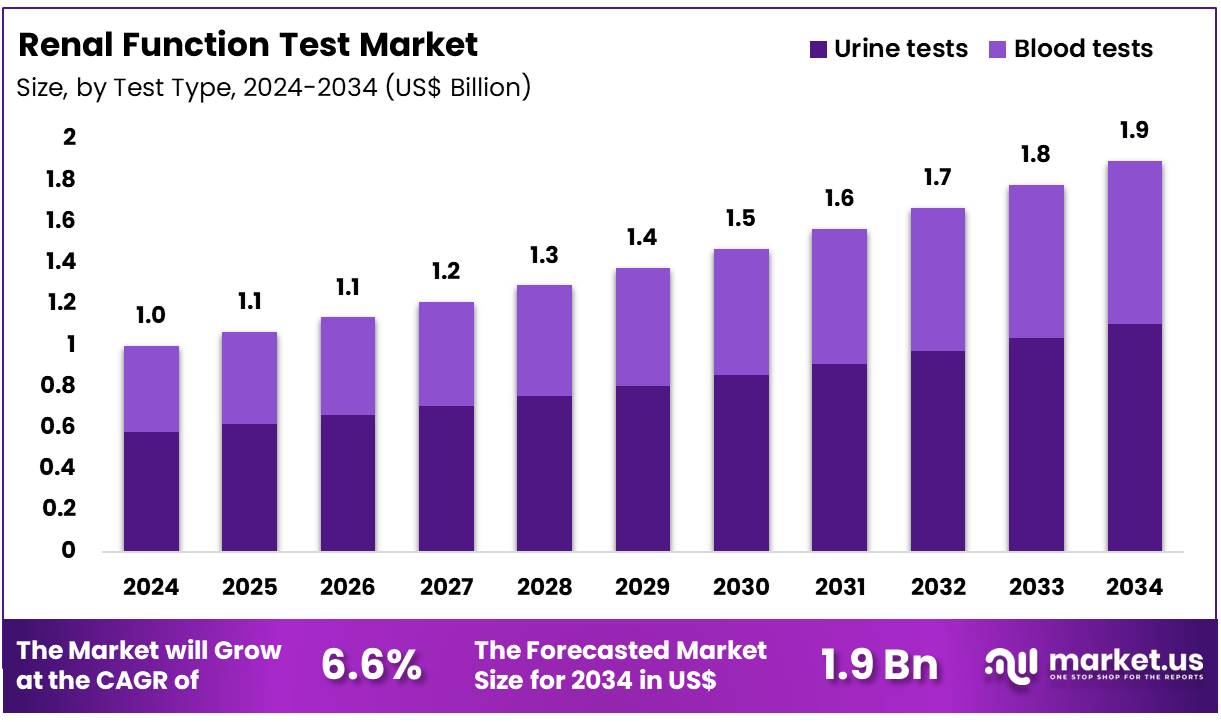
New York, NY – Aug 25, 2026 – Global Renal Function Test Market size is expected to be worth around US$ 1.9 Billion by 2034 from US$ 1.0 Billion in 2024, growing at a CAGR of 6.6% during the forecast period 2025 to 2034. In 2024, North America led the market, achieving over 38.3% share with a revenue of US$ 0.4 Billion.
The global Renal Function Test Market is witnessing steady growth due to the rising prevalence of chronic kidney diseases (CKD), diabetes, hypertension, and increasing demand for early kidney disorder detection. Renal function tests, including serum creatinine tests, blood urea nitrogen (BUN) tests, estimated glomerular filtration rate (eGFR) assessments, and urine albumin tests, are essential diagnostic tools for monitoring kidney health and treatment outcomes.
According to global health estimates, more than 850 million people worldwide are affected by kidney diseases, highlighting the growing need for advanced diagnostic solutions. Chronic kidney disease impacts approximately 10% of the global adult population, with millions requiring regular monitoring through laboratory-based renal assessments. The increasing adoption of automated analyzers and point-of-care testing systems is improving diagnostic accuracy and reducing turnaround time.
The market is expanding as healthcare systems focus on preventive screening programs and early-stage disease management. Technological advancements such as high-sensitivity biomarkers, digital laboratory platforms, and AI-supported diagnostic workflows are enhancing renal testing capabilities. Additionally, the growing geriatric population, rising incidence of diabetes affecting over 800 million adults globally, and increasing healthcare expenditure are supporting market development.
Hospitals, diagnostic laboratories, and research institutions are increasingly adopting renal function testing solutions for routine screening and disease progression monitoring. With continuous innovation in testing technologies and increased awareness about kidney health, the renal function test market is expected to experience significant opportunities in the coming years, driven by the demand for faster, accurate, and accessible diagnostic services.
Key Takeaways
- In 2024, the market generated a revenue of US$1.0 billion, with a CAGR of 6.6%, and is projected to reach US$1.9 billion by 2034.
- Based on product type, the market is segmented into dipsticks, reagents, and disposables. Among these, dipsticks dominated in 2023, accounting for a 46.8% market share.
- By test type, the market is categorized into urine tests and blood tests, with urine tests holding a significant share of 58.3%.
- In terms of end users, the market is segmented into hospitals, diagnostic laboratories, and research laboratories & institutes. The hospitals segment led the market, capturing the highest revenue share of 52.9%.
- North America emerged as the leading regional market in 2023, securing a 38.3% share of the global market.
Statistical Information
- Smartphone-enabled urine albumin-to-creatinine ratio (uACR) testing achieved 96.4% sensitivity and 84.2% specificity for detecting albuminuria in at-risk kidney disease populations in a 2025 clinical accuracy study.
- The smartphone-enabled uACR kidney test achieved a 98.6% negative predictive value (NPV) and correctly classified 85.6% of samples into KDIGO albuminuria categories A1, A2, and A3 in 2025 testing.
- In a 2026 evaluation of point-of-care creatinine testing, P30 accuracy was 32.6% compared with laboratory creatinine measurements and 28.1% compared with cystatin C-based eGFR calculations.
- Point-of-care creatinine testing demonstrated a negative predictive value of 91.3% for detecting chronic kidney disease stage 3 or higher when compared with cystatin C reference measurements in a 2026 study.
- The 2025 NIST assessment of urine albumin and creatinine reference materials showed measurement equivalence intervals agreeing at approximately a 95% confidence level for improving renal test calibration accuracy.
- NIST’s 2025 Standard Reference Material 3666 for renal testing contains 4 frozen human urine reference levels designed for validation and quality control of albumin, creatinine, and albumin-to-creatinine ratio measurements.
- Siemens’ CLINITEK urine albumin-to-creatinine ratio testing technology provides kidney screening results within 1 minute using automated urine strip analysis.
- Siemens CLINITEK Microalbumin testing detects urinary albumin concentrations as low as 10 mg/L, supporting early-stage renal function screening.
- A 2026 BMJ prospective cohort study evaluating creatinine- and cystatin C-based kidney function estimation reported that cystatin C-based testing achieved 95% accuracy for baseline kidney function estimation compared with 90% accuracy for creatinine-based testing.
- Kidney function estimates based on different eGFR equations in a 2026 multicenter analysis of 1,909,042 adults showed predictive discrimination differences, with AUROC values ranging from 0.846 to 0.862 for kidney failure prediction.
Regional Analysis
North America held a leading position in the renal function test market, supported by strong healthcare infrastructure, early CKD detection initiatives, and widespread adoption of diagnostic technologies. In the United States, the CDC estimates that more than 1 in 7 adults, or approximately 35.5 million people, are affected by chronic kidney disease, increasing demand for eGFR, creatinine, and urine albumin-to-creatinine ratio testing. Growing screening programs for diabetes and hypertension patients, along with advancements in automated laboratory analyzers, continue to strengthen regional growth.
Asia Pacific is expected to register the fastest growth during the forecast period due to rising CKD prevalence, aging populations, and increasing diabetes cases. Countries including China, India, Japan, and South Korea are expanding diagnostic access through government healthcare programs, digital health initiatives, and investments in automated renal testing platforms. According to WHO estimates, CKD prevalence across Asia-Pacific countries ranged from 4.7% to 17.4%, highlighting significant demand for early kidney disease detection solutions.
Emerging Trends
- Rising Adoption of Early CKD Screening Using eGFR and Albumin Tests: Healthcare systems are increasingly prioritizing early chronic kidney disease (CKD) detection through estimated glomerular filtration rate (eGFR) and urine albumin-to-creatinine ratio (ACR) testing. CDC reports that more than 35 million U.S. adults have CKD, while nearly 9 out of 10 people with CKD are unaware of their condition, driving demand for preventive renal screening programs.
- Increasing Demand for Point-of-Care Renal Testing Solutions: Point-of-care renal testing is becoming a major trend due to the need for faster diagnosis in emergency departments, clinics, and remote healthcare settings. Portable analyzers can provide creatinine and kidney function results within minutes, improving decision-making. This trend is supported by the growing burden of CKD, which affects approximately 1 in 7 U.S. adults.
- Growth of Advanced Kidney Biomarkers for Early Damage Detection: The renal diagnostics landscape is moving beyond traditional creatinine testing toward biomarkers such as cystatin C, kidney injury molecule-1 (KIM-1), and neutrophil gelatinase-associated lipocalin (NGAL). These markers help identify kidney injury earlier, particularly in acute kidney injury cases where rapid detection can improve patient outcomes.
- Integration of Digital Health and Artificial Intelligence in Kidney Monitoring: Artificial intelligence and digital platforms are emerging in renal diagnostics by combining laboratory values, patient history, and electronic health records for improved risk prediction. AI-based kidney models are being developed to identify CKD progression patterns, supporting personalized treatment decisions and improving monitoring efficiency among high-risk populations.
- Expansion of Home-Based and Remote Kidney Testing: Home-based kidney monitoring is gaining attention as healthcare shifts toward decentralized diagnostics. Connected urine testing devices and remote monitoring platforms allow patients with diabetes, hypertension, and CKD risks to track kidney health regularly. Since diabetes contributes to approximately 40% of kidney failure cases, home monitoring solutions are expected to support early intervention.
Use Cases
- Diabetes-Related Kidney Disease Monitoring: Renal function tests are widely used for diabetic patients to detect kidney damage before severe progression occurs. CDC estimates that around 38% of adults with diabetes have CKD, increasing demand for regular eGFR and urine albumin testing to support early diagnosis, medication management, and prevention of kidney failure.
- Hypertension and Cardiovascular Disease Management: Kidney function testing is increasingly used among hypertension patients because high blood pressure can accelerate kidney damage. CDC data indicates that approximately 1 in 5 adults with hypertension have CKD, creating demand for routine creatinine, eGFR, and albuminuria assessments in primary care and cardiovascular risk programs.
- Medication Safety and Dose Adjustment: Renal function tests are essential for evaluating kidney capacity before prescribing medications that are eliminated through the kidneys. Physicians use creatinine and eGFR measurements to adjust drug doses, reduce toxicity risks, and improve treatment safety, especially among elderly patients and individuals with reduced kidney function.
- Dialysis and Kidney Transplant Monitoring: Renal function tests are critical for monitoring patients undergoing dialysis or kidney transplantation. Healthcare providers regularly evaluate creatinine levels, eGFR values, and other kidney indicators to assess treatment effectiveness. An eGFR below 15 mL/min/1.73 m² is considered kidney failure and may require renal replacement therapy.
- High-Risk Population Screening Programs: Government healthcare initiatives are expanding targeted kidney screening among people with diabetes, hypertension, obesity, and cardiovascular conditions. Since CKD often develops without noticeable symptoms during early stages, blood and urine-based renal tests help identify disease earlier and enable timely lifestyle changes and medical interventions.
Frequently Asked Questions on Renal Function Test
- Why are Renal Function Tests performed?
Renal Function Tests are performed to detect kidney damage, monitor chronic kidney disease progression, evaluate treatment effectiveness, and assess kidney performance before certain medical procedures. Regular testing supports early diagnosis and helps prevent severe kidney-related complications. - What are the main parameters measured in Renal Function Tests?
Renal Function Tests commonly measure serum creatinine, blood urea nitrogen (BUN), eGFR, urine albumin levels, and electrolyte balance. These parameters provide insights into kidney filtration capacity, waste elimination ability, and overall renal system functioning. - What factors are increasing the demand for Renal Function Tests?
Growing cases of chronic kidney disease, diabetes, hypertension, and aging populations are increasing demand for Renal Function Tests. Rising awareness about preventive healthcare and routine screening programs is also encouraging wider adoption of kidney diagnostic solutions. - What technologies are used in Renal Function Testing?
Renal Function Testing uses technologies such as automated clinical chemistry analyzers, immunoassays, biosensors, and point-of-care testing devices. These technologies enhance diagnostic accuracy, provide faster results, and improve accessibility of kidney function monitoring across healthcare settings. - What are the major applications of the Renal Function Test Market?
The Renal Function Test Market is used for chronic kidney disease diagnosis, dialysis monitoring, drug safety assessments, hospital diagnostics, and preventive health screenings. These applications help healthcare providers evaluate kidney performance and make informed treatment decisions. - What are the emerging trends in the Renal Function Test Market?
Emerging trends include point-of-care diagnostics, artificial intelligence-based analysis, digital health integration, advanced biomarker development, and automated laboratory systems. These innovations aim to improve testing speed, accuracy, patient convenience, and early kidney disease detection. - What is the future outlook of the Renal Function Test Market?
The Renal Function Test Market is expected to grow with increasing kidney disease awareness, technological advancements, and demand for early diagnosis. Future developments will focus on personalized testing, portable diagnostic devices, and improved access to renal healthcare services.
Conclusion
The renal function test market is positioned for significant expansion as healthcare systems increasingly focus on early detection, disease prevention, and continuous monitoring of kidney health. Rising cases of chronic kidney disorders, aging populations, and the growing prevalence of lifestyle-related diseases are driving demand for reliable diagnostic solutions.
Innovations in automated analyzers, biomarker-based testing, and point-of-care technologies are improving testing efficiency and accessibility. With increasing investments in healthcare infrastructure and diagnostic capabilities, renal function tests are becoming essential tools for managing kidney-related conditions. The market is expected to experience sustained growth as awareness and adoption of advanced testing methods continue to rise globally.
Discuss your needs with our analyst
Please share your requirements with more details so our analyst can check if they can solve your problem(s)




