


Overview
New York, NY – Sep 09, 2026 – The Global Procalcitonin (PCT) Assay Market size is expected to be worth around US$ 580.7 Million by 2034 from US$ 312.3 Million in 2024, growing at a CAGR of 6.4% during the forecast period 2025 to 2034. In 2024, North America led the market, achieving over 40.3% share with a revenue of US$ 125.9 Million.
Procalcitonin (PCT) Assay is expanding due to the growing need for rapid diagnosis and monitoring of bacterial infections, particularly sepsis, pneumonia, and other severe inflammatory conditions. Procalcitonin is a clinically important biomarker that helps healthcare providers identify bacterial infections, assess disease severity, and support antibiotic treatment decisions.
According to the World Health Organization (WHO), sepsis affects an estimated 49 million people globally every year, resulting in approximately 11 million deaths annually, highlighting the demand for faster diagnostic solutions.
The increasing burden of antimicrobial resistance (AMR) is another major factor supporting PCT assay adoption. The WHO estimates that bacterial antimicrobial resistance directly contributes to around 1.27 million deaths annually worldwide, creating a need for diagnostic tools that enable targeted antibiotic use. Clinical studies have shown that PCT-guided antibiotic strategies can reduce antibiotic exposure by approximately 2–4 days in many patient groups while maintaining patient safety.
The market includes advanced testing technologies such as chemiluminescent immunoassays (CLIA), enzyme-linked immunosorbent assays (ELISA), fluorescence immunoassays, and point-of-care testing (POCT) platforms.
Modern automated PCT analyzers can deliver results in approximately 20–60 minutes, supporting faster clinical decision-making in emergency and intensive care settings. Many PCT assays are designed to detect low biomarker concentrations, often measuring levels from 0.02 ng/mL to more than 100 ng/mL, depending on disease severity.
Hospitals and diagnostic laboratories are the major end users due to the increasing adoption of biomarker-based testing in intensive care units (ICUs). According to healthcare studies, approximately 30%–50% of ICU patients with suspected infections may undergo biomarker-based evaluation to improve diagnosis and treatment management.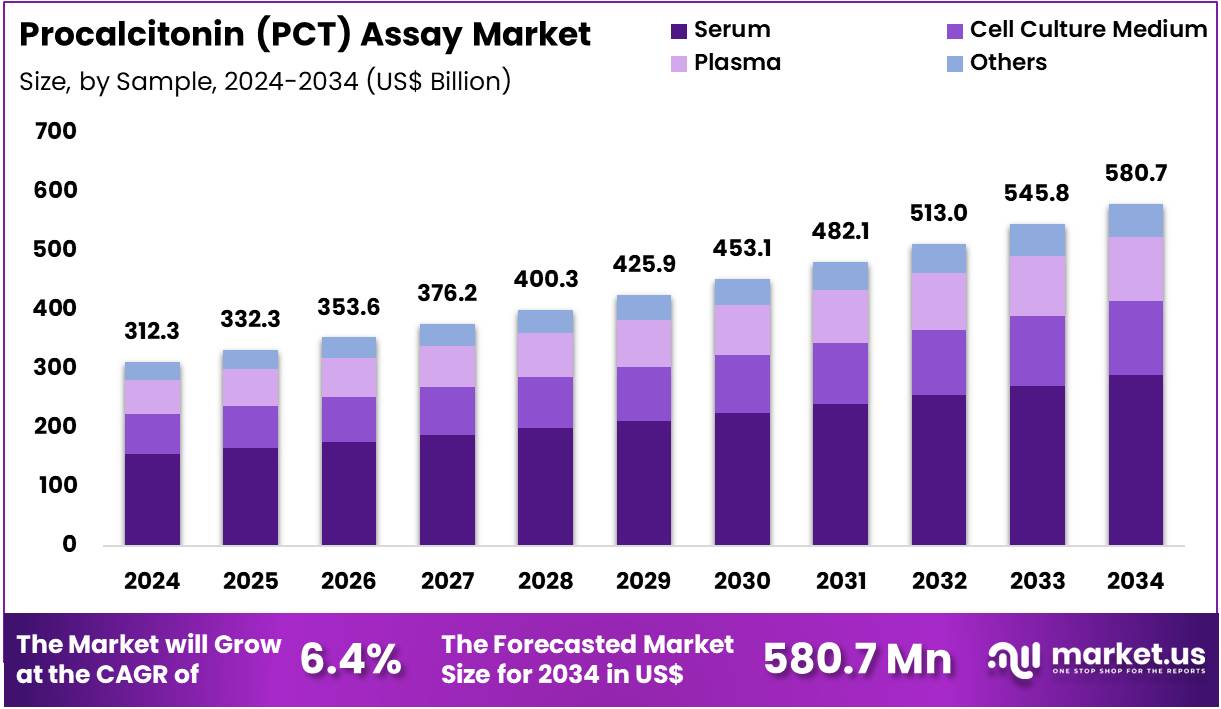
Key Takeaways
- In 2024, the Procalcitonin (PCT) Assay Market recorded revenue of US$ 312.3 million and is projected to grow at a CAGR of 6.4%, reaching approximately US$ 580.7 million by 2034.
- Based on product type, the market is segmented into test kits, consumables, and analyzers & instruments. The test kits segment dominated in 2024, accounting for the highest market share of 45.6%, driven by increasing demand for rapid and accurate infection detection.
- By sample type, the market is categorized into serum, cell culture medium, plasma, and others. The serum segment held a leading position in 2024, capturing a significant market share of 49.8% due to its widespread use in clinical PCT testing.
- Based on end-user, the market is segmented into hospitals, specialty clinics, diagnostic laboratories, and academic & research institutes. The hospital segment emerged as the largest contributor in 2024, representing 47.2% of the total market revenue due to higher adoption of PCT testing in critical care settings.
- Regionally, North America dominated the Procalcitonin (PCT) Assay Market in 2024, accounting for a market share of 40.3%, supported by advanced healthcare infrastructure, increased sepsis testing, and strong adoption of biomarker-based diagnostics.
Statistical Information
- Increasing Global Sepsis Cases Driving Procalcitonin Assay Adoption: Sepsis is one of the major clinical drivers for Procalcitonin (PCT) testing because rapid identification of bacterial infections helps physicians make faster treatment decisions. In the United States, the CDC estimates that at least 1.7 million adults develop sepsis every year, with approximately 350,000 adults dying during hospitalization or being discharged to hospice care. Additionally, 1 in 3 adults who die in a hospital had sepsis during their hospital stay, increasing demand for early infection biomarkers.
- Antimicrobial Resistance Increasing Need for PCT-Based Antibiotic Guidance: Antimicrobial resistance is increasing the importance of diagnostic tools that help reduce unnecessary antibiotic use. WHO reported that bacterial antimicrobial resistance was associated with approximately 4.7 million deaths globally in 2021, while antibiotic-resistant bacterial infections directly caused more than 1.2 million deaths annually. Improved diagnostic approaches, including biomarker testing such as PCT, support antimicrobial stewardship programs.
- Growing Need for Faster Diagnostics Supports Future PCT Applications: The combination of 1.7 million annual adult sepsis hospitalizations in the U.S., 350,000 annual severe outcomes, rising antimicrobial resistance, and increased antibiotic stewardship efforts continues to support the adoption of Procalcitonin assays across hospitals and diagnostic laboratories.
- Annual PCT test volume and avoidable utilization: A large US health‑system analysis reported 142,644 PCT assays performed in one calendar year, with 44.1% deemed avoidable based on clinical presentation and outcome. Avoiding these tests could have saved USD 594,390 annually, highlighting both high utilization and significant optimization potential in PCT assay ordering behavior across hospitals.
- Global sepsis burden underpinning PCT assay demand: The Global Burden of Disease 2017 analysis estimated 48.9 million sepsis cases and 11.0 million sepsis‑related deaths worldwide in 2017, representing 19.7% of all global deaths. This enormous clinical burden, dominated by bacterial infections and high antibiotic use, provides the epidemiological base driving adoption of PCT assays for sepsis diagnosis and stewardship.
- SAPS trial outcomes supporting PCT assay utilization: The SAPS trial reported that PCT‑guided therapy reduced antibiotic duration from 7 to 5 days (p<0.0001) and lowered 28‑day mortality from 25% to 20.9%, with similar improvements at one year. These outcome benefits position PCT assays not just as diagnostics, but as value‑adding tools influencing length of stay, costs, and survival.
- Hospital-level PCT assay cost and monthly spend: In a rural 65‑bed US hospital, the laboratory cost per PCT assay was USD 26, with average monthly expenditure of USD 6,600 on PCT. Published estimates place per‑sample assay costs between USD 10 and 30. Despite meaningful spending, the initial 6‑month evaluation showed no detectable savings in antibiotic purchasing or length of stay.
Regional Analysis
North America led the market by securing a market share of 40.3% in 2024.
North America remains a leading region for Procalcitonin (PCT) assay adoption due to advanced healthcare infrastructure, increasing sepsis awareness, and strong implementation of antimicrobial stewardship programs. The United States has a high burden of severe infections, with the CDC reporting approximately 1.7 million adults developing sepsis annually and around 350,000 adults dying during hospitalization or being discharged to hospice after sepsis.
Hospitals and intensive care units increasingly use PCT testing to support early infection assessment and antibiotic management decisions. Growth is further supported by FDA-cleared immunoassay technologies, expanding laboratory automation, and increased adoption of biomarker-based diagnostic pathways. Asia Pacific is projected to experience significant growth due to improving healthcare access, rising investments in diagnostic infrastructure, and increasing focus on antimicrobial resistance control.
Healthcare systems are expanding infection surveillance and adopting rapid diagnostic technologies. Australia reported 18,659 sepsis-related deaths in 2022, highlighting the need for early detection strategies. Increasing hospital capacity and adoption of automated diagnostic platforms are expected to support regional PCT assay demand.
Emerging Trends
- Growing Adoption of PCT Testing for Early Sepsis Detection: Hospitals are increasingly integrating Procalcitonin assays into sepsis pathways to enable faster bacterial infection assessment. The CDC reports that approximately 1.7 million adults develop sepsis annually in the U.S., with nearly 350,000 deaths or hospice discharges, increasing demand for rapid diagnostic biomarkers.
- Expansion of Antimicrobial Stewardship Programs Using PCT Biomarkers: Healthcare systems are adopting PCT-guided antibiotic strategies to reduce unnecessary antibiotic exposure and combat antimicrobial resistance. CDC data shows that 55% of U.S. hospitals incorporated antibiotic stewardship programs into sepsis care activities in 2022, supporting wider biomarker utilization.
- Increasing Demand for Automated Immunoassay-Based PCT Platforms: Clinical laboratories are shifting toward automated analyzers that improve testing speed, accuracy, and workflow efficiency. FDA-cleared PCT systems use advanced immunoassay technologies, including chemiluminescent methods, for quantitative measurement of procalcitonin levels in patient samples.
- Rising Focus on Antimicrobial Resistance Management: The global increase in antibiotic-resistant infections is accelerating demand for diagnostic tools that support targeted therapy. WHO estimates that antimicrobial resistance directly caused approximately 1.27 million deaths globally in 2019 and was associated with 4.95 million deaths, strengthening the need for infection biomarkers.
- Increasing Integration of PCT Testing in Intensive Care Units: Intensive care units are expanding the use of PCT assays for monitoring critically ill patients with suspected bacterial infections. CDC data indicates that sepsis contributes to more than one-third of hospital deaths in the U.S., increasing demand for rapid infection assessment technologies.
Use Cases
- Sepsis Diagnosis and Infection Risk Assessment: Procalcitonin assays are widely used in hospitals to support the evaluation of patients with suspected bacterial sepsis. FDA-cleared PCT tests help measure biomarker levels in blood samples and assist clinicians in assessing infection severity along with clinical symptoms and other laboratory findings.
- Antibiotic Therapy Guidance and Stewardship: PCT testing is used to support antibiotic initiation and discontinuation decisions, helping physicians avoid unnecessary antibiotic exposure. WHO reported that antimicrobial resistance was directly responsible for approximately 1.27 million deaths globally in 2019, increasing the importance of diagnostic tools that improve antibiotic management.
- Lower Respiratory Tract Infection Management: Procalcitonin assays are applied in suspected lower respiratory tract infections, including pneumonia cases, to support antibiotic treatment decisions. FDA-cleared PCT indications include use as an aid in antibiotic therapy decisions for patients with respiratory infections and other bacterial infection conditions.
- Emergency Department Rapid Infection Evaluation: Emergency departments use PCT testing to provide faster infection-related information for critically ill patients. CDC data shows that approximately 1.7 million adults develop sepsis annually in the United States, highlighting the need for rapid diagnostic solutions during emergency care.
- Intensive Care Unit Patient Monitoring: ICUs use PCT assays to monitor bacterial infection progression and treatment response in critically ill patients. FDA-cleared PCT platforms support risk assessment applications in intensive care settings, helping healthcare providers combine biomarker results with clinical evaluation for improved patient management.
- Hospital Antimicrobial Stewardship Programs: Hospitals integrate PCT testing into antimicrobial stewardship workflows to improve antibiotic selection and reduce overuse. CDC reported that 55% of U.S. hospitals included stewardship activities in sepsis care programs in 2022, supporting increased adoption of biomarker-based approaches.
Frequently Asked Questions on Procalcitonin Assay
- What are the major product types in the Procalcitonin Assay Market?
The Procalcitonin Assay Market includes test kits, consumables, and analyzers & instruments. Test kits are widely used due to their convenience and accuracy, while automated analyzers are gaining adoption because they improve laboratory efficiency and provide faster results. - Which sample types are used for Procalcitonin testing?
Procalcitonin assays primarily use blood-based samples, including serum and plasma. These sample types are preferred because they provide reliable measurement of PCT concentrations and are widely validated across hospital laboratories, diagnostic centers, and clinical testing environments. - What are the key applications of Procalcitonin assays?
Key applications of Procalcitonin assays include sepsis diagnosis support, lower respiratory tract infection management, intensive care monitoring, antibiotic therapy guidance, and emergency infection assessment. These applications improve clinical decision-making and support personalized infection management strategies. - Which region dominates the Procalcitonin Assay Market?
North America holds a leading position in the Procalcitonin Assay Market due to advanced healthcare infrastructure, high adoption of diagnostic technologies, strong sepsis management programs, and increasing use of biomarker-based testing in hospitals and clinical laboratories. - How does technology influence Procalcitonin assay development?
Advancements in immunoassay technologies, automation, and rapid diagnostic platforms are improving Procalcitonin testing performance. Modern systems provide faster turnaround times, enhanced accuracy, and better laboratory workflow management, supporting broader adoption in hospitals and diagnostic facilities. - What is the future outlook for the Procalcitonin Assay Market?
The future outlook for the Procalcitonin Assay Market remains positive due to rising infection burdens, increasing antimicrobial resistance concerns, and growing demand for rapid diagnostics. Continued innovation in automated and point-of-care testing is expected to support market expansion. - Who are the major end users of Procalcitonin assays?
Major end users include hospitals, diagnostic laboratories, specialty clinics, academic research institutes, and emergency care centers. Hospitals and laboratories represent the largest users because they require rapid infection assessment tools for critical patient management. - How does PCT testing help in respiratory infection management?
PCT testing helps evaluate suspected bacterial respiratory infections by providing biomarker information that supports antibiotic treatment decisions. It is commonly used alongside clinical assessment to improve diagnosis accuracy and avoid unnecessary antibiotic prescriptions.
Conclusion
The Procalcitonin (PCT) Assay Market is experiencing steady growth due to the rising burden of sepsis, increasing antimicrobial resistance, and growing demand for rapid infection diagnostics. PCT testing plays an important role in supporting antibiotic stewardship, improving clinical decision-making, and enabling early identification of bacterial infections.
Hospitals, intensive care units, and diagnostic laboratories are increasingly adopting automated immunoassay platforms and advanced testing solutions to enhance patient care. With continued technological advancements, expanding healthcare infrastructure, and increasing focus on precision diagnostics, the adoption of Procalcitonin assays is expected to grow significantly, supporting improved infection management worldwide.
Discuss your needs with our analyst
Please share your requirements with more details so our analyst can check if they can solve your problem(s)




