


Overview
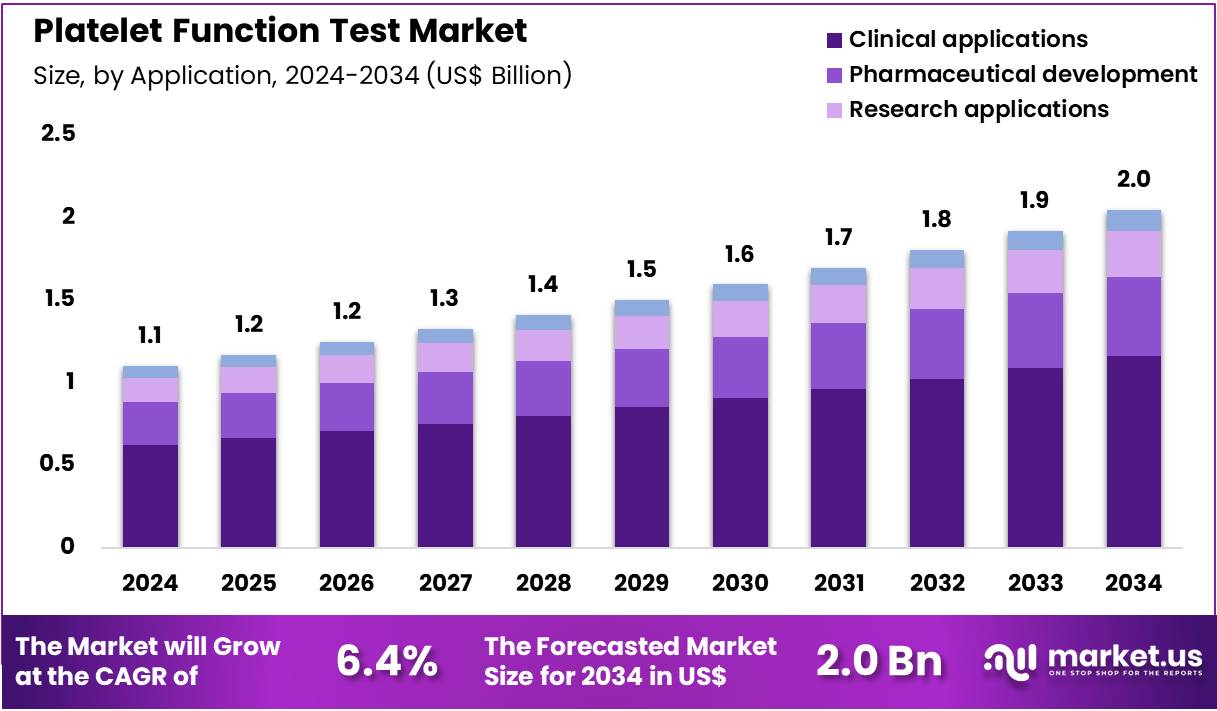
Global Platelet Function Test Market size is expected to be worth around US$ 2.0 Billion by 2034 from US$ 1.1 Billion in 2024, growing at a CAGR of 6.4% during the forecast period 2025 to 2034. In 2024, North America led the market, achieving over 41.4% share with a revenue of US$ 0.5 Billion.
Platelet function tests are specialized laboratory assessments that evaluate how effectively platelets form blood clots after blood vessel injury. These tests play an important role in diagnosing inherited and acquired platelet disorders, monitoring the effects of antiplatelet medications, and supporting clinical decisions before high-risk surgeries or invasive cardiovascular procedures.
Unlike a routine platelet count, platelet function testing measures the ability of platelets to adhere, activate, and aggregate, providing deeper insight into clotting performance. Common testing methods include light transmission aggregometry, platelet function analyzers, whole blood impedance aggregometry, and point-of-care platelet function systems, depending on the clinical setting and diagnostic need.
Healthcare organizations continue to emphasize accurate evaluation of platelet-related disorders because abnormal platelet activity can contribute to excessive bleeding or unwanted blood clot formation. According to the U.S. National Heart, Lung, and Blood Institute (NHLBI), a normal platelet count generally ranges from 150,000 to 400,000 platelets per microliter of blood, although platelet function may still be impaired despite normal counts.
Growing awareness of precision medicine, advancements in laboratory automation, and increasing cardiovascular interventions are supporting the adoption of platelet function testing across hospitals and specialized diagnostic laboratories.
Continuous improvements in testing accuracy, workflow efficiency, and point-of-care technologies are expected to strengthen the role of platelet function tests in personalized patient care, helping clinicians optimize treatment strategies while reducing bleeding and thrombotic risks.
Key Takeaways
- In 2024, the global market was valued at US$1.1 billion and is projected to reach US$2.0 billion by 2034, expanding at a CAGR of 6.4% during the forecast period.
- By product type, the market is segmented into systems, accessories, and reagents. Among these, systems emerged as the leading segment, accounting for 49.8% of the market share in 2023.
- Based on application, the market is categorized into clinical applications, pharmaceutical development, research applications, and others. Clinical applications dominated the segment with a 56.7% market share.
- In terms of end users, the market is divided into hospitals, diagnostic centers, blood banks, and others. Hospitals held the largest share, contributing 52.1% of the total market revenue.
- North America maintained its leading position in the global market, capturing a 41.4% market share in 2023.
Statistical Information
- A 2025 Scientific Reports study involving 124 neuroendovascular patients analyzed 437 platelet function test comparisons, showing that the ADP-induced Platelet Aggregation Level (APAL) correlated with VerifyNow PRU at r = 0.55 (p < 0.01), compared with r = 0.42 (p < 0.01) for 10 μM ADP maximum aggregation, indicating stronger agreement with the widely used VerifyNow system.
- The same 2025 study established that an APAL score of 8.3 corresponded to a VerifyNow P2Y12 Reaction Unit (PRU) value of 240, providing a quantitative conversion point between the two platelet function testing methods.
- Blood samples in the 2025 neuroendovascular study were collected at three standardized testing intervals: before surgery, 1–3 days after surgery, and 1 month after surgery, demonstrating an operational monitoring protocol for platelet function testing.
- The 2025 study reported that PRU, % inhibition, and APAL values changed significantly over time, whereas 10 μM ADP maximum aggregation showed no significant temporal change, indicating better monitoring sensitivity for APAL and PRU.
- An ISTH 2025 Congress presentation evaluating platelet function tests also analyzed 437 paired measurements and found APAL–PRU correlation of r = 0.56 (p < 0.01) compared with r = 0.44 (p < 0.01) for light transmission aggregometry, supporting improved analytical performance.
- A 2025 review in the Journal of Thrombosis and Haemostasis reported that the Platelet Function Analyzer (PFA-100/200) evaluates platelet function under a high shear rate of approximately 5,000 s⁻¹, simulating arterial blood flow conditions.
- The same review states that the PFA system performs testing using two standardized agonist cartridges: collagen/epinephrine (EPI) and collagen/ADP, with closure time reported as the quantitative output.
- The 2026 ISTH Consensus on Aggregometry highlights that platelet function assessment by aggregometry becomes technically challenging when platelet counts are below 50 × 10⁹/L, providing a numerical threshold relevant for laboratory testing quality.
Regional Analysis
North America accounted for 41.4% of the global Platelet Function Test market in 2024, supported by its advanced cardiovascular care infrastructure, widespread adoption of precision diagnostics, and strong clinical research ecosystem. The growing burden of cardiovascular disease continues to increase demand for platelet function testing, particularly for patients receiving antiplatelet therapy after percutaneous coronary intervention (PCI).
According to the U.S. Centers for Disease Control and Prevention (CDC), cardiovascular disease caused 919,032 deaths in 2023, reinforcing the need for timely diagnostic testing to optimize treatment decisions.
The 2024 International Consensus Statement from the American College of Cardiology further strengthened the role of platelet function and genetic testing in selected PCI patients, encouraging broader clinical use in specialized cardiovascular centers. Continued investments by the National Institutes of Health and the availability of modern laboratory technologies, including optical aggregometry and flow cytometry, support innovation across the region.
Favorable reimbursement systems, experienced healthcare professionals, and early adoption of evidence-based diagnostic practices are expected to maintain North America’s leadership throughout the forecast period.
Emerging Trends
- Rising use of point-of-care platelet function testing: Hospitals are increasingly adopting point-of-care platelet function analyzers to support faster treatment decisions during cardiac and vascular procedures. The FDA recognizes CLSI POCT14 standards for point-of-care coagulation testing, encouraging standardized performance and broader clinical adoption across healthcare facilities.
- Personalized antiplatelet therapy is expanding: Healthcare providers are increasingly using platelet function tests to identify patients with high on-treatment platelet reactivity after antiplatelet therapy. Recent clinical reviews highlight growing use of these tests to optimize drug selection, reduce thrombotic complications, and improve individualized cardiovascular care.
- Integration with real-world clinical data: Platelet function testing is increasingly combined with electronic health records and real-world evidence programs. The FDA promotes the use of routinely collected healthcare data to improve medical device evaluation, supporting better validation and long-term performance monitoring of platelet testing technologies.
- Stronger focus on standardized testing quality: Manufacturers are increasingly designing platelet testing systems to comply with internationally recognized laboratory and device standards. FDA-recognized ISO and CLSI standards improve analytical consistency, enhance reproducibility, and strengthen confidence in platelet function results across laboratories and clinical settings.
- Advanced laboratory technologies improving platelet analysis: Research laboratories are adopting improved platelet purification and proteomic workflows to enhance biomarker discovery. A 2025 study found that label-free data-independent acquisition (LFQ-DIA) delivered superior protein coverage and sensitivity compared with alternative analytical methods, supporting future diagnostic innovation.
Use Cases
- Rising use of point-of-care platelet function testing: Hospitals are increasingly adopting point-of-care platelet function analyzers to support faster treatment decisions during cardiac and vascular procedures. The FDA recognizes CLSI POCT14 standards for point-of-care coagulation testing, encouraging standardized performance and broader clinical adoption across healthcare facilities.
- Personalized antiplatelet therapy is expanding: Healthcare providers are increasingly using platelet function tests to identify patients with high on-treatment platelet reactivity after antiplatelet therapy. Recent clinical reviews highlight growing use of these tests to optimize drug selection, reduce thrombotic complications, and improve individualized cardiovascular care.
- Integration with real-world clinical data: Platelet function testing is increasingly combined with electronic health records and real-world evidence programs. The FDA promotes the use of routinely collected healthcare data to improve medical device evaluation, supporting better validation and long-term performance monitoring of platelet testing technologies.
- Stronger focus on standardized testing quality: Manufacturers are increasingly designing platelet testing systems to comply with internationally recognized laboratory and device standards. FDA-recognized ISO and CLSI standards improve analytical consistency, enhance reproducibility, and strengthen confidence in platelet function results across laboratories and clinical settings.
- Advanced laboratory technologies improving platelet analysis: Research laboratories are adopting improved platelet purification and proteomic workflows to enhance biomarker discovery. A 2025 study found that label-free data-independent acquisition (LFQ-DIA) delivered superior protein coverage and sensitivity compared with alternative analytical methods, supporting future diagnostic innovation.
Frequently Asked Questions on Platelet Function Test
- Why is the Platelet Function Test important?
The test is important because platelet count alone cannot determine how effectively platelets function. It provides valuable information for diagnosing inherited platelet disorders, monitoring treatment response, reducing surgical bleeding complications, and optimizing therapy for patients with cardiovascular diseases. - Who should undergo a Platelet Function Test?
Doctors recommend platelet function testing for patients with unexplained bleeding, recurrent bruising, suspected platelet disorders, or those receiving antiplatelet drugs such as aspirin or clopidogrel. It is also used before selected surgeries to assess bleeding or clotting risks. - What are the common methods used for Platelet Function Testing?
Common testing methods include light transmission aggregometry, impedance aggregometry, VerifyNow assays, PFA-100/200 systems, thromboelastography (TEG), and flow cytometry. Each method measures platelet activity differently and is selected based on clinical needs, laboratory resources, and diagnostic objectives. - How should patients prepare for a Platelet Function Test?
Preparation depends on the specific test ordered. Patients should inform their physician about all medications, supplements, and recent illnesses because several drugs, including aspirin and NSAIDs, can influence platelet activity and affect the interpretation of test results. - What factors can influence Platelet Function Test results?
Results may vary because of medications, smoking, alcohol intake, infections, inflammatory conditions, low platelet counts, anemia, sample handling, and laboratory techniques. Proper patient preparation and standardized testing procedures help improve the reliability and accuracy of the results. - What is driving the growth of the Platelet Function Test Market?
The market is expanding due to increasing cardiovascular diseases, growing use of antiplatelet therapy, rising awareness of precision medicine, higher surgical volumes, and continuous advancements in automated diagnostic technologies that improve testing speed, accuracy, and clinical decision-making. - Which region leads the Platelet Function Test Market?
North America leads the platelet function test market due to advanced healthcare infrastructure, widespread cardiovascular disease management, strong diagnostic laboratory networks, favorable reimbursement policies, and early adoption of innovative platelet function analyzers across hospitals and specialized healthcare facilities. - What are the future opportunities in the Platelet Function Test Market?
Future opportunities include the development of portable point-of-care testing devices, artificial intelligence-assisted interpretation, personalized antiplatelet therapy, expanding diagnostic services in emerging economies, and greater integration of platelet function testing into routine cardiovascular and perioperative patient management.
Conclusion
The global Platelet Function Test Market is poised for steady growth, driven by the increasing prevalence of cardiovascular diseases, bleeding disorders, and the expanding use of personalized antiplatelet therapy. Rising adoption of automated analyzers, point-of-care testing systems, and microfluidic technologies is improving diagnostic speed, accuracy, and clinical decision-making.
Hospitals remain the largest end users due to strong diagnostic infrastructure and growing patient volumes, while North America continues to lead the market through advanced healthcare systems and ongoing research investments. As precision medicine gains momentum and demand for rapid, reliable hemostasis testing rises, the market is expected to witness sustained expansion, supported by technological innovation, favorable clinical guidelines, and broader adoption across healthcare settings worldwide.
Discuss your needs with our analyst
Please share your requirements with more details so our analyst can check if they can solve your problem(s)




