


Overview
New York, NY – Sep 10, 2026 – The Global Plasma Separation Tubes Market size is expected to be worth around US$ 1,032.4 Million by 2034 from US$ 560.4 Million in 2024, growing at a CAGR of 6.3% during the forecast period 2025 to 2034. In 2024, North America led the market, achieving over 38.5% share with a revenue of US$ 215.8 Million.
Plasma Separation Tubes are experiencing consistent growth, supported by the increasing demand for clinical diagnostics, preventive healthcare, and laboratory automation. Plasma separation tubes are essential blood collection devices used to separate plasma from whole blood for biochemical, immunological, molecular, and infectious disease testing.
These tubes contain anticoagulants and separation gel that help preserve sample quality and improve diagnostic accuracy. Rising cases of chronic diseases, expanding hospital networks, and higher testing volumes are accelerating the adoption of advanced blood collection products worldwide.
Globally, healthcare systems perform more than 14 billion laboratory tests each year, with 70–80% of medical decisions influenced by laboratory test results. According to the World Health Organization (WHO), approximately 118.5 million blood donations are collected worldwide annually, requiring safe and standardized blood collection devices. The U.S. Centers for Disease Control and Prevention (CDC) estimates that around 129 million emergency department visits occur annually in the United States, many involving routine blood testing.
National Institutes of Health (NIH) reports that cardiovascular diseases affect over 620 million people globally, while diabetes impacts more than 830 million people, driving the need for frequent plasma-based diagnostic testing. The Global Burden of Disease Study also estimates over 20 million new cancer cases annually, further increasing demand for laboratory diagnostics.
North America remains the leading regional market due to advanced diagnostic infrastructure, widespread laboratory automation, and high healthcare expenditure exceeding US$ 4.9 trillion annually in the United States. Europe continues to benefit from well-established clinical laboratory networks and stringent quality standards.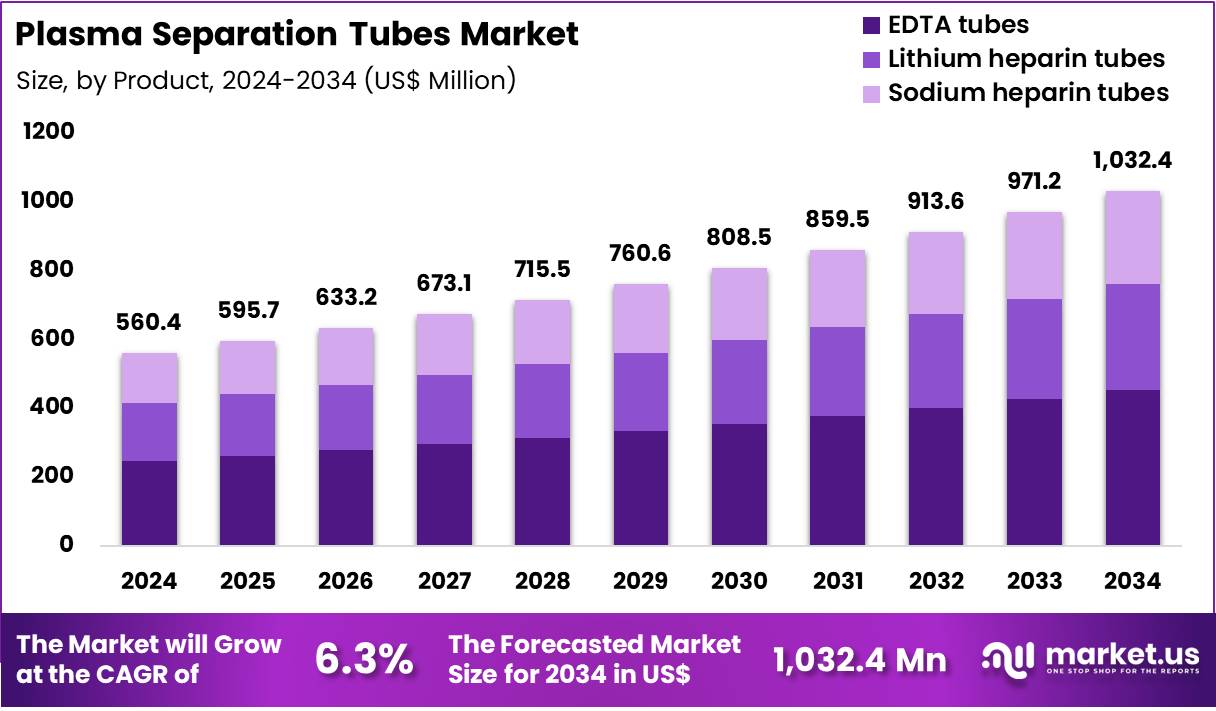
Key Takeaways
- The Plasma Separation Tubes Market generated US$ 560.4 million in revenue in 2024 and is projected to reach US$ 1,032.4 million by 2034, expanding at a CAGR of 6.3% during the forecast period.
- By Product, the market is segmented into EDTA Tubes, Lithium Heparin Tubes, and Sodium Heparin Tubes. EDTA Tubes dominated the segment in 2024, accounting for 43.9% of the total market share.
- By Material, the market is categorized into Glass and Plastic. Plastic emerged as the leading material segment in 2024, capturing 61.5% of the market share.
- By Application, the market is segmented into Diagnostic Procedures, Biochemical Tests, Blood Routine Examination, Coagulation Testing, and Others. Diagnostic Procedures held the largest share in 2024, representing 47.2% of the market.
- By End User, the market is classified into Hospitals, Ambulatory Surgical Centers, Diagnostic Centers, and Others. Hospitals led the segment in 2024 with a 40.8% market share.
- North America was the leading regional market in 2024, accounting for 38.5% of the global Plasma Separation Tubes Market.
Statistical Information
- Global Blood Donations Continue to Increase Demand for Plasma Separation Tubes: According to the World Health Organization (WHO), approximately 120.4 million blood donations are collected each year globally. Around 36% of these donations are collected in high-income countries, although they represent only 15% of the world’s population. Every donated unit requires blood collection, plasma separation, processing, and laboratory testing, directly supporting demand for plasma separation tubes.
- Blood Component Separation is Nearly Universal in Developed Healthcare Systems: WHO reports that 98% of blood collected in high-income countries is separated into blood components such as plasma, red blood cells, and platelets. In comparison, component separation reaches 94% in upper-middle-income countries, 81% in lower-middle-income countries, and 52% in low-income countries, highlighting the growing need for plasma separation technologies.
- Plasma-Derived Medicines Depend on Large Plasma Collection Volumes: The WHO Global Status Report states that approximately 21.5 million liters of plasma from 36 reporting countries were fractionated for plasma-derived medicinal products (PDMPs). In addition, only 49 of 168 reporting countries currently produce PDMPs domestically, while 119 countries rely entirely on imports, creating demand for standardized plasma collection systems.
- Every Blood Donation Undergoes Mandatory Infectious Disease Testing: WHO recommends that 100% of donated blood be screened for HIV, Hepatitis B, Hepatitis C, and Syphilis before transfusion. However, WHO reports that 10 reporting countries are still unable to screen every donation for one or more mandatory infections, emphasizing the importance of reliable plasma collection and laboratory testing systems.
- Voluntary Blood Donation Has Increased Significantly: WHO reports an increase of 11.6 million voluntary unpaid blood donations between 2013 and 2023. Additionally, 80 countries now obtain more than 90% of their blood supply from voluntary unpaid donors, strengthening demand for blood collection consumables, including plasma separation tubes.
- Blood Safety Systems Cover Nearly the Entire Global Population: The WHO Global Database on Blood Safety includes data from 168 countries, representing approximately 97% of the world’s population. These countries monitor blood collection, plasma processing, infectious disease screening, and transfusion quality, reinforcing the widespread use of plasma separation products.
- Quality Assessment Programs Continue to Expand Worldwide: WHO reports that 63% of blood screening laboratories worldwide participate in external quality assessment (EQA) programs. Participation reaches 92% in high-income countries, 66% in upper-middle-income countries, 48% in lower-middle-income countries, and 68% in low-income countries, increasing the need for standardized blood collection and plasma separation devices.
Regional Analysis
North America led the market by securing a market share of 38.5% in 2024.
North America dominates the Plasma Separation Tubes Market due to its well-established healthcare infrastructure, extensive diagnostic laboratory network, and high volume of blood testing. According to the U.S. Centers for Disease Control and Prevention (CDC), U.S. emergency departments record approximately 139.8 million visits annually, with blood testing being one of the most frequently ordered diagnostic procedures.
The Centers for Medicare & Medicaid Services (CMS) reported that U.S. healthcare expenditure reached US$ 4.9 trillion in 2023, equivalent to 17.6% of GDP, supporting continuous investment in laboratory equipment and consumables.
In addition, the American Red Cross supplies about 40% of the U.S. blood supply, requiring millions of blood collection tubes for donor screening and laboratory analysis each year. The widespread use of automated analyzers, standardized laboratory practices, and strong regulatory oversight from the FDA continue to drive demand for EDTA and lithium heparin plasma separation tubes across hospitals, blood banks, and diagnostic laboratories.
Emerging Trends
- Increasing Adoption of Automated Laboratory Systems: Hospitals and diagnostic laboratories are rapidly adopting automated blood processing and analyzers to improve efficiency. FDA-recognized standards for blood collection tubes support reliable plasma testing workflows, helping laboratories process higher sample volumes with improved accuracy and reduced manual handling errors.
- Rising Demand from Global Blood Safety Programs: Growing blood donation and transfusion activities are increasing the requirement for plasma separation tubes. WHO reports approximately 118–120 million blood donations annually worldwide, with blood components requiring standardized separation and testing procedures before clinical use.
- Growth in Chronic Disease Monitoring Applications: Increasing cases of diabetes, cardiovascular diseases, and kidney disorders are driving routine plasma-based diagnostic testing. The CDC reports that more than 38 million Americans have diabetes, requiring regular blood glucose and metabolic monitoring supported by plasma sample analysis.
- Expansion of Molecular Diagnostics and Precision Medicine: Plasma separation tubes are increasingly used for biomarker testing, molecular diagnostics, and personalized medicine research. Growing adoption of advanced diagnostic techniques is increasing demand for high-quality plasma samples with minimal contamination and improved stability.
- Shift Toward Plastic-Based Plasma Separation Tubes: Healthcare facilities are increasingly using plastic tubes due to their lightweight design, reduced breakage risk, and compatibility with automated systems. FDA-regulated blood collection devices increasingly incorporate advanced polymer materials for improved laboratory safety and efficiency.
Use Cases
- Clinical Chemistry Testing: Plasma separation tubes are widely used in hospitals and diagnostic laboratories for biochemical analysis, including glucose, cholesterol, liver function, and kidney function tests. These tubes help obtain high-quality plasma samples required for accurate measurement of biomarkers used in routine disease monitoring and diagnosis.
- Diabetes Monitoring and Metabolic Testing: Plasma separation tubes support frequent blood testing for diabetes management, including glucose and HbA1c-related assessments. The CDC reports that more than 38 million people in the U.S. have diabetes, increasing the need for regular laboratory monitoring and plasma-based diagnostic procedures.
- Cardiovascular Disease Diagnostics: Plasma samples collected using lithium heparin and EDTA tubes are used for cardiac biomarker testing, lipid profiles, and metabolic panels. The CDC reports that heart disease causes approximately 695,000 deaths annually in the United States, supporting continued demand for cardiovascular laboratory testing.
- Infectious Disease Detection: Plasma separation tubes are used for laboratory testing of infectious diseases such as HIV, hepatitis B, hepatitis C, and other blood-borne infections. WHO recommends screening 100% of donated blood units for major transfusion-transmissible infections to ensure blood safety.
- Blood Donation Screening and Transfusion Services: Blood banks use plasma separation tubes during donor testing, compatibility analysis, and quality assessment. WHO reports approximately 118–120 mbillion blood donations globally each year, requiring reliable sample collection and separation technologies for safe transfusion practices.
Frequently Asked Questions on Plasma Separation Tubes
- What factors are driving the Plasma Separation Tubes Market growth?
The market growth is driven by increasing diagnostic testing volumes, rising chronic disease cases, growing blood donation activities, laboratory automation adoption, and demand for accurate plasma-based testing. Expanding healthcare infrastructure and improved laboratory quality standards are also supporting market expansion. - What are the major applications of Plasma Separation Tubes?
Plasma separation tubes are used in diagnostic procedures, biochemical tests, blood routine examinations, coagulation testing, infectious disease screening, and molecular diagnostics. Their ability to provide reliable plasma samples makes them important tools for modern healthcare testing. - How are hospitals using Plasma Separation Tubes?
Hospitals use plasma separation tubes for routine diagnostics, emergency testing, disease monitoring, and patient health assessments. These tubes support analysis of glucose levels, kidney function markers, cardiac biomarkers, infections, and other clinical parameters required for treatment decisions. - How does chronic disease prevalence influence market demand?
Increasing cases of diabetes, cardiovascular diseases, cancer, and kidney disorders are creating demand for regular blood testing. Plasma separation tubes support continuous monitoring of disease-related biomarkers, increasing their usage in hospitals, diagnostic centers, and specialized healthcare facilities. - What role do Plasma Separation Tubes play in blood donation?
Plasma separation tubes are used in blood banks for donor screening, infectious disease testing, and sample analysis before transfusion. With approximately 118 million blood donations collected globally every year, reliable blood collection and separation products are essential for safety. - Which region leads the Plasma Separation Tubes Market?
North America leads the market due to advanced healthcare infrastructure, high diagnostic testing volumes, strong laboratory networks, and strict regulatory standards. High healthcare expenditure and widespread adoption of automated laboratory technologies continue to support regional market growth.
Conclusion
The Plasma Separation Tubes Market is expected to witness steady growth due to increasing demand for accurate diagnostic testing, rising chronic disease monitoring, expanding blood safety programs, and growing laboratory automation. EDTA tubes, plastic materials, diagnostic procedures, and hospital applications continue to represent key market segments.
North America maintains market leadership due to advanced healthcare infrastructure and high testing volumes, while Asia-Pacific offers significant growth opportunities through expanding healthcare access and laboratory networks.
Technological advancements in sample handling, molecular diagnostics, and precision medicine are further strengthening market adoption. Overall, plasma separation tubes remain essential components of modern healthcare diagnostics and research.
Discuss your needs with our analyst
Please share your requirements with more details so our analyst can check if they can solve your problem(s)




