


Overview
The Global Pancreatic Stone Protein Testing Market size is expected to be worth around US$ 2.9 Billion by 2034 from US$ 2.3 Billion in 2024, growing at a CAGR of 2.4% during the forecast period 2025 to 2034. In 2024, North America led the market, achieving over 42.1% share with a revenue of US$ 1.0 Billion.
Pancreatic Stone Protein (PSP) Testing is expanding due to the increasing need for rapid biomarkers for detecting severe inflammatory conditions, particularly sepsis, acute pancreatitis, and systemic inflammatory response syndrome (SIRS). PSP, also known as Regenerating Protein 1 Alpha (REG1A), is gaining importance as an early indicator of immune response activation and disease severity assessment.
The global burden of sepsis is driving demand for advanced diagnostic solutions. According to the World Health Organization (WHO), sepsis affects approximately 49 million people annually worldwide and contributes to nearly 11 million deaths each year, representing around 20% of global deaths. In intensive care units (ICUs), sepsis accounts for a significant proportion of emergency admissions, increasing the requirement for rapid diagnostic biomarkers such as PSP.
Acute pancreatitis is another major application area for PSP testing. Globally, acute pancreatitis incidence is estimated at approximately 13–45 cases per 100,000 people annually, with severe cases accounting for nearly 20% of hospitalized patients. Early identification of high-risk patients can support timely clinical intervention and reduce complications.
Technological advancements in enzyme-linked immunosorbent assays (ELISA), automated immunoassay platforms, and point-of-care diagnostic systems are improving PSP test accessibility. Modern diagnostic platforms can deliver biomarker results within 30–60 minutes, supporting faster decision-making in emergency and critical care settings.
North America and Europe remain key regions due to advanced healthcare infrastructure, higher ICU availability, and increasing adoption of biomarker-based diagnostics. The global healthcare system operates more than 70,000 intensive care beds in the United States alone, creating substantial demand for rapid inflammatory marker testing.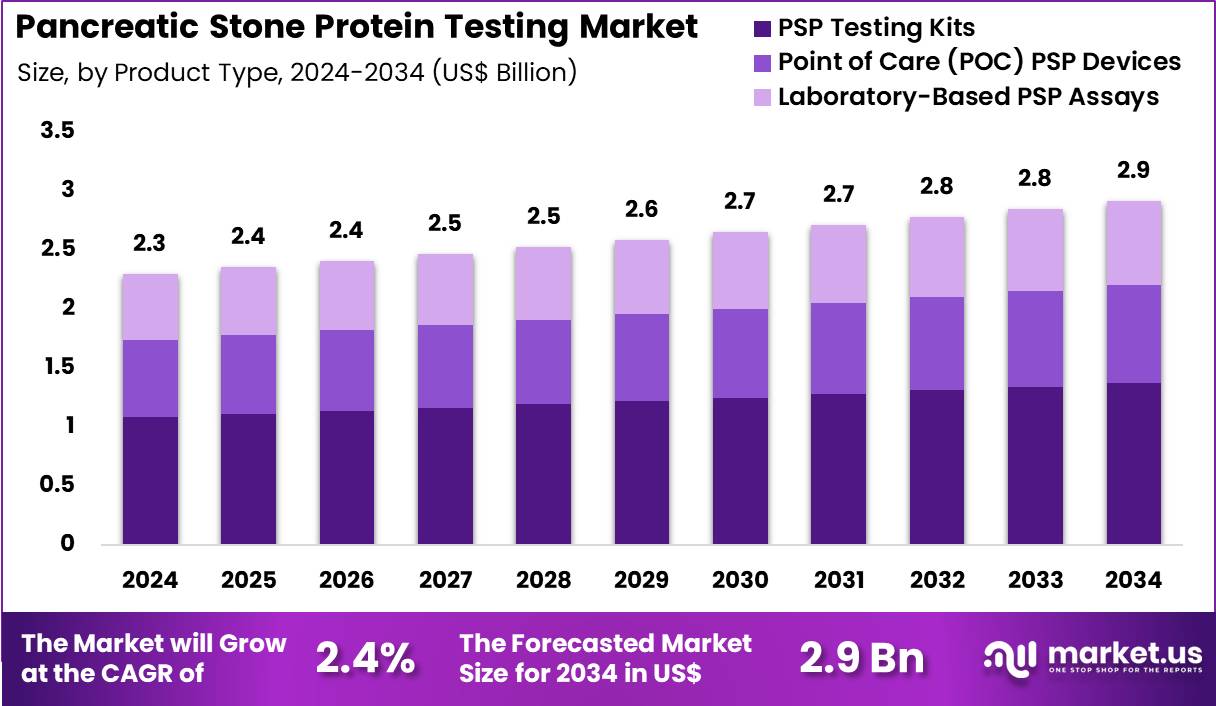
Key Takeaways
- In 2024, the Pancreatic Stone Protein Testing Market generated revenue of US$ 2.3 Billion and is projected to grow at a CAGR of 2.4%, reaching approximately US$ 2.9 Billion by 2034.
- Based on product type, the market is segmented into PSP testing kits, point-of-care (POC) PSP devices, and laboratory-based PSP assays. Among these, PSP testing kits dominated the market in 2024, accounting for a 47.1% market share.
- Based on application, the market is categorized into sepsis diagnosis, acute pancreatitis monitoring, and critical care. The sepsis diagnosis segment held the leading position in 2024, capturing a 52.3% market share.
- Based on end user, the market is segmented into hospitals, specialty clinics, and diagnostic laboratories. The hospitals segment emerged as the largest contributor in 2024, holding a revenue share of 50.6%.
- Regionally, North America dominated the Pancreatic Stone Protein Testing Market in 2024, accounting for a significant market share of 42.1%.
Market Segmentation Overview
- Product Type Analysis: PSP Testing Kits, holding 47.1% market share, are expected to dominate the product segment due to their high adoption in hospitals, emergency departments, and clinical laboratories. These kits provide rapid pancreatic stone protein detection, supporting early diagnosis of pancreatitis and sepsis. Their cost-effectiveness, simple operation, and compatibility with different testing settings are driving increased demand.
- Application Analysis: Sepsis Diagnosis, accounting for 52.3% market share, is projected to lead the application segment due to the growing need for early sepsis detection and continuous patient monitoring. PSP testing supports clinicians in evaluating disease progression and treatment response. Increasing ICU admissions, critical care requirements, and focus on reducing sepsis-related mortality are strengthening market growth.
- End-User Analysis: Hospitals, contributing 50.6% market share, are expected to remain the largest end-user segment due to their extensive utilization of PSP testing in emergency and intensive care units. Hospitals use PSP assays for rapid clinical decisions in sepsis and acute pancreatitis management. Increasing patient admissions, advanced diagnostic infrastructure, and automated testing adoption are boosting demand.
Statistical Information
- Rising Global Sepsis Burden Increasing Demand for PSP-Based Diagnostic Testing: Sepsis remains a major driver for advanced biomarker testing, as early identification of high-risk patients is critical for improving survival outcomes. According to the World Health Organization (WHO), approximately 49 million people develop sepsis annually worldwide, resulting in nearly 11 million deaths each year, accounting for around 20% of all global deaths.
- United States Sepsis Cases Driving Hospital-Based Diagnostic Demand: In the United States, sepsis contributes significantly to emergency and intensive care testing demand. According to the Centers for Disease Control and Prevention (CDC), at least 1.7 million adults develop sepsis every year, while approximately 350,000 adults die during hospitalization or are transferred to hospice care after developing sepsis.
- Sepsis Mortality Reduction Requires Faster Diagnostic Identification: Early diagnosis is critical because delayed recognition of infection-related organ dysfunction increases mortality risk. WHO estimates that among the 49 million annual sepsis cases, approximately 11 million deaths occur globally, highlighting the need for rapid biomarker-based testing solutions such as PSP assays.
- Healthcare Spending Supports Advanced Diagnostic Adoption: The United States continues investing heavily in healthcare infrastructure and diagnostic technologies. According to CMS National Health Expenditure Data, U.S. healthcare spending reached approximately US$4.5 trillion in 2022, accounting for nearly 17.3% of GDP, supporting adoption of advanced diagnostic systems.
- Acute Pancreatitis Creates Need for Continuous Patient Monitoring: Acute pancreatitis often requires hospitalization and repeated clinical evaluation. NIDDK data indicates that approximately 275,000 acute pancreatitis hospital stays occur annually in the United States, while chronic pancreatitis contributes around 86,000 hospital stays annually, increasing the need for pancreatic-related diagnostic monitoring.
- Critical Care Testing Market Benefits from Rising Sepsis Awareness: WHO highlights that nearly 15 out of every 1,000 hospitalized patients develop healthcare-associated sepsis complications, increasing pressure on healthcare providers to improve early infection detection and monitoring capabilities.
- PSP Demonstrates Diagnostic Value in Sepsis Detection: Clinical evidence shows that Pancreatic Stone Protein (PSP) has potential as a sepsis detection biomarker. A multicenter prospective study evaluated PSP performance and reported that at a 117 ng/mL cutoff, PSP achieved 74b.2% sensitivity, 67.8% specificity, and 71.0% overall accuracy for identifying sepsis patients.
Regional Analysis
North America led the market by securing a market share of 42.1% in 2024.
North America remains a major region for Pancreatic Stone Protein (PSP) testing adoption due to advanced healthcare infrastructure, high diagnostic capacity, and increasing demand for early detection of inflammatory and pancreatic disorders.
The United States reported approximately 64,050 new pancreatic cancer cases in 2023, according to the National Cancer Institute, highlighting the need for improved biomarker-based diagnostics. Rising hospital admissions related to pancreatitis and sepsis are supporting the use of PSP assays in critical care and laboratory settings.
Asia Pacific is witnessing increasing demand for PSP testing due to rising pancreatic disease burden, aging populations, and improving healthcare access. China and Japan are among the countries with significant pancreatic cancer incidence, while healthcare systems are expanding diagnostic capabilities. Growing awareness of early disease detection and investment in advanced laboratory technologies are supporting PSP testing adoption across hospitals and diagnostic centers.
Business Opportunities
The Pancreatic Stone Protein (PSP) Testing Market presents significant business opportunities due to the increasing demand for early diagnosis of sepsis, pancreatitis, and other inflammatory conditions.
Companies can expand by developing rapid point-of-care PSP testing platforms that provide faster results in emergency departments and intensive care units. Growing adoption of biomarker-based diagnostics creates opportunities for manufacturers to improve test sensitivity, automation, and integration with hospital laboratory systems.
The rising global burden of sepsis, affecting approximately 49 million people annually according to WHO, highlights the need for advanced diagnostic solutions. Partnerships between diagnostic companies, hospitals, and research institutions can accelerate PSP assay development and clinical adoption.
Emerging healthcare markets in Asia Pacific and Latin America offer additional growth opportunities due to improving healthcare infrastructure and increasing investment in advanced diagnostics. Companies focusing on affordable, accurate, and accessible PSP testing technologies are positioned to benefit from expanding clinical demand.
Emerging Trends
- Increasing Adoption of PSP as an Early Sepsis Biomarker: PSP testing is gaining attention for early sepsis risk assessment as global sepsis cases reach approximately 48.9 million annually, with around 11 million deaths worldwide. Hospitals are exploring PSP assays to improve rapid identification of infection severity and support faster treatment decisions.
- Growing Demand for Point-of-Care PSP Testing Solutions: Rapid PSP diagnostic platforms are becoming important in emergency and ICU settings where faster results are required. A multicenter study found PSP testing at a 117 ng/mL cutoff achieved 74.2% sensitivity, 67.8% specificity, and 71.0% accuracy, supporting further clinical adoption.
- Integration of PSP With Other Inflammatory Biomarkers: Healthcare providers are increasingly evaluating PSP alongside CRP and other inflammatory markers to improve diagnostic accuracy. Clinical evidence showed that combining PSP with CRP increased diagnostic specificity to approximately 95.2%, supporting multi-marker testing approaches in critical care.
- Expansion of PSP Testing in Intensive Care Units: ICU applications represent a major growth area because critically ill patients require continuous infection monitoring. WHO reports that approximately 15 out of every 1,000 hospitalized patients develop sepsis as a healthcare complication, increasing demand for reliable biomarkers such as PSP.
- Increasing Clinical Validation of PSP Diagnostic Accuracy: Research studies are expanding to confirm PSP effectiveness in sepsis detection. A systematic review reported pooled PSP diagnostic performance with approximately 88% sensitivity, 78% specificity, and 0.90 area under the curve (AUC), supporting its potential role in infection diagnosis.
Use Cases
- Early Sepsis Detection in Emergency Care: PSP testing is increasingly used to support early identification of sepsis among patients arriving at emergency departments. A clinical study involving 156 patients found 26 patients (16.7%) with sepsis, and PSP showed an association with sepsis diagnosis, supporting its role as an additional biomarker for emergency assessment.
- Monitoring Critically Ill Patients in Intensive Care Units: PSP testing is used in ICU settings to evaluate infection severity and patient risk. A prospective study of 107 patients with severe sepsis or septic shock reported PSP levels of 343.5 ng/mL in septic shock patients compared with 73.5 ng/mL in severe sepsis patients, highlighting its potential for severity assessment.
- Point-of-Care Testing for Faster Clinical Decisions: Rapid PSP point-of-care testing is being explored for emergency and ICU applications where quick results are required. A multicenter study involving 466 ICU adults reported that PSP at a 117 ng/mL cutoff achieved 74.2% sensitivity, 67.8% specificity, and 71.0% accuracy for sepsis detection.
- Predicting Sepsis Progression and Patient Risk: PSP testing is being evaluated for predicting worsening infection and clinical outcomes. Research involving 285 patients with suspected sepsis showed PSP had comparable diagnostic performance with procalcitonin, with reported AUC values of 0.71–0.72, supporting its role in patient risk classification.
- Combination Testing With CRP and Other Biomarkers: PSP is increasingly used alongside inflammatory markers such as CRP and procalcitonin to improve diagnostic accuracy. A multicenter ICU study found that combining PSP with CRP improved diagnostic specificity to approximately 95.2%, supporting multi-marker approaches in critical care.
Recent Development
- In 2026, Siemens Healthineers continued strengthening its diagnostics portfolio through laboratory automation, digital healthcare solutions, and advanced diagnostic platforms. The company focused on improving diagnostic workflow efficiency and supporting faster clinical decision-making through integrated laboratory systems. Its Diagnostics segment remained focused on improving testing capabilities despite market challenges in some regions.
- In 2026, Abbott Laboratories expanded its focus on rapid diagnostics and near-patient testing technologies. The company highlighted growth opportunities in point-of-care diagnostics, with its rapid diagnostics business supporting faster testing access across healthcare settings. Abbott reported that approximately 2 billion rapid diagnostic tests were performed using its rapid diagnostic and point-of-care devices in the previous year, supporting expansion of decentralized testing solutions.
- In 2026, Roche Diagnostics continued advancing its diagnostics innovation strategy through investments in laboratory testing, digital diagnostics, and biomarker-based solutions. The company expanded research activities in next-generation diagnostic technologies, including advanced blood-based biomarker testing approaches. Roche Diagnostics operates across more than 100 countries with a broad in-vitro diagnostics portfolio supporting disease detection and monitoring.
- In 2026, Thermo Fisher Scientific, Inc. continued expanding its clinical diagnostics and laboratory solutions through investments in advanced analytical technologies, automation, and research platforms. The company focused on supporting healthcare laboratories with high-throughput testing solutions that improve diagnostic accuracy and efficiency for infectious disease and biomarker applications.
Frequently Asked Questions on Pancreatic Stone Protein Testing
- What factors are driving the growth of the Pancreatic Stone Protein Testing Market?
The market growth is driven by increasing sepsis cases, rising demand for rapid diagnostic solutions, growing ICU admissions, and advancements in biomarker-based testing technologies. Healthcare providers are adopting PSP assays to improve early disease detection and patient monitoring. - Which application segment dominates the PSP Testing Market?
Sepsis diagnosis dominates the PSP Testing Market due to the increasing global burden of severe infections. PSP testing helps clinicians identify inflammatory responses and monitor disease progression, making it valuable in hospitals, emergency departments, and intensive care units. - How is PSP Testing used in intensive care units?
In intensive care units, PSP testing is used to monitor critically ill patients with suspected infections or inflammatory conditions. It provides additional biomarker information that helps physicians evaluate disease severity, predict risks, and support clinical decision-making. - Which end-user segment leads the Pancreatic Stone Protein Testing Market?
Hospitals represent the leading end-user segment due to their high patient volume and extensive use of diagnostic technologies. Emergency departments and ICUs utilize PSP testing for rapid assessment of sepsis, pancreatitis, and other critical inflammatory conditions. - Which regions are expected to contribute significantly to PSP Testing Market growth?
North America currently represents a major market due to advanced healthcare infrastructure and diagnostic adoption. Asia Pacific is expected to experience growth because of increasing healthcare investment, rising disease awareness, and expanding access to advanced diagnostic technologies. - How does PSP Testing support sepsis management?
PSP testing supports sepsis management by helping healthcare professionals identify inflammatory responses and evaluate infection severity. It can complement existing diagnostic markers, allowing clinicians to improve patient classification, monitor progression, and optimize treatment strategies. - What technological advancements are influencing the PSP Testing Market?
Technological advancements such as automated immunoassay systems, improved biomarker detection methods, and point-of-care platforms are influencing market development. These innovations enhance testing accuracy, reduce turnaround times, and improve accessibility across hospitals and clinical laboratories.
Conclusion
The Pancreatic Stone Protein Testing Market is witnessing increasing attention due to the rising need for early detection of sepsis, pancreatitis, and other inflammatory conditions. Growing adoption of biomarker-based diagnostics, point-of-care testing solutions, and automated laboratory platforms is supporting market development. Hospitals and intensive care units remain key users due to the requirement for rapid clinical decision-making.
North America leads adoption with advanced healthcare infrastructure, while emerging regions offer future growth opportunities. Continuous research, technological advancements, and increasing focus on personalized medicine are expected to strengthen PSP testing applications and improve patient outcomes in the coming years.
Discuss your needs with our analyst
Please share your requirements with more details so our analyst can check if they can solve your problem(s)




