


Overview
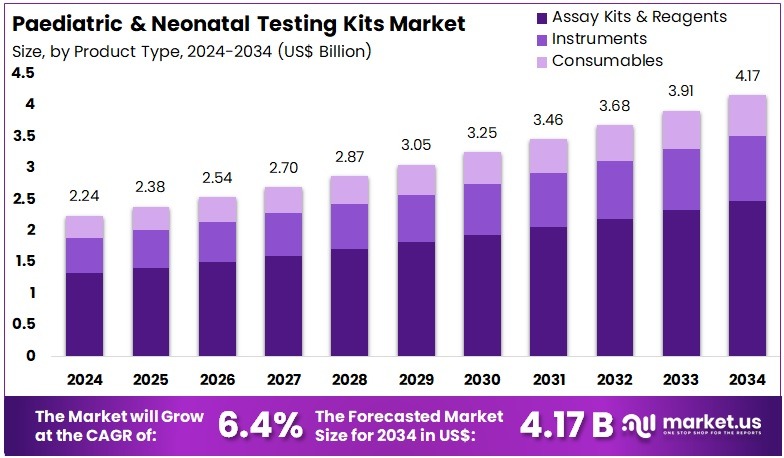
New York, NY – Sep 03, 2026 –The Paediatric & Neonatal Testing Kits Market Size is expected to be worth around US$ 4.17 Billion by 2034 from US$ 2.24 Billion in 2024, growing at a CAGR of 6.4% during the forecast period 2025 to 2034. North America held a dominant market position, capturing more than a 41.2% share and holding US$ 922.9 Million market value for the year.
The Paediatric & Neonatal Testing Kits Market is witnessing steady growth as healthcare systems prioritize early diagnosis and timely treatment of newborns and children. Rising birth rates in developing countries, increasing awareness of newborn screening programs, and the growing prevalence of congenital disorders are supporting demand for advanced diagnostic kits.
According to the World Health Organization (WHO), approximately 2.3 million newborns die each year, highlighting the importance of rapid neonatal testing and early intervention. In addition, the U.S. Centers for Disease Control and Prevention (CDC) states that about 1 in 33 babies is born with a birth defect, emphasizing the need for routine screening.
Paediatric and neonatal testing kits are widely used for detecting metabolic disorders, genetic conditions, infectious diseases, jaundice, glucose abnormalities, and other critical health issues shortly after birth. Many countries now recommend screening for more than 30 to 60 inherited conditions, depending on national healthcare policies, improving survival rates, and reducing long-term healthcare costs.
Technological advancements, including point-of-care diagnostics, molecular testing, and automated screening platforms, are improving test accuracy while reducing turnaround time. Hospitals, neonatal intensive care units (NICUs), maternity centers, and diagnostic laboratories remain the primary end users.
North America continues to lead the market due to well-established newborn screening programs, while Asia-Pacific is expected to record strong growth because of expanding healthcare infrastructure and increasing government investments in maternal and child healthcare. Continuous innovation, favorable healthcare policies, and growing awareness of early disease detection are expected to support long-term market expansion.
Key Takeaways
- In 2024, the Paediatric & Neonatal Testing Kits market generated US$ 2.4 billion in revenue and is projected to reach US$ 4.17 billion by 2034, expanding at a CAGR of 6.4% during the forecast period.
- By Product Type, the market is segmented into Assay Kits & Reagents, Instruments, and Consumables. Among these, Assay Kits & Reagents dominated the market in 2024, accounting for a 59.4% share.
- By Test Type, the market is categorized into Newborn Screening Panels, Genetic Testing, Infectious Disease Testing, Hearing Screening, Critical Congenital Heart Defect (CCHD) Screening, and Others. Newborn Screening Panels held the largest market share of 40.5% in 2024.
- By End User, the market is segmented into Hospitals (NICUs/PICUs), Diagnostic Laboratories, Maternity & Specialty Clinics, and Point-of-Care Settings. Hospitals (NICUs/PICUs) emerged as the leading segment, capturing a 53.4% market share in 2024.
- North America dominated the global Paediatric & Neonatal Testing Kits market in 2024, holding the largest regional market share of 41.2%.
Market Segmentation
- Product Type Analysis: Assay Kits & Reagents dominated the Paediatric & Neonatal Testing Kits market with a 59.4% share in 2024, driven by their routine use in newborn screening, infectious disease detection, genetic testing, bilirubin assessment, and metabolic disorder diagnosis. Their recurring consumption across neonatal care supports sustained market demand.
- Test Type Analysis: Newborn Screening Panels accounted for 40.5% of the market in 2024, supported by expanding national screening programs for congenital and metabolic disorders. With approximately 140 million births annually worldwide, increasing screening coverage continues to drive demand for neonatal diagnostic testing kits.
- End-User Analysis: Hospitals (NICUs/PICUs) held a 53.4% market share in 2024, as critically ill newborns require rapid and repeated diagnostic testing. Continuous screening for infections, metabolic disorders, jaundice, and congenital conditions makes hospitals the largest end users of paediatric and neonatal testing kits.
Statistical Information
- More than 98% of the approximately 3.6 million infants born annually in the United States receive dried blood spot newborn screening, demonstrating one of the world’s highest neonatal testing coverage rates.
- A 2025 JAMA Pediatrics review reported that newborn screening enables early diagnosis and treatment for more than 7,000 newborns each year in the United States.
- A 2025–2026 American Academy of Pediatrics study assessed 5,470 infants during the first year of universal G6PD newborn screening, demonstrating large-scale operational implementation.
- Researchers reported that relying only on risk-factor screening would have failed to detect 44% of G6PD-deficient newborns before hospital discharge, supporting universal neonatal testing protocols.
- Among male infants in the universal screening cohort, 2.9% were diagnosed with G6PD deficiency, highlighting the importance of routine neonatal enzymatic testing.
- The WHO’s 2026 newborn screening report estimated that approximately 8 million babies are born with birth defects every year, reinforcing demand for expanded neonatal diagnostic screening.
- According to the WHO (2026), birth defects are responsible for almost 8% of all deaths among children younger than five years, emphasizing the value of early paediatric testing.
- The WHO reported in 2026 that India’s newborn programme screened more than 28 million children over three years and identified approximately 900,000 children with birth defects requiring follow-up care.
Regional Analysis
North America is leading the Paediatric & Neonatal Testing Kits Market
North America leads the market with 41.2% market share due to highly advanced NICU infrastructure, mandatory newborn screening policies, extensive genetic testing adoption, and strong clinical guidelines for infectious disease testing in neonates.
High awareness and early-life health-prioritization reinforce demand for specialized neonatal kits is the driving factor in the region. Illumina, Inc. highlighted that global newborn screening programmes are moving toward genome sequencing (NGS) pilots, citing screening of ~14,000+ newborns in the GUARDIAN programme and expansion of conditions screened.
The Asia Pacific region is expected to experience the highest CAGR during the forecast period
Asia Pacific is expanding quickly, driven by rising birth rates, government-funded newborn screening initiatives, improved neonatal intensive care facilities, and increased burden of congenital disorders. Rapid urbanization and investment in NICUs accelerate the adoption of advanced neonatal testing kits across China, India, Japan, and South Korea.
Business opportunities
The Paediatric & Neonatal Testing Kits Market offers significant business opportunities as governments continue expanding newborn screening programs and investing in early disease detection. Increasing adoption of molecular diagnostics, genetic testing, and point-of-care technologies is creating demand for advanced assay kits and automated screening systems.
Rising awareness of congenital disorders, neonatal infections, and inherited metabolic diseases is encouraging hospitals and diagnostic laboratories to adopt faster and more accurate testing solutions. Manufacturers also have strong growth potential in emerging economies, where healthcare infrastructure and universal newborn screening initiatives are expanding.
Additionally, the development of multiplex testing platforms capable of detecting multiple conditions from a single sample, along with portable diagnostic devices for neonatal intensive care units (NICUs) and maternity centers, is opening new revenue opportunities.
Strategic collaborations with healthcare providers, public health agencies, and research institutions, combined with continuous innovation in rapid, affordable, and high-precision testing technologies, are expected to further accelerate market expansion and improve access to neonatal diagnostics worldwide.
Emerging Trends
- Expansion of comprehensive newborn screening programs: Countries are expanding newborn screening beyond traditional metabolic diseases. In 2026, WHO highlighted that around 8 million babies are born with birth defects annually, encouraging broader screening programs integrated into national healthcare systems for earlier diagnosis and treatment.
- Higher adoption of universal newborn hearing screening: Universal hearing screening continues to become standard practice. According to the CDC, more than 98% of U.S. newborns receive hearing screening, and over 6,000 infants were identified with permanent hearing loss, increasing demand for neonatal hearing testing kits.
- Greater use of pulse oximetry for heart defect screening: Pulse oximetry screening is becoming routine before hospital discharge. The CDC reported in 2025 that universal screening has reduced early infant deaths from critical congenital heart defects by 33%, preventing approximately 120 deaths annually through earlier diagnosis.
- Expansion of genetic newborn testing panels: Governments are adding more genetic diseases to newborn screening panels. In 2025, the U.S. expanded the Recommended Uniform Screening Panel by 2 additional rare disorders, enabling earlier diagnosis and access to treatment for affected newborns
- Growing focus on standardized newborn screening before discharge: Healthcare systems increasingly perform multiple neonatal tests before discharge. CDC guidance recommends blood spot collection within 24–48 hours after birth and pulse oximetry screening after 24 hours, improving consistency and reducing missed diagnoses.
Use Cases
- Routine metabolic disorder screening in newborns: Blood spot testing kits are widely used to identify inherited metabolic disorders shortly after birth. HRSA notes newborn screening combines 3 essential screening components—blood spot, pulse oximetry, and hearing tests—to support timely medical intervention
- Early detection of congenital hearing loss: Hospitals use automated hearing screening kits before newborn discharge to identify permanent hearing impairment. CDC data show more than 98% of U.S. newborns undergo screening, supporting earlier hearing rehabilitation and language development.
- Screening newborns for critical congenital heart defects: Pulse oximetry testing kits are routinely used in maternity hospitals to detect critical congenital heart defects. Screening is recommended at 24 hours of age or later, allowing treatment before symptoms become life-threatening.
- Universal G6PD deficiency testing in neonatal units: Hospitals are increasingly implementing universal G6PD deficiency screening. A 2025 pediatric study screened 5,470 newborns, identifying 1.7% with G6PD deficiency and demonstrating improved detection compared with selective testing approaches.
- Diagnostic testing in neonatal intensive care units (NICUs): NICUs use paediatric and neonatal testing kits for premature and critically ill infants requiring continuous monitoring. Blood spot screening, hearing assessment, and pulse oximetry performed within the first 24–48 hours enable rapid diagnosis and treatment initiation.
Recent development
- In June 2025, Thermo Fisher Scientific Inc. announced a collaboration with the Regeneron Genetics Center to use the Olink Explore platform for large-scale proteomics research involving nearly 200,000 patient samples, supporting the development of next-generation diagnostic biomarkers.
- In February 2026, Bio-Rad Laboratories announced it had discontinued a development project initiated in 2024 to focus resources on its core clinical diagnostics business, including molecular and newborn screening technologies.
- In June 2026, bioMérieux SA reported continued expansion of its diagnostics portfolio, with GO•28 growth drivers increasing 8.5% organically during the second quarter of 2026, supported by innovation across molecular diagnostics and infectious disease testing.
Frequently Asked Questions on Paediatric & Neonatal Testing Kits
- What factors are driving the Paediatric & Neonatal Testing Kits Market?
Key growth drivers include increasing birth rates in developing countries, government-supported newborn screening initiatives, rising prevalence of congenital disorders, improved healthcare infrastructure, and growing adoption of molecular diagnostics and point-of-care testing technologies. - Which diseases are commonly detected using paediatric and neonatal testing kits?
These testing kits help identify metabolic disorders, congenital hypothyroidism, cystic fibrosis, sickle cell disease, G6PD deficiency, neonatal infections, hearing impairment, and critical congenital heart defects, enabling healthcare providers to begin treatment at the earliest possible stage. - Which product segment dominates the Paediatric & Neonatal Testing Kits Market?
Assay kits and reagents represent the leading product segment because they are routinely used in newborn screening, infectious disease testing, bilirubin measurement, and genetic analysis. Their repeated use across healthcare facilities supports consistent market demand. - What technologies are shaping the Paediatric & Neonatal Testing Kits Market?
Modern technologies include polymerase chain reaction (PCR), next-generation sequencing (NGS), tandem mass spectrometry, multiplex immunoassays, automated analyzers, and portable point-of-care devices that improve testing accuracy, speed, and clinical decision-making. - Which region leads the Paediatric & Neonatal Testing Kits Market?
North America remains the leading regional market due to established newborn screening programs, advanced healthcare infrastructure, strong regulatory support, and widespread adoption of innovative diagnostic technologies across hospitals, diagnostic laboratories, and specialized pediatric healthcare centers. - What opportunities exist in the Paediatric & Neonatal Testing Kits Market?
Growing investment in newborn healthcare, expansion of genetic screening, increasing demand for rapid diagnostic solutions, and the development of affordable point-of-care testing devices create significant opportunities for manufacturers, healthcare providers, and diagnostic technology companies. - What is the future outlook for the Paediatric & Neonatal Testing Kits Market?
The market is expected to benefit from continuous innovation in molecular diagnostics, broader newborn screening coverage, improved healthcare access, and increased awareness of early disease detection, supporting sustained demand for advanced paediatric and neonatal diagnostic testing solutions.
Conclusion
The Paediatric & Neonatal Testing Kits Market is expected to experience steady growth, driven by the increasing emphasis on early disease detection, expansion of national newborn screening programs, and continuous advancements in molecular diagnostics and point-of-care technologies.
Growing awareness of congenital, metabolic, genetic, and infectious disorders is encouraging healthcare providers to adopt rapid and accurate testing solutions that improve neonatal survival and long-term health outcomes.
Hospitals, diagnostic laboratories, and maternity centers remain the primary users, supported by investments in advanced screening infrastructure and automation. Emerging technologies such as PCR, tandem mass spectrometry, next-generation sequencing, and digital diagnostics are enhancing testing accuracy and efficiency.
In addition, expanding healthcare access in developing regions and supportive government initiatives are creating new growth opportunities. Continued innovation, strategic collaborations, and increased adoption of comprehensive newborn screening are expected to strengthen the market’s long-term outlook while improving the quality of paediatric and neonatal healthcare worldwide.
Discuss your needs with our analyst
Please share your requirements with more details so our analyst can check if they can solve your problem(s)




