


Overview
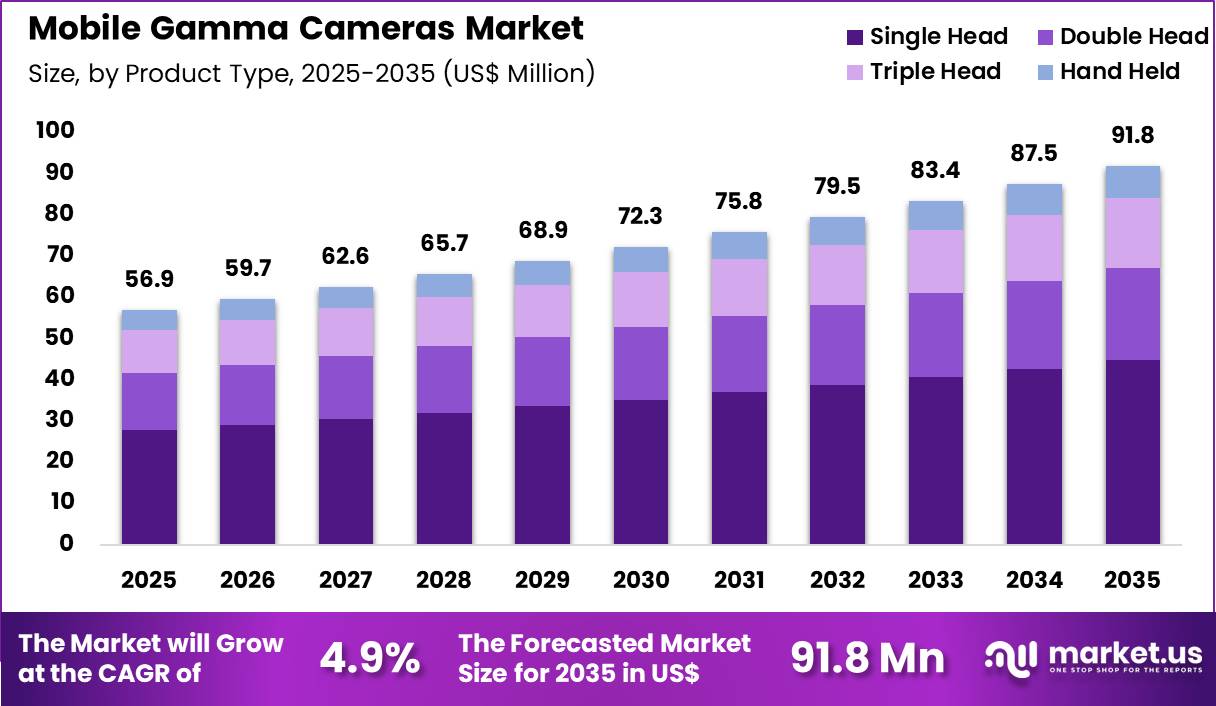
New York, NY – Nov 11 2026 – The Global Mobile Gamma Cameras Market size is expected to be worth around US$ 91.8 Million by 2035 from US$ 56.9 Million in 2025, growing at a CAGR of 4.9% during the forecast period 2026-2035. In 2025, North America led the market, achieving over 36.2% share with a revenue of US$ 20.6 Million.
Mobile Gamma Cameras are advanced medical imaging systems designed to detect gamma radiation emitted by radioactive tracers administered to patients. These devices play an important role in nuclear medicine by enabling the visualization and assessment of organ function, tissue activity, and disease-related changes within the body.
Unlike conventional stationary gamma camera systems, mobile gamma cameras offer enhanced portability and flexibility, allowing diagnostic imaging to be performed in different clinical settings, including hospital wards, intensive care units, operating rooms, and specialized diagnostic departments. Their compact design supports patient-side imaging, particularly for individuals who cannot be easily transported to conventional imaging facilities.
These systems are widely used in applications such as cardiac imaging, thyroid examinations, bone imaging, sentinel lymph node detection, and intraoperative procedures. Technological advancements, including improved detector sensitivity, digital image processing, compact detector designs, and enhanced imaging software, are contributing to better image quality and greater operational efficiency.
The growing demand for advanced diagnostic technologies, increasing adoption of nuclear medicine procedures, and the need for flexible imaging solutions are supporting interest in mobile gamma cameras. As healthcare facilities continue to prioritize efficient diagnostic workflows and patient-centered care, mobile gamma cameras are expected to remain an important component of modern nuclear medicine infrastructure.
Key Takeaways
- In 2025, the Mobile Gamma Cameras Market was valued at US$ 56.9 Million and is projected to grow at a CAGR of 4.9%, reaching US$ 91.8 Million by 2035.
- Based on product type, the market is segmented into single head, triple head, double head, and hand-held systems. Among these, the single-head segment dominated the market, accounting for 48.7% of the total market share.
- By indication, the market is categorized into cardiac imaging, renal imaging, breast imaging, brain imaging, and others. The cardiac imaging segment held the leading position, capturing a 42.9% market share.
- In terms of end users, the market is segmented into hospitals, cancer research institutes, ambulatory surgical centers, and specialized clinics. The hospital segment dominated the market, accounting for the largest revenue share of 54.2%.
- Regionally, North America dominated the Mobile Gamma Cameras Market, accounting for the largest market share of 36.2%.
Key Market Segments
- Product Type Analysis: The single-head segment dominated the product type category, accounting for 48.7% of the market share. Its leadership is attributed to cost-effectiveness, portability, and versatility in routine nuclear imaging. Increasing adoption across hospitals and diagnostic centers, coupled with advancements in detector sensitivity, image resolution, and compact designs, is expected to support segment growth.
- Indications Analysis: The cardiac imaging segment dominated the indications category, accounting for 42.9% of the market share. Growth is primarily driven by the rising prevalence of cardiovascular diseases and increasing demand for early diagnosis. Advancements in myocardial perfusion imaging, bedside diagnostic capabilities, and non-invasive imaging procedures are further supporting the adoption of mobile gamma cameras.
- End-User Analysis: The hospital segment dominated the end-user category, accounting for 54.2% of the market share. Its leading position is supported by high patient volumes, established nuclear medicine departments, and advanced diagnostic infrastructure. Increasing investments in imaging facilities, expansion of cardiac and oncological diagnostics, and growing demand for bedside imaging are expected to drive segment growth.
Regional Analysis
North America Market Analysis
North America dominated the Mobile Gamma Cameras Market, accounting for 36.2% market share in 2024. Regional growth is supported by increasing adoption of portable nuclear imaging technologies across hospitals and diagnostic centers. Rising demand for rapid functional imaging, growing prevalence of chronic diseases, and advancements in digital detector technology are encouraging healthcare facilities to adopt mobile systems.
Favorable reimbursement policies, improved clinical training, and collaborations between manufacturers and healthcare networks are further strengthening market penetration. Additionally, the integration of mobile imaging into telehealth services is improving diagnostic accessibility across remote and underserved areas.
Asia Pacific Market Analysis
The Asia Pacific region is expected to register the highest CAGR during the forecast period, driven by expanding healthcare infrastructure and increasing investments in diagnostic imaging technologies. Rising incidences of cardiovascular diseases and cancer, an aging population, and growing adoption of SPECT and hybrid imaging systems are supporting regional demand.
Government healthcare initiatives, hospital expansion, and increasing availability of cost-effective imaging solutions across China, India, Japan, and South Korea are further accelerating market growth.
Emerging Trends
- Development of Compact and Lightweight Imaging Systems: The development of compact and lightweight gamma cameras is gaining attention. These systems can be moved between hospital departments, operating rooms, and patient care areas, improving equipment flexibility and supporting imaging procedures where conventional large scanners may be difficult to access.
- Integration of Hybrid Gamma and Optical Imaging: The integration of gamma imaging with optical imaging is emerging as an important technology trend. These systems can combine radioactive tracer information with visible or fluorescence images, helping surgeons identify target tissues and understand their location during surgical procedures.
- Advancement in Cadmium Zinc Telluride (CZT) Detectors: Advanced detector technologies, including cadmium zinc telluride (CZT), are being explored to improve gamma-ray detection. Better detector sensitivity and image quality can support the identification of small radioactive targets and improve the usefulness of portable cameras during complex procedures.
- Growing Adoption of Real-Time Intraoperative Imaging: Real-time intraoperative imaging is gaining importance in radioguided surgery. Mobile gamma cameras can display radioactive tracer distribution during operations, helping medical professionals identify target tissues and check whether radioactive lymph nodes or lesions have been completely removed.
- Integration of Three-Dimensional Imaging and Surgical Navigation: The combination of portable gamma cameras with tracking systems and navigation software is creating opportunities for three-dimensional imaging. These technologies can help surgeons understand the position of radioactive targets and improve localization during selected minimally invasive and open surgical procedures.
Use Cases
- Sentinel Lymph Node Detection in Cancer Surgery: Mobile gamma cameras are used to identify sentinel lymph nodes, which are the first lymph nodes that cancer may spread to from a primary tumor. They support breast cancer, melanoma, and head and neck cancer surgeries by helping medical teams locate radioactive lymph nodes.
- Localization of Non-Palpable Breast Lesions: These cameras can support the localization of small breast abnormalities that cannot be easily felt during physical examination. By detecting radioactive markers placed near the target tissue, they help surgeons identify the correct area for removal during breast-conserving surgery.
- Parathyroid Gland Localization: Mobile gamma cameras can assist in identifying abnormal parathyroid glands during surgery. They detect radioactive tracer uptake in the targeted tissue, helping surgeons locate parathyroid adenomas and supporting procedures performed for patients with certain parathyroid disorders.
- Localization of Neuroendocrine Tumors: Mobile gamma imaging can support radioguided removal of selected neuroendocrine tumors. When suitable radioactive tracers are used, the camera helps visualize tracer accumulation around the target, providing additional information to surgeons during tumor localization and removal.
- Intraoperative Detection of Head and Neck Cancer Lesions: Mobile gamma cameras can assist surgeons in locating sentinel lymph nodes and radioactive target tissues during head and neck cancer procedures. Their imaging capability provides a visual representation of tracer distribution and supports surgical decisions in selected cases.
Frequently Asked Questions About Mobile Gamma Cameras
- How does a mobile gamma camera work?
A mobile gamma camera detects gamma photons emitted by radiopharmaceuticals administered to patients. Its detector captures these signals and converts them into images, allowing medical professionals to identify areas of radioactive tracer accumulation. - What are the major applications of mobile gamma cameras?
Mobile gamma cameras are primarily used in sentinel lymph node detection, breast lesion localization, parathyroid surgery, neuroendocrine tumor localization, and radioguided cancer procedures. Their applications depend on the radioactive tracer and camera configuration. - What are the advantages of mobile gamma cameras?
Mobile gamma cameras offer portability, flexible positioning, and intraoperative imaging capabilities. They allow medical teams to visualize radioactive targets near the surgical site without relying exclusively on conventional nuclear medicine imaging equipment. - Which healthcare professionals use mobile gamma cameras?
Mobile gamma cameras are used by nuclear medicine specialists, surgeons, radiologists, and other trained healthcare professionals. Their operation and clinical interpretation depend on the procedure, institutional protocols, and applicable radiation safety requirements. - Are mobile gamma cameras used during cancer surgery?
Yes, mobile gamma cameras are used during selected cancer surgeries, particularly sentinel lymph node biopsy and radioactive lesion localization. They help surgeons visualize radioactive tracer uptake and identify target tissues during surgical procedures. - What technologies are used in mobile gamma cameras?
Mobile gamma cameras use scintillation detectors, collimators, and image-processing systems to detect gamma radiation. Advanced systems are also exploring CZT detectors, optical imaging integration, and tracking technologies for improved localization capabilities. - Which technological developments are creating opportunities in the market?
Developments in advanced detector materials, hybrid gamma-optical imaging, three-dimensional localization, and surgical navigation are creating opportunities. These technologies may improve target visualization and support more precise image-guided interventions in selected clinical applications. - Why are hospitals adopting mobile gamma cameras?
Hospitals consider mobile gamma cameras because they offer flexible positioning and support imaging near the patient or surgical site. These capabilities can improve workflow flexibility and provide additional visual information during selected medical procedures.
Conclusion
The Mobile Gamma Cameras Market is expected to witness steady growth, driven by the increasing adoption of nuclear medicine procedures and rising demand for portable diagnostic imaging solutions. Valued at US$ 56.9 million in 2025, the market is projected to reach US$ 91.8 million by 2035, growing at a CAGR of 4.9%.
Technological advancements in CZT detectors, hybrid imaging, and real-time intraoperative visualization are expected to enhance clinical applications. North America will continue to maintain a significant market position, while Asia Pacific is anticipated to experience the fastest growth, supported by expanding healthcare infrastructure and diagnostic investments.
Discuss your needs with our analyst
Please share your requirements with more details so our analyst can check if they can solve your problem(s)



