


Overview
New York, NY – July 29, 2026 – The Global Medical Tapes & Bandages Market size is expected to be worth around US$ 11.4 Billion by 2034 from US$ 8.1 Billion in 2024, growing at a CAGR of 3.5% during the forecast period 2025 to 2034. In 2024, North America led the market, achieving over 44.8% share with a revenue of US$ 3.6 Billion.
The global Medical Tapes and Bandages Market is witnessing steady growth as healthcare systems increasingly focus on effective wound management, infection prevention, and patient safety. Medical tapes and bandages are essential for securing dressings, protecting wounds, supporting injured muscles and joints, and improving recovery outcomes in hospitals, clinics, ambulatory care centers, and home healthcare settings. The growing number of surgical procedures, trauma cases, and chronic wounds continues to strengthen market demand.
One of the key growth drivers is the increasing prevalence of diabetes and related complications. According to healthcare estimates, nearly 1.6 million people in the United States develop diabetic foot ulcers each year, while approximately 80% of diabetes-related lower-extremity amputations are preceded by foot ulcers. This rising patient population is fueling the need for advanced wound care products, including high-performance medical tapes and bandages.
Sports and recreational injuries are also contributing significantly to market expansion. The Centers for Disease Control and Prevention (CDC) reports that nearly 30 million children and teenagers participate in organized sports annually in the U.S., with more than 3.5 million sports-related injuries occurring every year. Medical tapes and elastic bandages are widely used to stabilize joints, treat sprains and strains, and support injury prevention.
Growing awareness of infection control further supports market growth. Pressure ulcers alone impose healthcare costs of billions of dollars annually in the United States, while over 60,000 patients die each year from pressure ulcer complications. These clinical and economic challenges are encouraging the adoption of advanced, antimicrobial, and skin-friendly wound care products, supporting the long-term expansion of the medical tapes and bandages market.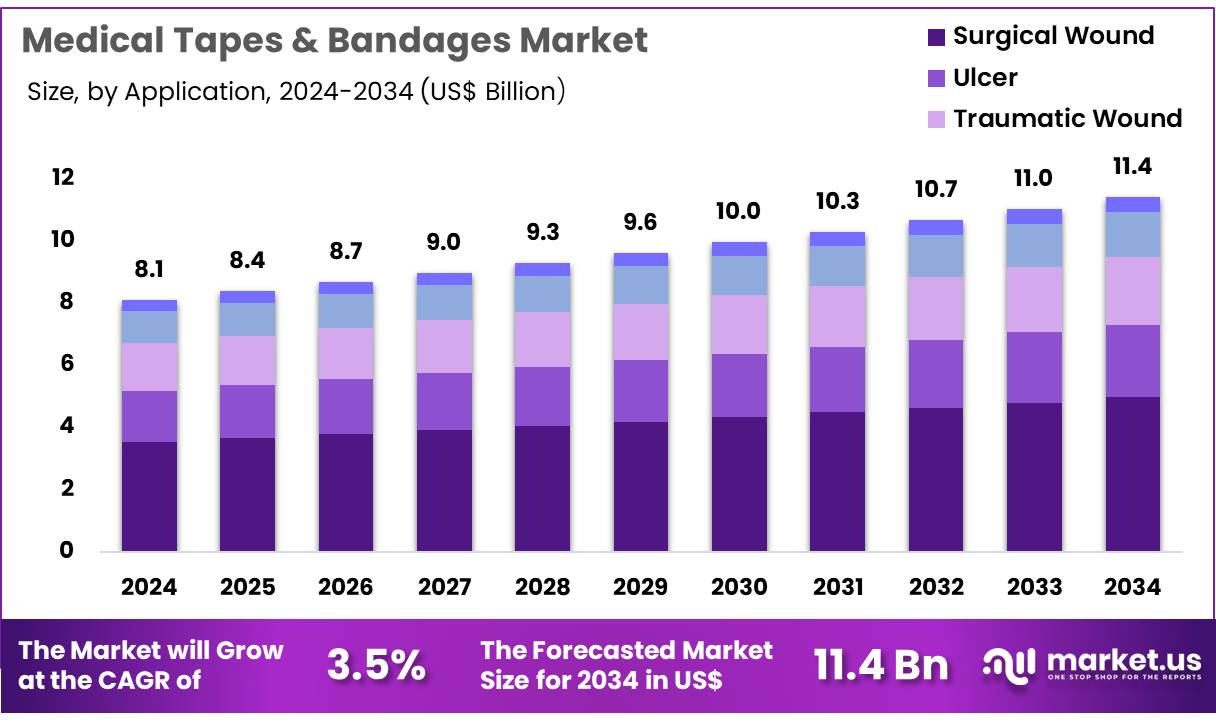
Key Takeaways
- The global Medical Tapes & Bandages Market was valued at US$ 8.1 Billion in 2024 and is projected to reach US$ 11.4 Billion by 2034, expanding at a CAGR of 3.5% during the forecast period.
- Based on product type, the market is categorized into medical tapes and medical bandages. Among these, medical bandages emerged as the leading segment, accounting for 54.3% of the market share.
- By application, the market is segmented into surgical wounds, ulcers, traumatic wounds, burn injuries, and others. The surgical wound segment dominated the market with a 43.5% revenue share.
- In terms of end users, the market includes hospitals, retail, clinics, ambulatory surgery centers, and others. Hospitals held the largest share, contributing 43.5% of the overall market revenue.
- North America remained the leading regional market, capturing 44.8% of the global Medical Tapes & Bandages Market share.
Statistical Information
- Rising Burden of Diabetic Foot Ulcers is Driving Demand for Advanced Wound Care: Diabetes remains one of the biggest drivers of the medical tapes and bandages market because chronic foot ulcers require frequent dressing changes and long-term wound management. According to the CDC, about half of people with diabetes develop some form of nerve damage, significantly increasing the risk of foot ulcers and amputations. The CDC also reports that around 12% of people with diabetes develop a diabetic foot ulcer during their lifetime.
- Sports Injuries Create Strong Demand for Medical Tapes and Bandages: Sports participation continues to support demand for medical tapes and elastic bandages used for sprains, strains, and joint stabilization. According to the CDC, around 30 million children and teenagers participate in organized sports in the United States every year, and more than 3.5 million sports-related injuries occur annually, requiring treatment and rehabilitation.
- Pressure Ulcers Increase the Need for Advanced Wound Dressings: Pressure injuries remain a major healthcare challenge. The Agency for Healthcare Research and Quality (AHRQ) estimates that more than 2.5 million people in the United States develop pressure ulcers every year. These wounds increase infection risk, prolong hospital stays, and require continuous use of medical bandages, adhesive tapes, and advanced dressings.
- Surgical Wound Care Continues to Support Product Demand: Surgical wound management represents one of the largest applications for medical tapes and bandages. According to AHRQ, more than 9 million inpatient hospital stays in the United States involve surgical procedures each year, creating substantial demand for sterile wound closure and dressing products throughout recovery.
- Hospitals Remain the Largest Users of Medical Tapes and Bandages: Hospitals continue to consume large volumes of medical tapes and bandages because of high patient admissions and wound care needs. AHRQ reports that about 1.2 million hospital-acquired pressure ulcers were recorded in the United States in 2015, emphasizing the importance of preventive wound care products.
- Diabetic Foot Ulcers Result in Significant Healthcare Utilization: According to AHRQ, Medicare beneficiaries with diabetic foot ulcers visit outpatient providers about 14 times annually and experience approximately 1.5 hospitalizations per year. Their average annual Medicare reimbursement is about US$ 33,000 per patient, demonstrating the economic importance of effective wound care management.
- Patient Safety Programs are Increasing Focus on Pressure Injury Prevention: AHRQ’s national patient safety initiatives encourage hospitals to implement standardized pressure injury prevention protocols. The agency reports that hospital-acquired pressure ulcer rates declined from 40 to 36 cases per 1,000 hospital discharges between 2010 and 2015, reflecting growing adoption of better wound care practices.
Regional Analysis
North America dominated the global medical tapes and bandages market in 2024, accounting for 44.8% of total revenue. The region benefits from advanced healthcare infrastructure, high healthcare spending, and strong adoption of modern wound care products. A growing burden of chronic diseases, including diabetes and cardiovascular disorders, has increased the number of patients requiring long-term wound management.
Chronic wounds such as diabetic foot ulcers and pressure injuries continue to drive demand for high-performance medical tapes and advanced bandages. In addition, the United States performs millions of surgical procedures annually, creating sustained demand for postoperative wound closure and dressing products. Continuous product innovation, including silicone-based adhesives and skin-friendly materials, further strengthens market growth by improving patient comfort and reducing skin damage.
The Asia Pacific region is projected to register the fastest CAGR during the forecast period due to expanding healthcare infrastructure, rising healthcare expenditure, and a rapidly aging population. The increasing prevalence of non-communicable diseases, including diabetes and cardiovascular disorders, has significantly raised the need for surgical care and chronic wound management across the region.
Governments are investing in healthcare modernization and improving access to essential medical products, while awareness of advanced wound care continues to increase. Large patient populations, rising trauma and burn injuries, and greater adoption of modern dressing technologies are expected to accelerate demand for medical tapes and bandages throughout Asia Pacific.
Emerging Trends
- Growing demand for advanced wound care products: Healthcare providers are increasingly adopting silicone-based and gentle adhesive medical tapes that reduce skin damage during dressing changes. According to the CDC, 40.1 million Americans were living with diabetes in 2023, increasing the need for long-term wound management products and specialized bandages.
- Higher use of antimicrobial dressings: Hospitals are expanding the use of antimicrobial and chlorhexidine-impregnated dressings to reduce catheter-related infections. In 2024, the CDC updated recommendations supporting appropriate use of these advanced dressings for infection prevention in clinical settings, driving innovation in medical tapes and bandages.
- Innovation in chronic wound treatment: Manufacturers are developing advanced wound dressings combined with new healing technologies. The FDA authorized devices for diabetic foot ulcers after clinical studies showed 44% wound closure compared with 30% using standard care, encouraging adoption of advanced wound management solutions.
- Increasing focus on skin-friendly adhesives: Healthcare facilities are shifting toward silicone and atraumatic adhesive tapes that minimize skin injuries, particularly for elderly and neonatal patients. FDA-cleared advanced silicone adhesive dressings continue to support safer wound care while improving patient comfort during repeated dressing changes.
- Expansion of home-based wound care: More chronic wound patients are receiving treatment at home, increasing demand for easy-to-apply medical tapes and bandages. The WHO estimates that over 150 million people worldwide have diabetes, with around 15% expected to develop diabetic foot ulcers during their lifetime, supporting long-term home wound care needs.
Use Cases
- Post-surgical wound management: Medical tapes and bandages are widely used after surgical procedures to secure dressings, protect incisions, and reduce infection risk. The United States performs around 30 million surgeries annually, creating consistent demand for reliable wound closure and dressing products.
- Diabetic foot ulcer treatment: Patients with diabetic foot ulcers require frequent dressing changes using specialized tapes and bandages. According to the CDC, 40.1 million Americans had diabetes in 2023, making diabetic wound care one of the largest applications for advanced bandage products.
- Burn injury care: Medical bandages protect burn wounds, maintain moisture balance, and reduce contamination. The WHO identifies burns as a major cause of injury worldwide, and advanced wound dressings are commonly used to improve healing while lowering infection risk in healthcare facilities.
- Catheter and IV securement: Hospitals use specialized medical tapes and transparent dressings to secure intravenous catheters and central lines. The CDC’s updated infection-control recommendations encourage the appropriate use of chlorhexidine-impregnated dressings to reduce catheter-related bloodstream infections in eligible patients.
- Pressure ulcer prevention and treatment: Medical tapes and foam dressings are extensively used to manage pressure injuries among elderly and immobile patients. The WHO reports over 2 million pressure ulcers occur annually in the United States, highlighting the ongoing need for effective wound protection and advanced dressing solutions.
Frequently Asked Questions on Medical Tapes & Bandages
- What factors are driving the Medical Tapes & Bandages Market?
The market is driven by rising surgical procedures, increasing cases of diabetes and chronic wounds, a growing elderly population, and greater awareness of infection prevention. Continuous innovation in skin-friendly adhesives and advanced wound care products also supports market growth. - Which product segment leads the Medical Tapes & Bandages Market?
Medical bandages hold a significant market share because they are extensively used for surgical wounds, burn care, orthopedic support, and chronic wound treatment. Their broad application across healthcare settings continues to increase global demand for these products. - Which region dominates the Medical Tapes & Bandages Market?
North America dominates the market due to advanced healthcare infrastructure, high healthcare spending, increasing surgical procedures, and widespread adoption of advanced wound care technologies. The region also has a high prevalence of chronic diseases requiring regular wound management. - Which region is expected to grow the fastest in the Medical Tapes & Bandages Market?
Asia Pacific is projected to witness the fastest growth because of expanding healthcare infrastructure, rising healthcare investments, increasing chronic disease cases, improving medical access, and greater awareness of advanced wound care products across developing countries. - What are the major applications of medical tapes and bandages?
Medical tapes and bandages are widely used in surgical wound care, diabetic foot ulcer treatment, burn management, trauma care, catheter securement, orthopedic injuries, pressure ulcer prevention, and home-based wound care, making them essential healthcare products. - Who are the major end users in the Medical Tapes & Bandages Market?
Hospitals represent the largest end-user segment due to high patient volumes and surgical procedures. Other major users include ambulatory surgical centers, specialty clinics, long-term care facilities, emergency care providers, and home healthcare services. - What trends are shaping the future of the Medical Tapes & Bandages Market?
The market is evolving through the adoption of silicone-based adhesives, antimicrobial dressings, advanced wound care materials, eco-friendly products, wearable wound monitoring technologies, and increasing demand for home healthcare solutions that improve patient outcomes.
Conclusion
The global Medical Tapes & Bandages Market is expected to witness steady growth, supported by the increasing prevalence of chronic wounds, rising surgical procedures, and growing demand for effective wound management solutions. Continuous innovation in skin-friendly adhesives, antimicrobial dressings, and advanced wound care products is improving patient outcomes across healthcare settings.
North America remains the leading regional market due to its advanced healthcare infrastructure. At the same time, Asia Pacific is projected to experience the fastest growth because of expanding healthcare investments and a large patient population. Increasing home healthcare services and greater awareness of infection prevention will further strengthen long-term market demand.
Discuss your needs with our analyst
Please share your requirements with more details so our analyst can check if they can solve your problem(s)




