


Overview
New York, NY – Aug 17, 2026 –The Global Medical Protective Equipment Market size is expected to reach around US$ 27.62 Billion by 2034, up from US$ 17.45 Billion in 2024, growing at a CAGR of 4.7% during the forecast period from 2025 to 2034. North America held a dominant market position, capturing more than a 35.9% share and a US$6.26 billion market value for the year.
The global medical protective equipment market is witnessing steady growth, supported by rising infection prevention measures, stronger healthcare investments, and stricter workplace safety regulations. Medical protective equipment, including surgical masks, respirators, gloves, gowns, face shields, and protective footwear, remains essential for safeguarding healthcare professionals and patients across hospitals, clinics, laboratories, and emergency care settings.
According to the World Health Organization (WHO), approximately 7 in 100 patients in high-income countries and 15 in 100 patients in low- and middle-income countries acquire healthcare-associated infections (HAIs), reinforcing the need for routine use of certified protective equipment. During the COVID-19 pandemic, WHO estimated monthly global requirements of 89 million masks, 76 million gloves, and 1.6 million goggles, while indicating that worldwide PPE production needed to increase by nearly 40% to meet demand.
Growing concerns over antimicrobial resistance (AMR) further strengthen market demand. WHO and the U.S. CDC reported that drug-resistant bacterial infections directly caused around 1.27 million deaths globally in 2019 and were associated with nearly 5 million deaths. In the United States, more than 2.8 million antimicrobial-resistant infections occur each year, highlighting the importance of protective equipment in limiting disease transmission.
Additionally, regulatory frameworks such as OSHA standards in the United States and Regulation (EU) 2016/425 continue to support consistent PPE adoption. Combined with expanding healthcare expenditure, emergency preparedness initiatives, and innovation in sustainable protective materials, these factors are expected to drive long-term growth across the global medical protective equipment market.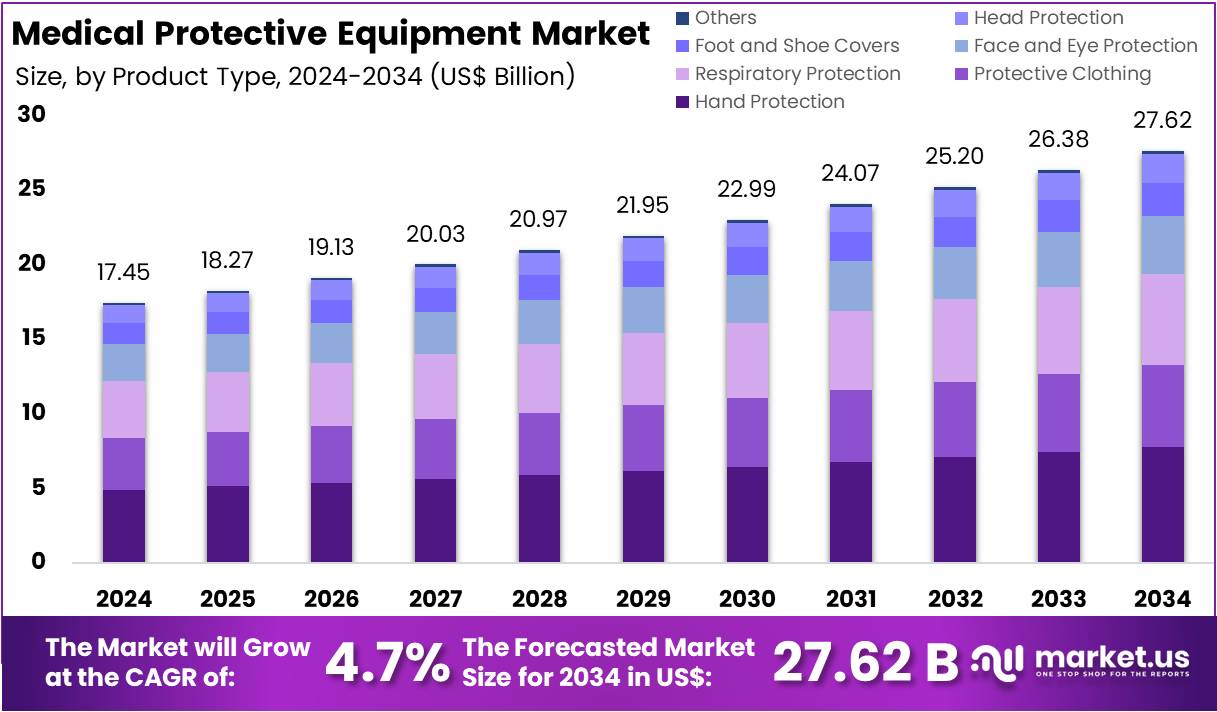
Key Takeaways
- The Global Medical Protective Equipment Market is expected to increase from US$ 17.45 billion in 2024 to US$ 27.62 billion by 2034.
- The market is projected to register a CAGR of 4.7% during the 2025–2034 forecast period.
- In 2024, the Hand Protection segment led the Product Type category, accounting for over 28.2% of the global market.
- The Disposable segment dominated the Usability category in 2024, capturing more than 67.9% of the total market share.
- Hospitals and Clinics emerged as the leading End-User segment in 2024, contributing over 54.1% of the global market.
- North America held the largest regional market share in 2024, accounting for 35.9% of the global market, with a market value of approximately US$ 6.26 billion.
Statistical Information
- Healthcare-Associated Infections Continue to Increase PPE Consumption: Healthcare-associated infections (HAIs) remain one of the largest drivers of medical protective equipment usage worldwide. According to the WHO, 7 out of every 100 hospitalized patients in high-income countries and 15 out of every 100 patients in low- and middle-income countries acquire at least one healthcare-associated infection. WHO also reports that up to 70% of these infections can be prevented through effective infection prevention and control (IPC) measures, including proper use of gloves, gowns, masks, respirators, and eye protection. In the United States, the CDC estimates that 1 in 31 hospital patients has at least one HAI on any given day, with approximately 687,000 HAIs and nearly 72,000 associated deaths occurring annually in U.S. acute-care hospitals.
- COVID-19 Created Unprecedented Global PPE Demand: The COVID-19 pandemic demonstrated the critical importance of medical protective equipment. WHO estimated that healthcare systems required 89 million medical masks, 76 million examination gloves, and 1.6 million goggles every month during the pandemic. WHO further estimated that global PPE manufacturing needed to increase by around 40% to meet demand. During shortages, surgical mask prices increased sixfold, N95 respirators tripled in price, and medical gowns doubled, significantly affecting healthcare procurement worldwide
- Antimicrobial Resistance Strengthens Long-Term PPE Demand: According to the CDC, antimicrobial resistance (AMR) causes more than 2.8 million infections every year in the United States and results in over 35,000 deaths annually. Globally, WHO reports that antimicrobial-resistant bacterial infections directly caused approximately 1.27 million deaths in 2019 and were associated with nearly 5 million deaths. The CDC also estimates that treatment of six major resistant pathogens costs the U.S. healthcare system more than US$4.6 billion every year, reinforcing the need for infection prevention using certified PPE.
- Government PPE Stockpiles Continue to Expand: A CDC-supported study evaluating U.S. emergency stockpiles found an inventory of approximately 53 million respirators across 20 government and healthcare stockpiles. About 69% (35.8 million respirators) had been stored for 5–10 years, demonstrating the scale of government preparedness programs and the need for continual PPE replacement and quality monitoring.
- Hospital PPE Usage is Dominated by Gloves and Masks: A hospital demand modeling study using data from 22,039 hospitalized patients found that gloves and surgical masks accounted for nearly 90% of total PPE consumption in hospital settings. The study also estimated that 86% of surgical mask use resulted from routine healthcare worker protection requirements rather than direct patient procedures, demonstrating the recurring demand for disposable PPE.
- Infection Prevention Programs Deliver Measurable Results: The CDC’s latest National Healthcare Safety Network report showed measurable reductions in healthcare-associated infections between 2023 and 2024, including 11% fewer Clostridioides difficile infections, 10% fewer catheter-associated urinary tract infections (CAUTIs), 9% fewer central line-associated bloodstream infections (CLABSIs), and 7% fewer MRSA bloodstream infections. Continued PPE compliance remains a core component of these infection prevention programs.
- Global PPE Demand Increased Due to Healthcare Worker Protection Needs: The World Health Organization (WHO) estimated that healthcare workers required approximately 89 million medical masks, 76 million examination gloves, and 1.6 million goggles every month during the COVID-19 response. WHO highlighted that global manufacturing capacity needed to expand by 40% to meet healthcare demand and prevent shortages affecting frontline workers. Surgical mask prices increased by 6 times, N95 respirator prices increased by 3 times, and medical gown prices doubled during supply disruptions.
- Hospitals Experience Continuous PPE Consumption Through Routine Patient Care: A hospital PPE utilization study analyzing 22,039 patient admissions found that gloves and surgical masks represented approximately 90% of predicted PPE usage in hospital environments. The study also reported that 86% of surgical mask demand was linked to healthcare worker requirements outside direct patient interaction, showing that PPE consumption is driven by daily hospital operations, not only emergencies.
- Healthcare-Associated Infections Create Persistent PPE Requirements: The U.S. CDC reports that approximately 1 in 31 hospital patients has at least one healthcare-associated infection (HAI) on any given day. CDC data estimates around 687,000 HAIs annually in U.S. acute-care hospitals, resulting in approximately 72,000 deaths during hospitalization. These infection risks support continuous demand for gloves, gowns, masks, respirators, and other protective equipment.
Regional Analysis
North America emerged as the leading regional market in 2024, holding a 35.9% share
North America remains a leading region in the medical protective equipment market, supported by high healthcare spending, strong regulatory standards, and continuous infection prevention initiatives. The United States spent approximately US$4.9 trillion on healthcare in 2023, representing 17.6% of GDP, according to the Centers for Medicare & Medicaid Services (CMS). This extensive healthcare infrastructure drives consistent demand for masks, gloves, gowns, respirators, and other protective products.
Strict safety regulations from agencies such as the U.S. FDA, CDC, OSHA, and NIOSH ensure the use of certified PPE across hospitals and healthcare facilities. NIOSH-approved respirators and FDA-regulated protective devices support quality-based procurement. Additionally, government preparedness programs, including the Strategic National Stockpile, maintain emergency PPE reserves to address future health crises. Rising focus on infection control, antimicrobial resistance prevention, and healthcare worker safety continues to strengthen long-term PPE adoption across the region.
Emerging Trends
- Growing Adoption of Advanced Respiratory Protection Equipment: Healthcare facilities are increasingly shifting toward certified respirators and high-filtration PPE to improve protection against airborne infections. NIOSH-approved N95 respirators must meet strict performance requirements, including minimum 95% filtration efficiency against airborne particles. Rising concerns around respiratory diseases and infection control are supporting demand for advanced protective solutions.
- Sustainable and Recyclable PPE Development Gains Attention: The increasing use of disposable protective equipment has created pressure to reduce medical waste. During the COVID-19 response, WHO estimated monthly global requirements of approximately 89 million medical masks, 76 million gloves, and 1.6 million goggles. This has encouraged healthcare systems and manufacturers to explore biodegradable materials, reusable gowns, and improved PPE recycling methods.
- Digital PPE Inventory Management and Demand Forecasting: Hospitals are adopting digital inventory tracking systems to avoid shortages and improve emergency preparedness. A study analyzing PPE requirements from 22,039 hospital patient admissions found that gloves and surgical masks accounted for approximately 90% of predicted PPE consumption. These insights are encouraging healthcare providers to use data-driven forecasting systems for procurement planning.
- Expansion of PPE Usage Beyond Traditional Hospital Settings: Medical protective equipment is increasingly used in laboratories, emergency response, long-term care facilities, and outbreak management programs. WHO highlights that PPE protects healthcare workers from biological hazards, including viruses and bacteria transmitted through contact, droplets, airborne routes, and contaminated surfaces. This broader application is creating continuous demand across multiple healthcare environments.
- Rising Focus on Healthcare Worker Safety and Occupational Protection: Healthcare worker safety has become a major priority due to exposure risks from infectious diseases and workplace hazards. WHO reports that approximately 136 million people work in the global health and social care sector. Healthcare workers face biological, chemical, physical, and ergonomic risks, increasing the need for continuous PPE availability.
Use Cases
- Hospital Infection Prevention and Patient Care: Medical protective equipment is widely used in hospitals to prevent transmission of infectious diseases between healthcare workers and patients. Gloves, masks, gowns, respirators, and eye protection are required during routine care, surgeries, and isolation procedures. The CDC reports that approximately 1 in 31 U.S. hospital patients has at least one healthcare-associated infection (HAI) on any given day, increasing the need for effective PPE practices.
- Surgical Procedures and Operating Room Protection: Surgeons and operating room teams use sterile gowns, surgical masks, gloves, and face shields to reduce contamination risks during invasive procedures. The FDA regulates surgical gowns and masks as medical devices requiring specific performance standards for fluid resistance and protection. Increasing surgical volumes and complex procedures continue to support PPE demand in healthcare facilities.
- Respiratory Disease Management and Isolation Care: N95 respirators and other advanced masks are used for protecting healthcare workers treating patients with airborne diseases such as tuberculosis, influenza, and emerging respiratory infections. NIOSH-certified N95 respirators must demonstrate at least 95% filtration efficiency against airborne particles. Hospitals maintain respiratory protection programs involving fit testing, training, and regular equipment replacement.
- Emergency Response and Pandemic Preparedness: Medical protective equipment plays a critical role during infectious disease outbreaks, natural disasters, and public health emergencies. During COVID-19, WHO estimated global monthly requirements of 89 million masks, 76 million gloves, and 1.6 million goggles for healthcare workers. Governments and healthcare organizations now maintain PPE reserves to improve emergency readiness.
- Laboratory and Diagnostic Testing Applications: Laboratory professionals use gloves, protective coats, masks, and eye protection while handling biological samples, chemicals, and infectious materials. CDC biosafety guidelines recommend appropriate PPE based on laboratory risk levels and procedures. Growing diagnostic testing activities and infectious disease surveillance programs continue increasing demand for specialized protective equipment.
Frequently Asked Questions on Medical Protective Equipment
- Why is medical protective equipment important in healthcare?
Medical protective equipment is essential for preventing infection transmission between healthcare workers and patients. It supports infection prevention programs by reducing exposure to blood, body fluids, airborne pathogens, and contaminated surfaces in hospitals, laboratories, clinics, and emergency healthcare environments. - Why are disposable PPE products widely used?
Disposable PPE products are preferred because they reduce contamination risks, simplify infection control procedures, and eliminate the need for complex sterilization processes. Hospitals commonly use disposable gloves, masks, gowns, and protective covers to maintain hygiene standards during patient care. - How did COVID-19 impact the medical protective equipment market?
COVID-19 significantly increased global PPE demand as healthcare systems required large quantities of masks, gloves, gowns, and respirators. WHO estimated monthly requirements of 89 million masks and 76 million gloves during the pandemic, highlighting the importance of supply chain preparedness. - What role do government regulations play in the PPE market?
Government regulations ensure that medical protective equipment meets safety, quality, and performance requirements. Agencies such as FDA, CDC, OSHA, and NIOSH establish standards for respirators, surgical masks, gowns, and gloves, supporting consistent adoption of certified protective products. - How does antimicrobial resistance influence PPE demand?
Rising antimicrobial resistance increases the importance of infection prevention measures, including PPE usage. WHO reported antimicrobial-resistant infections caused approximately 1.27 million deaths globally in 2019, encouraging healthcare facilities to strengthen protective practices and reduce pathogen transmission. - What are the emerging trends in the medical protective equipment market?
Key emerging trends include sustainable PPE materials, reusable protective clothing, smart inventory management systems, advanced filtration technologies, improved comfort designs, and domestic manufacturing initiatives. Healthcare organizations are focusing on reliable supply chains and environmentally responsible protective solutions. - Who are the major end-users of medical protective equipment?
Hospitals and clinics are the largest users of medical protective equipment due to regular patient care activities and infection control requirements. Other important users include laboratories, diagnostic centers, nursing homes, pharmaceutical companies, emergency responders, and research institutions. - Why is North America a leading region in the medical protective equipment market?
North America leads due to high healthcare spending, advanced hospital infrastructure, strict safety regulations, and strong emergency preparedness programs. The United States spent approximately US$4.9 trillion on healthcare in 2023, supporting continuous demand for protective equipment.
Conclusion
The medical protective equipment market is supported by rising infection prevention requirements, healthcare worker safety initiatives, and increasing preparedness for future health emergencies. Continuous demand for gloves, masks, gowns, respirators, and other protective products is driven by healthcare-associated infections, antimicrobial resistance concerns, and strict regulatory standards.
Government investments, advanced PPE technologies, sustainable solutions, and improved supply chain management are further strengthening market development. With hospitals, laboratories, and emergency response organizations maintaining higher safety standards, medical protective equipment will remain a critical component of global healthcare infrastructure, ensuring long-term demand and innovation opportunities across the industry.
Discuss your needs with our analyst
Please share your requirements with more details so our analyst can check if they can solve your problem(s)




