


Overview
New York, NY – Aug 07, 2026 – The Global Medical Kiosk Market Size is expected to be worth around US$ 7.0 Billion by 2034 from US$ 1.7 Billion in 2024, growing at a CAGR of 15.2% during the forecast period 2025 to 2034. North America held a dominant market position, capturing more than a 53.9% share and holds US$ 0.9 Billion market value for the year.
The global medical kiosk market is witnessing strong growth as healthcare providers increasingly adopt automation to overcome workforce shortages, improve operational efficiency, and enhance patient experiences.
Medical kiosks are becoming essential tools for streamlining administrative and basic healthcare services, including patient registration, insurance verification, appointment scheduling, digital check-ins, and health information access. The rising pressure on healthcare systems due to limited workforce availability is accelerating the adoption of these self-service solutions.
The US healthcare sector is experiencing significant staffing challenges, creating demand for automated technologies. The American Hospital Association projects a shortage of up to 124,000 physicians by 2033, while the Bureau of Labor Statistics estimates that the healthcare sector will require more than 200,000 new registered nurses annually to meet demand. These shortages are encouraging hospitals, clinics, and healthcare facilities to implement medical kiosks to reduce administrative workloads and improve workflow efficiency.
Technological advancements, particularly in artificial intelligence (AI), cloud-based platforms, and digital healthcare solutions, are transforming medical kiosks into advanced patient engagement systems. In March 2024, Olea Kiosks Inc. introduced Virtual Reception and Self-Service Kiosks designed to automate tasks such as appointment management and patient communication.
Additionally, rising demand for convenient and contactless healthcare services is supporting market expansion. According to the Health Resources and Services Administration (HRSA), more than 75 million people in the US live in primary care Health Professional Shortage Areas, increasing the need for accessible healthcare technologies. Medical kiosks help improve healthcare access, reduce waiting times, and support efficient service delivery across hospitals, pharmacies, and retail healthcare locations.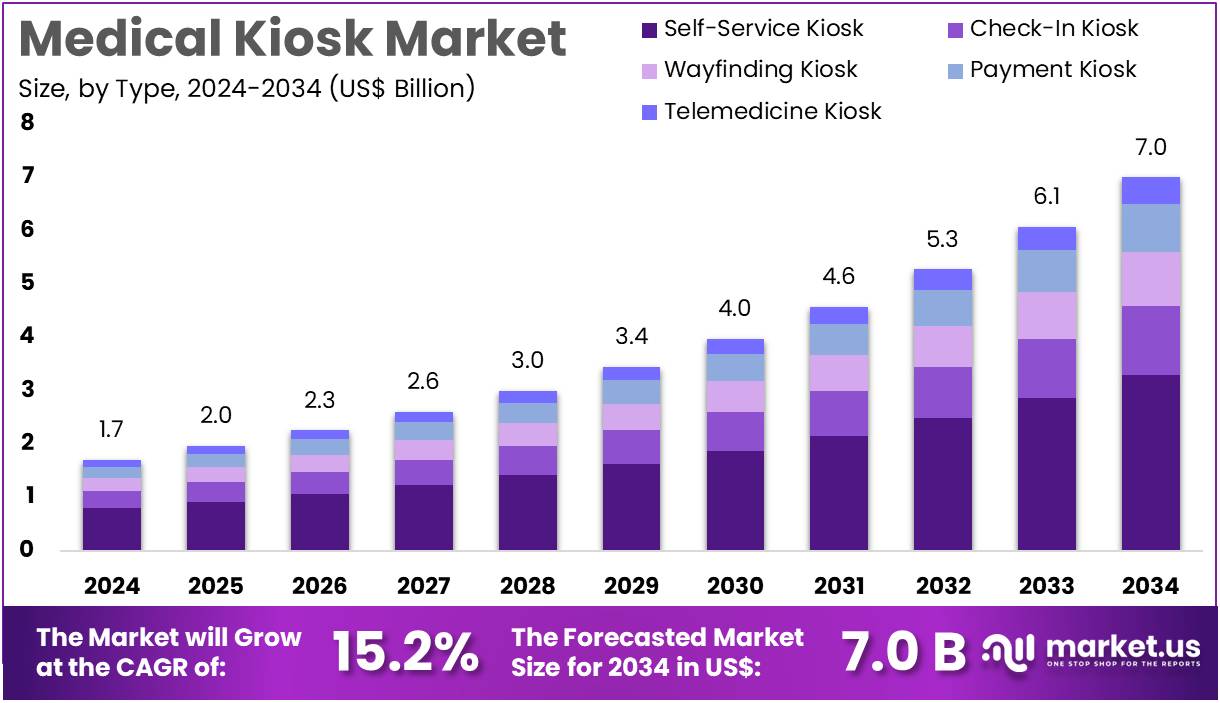
Key Takeaways
- In 2024, the medical kiosk market generated revenue of US$ 1.7 billion and is projected to grow at a CAGR of 15.2%, reaching approximately US$ 7.0 billion by 2034.
- Based on type, the market is segmented into self-service kiosks, check-in kiosks, wayfinding kiosks, payment kiosks, and telemedicine kiosks. The self-service kiosk segment dominated the market in 2023, accounting for a 47.2% share.
- By facility, the medical kiosk market is categorized into hospitals, pharmacies, specialty clinics, and others. Among these, hospitals held the largest market share of 52.6% in 2023.
- Regionally, North America emerged as the leading market in 2023, capturing a significant share of 53.9% due to increasing healthcare automation adoption and demand for self-service solutions.
Statistical Information
- Rising Adoption of Digital Healthcare Access Platforms Among Patients: Consumer adoption of digital healthcare services is increasing, supporting demand for patient-facing technologies such as self-service kiosks. The Office of the National Coordinator for Health Information Technology (ONC) reported that in 2024, 65% of individuals in the US accessed their online medical records or patient portals, compared with only 25% in 2014. This indicates growing patient acceptance of digital healthcare interactions.
- Increasing Use of Mobile and Digital Healthcare Tools by Chronic Disease Patients: Patients managing long-term health conditions are showing higher engagement with digital healthcare platforms. In 2024, 81% of individuals with chronic conditions were offered online access to medical records, while 69% accessed their records at least once during the year. Medical kiosks integrated with electronic health records and telehealth platforms can support similar digital-first healthcare experiences.
- Scale of Kiosk Usage for Blood Pressure Monitoring: Between 2017 and 2024, 1.27 million adults used self-service health kiosks in US retail stores to measure blood pressure. About 50% had high blood pressure (either diagnosed or measured ≥140/90 mm Hg). Usage was highest among non-Hispanic Black adults (55.6% in 2023–24) and adults over 65 (71.9%). This real-world data demonstrates kiosks’ role in expanding access to cardiovascular screening outside clinical settings.
- Patient Interest in Kiosk-Delivered Health Information: In a survey of 4,351 ED patients, 50.3% expressed interest in receiving health information via kiosk. Top topics high blood pressure (30%), depression (21%), and diabetes (18%). Older patients (>55 years) were 4× more likely to want hypertension info than those aged 18–24. Results indicate substantial patient willingness to engage with kiosk-based education in acute-care environments.
- Physician Adoption of Digital Health Tools: AMA surveyed 1,300 physicians. Use of digital health tools rose from 2.2 tools/physician to 3.8. Tele-visits grew from 14% to 80%; remote monitoring devices from 12% to 30%. 93% of physicians saw digital tools as advantageous for patient care by 2022. This reflects growing provider readiness for kiosk-integrated workflows.
- Consumer Comfort and Preference for Self-Service Kiosks: 72% of consumers are comfortable using in-store kiosks. 61% want more kiosks in restaurants. 42% use kiosks weekly 25% order from cashiers less often than last year. 76% reported buying more than intended at least once via kiosk. This shift indicates rising consumer acceptance of self-service interfaces.
- Telehealth Growth is Increasing Demand for Telemedicine-Enabled Kiosks: Telemedicine adoption has expanded significantly, creating opportunities for telemedicine kiosks equipped with video consultation, remote monitoring, and digital health tools. According to the US Department of Health and Human Services (HHS), 25% of Medicare fee-for-service beneficiaries used telehealth services in 2024, while 95% of HRSA-funded health centers used telehealth for primary care delivery in 2024.
- Electronic Health Record Adoption Creates Strong Infrastructure for Medical Kiosks: The widespread adoption of electronic health record (EHR) systems is supporting the integration of medical kiosks with hospital information systems. According to the CDC National Center for Health Statistics (NCHS), 95% of US office-based physicians had adopted EHR systems in 2024, with 83.6% using certified EHR technology. This digital infrastructure enables kiosks to connect with patient records, registration systems, and healthcare workflows.
Regional Analysis
North America led the market by securing a market share of 53.9% in 2023.
North America holds a leading position in the medical kiosk market due to its advanced healthcare infrastructure, rapid adoption of digital health technologies, and increasing demand for automated patient services. The region’s high burden of chronic diseases is encouraging healthcare providers to implement self-service solutions for patient monitoring, registration, and care management.
According to the CDC, 6 in 10 adults in the US live with at least one chronic disease, creating demand for efficient healthcare delivery models. Additionally, the ONC reported that 99% of US hospitals had adopted patient engagement capabilities in 2024, supporting the integration of digital kiosks into healthcare workflows.
Asia Pacific is expected to witness significant growth due to expanding healthcare infrastructure, government-led digital health initiatives, and increasing demand for accessible medical services. Telemedicine adoption is rising rapidly, with India’s e-Sanjeevani platform completing over 340 million consultations by February 2025. Countries such as Vietnam are also investing in smart healthcare kiosks to improve patient access and operational efficiency across medical facilities.
Emerging Trends
- AI-Powered Medical Kiosks for Automated Healthcare Support: Artificial intelligence is transforming medical kiosks into advanced healthcare platforms that can support symptom assessment, patient guidance, and automated assistance. The US Department of Health and Human Services (HHS) is promoting AI adoption in healthcare to improve efficiency, decision-making, and patient services.
- Growing Adoption of Telemedicine-Enabled Kiosks: Telemedicine kiosks are gaining popularity as healthcare providers seek solutions to expand remote care access. According to HHS, 25% of Medicare fee-for-service beneficiaries used telehealth services in 2024, while HRSA-supported health centers increasingly use telehealth for primary care delivery.
- Integration with Electronic Health Records (EHRs): Medical kiosks are increasingly connected with electronic health record systems to improve patient registration, health data access, and workflow automation. CDC data shows that 95% of US office-based physicians adopted EHR systems in 2024, supporting wider use of digital healthcare technologies.
- Increasing Demand for Contactless Patient Services: Patients are showing greater preference for self-service healthcare options, including digital check-in, appointment scheduling, and automated payment systems. ONC reported that 99% of US hospitals had patient engagement capabilities in 2024, encouraging healthcare providers to adopt digital interaction tools.
- Expansion of Healthcare Kiosks in Underserved Areas: Medical kiosks are being deployed in locations with limited healthcare availability to improve access through remote consultations and basic health assessments. HRSA data highlights that millions of Americans live in healthcare shortage areas, increasing demand for technology-enabled care delivery.
Use Cases
- Automated Patient Check-In and Registration: Hospitals are implementing medical kiosks to automate patient registration, identity verification, insurance checks, and appointment confirmation. These solutions reduce administrative workload and improve patient flow, allowing healthcare workers to focus on clinical responsibilities and improving overall operational efficiency.
- Remote Telehealth Consultations: Telemedicine kiosks enable patients to connect with healthcare professionals through video consultations and remote monitoring tools. HHS reported continued growth in telehealth adoption, with millions of Medicare beneficiaries using virtual healthcare services annually, supporting kiosk-based care models.
- Preventive Health Screening and Monitoring: Healthcare kiosks equipped with digital sensors can measure vital signs such as blood pressure, oxygen levels, and temperature. These systems support preventive care by enabling early detection and encouraging regular health monitoring outside traditional healthcare facilities.
- Digital Payment and Administrative Management: Payment kiosks help healthcare facilities simplify billing processes, reduce waiting times, and improve patient convenience. These systems allow users to complete payments, update personal information, and manage healthcare services independently through secure digital platforms.
- Pharmacy and Community Healthcare Services: Medical kiosks are expanding into pharmacies, retail healthcare locations, and community centers to improve access to basic healthcare services. These systems provide health information, patient education, and remote consultation options, helping address healthcare accessibility challenges in underserved communities.
Frequently Asked Questions on Medical Kiosk
- What are the major applications of medical kiosks?
Medical kiosks are used for patient check-in, insurance verification, digital payments, healthcare navigation, telehealth consultations, health screenings, and patient education. Hospitals, clinics, pharmacies, and community healthcare centers use these systems to improve patient flow and service quality. - Why is the medical kiosk market growing?
The medical kiosk market is growing due to increasing healthcare workforce shortages, rising demand for digital healthcare solutions, patient preference for self-service options, and the need to automate administrative processes while improving operational efficiency in healthcare facilities. - How do medical kiosks improve patient experience?
Medical kiosks improve patient experience by reducing waiting times, simplifying registration procedures, providing quick access to healthcare information, and supporting contactless interactions. These solutions help patients manage routine healthcare tasks more conveniently and improve overall satisfaction. - Which segment dominates the medical kiosk market?
The self-service kiosk segment leads the medical kiosk market due to increasing adoption of automated registration, digital check-in systems, and patient engagement solutions. Healthcare facilities use these kiosks to reduce administrative workload and enhance operational performance. - Why are telemedicine kiosks gaining popularity?
Telemedicine kiosks are gaining popularity because they enable remote consultations, digital health monitoring, and virtual access to healthcare professionals. These systems help address physician shortages and improve healthcare availability in rural and underserved communities. - Which end users utilize medical kiosks?
Medical kiosks are utilized by hospitals, specialty clinics, pharmacies, diagnostic centers, and other healthcare facilities. Hospitals represent a major user group due to high patient traffic and the requirement for efficient registration, payment, and patient management solutions. - What are the future trends in the medical kiosk market?
Future trends include AI-enabled kiosks, integration with electronic health records, biometric authentication, remote patient monitoring, cloud-based healthcare platforms, and expansion into retail healthcare locations. These advancements will support more personalized and efficient healthcare delivery. - How does North America support medical kiosk market growth?
North America supports medical kiosk growth through advanced healthcare infrastructure, strong adoption of digital health technologies, increasing automation investments, and rising demand for convenient healthcare services. The region’s focus on patient-centered care encourages wider kiosk deployment.
Conclusion
The medical kiosk market is experiencing significant growth due to rising healthcare workforce shortages, increasing demand for digital healthcare solutions, and the need for improved operational efficiency. Advanced technologies such as artificial intelligence, telemedicine, and electronic health record integration are transforming kiosks into comprehensive healthcare platforms.
Hospitals, pharmacies, and clinics are adopting these solutions to reduce waiting times, automate administrative tasks, and enhance patient experiences. With growing digital health adoption, increasing focus on preventive care, and expanding access to remote healthcare services, medical kiosks are expected to play an important role in shaping the future of efficient, patient-centered healthcare delivery.
Discuss your needs with our analyst
Please share your requirements with more details so our analyst can check if they can solve your problem(s)




