


Overview
New York, NY – July 23, 2026 – The Global Medical Imaging Devices Market size is expected to be worth around USD 56.4 Billion by 2033 from USD 34.0 Billion in 2023, growing at a CAGR of 5.2% during the forecast period from 2024 to 2033.
Medical imaging has become an essential component of modern healthcare by enabling physicians to visualize internal body structures for accurate diagnosis, disease monitoring, and treatment planning. Advanced imaging technologies, including magnetic resonance imaging (MRI), computed tomography (CT), ultrasound, radiography, nuclear medicine, mammography, and emerging techniques such as photoacoustic imaging, provide detailed insights into anatomical and functional changes within the human body.
The increasing burden of chronic diseases, rising demand for early diagnosis, and growing geriatric population are major factors supporting the expansion of medical imaging applications worldwide. Older adults often require advanced diagnostic procedures due to the higher prevalence of cardiovascular disorders, cancer, neurological conditions, and musculoskeletal diseases. As a result, radiology and imaging technologies are becoming increasingly important in multidisciplinary geriatric care.
Continuous technological advancements are transforming the medical imaging landscape by improving image quality, reducing scanning time, and enhancing diagnostic accuracy. Innovations such as artificial intelligence (AI)-assisted imaging analysis, portable and open MRI systems, digital mammography, 3D and 4D imaging technologies, and advanced image reconstruction techniques are helping healthcare professionals detect diseases at earlier stages and deliver personalized treatment strategies.
Furthermore, increasing investments in healthcare infrastructure, expansion of diagnostic centers, and rising adoption of minimally invasive treatment approaches are creating new opportunities for imaging technologies. Medical imaging continues to play a critical role in improving patient outcomes by supporting precise diagnosis, effective disease management, and better clinical decision-making across diverse healthcare settings.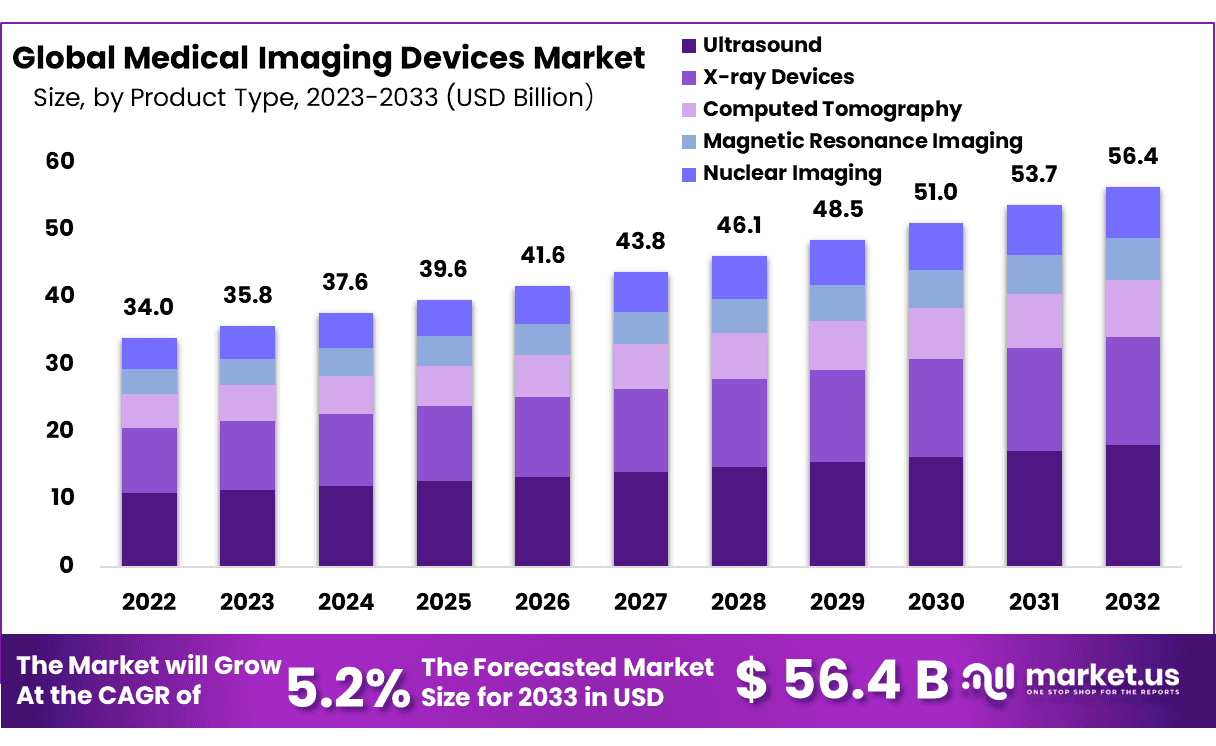
Key Takeaways
- Market Size & Growth: The Medical Imaging Devices Market is projected to reach approximately USD 56.4 Billion by 2033, increasing from USD 34.0 Billion in 2023, with a steady CAGR of 5.2% during the forecast period.
- Product Type Analysis: Ultrasound devices represent the leading product segment in the Medical Imaging Devices Market, accounting for around 32% market share in 2023 due to their cost-effectiveness, safety, and wide clinical applications.
- End-use Analysis: Hospitals hold the largest share in the Medical Imaging Devices Market, capturing approximately 45.6% market share in 2023 due to high demand for advanced diagnostic and treatment procedures.
- Regional Analysis: North America dominates the Medical Imaging Devices Market with nearly 33% market share in 2023, generating around USD 11.22 Billion in revenue due to advanced healthcare infrastructure and high adoption of imaging technologies.
Statistical Information
- Highest combined CT, MRI, PET exam rates in OECD: According to OECD “Health at a Glance 2025,” the combined use of CT, MRI and PET diagnostic exams was over 370 exams per 1,000 population in 2023 in Luxembourg, Korea, Austria, France and Portugal, making these the highest‑utilization countries among 31 OECD states with scanner‑use data.
- Growth in CT and MRI exam rates 2013–2023: Between 2013 and 2023, OECD data show that the number of CT exams per 1,000 population more than doubled in Korea, and increased by more than 50% in Australia and Latvia, illustrating rapid expansion of CT utilization over one decade.
- CT scanner access by income group: The Lancet Oncology Commission’s global assessment of imaging resources calculated that one CT scanner serves on average 25,000 people in high‑income countries, 79,000 in upper‑middle‑income countries, 227,000 in lower‑middle‑income countries, and 1,694,000 in low‑income countries.
- Exam‑to‑scanner ratio trends for CT, MRI, PET: A 2023 study of diagnostic technology trends in 16 OECD countries found that most countries experienced a rise in the exam‑to‑scanner ratio for CT, MRI and PET between 2011 and 2020, meaning exam volumes increased faster than the number of installed devices.
- EU hospital availability of CT and MRI units per 100,000 inhabitants: Eurostat’s healthcare resources news release reports that in 2019, Denmark had the highest availability of CT scanners in hospitals among EU Member States with data, at 4.0 CT scanners per 100,000 inhabitants, followed by Cyprus (3.5), Bulgaria (2.9), and Italy and Sweden (both 2.6).
- Changes in CT and MRI unit availability in the EU: Between 2014 and 2019, Eurostat data show that CT scanner availability per 100,000 inhabitants increased by 0.4 units in Bulgaria, Romania and Slovenia, representing the largest positive changes among Member States with data.
- Drops and rebounds in imaging exams during COVID‑19: OECD’s diagnostic technologies chapter for 2023 reports that MRI exam volumes fell sharply between 2019 and 2020 across many OECD countries, with reductions over 30% in the United States, due to delayed or cancelled diagnostics early in the COVID‑19 pandemic.
Regional Analysis
North America accounted for approximately 33% of the Medical Imaging Devices Market in 2023, generating around USD 11.22 Billion in revenue, supported by advanced healthcare infrastructure, high adoption of diagnostic technologies, and strong demand for early disease detection. The region benefits from widespread availability of hospitals, specialized imaging centers, and advanced radiology facilities that utilize MRI, CT, ultrasound, and digital imaging systems for diagnosis and treatment planning.
The growing burden of chronic diseases, increasing geriatric population, and rising focus on precision diagnosis are encouraging healthcare providers to invest in advanced imaging solutions. Government initiatives, regulatory support, and reimbursement frameworks from organizations such as the FDA and CMS continue to improve patient access to medical imaging technologies. FDA regulations and CMS accreditation requirements for advanced diagnostic imaging facilities support quality, safety, and adoption of imaging systems across healthcare settings.
Furthermore, the increasing integration of artificial intelligence, digital imaging platforms, and image-guided procedures is strengthening North America’s position in the global medical imaging landscape. Healthcare providers are increasingly adopting innovative imaging technologies to enhance diagnostic accuracy, improve workflow efficiency, and deliver better patient outcomes.
Emerging Trends
- Artificial Intelligence Integration in Medical Imaging: AI is transforming medical imaging by improving image interpretation, disease detection, and workflow automation. The FDA maintains a list of AI-enabled medical devices, with many approved applications focused on radiology, including CT, MRI, and ultrasound analysis. AI helps clinicians detect conditions faster and improve diagnostic accuracy.
- Portable and Point-of-Care Imaging Growth: Portable imaging devices, especially handheld ultrasound systems, are gaining adoption in emergency care, rural hospitals, and outpatient clinics. WHO recognizes diagnostic imaging availability, including CT, MRI, PET, and mammography systems, as an important healthcare capacity indicator measured per million population.
- Advanced 3D and Hybrid Imaging Technologies: Healthcare providers are increasingly adopting 3D imaging, PET-CT, and PET-MRI technologies to improve disease visualization and treatment planning. These advanced systems provide functional and anatomical information, supporting precision medicine approaches in oncology, cardiology, and neurological disease management.
- Low-Dose Imaging and AI-Based Reconstruction: Medical imaging manufacturers are focusing on reducing radiation exposure while maintaining high-quality images. AI-powered reconstruction technologies help improve CT and MRI image clarity, shorten scanning time, and enhance patient safety. FDA-cleared AI imaging solutions are increasingly supporting image enhancement and diagnostic workflows.
- Cloud-Based Imaging and Remote Radiology Services: Cloud-based imaging platforms are expanding due to increasing demand for remote diagnosis and faster image sharing. Digital imaging networks support collaboration among radiologists, especially in regions facing specialist shortages. AI-based systems are helping prioritize urgent cases such as stroke and cancer detection.
Use Cases
- Cancer Detection and Treatment Monitoring: CT, MRI, PET, and ultrasound devices are widely used for detecting tumors, evaluating cancer progression, and monitoring treatment response. Advanced imaging provides detailed information about tumor size and location, while AI-assisted tools improve early detection and support personalized cancer treatment strategies.
- Cardiovascular Disease Diagnosis: Medical imaging devices such as echocardiography, cardiac MRI, CT angiography, and nuclear imaging help diagnose heart conditions by evaluating heart structure, blood flow, and vascular health. AI-based cardiovascular imaging solutions are improving automated analysis and supporting faster clinical decision-making.
- Neurological Disorder Diagnosis: MRI and CT scanners are essential for identifying brain tumors, strokes, and neurodegenerative disorders. Advanced imaging technologies provide detailed brain visualization, while AI algorithms assist radiologists in detecting abnormalities. FDA-approved AI radiology devices increasingly support neurological image analysis and emergency stroke assessment.
- Emergency and Trauma Care Applications: Imaging devices are critical in emergency departments for detecting fractures, internal injuries, bleeding, and life-threatening conditions. Portable ultrasound and rapid CT scanning allow faster diagnosis during trauma situations. AI-based triage solutions help healthcare teams prioritize critical cases and improve emergency response.
- Remote Healthcare and Tele-Radiology Services: Digital imaging systems and tele-radiology platforms enable medical images to be shared with specialists remotely, improving healthcare access in underserved regions. WHO identifies diagnostic imaging equipment availability, including CT, MRI, PET, and mammography systems, as an important measure of healthcare system capability.
Frequently Asked Questions on Medical Imaging Devices Market
- What factors are driving the Medical Imaging Devices Market growth?
Market growth is supported by rising chronic diseases, increasing demand for early diagnosis, healthcare infrastructure expansion, and technological advancements. Growing cases of cancer, cardiovascular disorders, and neurological diseases are increasing the adoption of advanced imaging technologies worldwide. - Which imaging technology is widely used in healthcare?
X-ray imaging is one of the most commonly used technologies due to its affordability and availability. However, MRI, CT, ultrasound, and PET imaging systems are gaining importance because they provide detailed diagnostic information for complex medical conditions. - How is artificial intelligence influencing medical imaging?
Artificial intelligence improves medical imaging by enabling automated image analysis, faster diagnosis, and better workflow management. AI-powered tools assist radiologists in detecting abnormalities, identifying diseases earlier, and improving accuracy in applications such as cancer, stroke, and cardiovascular disease diagnosis. - What are the major applications of medical imaging devices?
Medical imaging devices are used for cancer detection, cardiovascular diagnosis, neurological assessment, orthopedic evaluation, emergency care, and treatment monitoring. These technologies help healthcare professionals visualize internal organs, detect abnormalities, and create effective treatment strategies. - Why are portable medical imaging devices becoming popular?
Portable imaging devices improve healthcare access by allowing diagnosis in emergency departments, rural areas, ambulances, and remote locations. Compact ultrasound and mobile imaging solutions help healthcare providers deliver faster diagnostic services without depending only on large hospital-based imaging systems. - How are medical imaging devices used in cancer diagnosis?
Medical imaging devices such as MRI, CT, PET, and ultrasound help detect tumors, determine cancer stages, and monitor treatment response. These technologies provide detailed images that support early diagnosis, personalized treatment planning, and improved patient management. - What is the future outlook of the Medical Imaging Devices Market?
The future of the Medical Imaging Devices Market will focus on AI-powered diagnostics, cloud-based imaging platforms, portable systems, and advanced visualization technologies. Continuous innovation will improve diagnostic accuracy, reduce scanning time, and expand healthcare access globally.
Conclusion
The Medical Imaging Devices Market is evolving rapidly due to increasing demand for early disease detection, advanced diagnostic solutions, and improved patient care. Technologies such as artificial intelligence, portable imaging systems, cloud-based platforms, and advanced visualization tools are transforming healthcare delivery.
Medical imaging devices continue to play a critical role in diagnosing cancer, cardiovascular diseases, neurological disorders, and emergency conditions. Despite challenges such as high costs and limited accessibility, ongoing technological innovation and healthcare infrastructure development are expected to support market expansion. The future growth of this market will be driven by smarter, faster, and more accessible imaging solutions worldwide.
Discuss your needs with our analyst
Please share your requirements with more details so our analyst can check if they can solve your problem(s)




