


Overview
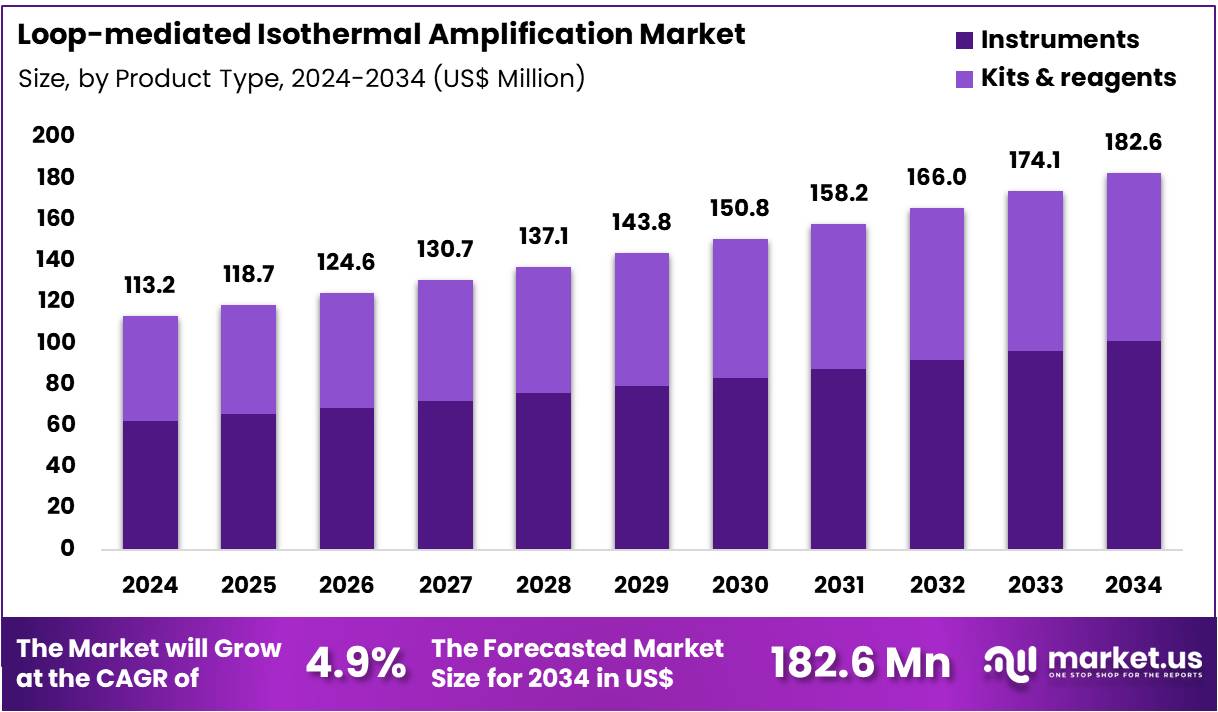
The Global Loop-mediated Isothermal Amplification Market size is expected to be worth around US$ 182.6 Million by 2034 from US$ 113.2 Million in 2024, growing at a CAGR of 4.9% during the forecast period 2025 to 2034. In 2024, North America led the market, achieving over 40.5% share with a revenue of US$ 45.8 Million.
Loop-mediated Isothermal Amplification (LAMP) is a rapid molecular diagnostic technology used for detecting specific DNA or RNA sequences with high accuracy under constant temperature conditions. Unlike conventional polymerase chain reaction (PCR), LAMP does not require thermal cycling and can amplify target genetic material at a stable temperature of approximately 60–56°C, making it suitable for point-of-care testing and resource-limited healthcare settings.
Developed in 2000 by Japanese researchers, LAMP technology uses a set of 4 to 6 primers and a strand-displacing DNA polymerase to generate large amounts of amplified DNA within 15–60 minutes. The method can achieve amplification levels of more than 10⁹ copies of target DNA, enabling sensitive detection of infectious diseases, genetic disorders, and agricultural pathogens.
LAMP-based diagnostics have gained importance in infectious disease management, including detection of pathogens such as SARS-CoV-2, tuberculosis, malaria, and sexually transmitted infections. The technology offers advantages including minimal equipment requirements, lower operational costs, and visual detection methods through color changes or fluorescence signals. Some LAMP assays can deliver results with sensitivity and specificity above 90–95%, depending on the target pathogen and testing conditions.
The growing demand for rapid diagnostics, decentralized testing, and outbreak preparedness is increasing the adoption of LAMP platforms worldwide. Government health programs, research institutions, and biotechnology companies are increasingly exploring LAMP-based solutions for faster disease surveillance and improving access to molecular testing.
Key Takeaways
- In 2024, the market generated revenue of US$ 113.2 Million, expanding at a CAGR of 4.9%, and is projected to reach US$ 182.6 Million by 2034.
- Based on product type, the market is categorized into instruments and kits & reagents, with instruments dominating in 2023 by capturing a 55.3% market share.
- By technology, the market is segmented into microfluidic technology, modern microsystem technology, and advanced infrared optical technology, among which microfluidic technology accounted for the largest share of 49.6%.
- Based on application, the market is divided into diagnostic purposes and research purposes, with diagnostic purposes leading the market with a 62.8% revenue share.
- By end user, the market is segmented into diagnostic centers, research & academic institutes, and hospital laboratories, where diagnostic centers held the dominant position with a 46.1% revenue share.
- Regionally, North America dominated the market in 2023, accounting for a 40.5% market share.
Statistical Information
- A 2025 LAMP-based diagnostic panel for hospital-acquired pneumonia analyzed 119 clinical samples and achieved 93.04% overall accuracy, with 93.33% sensitivity and 92.00% specificity for pathogen identification.
- The same 2025 hospital-acquired pneumonia LAMP assay detected target microorganisms with an average positivity time of 11.95 minutes (interquartile range: 9.86–14.55 minutes) among concordant samples.
- A 2025 clinical LAMP validation study reported a detection limit of 12.4 copies/µL, with complete amplification achieved in an average of 47.3 minutes.
- The 2025 clinical LAMP validation study demonstrated reproducibility with coefficient of variation values below 8.3% across different operators and equipment batches.
- A 2025 LAMP assay for gastrointestinal bacterial pathogen detection analyzed 204 stool samples and achieved overall sensitivity of 89.81% for samples with PCR cycle threshold values ≤40 and 95.14% when using a Ct cutoff ≤35.
- The 2025 gastrointestinal pathogen LAMP assay completed testing within 30 minutes, with only a few minutes required for sample preparation before detection.
- A 2025 paper-based LAMP assay for syphilis detection achieved 96.15% sensitivity and 100% specificity using a portable heating device for point-of-care testing.
- A 2025 LAMP assay for rapid detection of selected bacterial agents reduced turnaround time from conventional PCR’s 60 minutes to 30 minutes, with positive detection occurring in as little as 5–10 minutes.
- A 2025 clinical LAMP assay cost evaluation reported an approximate testing cost of €8.50 per test, representing a 44% reduction compared with conventional PCR methods.
Regional Analysis
North America Leading the Market
North America dominated the Loop-mediated Isothermal Amplification (LAMP) market in 2024, supported by strong adoption of rapid molecular diagnostics, advanced healthcare infrastructure, and government-backed infectious disease surveillance programs. Agencies such as the Centers for Disease Control and Prevention and National Institutes of Health have promoted the development of rapid nucleic acid testing platforms for respiratory infections and emerging pathogens.
LAMP technology is increasingly used in point-of-care settings due to its ability to deliver molecular detection within approximately 30–60 minutes without requiring complex thermal cycling equipment. Rising demand for decentralized testing, respiratory disease monitoring, and affordable diagnostics continues to strengthen regional adoption.
Asia Pacific Witnessing Fastest Growth
Asia Pacific is expected to register the highest growth rate during the forecast period due to increasing investments in infectious disease diagnostics, expanding healthcare access, and rising demand for cost-effective testing solutions. Countries including India, China, and Indonesia are adopting LAMP-based platforms for detecting diseases such as dengue, tuberculosis, and other vector-borne infections.
Support from organizations such as the World Health Organization is encouraging the use of rapid molecular tools for disease surveillance and outbreak management. Growth in portable diagnostic devices and digital health integration is further accelerating LAMP adoption across emerging economies.
Emerging Trends
- Expansion of Point-of-Care LAMP Diagnostics: The LAMP market is shifting toward portable molecular testing systems that support rapid diagnosis at clinics and field locations. These assays can provide results in approximately 15–40 minutes, reducing dependency on centralized laboratories and improving infectious disease testing access in remote areas.
- Growing Adoption of TB-LAMP Testing: Tuberculosis diagnosis is becoming a major application area for LAMP technology. The World Health Organization (WHO) recommends TB-LAMP as a molecular diagnostic option, with testing completed in less than 1 hour, supporting faster detection in healthcare facilities with limited laboratory resources.
- Integration with Digital and Smart Diagnostic Platforms: LAMP manufacturers are increasingly developing systems combined with smartphones, digital readers, and automated interpretation software. These platforms improve result tracking, data sharing, and remote monitoring, supporting decentralized healthcare models and strengthening disease surveillance programs.
- Development of Multiplex LAMP Technologies: Companies and research institutions are focusing on multiplex LAMP assays capable of detecting multiple pathogens in a single test. These innovations are improving respiratory infection screening, outbreak monitoring, and clinical decision-making by reducing testing time and increasing diagnostic efficiency.
- Increasing Use in Infectious Disease Surveillance: Public health programs are exploring LAMP technology for rapid detection of pathogens including tuberculosis, malaria, and respiratory viruses. Its ability to operate without complex thermal cyclers makes it suitable for outbreak response and community-level disease monitoring.
Use Cases
- Tuberculosis Diagnosis: TB detection is one of the most established healthcare applications of LAMP technology. WHO recognizes TB-LAMP as a useful molecular testing approach, especially for improving diagnosis where access to advanced laboratory systems is limited.
- COVID-19 and Respiratory Infection Testing: RT-LAMP has been widely studied for rapid detection of SARS-CoV-2 and other respiratory viruses. These tests can generate results within 30–60 minutes, supporting screening programs, emergency care, and community-level infection control.
- Malaria Detection: LAMP-based assays are being used in malaria research and surveillance because they offer high sensitivity and rapid pathogen identification. The technology supports testing in endemic regions where conventional molecular diagnostic facilities may not be easily available.
- Food Safety and Quality Monitoring: The food industry uses LAMP technology for detecting bacterial contamination, including pathogens such as Salmonella and E. coli. Rapid testing, often completed within one hour, helps manufacturers improve safety monitoring and reduce contamination risks.
- Veterinary Disease Detection: LAMP assays are increasingly applied in animal healthcare for detecting livestock and poultry infections. The technology supports early identification of diseases, helping farmers and veterinary authorities manage outbreaks and reduce economic losses.
Frequently Asked Questions on the Loop-mediated Isothermal Amplification
- What is Loop-mediated Isothermal Amplification (LAMP)?
Loop-mediated Isothermal Amplification (LAMP) is a nucleic acid amplification technology that detects genetic materials at a constant temperature. It uses specific primers and enzymes to rapidly amplify DNA or RNA, offering fast, sensitive, and accurate results without requiring traditional PCR thermal cycling systems. - How is LAMP different from PCR technology?
LAMP differs from PCR because it performs amplification at a constant temperature, eliminating the need for complex thermal cyclers. It provides faster results, requires simpler equipment, and is suitable for decentralized testing environments, while PCR generally requires advanced laboratory infrastructure. - What are the major applications of Loop-mediated Isothermal Amplification?
LAMP technology is used in infectious disease diagnostics, food safety testing, veterinary applications, agricultural pathogen detection, and environmental monitoring. It helps identify diseases such as tuberculosis, malaria, respiratory infections, and other microbial threats through rapid molecular testing. - How long does a LAMP test take to produce results?
A Loop-mediated Isothermal Amplification test can typically deliver results within 15 to 60 minutes, depending on the target pathogen and testing platform. This rapid detection capability makes LAMP valuable for point-of-care diagnostics and emergency disease surveillance. - What are the advantages of Loop-mediated Isothermal Amplification?
LAMP offers benefits including high sensitivity, rapid amplification, minimal equipment requirements, and cost-effective operation. Its ability to function in resource-limited settings makes it useful for hospitals, field clinics, and laboratories requiring quick molecular diagnostic solutions. - What is driving the growth of the Loop-mediated Isothermal Amplification Market?
The Loop-mediated Isothermal Amplification Market is growing due to increasing demand for rapid diagnostics, rising infectious disease monitoring needs, expansion of point-of-care testing, and technological advancements in portable molecular diagnostic devices for healthcare and research applications. - Which industries are adopting LAMP technology?
Healthcare, biotechnology, agriculture, veterinary medicine, food safety, and environmental testing industries are adopting LAMP technology. Its flexibility, affordability, and rapid detection capabilities support diverse applications, including pathogen identification, quality control, and biological research activities. - What is the future outlook for the Loop-mediated Isothermal Amplification Market?
The future outlook of the Loop-mediated Isothermal Amplification Market remains positive due to growing demand for rapid disease detection, portable diagnostic platforms, and decentralized healthcare solutions. Integration with digital technologies and multiplex testing approaches is expected to support future market expansion.
Conclusion
he Loop-mediated Isothermal Amplification (LAMP) market is expected to witness steady growth as demand rises for rapid, accurate, and cost-effective molecular diagnostics. The technology’s ability to amplify nucleic acids without complex thermal cycling equipment supports wider adoption in point-of-care testing, infectious disease detection, and resource-limited healthcare settings.
WHO has recognized TB-LAMP as a valuable diagnostic approach for pulmonary tuberculosis, highlighting its potential in improving early disease detection. Continuous advancements in microfluidics, automation, and integration with digital platforms are likely to expand LAMP applications across healthcare, research, and field-based testing environments.
Discuss your needs with our analyst
Please share your requirements with more details so our analyst can check if they can solve your problem(s)




