


Overview
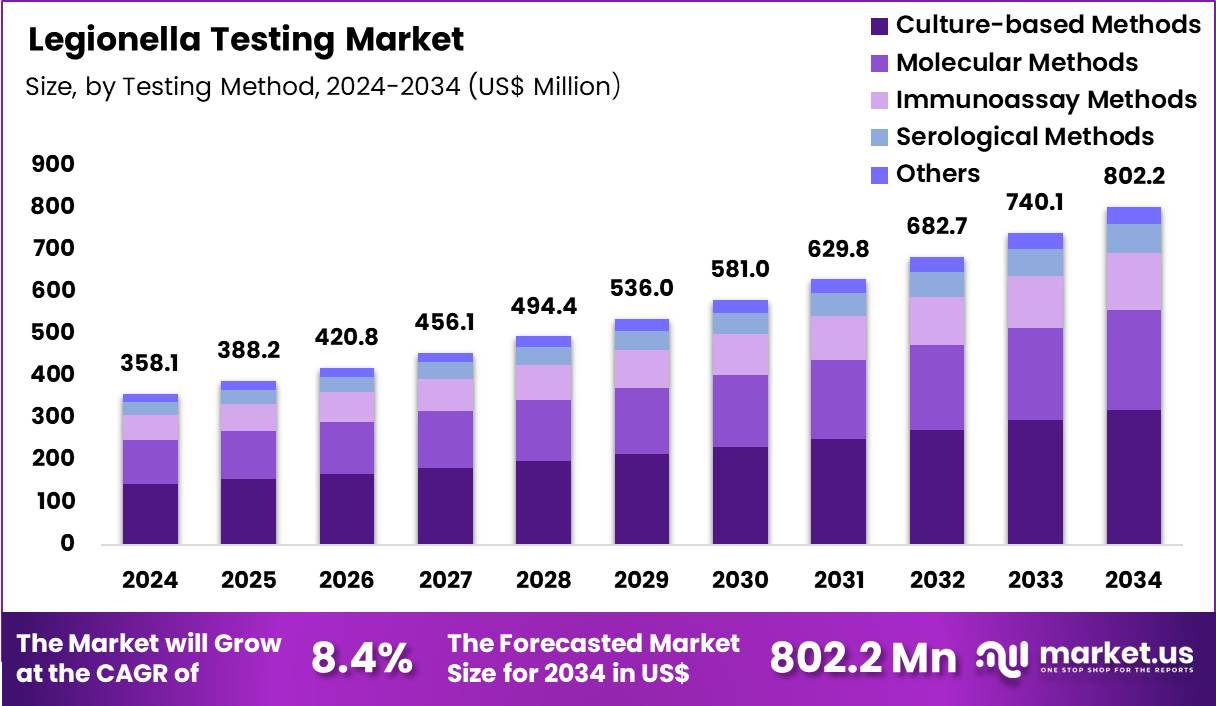
New York, NY – Sep 24, 2026 –The Global Legionella Testing Market size is expected to be worth around US$ 802.2 Million by 2034 from US$ 358.1 Million in 2024, growing at a CAGR of 8.4% during the forecast period 2025 to 2034. In 2024, North America led the market, achieving over 41.4% share with a revenue of US$ 148.3 Billion.
Legionella testing refers to laboratory-based methods used to detect and identify Legionella bacteria in clinical specimens and environmental water systems. The bacteria can cause Legionnaires’ disease, a severe form of pneumonia, and Pontiac fever. According to the CDC, at least 60 Legionella species have been identified, although L. pneumophila, particularly serogroup 1, causes most reported disease.
Testing is increasingly important because Legionella can grow in building water systems, including showerheads, faucets, hot tubs, decorative fountains, complex plumbing networks, and cooling towers. Growth is favored by conditions such as biofilm formation, inadequate disinfectant levels, slow water movement, and temperatures of approximately 77°F–113°F (25°C–45°C).
Clinical diagnosis commonly combines two testing approaches: a Legionella urinary antigen test and culture or molecular testing of lower respiratory specimens. The CDC recommends using these methods together because urinary antigen testing typically detects L. pneumophila serogroup 1, while culture and molecular methods can identify a broader range of Legionella types.
Environmental testing supports routine water-management programs, outbreak investigations, remediation verification, and identification of potential exposure sources. In January 2025, the CDC emphasized routine testing for establishing baseline measurements, evaluating bacterial growth, and validating water-management programs.
Regulatory attention is also expanding. In 2024, the U.S. EPA finalized guidance and a testing method for evaluating antimicrobial products against L. pneumophila in cooling-tower water, strengthening standardized approaches for Legionella control.
Key Takeaways
- In 2024, the Legionella Testing Market generated revenue of US$ 358.1 million and is projected to grow at a CAGR of 8.4%, reaching approximately US$ 802.2 million by 2034.
- Based on testing method, the market is segmented into culture-based methods, molecular methods, immunoassay methods, serological methods, and others. Among these, culture-based methods dominated in 2024, accounting for a 40.0% market share.
- By application, the Legionella Testing Market is categorized into environmental and clinical segments. The environmental segment held the leading position in 2024, capturing a significant 69.8% share of the overall market.
- In terms of end users, the market is divided into clinical laboratories, environmental/industrial testing laboratories, hospitals & clinics, and others. Environmental/industrial testing laboratories dominated, accounting for the largest revenue share of 65.5% in 2024.
- Regionally, North America dominated the Legionella Testing Market in 2024, accounting for a substantial 41.4% share of the global market, supported by increasing environmental monitoring, healthcare testing, and Legionella prevention initiatives.
Market Segmentation
Testing Method Analysis
Culture-based methods accounted for 40.0% of the market in 2024 and are expected to maintain leadership due to their regulatory acceptance and established role in Legionella detection. Their ability to confirm viable bacteria, support concentration measurement, and assist outbreak investigations makes them valuable for environmental monitoring programs.
Application Analysis
Environmental applications held 69.8% of the market in 2024 and are projected to remain dominant. Routine testing of building water systems, cooling towers, and industrial plumbing supports proactive Legionella prevention. Growing regulatory requirements, contamination risks, and water-system management programs continue to strengthen environmental testing demand.
End-User Analysis
Environmental and industrial testing laboratories captured 65.5% of the market in 2024 and are expected to remain the leading end-user segment. Their specialized infrastructure, testing expertise, accreditation, and ability to process large sample volumes make them preferred partners for hospitals, municipalities, and industrial facilities.
Statistical Information
- In 2026, New York City increased mandatory Legionella cooling-tower testing from every 90 days to every 31 days, representing a 3-fold increase in testing frequency while cooling towers are operating.
- In 2026, NYC required Legionella culture testing within 3–14 days of cooling-tower startup and at least once every 31 days during operation, establishing defined sampling intervals for operational monitoring.
- In 2026, NYC required building operators to report the date of each Legionella sample within 5 days of collection, creating a defined administrative turnaround requirement for cooling-tower monitoring.
- In 2026, NYC Health conducted nearly 1,600 cooling-tower inspections during the first six months of the year, representing a 35% increase compared with the same period in 2025.
- A 2026 clinical evaluation of the LIAISON Legionella urinary-antigen assay reported 97% sensitivity and 100% diagnostic specificity, demonstrating high clinical detection performance across samples obtained from 6 external laboratories.
- A 2026 evaluation of five Legionella urinary-antigen tests analyzed 81 urine samples across the assays, with 80 samples tested using the STANDARD F assay. BinaxNOW achieved 100% specificity for L. pneumophila serogroup 1.
- The same 2026 study reported 100% sensitivity and 100% specificity for ImmuView in detecting Legionella longbeachae, while sensitivity for L. pneumophila serogroup 1 was 92.6%.
- A 2025 environmental-water study validated multiplex TaqMan real-time PCR across 202 samples and reported a detection limit of 1 CFU/mL in suspensions and 1 CFU/L in filtered water, with 100% analytical specificity.
Regional Analysis
North America remains a major region for Legionella testing, supported by strengthened water-management requirements and increased monitoring of cooling towers and building water systems. In 2025, the CDC recommended routine Legionella testing to establish baseline measurements, evaluate bacterial growth, and validate water-management programs.
Asia Pacific is also strengthening Legionella surveillance through tighter water-quality management. Singapore’s 2025 drinking-water management guidelines specify a public-health goal of zero or less than 1 CFU for Legionella per specified sample volume. In Japan, the 2025 Osaka Expo temporarily suspended water attractions after Legionella levels reached 20 times the legal limit, demonstrating the importance of environmental testing and remediation.
Business Opportunities
The Legionella Testing Market presents growing business opportunities through routine environmental testing, cooling-tower monitoring, healthcare water-system surveillance, and outbreak investigation services. Testing laboratories can develop recurring contracts covering sample collection, culture-based testing, PCR analysis, reporting, and remediation verification for hospitals, hotels, nursing facilities, and industrial buildings.
Rapid molecular and portable testing technologies offer additional opportunities by enabling faster Legionella detection and supporting on-site monitoring. Companies can also provide specialized services such as Legionella serotyping, sequencing, and environmental isolate characterization for outbreak investigations.
Another promising area is digital water-system monitoring, integrating Legionella testing with automated measurement of temperature, disinfectant levels, and other risk indicators. Businesses can combine these technologies with water-management consulting, risk assessments, sampling plans, compliance documentation, and corrective-action verification. Long-term testing and monitoring agreements can create recurring revenue while helping facility operators strengthen Legionella prevention and reduce contamination-related risks.
Emerging Trends
- Routine Water Testing: In 2025, CDC guidance emphasized routine Legionella testing to establish baseline measurements, evaluate bacterial growth, and validate water-management programs. This is increasing attention toward regular monitoring schedules for complex building water systems and facilities serving vulnerable populations.
- Growth of PCR Testing: A 2025 peer-reviewed study analyzed 202 environmental water samples and detected Legionella in 48.51% using PCR, compared with 24.26% through culture. This highlights growing interest in molecular testing for sensitive environmental surveillance and faster detection.
- High-Risk System Monitoring: Cooling towers, healthcare facilities, and spa pools are receiving greater testing attention. UK HSE guidance recommends testing certain open water systems at least once every 3 months, while risk assessments determine whether more frequent monitoring is necessary.
- Improved Molecular Sensitivity: A 2025 study evaluating multiplex TaqMan qPCR achieved detection limits of 1 CFU/mL in bacterial suspensions and 1 CFU/L in filtered water. The method also demonstrated 100% analytical specificity, supporting more sensitive Legionella environmental surveillance.
- Combined Diagnostic Approaches: In 2026, CDC guidance recommended combining urinary-antigen testing with lower-respiratory culture or molecular testing for suspected Legionnaires’ disease. This approach helps laboratories detect L. pneumophila serogroup 1 while also identifying other Legionella species.
Use Cases
- Cooling Tower Testing: Legionella testing is widely used for cooling-tower surveillance because these systems can encourage bacterial growth and aerosol formation. UK HSE guidance recommends routine testing at least quarterly, helping operators identify contamination and evaluate whether water-treatment controls are effective.
- Healthcare Facility Monitoring: Healthcare water-system testing helps protect vulnerable patients from Legionella exposure. CDC guidance supports testing as part of water-management programs, particularly when facilities need to validate control measures and determine whether additional corrective actions are required.
- Outbreak Investigation: Environmental testing supports Legionella outbreak investigations by identifying possible contamination sources. CDC guidance recommends collecting environmental samples and comparing clinical and environmental isolates. Molecular analysis can establish relationships between isolates and strengthen source-tracking investigations.
- Remediation Verification: Testing after remediation helps determine whether corrective measures have controlled Legionella contamination. CDC identifies post-treatment testing as a non-routine application, allowing facilities to conduct repeat sampling after cleaning, disinfection, flushing, or other corrective measures.
- Water-Management Validation: Legionella testing supports building water-management programs by evaluating bacterial contamination alongside system conditions. CDC guidance recommends hot-water storage temperatures of 140°F (60°C) or higher, combined with appropriate controls, to reduce conditions favorable to Legionella growth.
Recent Development
- In January 2026, bioMérieux’s clinical product catalog listed Legionella culture media, including BCYE agar with and without L-cysteine and GVPC agar. The GVPC products were available in 20-plate and 100-plate formats and support selective Legionella isolation.
- In 2026, Eiken Chemical continued its LAMP molecular-diagnostics portfolio while maintaining its Legionella rapid-testing offering. Its IMMUNOCATCH Legionella test is designed to detect L. pneumophila serogroup 1 antigen in urine, with 10 tests per cassette package.
- In 2026, IDEXX’s annual filing confirmed the continued commercialization of Legiolert for Legionella testing. The company describes Legiolert as a culture-based method for detecting L. pneumophila in potable and non-potable water, with results available in 7 days.
Frequently Asked Questions About Legionella Testing
- Why is Legionella testing important?
Legionella testing helps detect contamination and supports timely control measures. Testing is particularly important in healthcare facilities, cooling towers, and complex building water systems where bacterial growth can create exposure risks for vulnerable populations. - What are the main Legionella testing methods?
The main methods include culture-based testing, urinary antigen testing, and molecular testing. Environmental culture can detect viable bacteria, while PCR identifies bacterial nucleic acids. Clinical testing commonly combines urinary antigen testing with respiratory culture or molecular methods. - What samples are used for Legionella testing?
Clinical testing commonly uses urine and lower-respiratory specimens such as sputum or bronchoalveolar lavage. Environmental testing uses water samples collected from sources including cooling towers, plumbing systems, showers, faucets, hot tubs, and other water-containing systems. - What factors are driving the Legionella Testing Market?
Market demand is supported by increasing water-system surveillance, healthcare infection-prevention activities, outbreak investigations, and regulatory attention. Growing adoption of molecular diagnostics and routine environmental testing is also creating opportunities for specialized laboratories and testing technology providers. - Which applications use Legionella testing?
Legionella testing is used for environmental water monitoring and clinical diagnosis. Environmental applications include cooling towers, healthcare water systems, hotels, spas, and commercial buildings, while clinical applications focus on diagnosing Legionnaires’ disease and related Legionella infections. - What is the future outlook for the Legionella Testing Market?
The market is expected to benefit from increasing adoption of molecular testing, routine environmental surveillance, and integrated water-management programs. Greater emphasis on outbreak preparedness and advanced laboratory characterization should support continued demand for Legionella testing technologies and services.
Conclusion
The Legionella Testing Market is expanding as healthcare facilities, commercial buildings, and industrial operators place greater emphasis on water safety and disease prevention. Culture-based testing remains important, while molecular and rapid diagnostic technologies are improving detection speed and supporting proactive monitoring.
Environmental testing continues to play a major role because cooling towers, plumbing systems, and other water sources require regular surveillance. North America maintains a strong position due to established public-health practices and testing infrastructure, while emerging regions are increasing surveillance capabilities.
Overall, technological innovation, stricter water-management practices, outbreak investigations, and growing awareness of Legionella risks are expected to create sustained opportunities for testing laboratories and diagnostic technology providers.
Discuss your needs with our analyst
Please share your requirements with more details so our analyst can check if they can solve your problem(s)




