


Overview
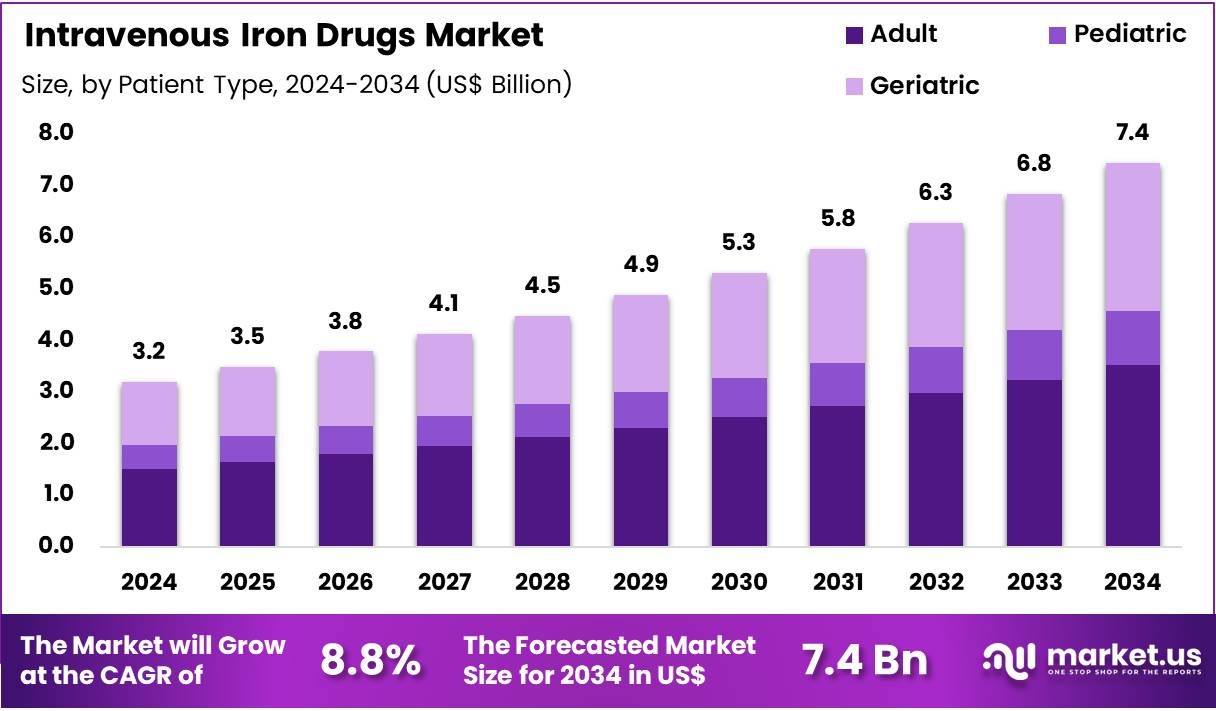
New York, NY – Aug 7, 2026 – Global Intravenous Iron Drugs Market size is expected to be worth around US$ 7.4 Billion by 2034 from US$ 3.2 Billion in 2024, growing at a CAGR of 8.8% during the forecast period from 2025 to 2034. In 2024, North America led the market, achieving over 45.4% share with a revenue of US$ 1.5 Billion.
The global Intravenous Iron Drugs Market is witnessing steady growth due to the rising prevalence of iron deficiency anemia, chronic kidney disease, cancer-related anemia, and inflammatory disorders requiring rapid iron replenishment. Intravenous iron therapies provide faster hemoglobin improvement compared with oral iron supplements, making them increasingly preferred for patients with poor absorption, intolerance, or severe iron deficiency.
In 2024, the global intravenous iron drugs market was valued at approximately US$ 3.9 billion and is projected to reach around US$ 7.1 billion by 2034, expanding at a compound annual growth rate (CAGR) of nearly 6.2% during the forecast period. Increasing demand for advanced anemia management solutions, growing dialysis patient populations, and rising adoption of high-dose iron formulations are key factors supporting market expansion.
The market is driven by the increasing burden of anemia worldwide, with the World Health Organization (WHO) estimating that anemia affects approximately 1.9 billion people globally, particularly women, children, and individuals with chronic diseases. Intravenous iron drugs such as ferric carboxymaltose, iron sucrose, ferric derisomaltose, and ferumoxytol are widely used across hospitals, specialty clinics, and dialysis centers.
North America represents a significant market due to advanced healthcare infrastructure, high chronic kidney disease prevalence, and strong adoption of innovative therapies. Pharmaceutical companies are focusing on improving safety profiles, developing longer-lasting formulations, and expanding regulatory approvals to strengthen their presence.
Increasing healthcare expenditure, growing awareness about anemia treatment options, and expanding access to infusion-based therapies are expected to create new opportunities for intravenous iron drug manufacturers globally.
Key Takeaways
- Market Size: The global Intravenous Iron Drugs Market is projected to reach approximately US$7.4 billion by 2034, increasing from US$3.2 billion in 2024.
- Market Growth: The market is expected to expand at a CAGR of 8.8% during the forecast period from 2025 to 2034, driven by rising demand for effective anemia treatment solutions and increasing adoption of intravenous therapies.
- Product Type Analysis: Ferric carboxymaltose dominated the market in 2024, capturing 44.1% of the global market share due to its favorable dosing benefits, shorter infusion duration, and reduced need for repeated hospital visits.
- Application Analysis: Chronic kidney disease (CKD) emerged as the leading application segment in 2024, accounting for 38.5% of the global market share, supported by increasing anemia cases among CKD patients.
- Patient Type Analysis: The adult segment held the largest market position in 2024, representing 47.4% of the global market share, owing to the high prevalence of iron deficiency conditions among adult populations.
- End-Use Analysis: Hospitals remained the dominant end-user segment in 2024, accounting for 48.7% of the global market share due to their extensive use of intravenous iron therapies for complex anemia management.
- Regional Analysis: North America led the global Intravenous Iron Drugs Market in 2024, capturing more than 45.4% market share with a revenue contribution of approximately US$1.5 billion, supported by advanced healthcare infrastructure and high treatment adoption.
Market Segmentation
- Product Type Analysis: The Intravenous Iron Drugs Market is segmented by formulation, with ferric carboxymaltose leading at 44.1% share in 2024 due to convenient dosing, shorter infusion time, and fewer repeat visits. Iron sucrose, iron derisomaltose, iron dextran, and sodium ferric gluconate maintain demand through established clinical use, cost benefits, and specific therapeutic applications.
- Application Analysis: Chronic kidney disease (CKD) dominated the application segment with 38.5% market share in 2024, driven by anemia prevalence and regular IV iron use in dialysis settings. Inflammatory bowel disease, cancer-related anemia, obstetric applications, heart failure, and perioperative care also contributed significantly, supported by increasing demand for rapid iron correction.
- Patient Type Analysis: The adult segment held the largest share at 47.4% in 2024, supported by high anemia prevalence among patients with chronic diseases, cancer, renal disorders, and postpartum conditions. Pediatric adoption is increasing due to improved safety profiles, while geriatric demand is rising because of age-related anemia, malabsorption issues, and chronic health conditions.
- End User Analysis: Hospitals accounted for 48.7% market share in 2024, remaining the leading end-user segment due to advanced infusion facilities and management of complex anemia cases. Pediatric units are expanding with improved treatment protocols, while geriatric care facilities are witnessing growth due to increasing demand for supervised IV iron administration among older patients.
Statistical Information
- A 2025 real-world evaluation of ferric derisomaltose intravenous iron therapy reported 2,468 patients treated across 2,775 infusion courses, with a mean administered dose of 1,244 mg per course.
- In a 2025 clinical service evaluation, ferric derisomaltose treatment increased mean hemoglobin levels by 20.9 g/L and increased mean ferritin levels by 188.8 µg/L after follow-up assessment.
- The same 2025 intravenous iron service study showed that 65.1% of treatment courses (962/1,478) achieved a clinical response, defined as patients becoming non-anemic or achieving a hemoglobin increase of ≥20 g/L.
- The 2025 ferric derisomaltose real-world analysis found that 33.4% of treatment courses (494/1,478) resulted in patients becoming non-anemic after therapy based on predefined hemoglobin thresholds.
- A 2025 real-world intravenous iron study reported that serious allergic reactions occurred in 1 out of 2,468 patients (0.04%) receiving ferric derisomaltose therapy.
- A clinical safety analysis of intravenous iron formulations reported serious or severe hypersensitivity reactions of 0.3% with ferric derisomaltose compared with 0.4% with iron sucrose in comparative trial populations.
- A pooled safety analysis of ferric derisomaltose and iron sucrose reported overall adverse drug reaction rates of 8.6% for ferric derisomaltose and 9.0% for iron sucrose.
- A 2025 evidence review of intravenous iron therapy in heart failure reported that patients receiving ferric derisomaltose experienced serious adverse cardiac events in 36% of cases compared with 43% in usual-care groups, representing a 7 percentage-point reduction.
Regional Analysis
North America maintained its leading position in the Intravenous Iron Drugs Market in 2024, accounting for more than 45.4% share with a market value of US$ 1.5 billion. The region’s growth is supported by advanced healthcare infrastructure, strong clinical adoption, and increasing diagnosis of iron deficiency anemia associated with chronic kidney disease, cancer, gastrointestinal disorders, and heart failure.
The widespread availability of specialized hospitals, dialysis centers, and outpatient infusion facilities has improved access to intravenous iron therapies. In the United States, intravenous iron products continue to receive clinical support for patients who cannot tolerate or respond adequately to oral iron treatments. Canada has also strengthened access through reimbursement recommendations for ferric carboxymaltose in eligible iron deficiency anemia patients.
Growing healthcare expenditure, favorable reimbursement frameworks, and continuous innovation in high-dose iron formulations are further accelerating adoption. Recent regulatory approvals, including new generic intravenous iron options in the U.S., are expected to improve treatment accessibility and competition.
Business Opportunities
The Intravenous Iron Drugs Market offers significant business opportunities through the development of advanced high-dose and rapid infusion formulations that improve treatment convenience and reduce repeat hospital visits. Companies investing in innovative iron complexes, including improved ferric carboxymaltose and ferric derisomaltose formulations, can address the growing demand for faster and more effective anemia management solutions.
The increasing prevalence of chronic kidney disease, cancer-related anemia, heart failure, and inflammatory disorders creates opportunities for manufacturers to expand targeted intravenous iron therapies across multiple clinical applications. Growth in outpatient infusion centers and specialty clinics also provides opportunities to establish efficient treatment delivery models outside traditional hospital settings.
Emerging markets present additional growth potential due to improving healthcare infrastructure, rising awareness of iron deficiency disorders, and increasing access to specialty medicines. Pharmaceutical companies can strengthen their presence through affordable formulations, local partnerships, and expanded distribution networks. The growing demand for cost-effective therapies is also encouraging opportunities in generic intravenous iron product development.
Furthermore, advancements in diagnostics and personalized medicine are creating opportunities for integrating biomarker-based treatment decisions with intravenous iron therapy. Strategic collaborations between pharmaceutical companies, healthcare providers, and research organizations can support clinical innovation, regulatory approvals, and the development of safer, more efficient iron replacement therapies.
Emerging Trends
- High-Dose Single Infusion Therapy Adoption:Intravenous iron treatment is shifting toward high-dose formulations that reduce repeated administrations. Ferric carboxymaltose and ferric derisomaltose therapies can deliver doses of up to 1,000–2,000 mg in single or limited infusions, improving convenience and supporting faster iron restoration.
- Expansion of Heart Failure Applications:The use of intravenous iron is expanding beyond anemia treatment into cardiovascular care. Clinical recommendations support IV iron therapy in heart failure patients with iron deficiency, particularly when ferritin is below 100 ng/mL or TSAT is below 20%.
- Development of Safer Iron Complexes:Manufacturers are focusing on improving the safety profile of intravenous iron formulations. Recent clinical evaluations reported serious cardiac adverse events of 36% with ferric derisomaltose compared with 43% under usual care, highlighting potential treatment benefits.
- Growth of Evidence-Based Treatment Guidelines:Healthcare organizations are strengthening intravenous iron treatment protocols using clinical evidence. Recent assessments have reviewed data from 12 randomized controlled trials to support safer patient selection, dosing strategies, and monitoring practices for intravenous iron administration.
- Increasing Use of Personalized Iron Monitoring:Healthcare providers are adopting laboratory-guided approaches for intravenous iron therapy. Treatment decisions increasingly rely on measurable indicators such as hemoglobin, ferritin, and transferrin saturation, with 3 major biomarkers commonly used to evaluate iron deficiency status.
Use Cases
- Chronic Kidney Disease (CKD) Anemia Management:Intravenous iron remains a major therapy for anemia associated with chronic kidney disease, particularly among dialysis patients. It is preferred when oral iron absorption is limited, helping restore iron availability and support erythropoiesis in patients requiring ongoing renal care.
- Heart Failure Patient Support:IV iron therapy is increasingly used for heart failure patients with iron deficiency to improve functional capacity and symptoms. Recent clinical evidence showed intravenous iron reduced cardiovascular death or first hospitalization risk by approximately 20% in selected patients.
- Cancer-Related Anemia Treatment:Intravenous iron is used in oncology care to manage anemia caused by chemotherapy, inflammation, and reduced iron availability. It enables rapid iron replacement for cancer patients who may not respond adequately to oral iron supplementation during treatment cycles.
- Pregnancy-Associated Iron Deficiency Treatment:Intravenous iron is increasingly applied in maternal healthcare for women with moderate-to-severe anemia who cannot tolerate oral iron. Programs using injectable iron therapies aim to improve maternal health outcomes, especially where anemia screening identifies severe iron deficiency cases.
- Gastrointestinal Disorder-Related Iron Deficiency:Patients with inflammatory bowel disease, Crohn’s disease, and ulcerative colitis often receive intravenous iron because intestinal inflammation affects iron absorption. IV therapy provides direct iron delivery and supports faster correction of deficiency compared with conventional oral supplementation.
Recent Development
- In 2025, CSL Vifor continued strengthening its intravenous iron and nephrology-focused portfolio through ongoing product commercialization activities for iron deficiency management. The company maintained focus on Ferinject® (ferric carboxymaltose) and expanding access to iron replacement therapies through healthcare partnerships.
- In 2025, Viatris expanded its complex injectable medicine capabilities through the launch pathway for intravenous iron products, including iron sucrose and ferric carboxymaltose injection programs. The company highlighted these products as part of its broader strategy to improve access to difficult-to-manufacture injectable medicines.
- In 2026, Pharmacosmos continued supporting adoption of Monoferric® as a single-dose intravenous iron option, with the therapy remaining available as ferric derisomaltose injection. The product has been evaluated in clinical trials involving 3,050 patients with iron deficiency anemia.
Frequently Asked Questions on Intravenous Iron Drugs
- Which intravenous iron formulation is most commonly used?
Ferric carboxymaltose is among the most widely used intravenous iron formulations due to its high-dose administration capability, shorter infusion duration, and reduced requirement for multiple treatment sessions. Other commonly used formulations include iron sucrose, ferric derisomaltose, and sodium ferric gluconate. - What conditions are treated using intravenous iron drugs?
Intravenous iron drugs are used for treating anemia associated with chronic kidney disease, inflammatory bowel disease, cancer, heart failure, pregnancy-related iron deficiency, and other conditions where oral iron therapy is ineffective or poorly tolerated by patients. - What are the advantages of intravenous iron therapy?
Intravenous iron therapy offers faster iron replenishment, higher bioavailability, and improved treatment efficiency compared with oral supplementation. It is especially beneficial for patients with absorption problems, severe iron deficiency, chronic diseases, or those requiring rapid hemoglobin improvement. - How is the intravenous iron drugs market growing?
The intravenous iron drugs market is growing due to increasing anemia cases, expanding chronic disease populations, improved healthcare access, and rising adoption of advanced iron formulations. Hospitals and specialty clinics are increasingly using intravenous therapies for effective anemia management. - Which segment dominates the intravenous iron drugs market?
The chronic kidney disease application segment represents a major portion of the intravenous iron drugs market due to frequent anemia occurrence among renal patients. Hospitals also dominate end-user adoption because they provide controlled environments for infusion therapy and patient monitoring. - What are the future opportunities in the intravenous iron drugs market?
Future opportunities include development of safer formulations, expansion of generic intravenous iron products, growth of outpatient infusion services, and increasing applications in heart failure and oncology care. Emerging markets also provide opportunities through improved healthcare infrastructure and treatment accessibility.
Conclusion
The Intravenous Iron Drugs Market is expected to witness strong expansion due to increasing cases of iron deficiency anemia, chronic kidney disease, cancer-related anemia, and other chronic conditions requiring rapid iron replenishment. Advanced formulations such as ferric carboxymaltose and ferric derisomaltose are gaining preference because of improved dosing convenience and treatment efficiency.
Hospitals and specialty clinics remain key adoption centers as intravenous therapies provide effective alternatives for patients who cannot tolerate oral iron. North America continues to demonstrate strong market presence due to advanced healthcare infrastructure and clinical adoption. Ongoing product innovations, regulatory approvals, and increasing focus on personalized anemia management are expected to create new opportunities for pharmaceutical companies operating in this sector.
Discuss your needs with our analyst
Please share your requirements with more details so our analyst can check if they can solve your problem(s)




