


Overview
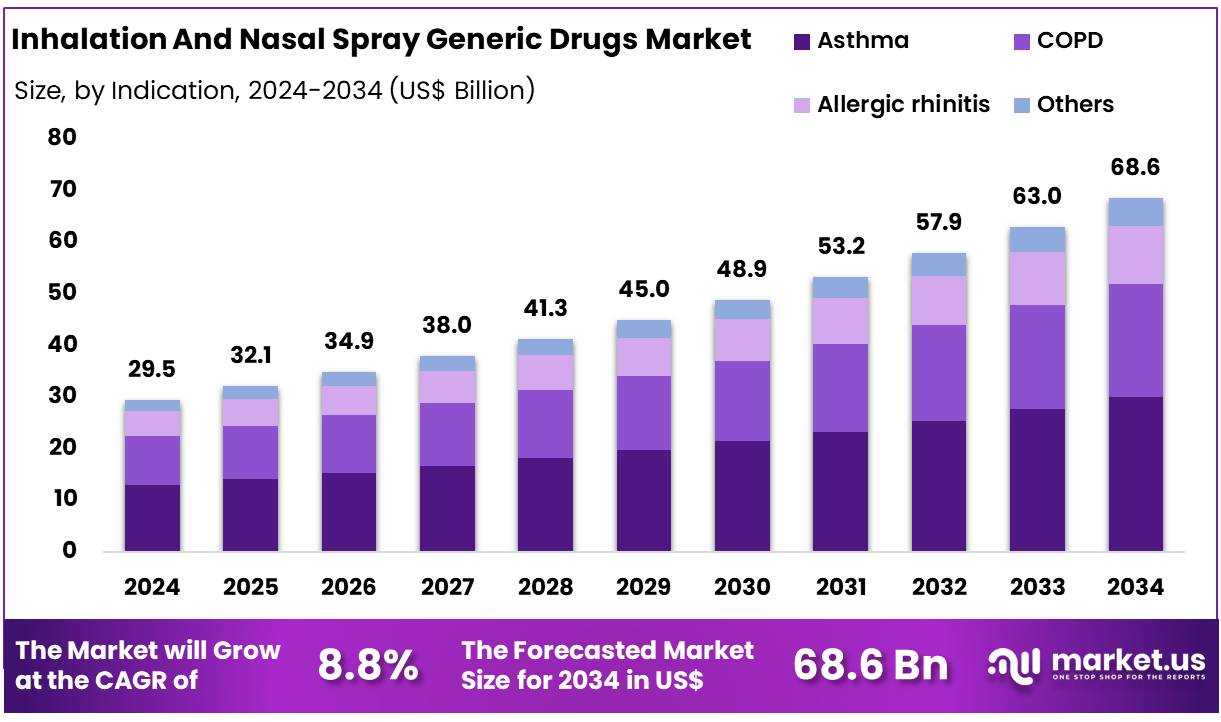
Global Inhalation and Nasal Spray Generic Drugs Market size is expected to be worth around US$ 68.6 Billion by 2034 from US$ 29.5 Billion in 2024, growing at a CAGR of 8.8% during the forecast period from 2025 to 2034. In 2024, North America led the market, achieving over 37.3% share with a revenue of US$11.0 Billion.
The global Inhalation and Nasal Spray Generic Drugs Market is witnessing steady growth due to increasing demand for affordable respiratory therapies, rising prevalence of chronic respiratory diseases, and expanding adoption of cost-effective generic alternatives.
Inhaled and nasal drug delivery systems provide targeted treatment with faster onset of action and improved patient convenience compared with conventional oral medications. These products are widely used for conditions such as asthma, chronic obstructive pulmonary disease (COPD), allergic rhinitis, sinusitis, and other respiratory disorders.
According to healthcare estimates, respiratory diseases affect millions of people worldwide, with asthma impacting more than 260 million individuals globally, while COPD affects approximately 392 million adults. The growing patient population is encouraging pharmaceutical companies to develop generic versions of inhalers, metered-dose inhalers (MDIs), dry powder inhalers (DPIs), and nasal spray formulations.
The market is supported by increasing regulatory approvals for generic inhalation products. In the United States, the U.S. Food and Drug Administration (FDA) continues to encourage complex generic drug development, including inhalation products, through initiatives focused on improving access to affordable medicines. Rising healthcare expenditure, patent expirations of branded respiratory drugs, and government initiatives promoting generic medicine adoption are further supporting market expansion.
Technological advancements in drug formulation, device design, and combination therapies are improving delivery efficiency and patient adherence. The global market is expected to experience significant growth during the forecast period, driven by increasing respiratory disease burden, cost-saving benefits of generics, and growing demand for accessible respiratory healthcare solutions.
Key Takeaways
- Market Size: The global Inhalation and Nasal Spray Generic Drugs Market is projected to reach approximately US$ 68.6 billion by 2034, expanding from US$ 29.5 billion in 2024.
- Market Growth: The market is anticipated to grow at a CAGR of 8.8% between 2025 and 2034, driven by rising respiratory disease prevalence, increasing demand for affordable generic therapies, and improved drug delivery technologies.
- Drug Class Analysis: Short-acting and long-acting bronchodilators dominated the market in 2024, capturing a 32.6% share, owing to their extensive use in managing respiratory conditions such as asthma and chronic obstructive pulmonary disease (COPD).
- Indication Analysis: Asthma held the leading position in 2024 with a 43.8% market share, supported by the growing global burden of asthma, improved diagnosis rates, and widespread dependence on inhalation-based treatment options.
- Age Group Analysis: Adults accounted for the largest market share of 39.5% in 2024, driven by increasing exposure to air pollution, workplace-related respiratory risks, and a higher incidence of chronic respiratory disorders among adult populations.
- Distribution Channel Analysis: Retail pharmacies dominated the market in 2024 with a 56.2% share, supported by their broad accessibility, convenient medication availability, and continued preference for face-to-face healthcare guidance.
- Regional Analysis: North America emerged as the leading regional market in 2024, accounting for more than 37.3% share with revenue of approximately US$ 11.0 billion, supported by advanced healthcare infrastructure, high respiratory disease awareness, and strong adoption of generic inhalation therapies.
Statistical Information
- A 2025 nasal spray deposition modeling study evaluated droplet sizes from 10–50 microns, formulation densities from 1.0–1.5 g/ml, and plume angles from 1–70 degrees to optimize intranasal drug delivery performance.
- The 2025 intranasal spray modeling study reported peak nasopharyngeal deposition performance at droplet sizes of 25–45 microns and plume angles equal to or below 30 degrees.
- A 2025 nasal powder deposition study tested spray-dried formulations with particle sizes of 20–30 microns and 3 microns to evaluate how powder properties influence nasal deposition behavior.
- The 2025 nasal powder delivery study examined application conditions using airflow rates of 0 L/min and 15 L/min, application angles of 45° and 60°, and fill weights of 20 mg and 40 mg.
- A 2025 inhaler medication adherence measurement study involving 145 asthma patients reported a nonadherence detection sensitivity of 78.95%, specificity of 98.13%, and overall accuracy of 93.10% for its assessment tool.
- A 2025 European Respiratory Society abstract reported that among asthma patients, very poor control was observed in of patients with good/intermediate inhaler adherence compared with 44.1% among poorly adherent patients.
- A 2025 generic versus brand-name nasal spray analysis evaluated spray pattern and plume geometry differences using quantitative analysis tools (Fiji/ImageJ and R software) to compare pharmaceutical performance characteristics.
Regional Analysis
North America Regional Analysis
In 2024, North America maintained a leading position in the global Inhalation and Nasal Spray Generic Drugs Market, accounting for more than 37.3% share with a market value of approximately US$ 11.0 billion.
The region’s dominance was supported by the rising demand for affordable respiratory treatments and the growing use of generic alternatives for asthma, COPD, and allergic rhinitis management. Favorable reimbursement policies, cost-containment initiatives, and increased adoption of generic medicines improved patient access and market penetration.
The region also benefited from a strong healthcare infrastructure, advanced regulatory environment, and established pharmaceutical manufacturing capabilities. The expansion of outpatient care and home-based respiratory treatment further increased demand for efficient inhalation and nasal delivery systems. Growing investments in innovative drug-device combinations and improved generic formulations are expected to support continued market growth, strengthening North America’s role in the global landscape.
Emerging Trends
- Advanced Bioequivalence Testing for Generic Inhalers: The development of generic inhalation products is shifting toward advanced in-vitro testing, computer modeling, and performance analysis. In 2025, FDA research focused on improving bioequivalence methods using aerosol particle size distribution, spray pattern, and plume geometry studies to reduce dependence on complex clinical trials.
- Growing Adoption of Cost-Effective Respiratory Generics: Healthcare systems are increasing the use of generic inhalers and nasal sprays to reduce treatment expenses for asthma, COPD, and allergy patients. In 2025, FDA continued prioritizing first generic approvals, including generic beclomethasone dipropionate aerosol metered inhalation for asthma management, improving affordable access.
- Smart Device Integration and Improved Drug Delivery Performance: Generic inhalation products are increasingly focusing on better device design, dose consistency, and patient-friendly delivery systems. FDA research highlights the importance of understanding how device design and formulation ingredients influence inhaled drug performance, supporting development of more reliable generic inhalers.
- Expansion of Nasal Spray Applications Beyond Allergy Treatment: Nasal sprays are evolving from traditional allergy and congestion treatments toward advanced drug delivery applications. Recent research highlights improved nasal absorption strategies and nose-to-brain delivery approaches, creating opportunities for generic nasal formulations in neurological and systemic therapies.
- Personalized Respiratory Therapy and Efficient Generic Formulations: The market is moving toward customized inhalation therapies with optimized particle size, deposition patterns, and formulation performance. FDA-supported research in 2025 emphasized predictive models and laboratory-based approaches to improve generic orally inhaled and nasal drug product development efficiency.
Use Cases
- Asthma Maintenance and Rescue Therapy: Generic inhalers are widely used for asthma control by delivering bronchodilators and corticosteroids directly into the lungs. In 2025, FDA approved generic beclomethasone dipropionate aerosol inhalation for maintenance treatment of asthma patients aged 5 years and older, supporting wider access.
- Chronic Obstructive Pulmonary Disease (COPD) Management: Inhalation generics play an important role in COPD treatment by providing affordable bronchodilator and anti-inflammatory options. These products improve airflow management, reduce symptoms, and support long-term respiratory care for millions of patients requiring daily inhaled medications.
- Allergic Rhinitis and Nasal Congestion Treatment: Generic nasal sprays are commonly used for allergic rhinitis, sinus symptoms, and nasal inflammation. Their direct delivery method enables localized action with reduced systemic exposure. Advanced formulations are focusing on improved absorption efficiency and targeted deposition inside nasal tissues.
- Emergency and Rapid-Action Drug Delivery: Nasal sprays are increasingly explored for rapid medication delivery because they avoid traditional administration barriers. Research into nose-to-brain delivery shows potential for faster transport of medicines across biological barriers, supporting future generic applications in specialized therapies.
- Hospital and Home-Based Respiratory Care: Generic inhalers and nebulized therapies are becoming important tools for both hospitals and home-care settings. Their ease of use, lower cost, and direct lung delivery support chronic disease management, especially among patients requiring continuous respiratory treatment.
Frequently Asked Questions on Inhalation And Nasal Spray Generic Drugs
- Why is the demand for inhalation and nasal spray generic drugs increasing?
Demand is increasing due to rising respiratory diseases, healthcare cost pressures, and the need for affordable treatments. Generic inhalation products help patients access effective therapies while reducing expenses for healthcare systems and individuals. - What diseases are treated using inhalation and nasal spray generic drugs?
These drugs are commonly used for asthma, chronic obstructive pulmonary disease (COPD), allergic rhinitis, sinus conditions, and other respiratory disorders. They deliver medication directly to the lungs or nasal passages for faster and targeted therapeutic action. - What are the major advantages of inhalation and nasal spray generic drugs?
The major advantages include lower treatment costs, improved medication delivery, reduced systemic side effects, and convenient administration. These products allow patients to manage respiratory conditions effectively while maintaining accessibility and affordability compared with branded alternatives. - What factors are driving the growth of the inhalation and nasal spray generic drugs market?
Market growth is driven by increasing respiratory disease prevalence, patent expirations of branded drugs, rising healthcare spending, and government initiatives supporting generic medicine adoption. Technological improvements in drug delivery systems are also supporting market expansion. - Which drug classes are commonly available as inhalation and nasal spray generics?
Common drug classes include bronchodilators, corticosteroids, antihistamines, and combination therapies. These medications help relax airway muscles, reduce inflammation, control allergic reactions, and improve breathing conditions among patients with respiratory disorders. - How is technology influencing the inhalation and nasal spray generic drugs market?
Advanced technologies such as smart inhalers, improved aerosol delivery systems, and precision spray mechanisms are enhancing drug administration. These innovations improve dose accuracy, patient adherence, and monitoring capabilities, creating new opportunities for generic respiratory medicine manufacturers. - What role do generic drugs play in respiratory healthcare cost reduction?
Generic inhalation and nasal spray drugs reduce healthcare costs by offering lower-priced alternatives to branded therapies. They support broader patient access, decrease financial pressure on healthcare systems, and improve availability of essential respiratory treatments. - What is the future outlook for the inhalation and nasal spray generic drugs market?
The market is expected to grow with increasing respiratory disorders, expanding generic medicine acceptance, and continuous innovation in delivery technologies. Rising demand for cost-effective therapies will encourage manufacturers to develop advanced inhalation and nasal spray solutions.
Conclusion
The Inhalation And Nasal Spray Generic Drugs Market is positioned for steady expansion as healthcare systems increasingly focus on accessible and cost-efficient respiratory care. Growing respiratory disorders, rising healthcare expenditure, and increasing preference for generic medications are strengthening market demand worldwide.
Continuous innovation in inhalation devices, formulation technologies, and nasal drug delivery platforms is improving treatment effectiveness and patient convenience. Regulatory support for generic drug approvals and expanding availability in emerging economies are further supporting market development. With increasing awareness and the need for affordable respiratory therapies, the market is expected to maintain significant growth opportunities throughout the forecast period.
Discuss your needs with our analyst
Please share your requirements with more details so our analyst can check if they can solve your problem(s)




