


Overview
New York, NY – August 19, 2026 – The Global In Vivo Imaging Systems Market size is expected to be worth around US$ 75.3 Billion by 2034 from US$ 54.4 Billion in 2024, growing at a CAGR of 3.3% during the forecast period 2025 to 2034. In 2024, North America led the market, achieving over 37.4% share with a revenue of US$ 20.3 Billion.
In Vivo Imaging Systems are transforming biomedical and preclinical research by enabling scientists to monitor biological processes inside living organisms in real time without invasive procedures. These advanced platforms integrate technologies such as bioluminescence, fluorescence, PET, SPECT, MRI, CT, and ultrasound to improve disease modeling, drug discovery, and therapy evaluation.
According to the World Health Organization, cancer caused approximately 9.7 million deaths, and an estimated 20 million new cancer cases were reported globally in 2022, creating strong demand for advanced imaging tools in oncology research.
The National Institutes of Health invested more than USD 47 billion in medical research in fiscal year 2024, supporting innovation in molecular imaging, precision medicine, and translational science. Meanwhile, the U.S. Food and Drug Administration approved 50 novel drugs in 2024, increasing the need for reliable preclinical imaging systems to evaluate drug safety and efficacy before human trials.
The growing burden of chronic diseases further supports adoption. According to the World Health Organization, noncommunicable diseases account for approximately 43 million deaths annually, representing about 75% of all global deaths.
In vivo imaging systems help researchers reduce animal use through longitudinal studies while improving data accuracy and reproducibility. Continuous advancements in artificial intelligence, high-resolution detectors, and multimodal imaging are enhancing image sensitivity, accelerating research workflows, and supporting faster development of innovative therapies across pharmaceutical, biotechnology, and academic research institutions.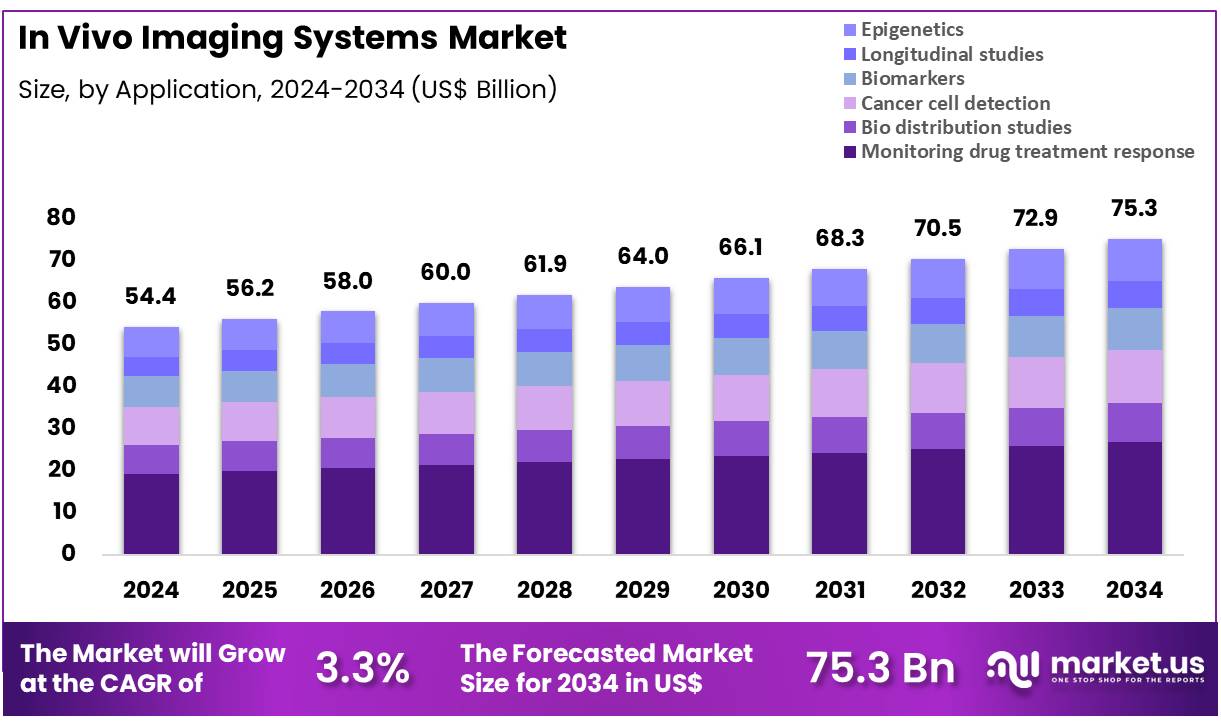
Key Takeaways
- In 2024, the global In Vivo Imaging Systems market generated US$ 54.4 billion in revenue and is projected to reach US$ 75.3 billion by 2034, expanding at a CAGR of 3.3% during the forecast period.
- By product type, the market is segmented into magnetic resonance imaging (MRI), digital angiography, ultrasound, nuclear imaging, positron emission tomography (PET), single-photon emission computed tomography (SPECT), optical imaging (OI), bioluminescence imaging, Cerenkov luminescence imaging, and others. Magnetic resonance imaging (MRI) emerged as the leading segment, accounting for 30.5% of the market share in 2024.
- Based on application, the market comprises monitoring drug treatment response, biodistribution studies, cancer cell detection, biomarkers, longitudinal studies, and epigenetics. Among these, monitoring drug treatment response dominated the market with a 35.6% share in 2024.
- By end user, the market is categorized into hospitals, clinics, pharmaceutical research institutes, diagnostic laboratories, forensic laboratories, and educational research institutes. Hospitals held the largest market share, contributing 42.2% of the total revenue in 2024.
- North America dominated the global In Vivo Imaging Systems market in 2024, capturing a 37.4% market share.
Statistical Information
- Global Cancer Burden is Driving Demand for In Vivo Imaging Systems: Cancer remains one of the largest application areas for in vivo imaging systems. According to the World Health Organization (WHO), 20.0 million new cancer cases and 9.7 million cancer deaths were reported globally in 2022. Approximately 1 in 5 people will develop cancer during their lifetime. This increasing disease burden is accelerating the use of MRI, PET, SPECT, and optical imaging technologies in oncology research, drug development, and treatment monitoring.
- NIH Invests Nearly US$48 Billion in Medical Research: The U.S. National Institutes of Health (NIH) invests nearly US$48 billion annually in biomedical research. About 82% of this funding supports extramural research through almost 50,000 competitive grants, benefiting more than 300,000 researchers at over 2,500 universities, hospitals, and research institutions. This funding significantly supports innovation in imaging technology and preclinical research.
- National Cancer Institute Invests Over US$7.2 Billion in Cancer Research: The U.S. National Cancer Institute (NCI) had US$7.2 billion in research funding available in FY2024. The institute allocated approximately US$852.3 million for clinical trials, US$495.1 million for cancer centers, and US$3.13 billion for research project grants. These investments support imaging-based cancer diagnosis, molecular imaging, and treatment monitoring.
- Imaging Expansion Could Save Millions of Lives: A global analysis published in The Lancet Oncology estimated that expanding access to diagnostic imaging between 2020 and 2030 could prevent approximately 2.46 million cancer deaths, save 54.9 million life-years, and generate US$1.23 trillion in lifetime productivity gains. The study estimated a return of approximately US$179 for every US$1 invested in imaging expansion.
- FDA Continues to Expand Medical Imaging Research: The FDA reports that its scientists have completed around 600 technical consultations related to innovative endoscopic and medical imaging technologies since 2013. Current regulatory research includes MRI, ultrasound, optical imaging, photoacoustic imaging, and AI-enabled imaging systems to improve device performance and patient safety.
- PET Imaging Procedures Continue to Grow in the United States: According to the Society of Nuclear Medicine and Molecular Imaging (SNMMI), approximately 2 million PET scans are performed annually in the United States. PET imaging is widely used for oncology, cardiology, and neurology, with more than 90% of PET procedures performed for cancer diagnosis, staging, and treatment monitoring.
- NIH Human Connectome Project Generated Over 100 Terabytes of MRI Data: The NIH-funded Human Connectome Project collected imaging data from more than 1,200 healthy adults, producing over 100 terabytes of MRI datasets. The project demonstrates the expanding use of high-resolution MRI technologies for neuroscience and biomedical research.
- The Cancer Imaging Archive Contains Over 50 Million Medical Images: The National Cancer Institute’s Cancer Imaging Archive (TCIA) hosts more than 50 million de-identified medical images collected from over 230 collections, supporting AI development, radiomics, biomarker discovery, and imaging-based cancer research worldwide.
- More Than 80% of NIH Budget Supports External Research: The NIH reports that approximately 82% of its annual budget supports research conducted at over 2,500 universities, medical schools, hospitals, and research institutions, accelerating adoption of advanced imaging technologies for biomedical research.
- More Than 9,000 Mammography Facilities Use Advanced Imaging Equipment: According to FDA MQSA statistics (2026), the United States has 9,099 certified mammography facilities operating 27,551 accredited imaging units, including 13,430 digital breast tomosynthesis (DBT) units. These facilities perform approximately 44.7 million mammography procedures annually, highlighting the scale of advanced medical imaging infrastructure.
Regional Analysis
North America led the market by securing a market share of 37.4% in 2023.
North America accounted for 37.4% of the global In Vivo Imaging Systems market in 2024, supported by robust investments in biomedical research, advanced healthcare infrastructure, and strong government funding.
The National Institutes of Health (NIH) invests nearly US$ 48 billion annually in biomedical research, while the National Cancer Institute (NCI) allocated approximately US$ 7.2 billion for cancer research in FY2024, driving demand for MRI, PET, CT, SPECT, and optical imaging technologies.
The U.S. Food and Drug Administration (FDA) continues to encourage the use of imaging biomarkers and advanced imaging platforms to improve drug development and regulatory science. The region also benefits from a high concentration of pharmaceutical companies, biotechnology firms, academic research centers, and leading imaging manufacturers.
Increasing adoption of hybrid PET/CT and PET/MRI systems, combined with growing oncology, neuroscience, and cardiovascular research, continues to strengthen North America’s leadership. Continuous innovation in artificial intelligence-enabled imaging and molecular diagnostics further supports sustained market expansion across the region.
Emerging Trends
- Artificial Intelligence is Improving Imaging Speed and Accuracy: Artificial intelligence (AI) is making in vivo imaging faster and more accurate. In 2024, NIH researchers demonstrated that AI made retinal imaging 100 times faster while improving image contrast by 3.5 times. In another NIH study, AI reduced the imaging data required for cellular imaging by 75%, enabling quicker image acquisition and supporting earlier disease detection and treatment monitoring.
- Development of Next-Generation Non-Invasive Optical Imaging: The NIH Common Fund launched the Non-Invasive Optical Imaging (NIOI) initiative to develop technologies capable of imaging deeper into living tissues without surgery. The program announced its first research awards in 2026, supporting innovations that improve disease diagnosis, health monitoring, and cellular imaging while reducing invasive procedures.
- AI Integration is Becoming a Core Part of Medical Imaging: The U.S. FDA continues expanding research on AI-enabled imaging systems through its Division of Imaging, Diagnostics, and Software Reliability. The agency develops methods to evaluate AI algorithms, image quality, and clinical trial performance, supporting safer deployment of intelligent MRI, CT, PET, and optical imaging technologies for biomedical research and clinical applications.
- Government Funding is Accelerating Optical Imaging Innovation: In 2025, the FDA released new draft guidance for developing drugs used with optical imaging technologies. The guidance supports fluorescence-based imaging for tumor detection and image-guided surgery, encouraging pharmaceutical companies and researchers to accelerate innovation in optical imaging systems and improve clinical trial design.
- Brain Research is Driving Demand for Advanced In Vivo Imaging: The NIH BRAIN 2.0 initiative continues supporting advanced in vivo imaging technologies capable of generating large-scale brain datasets. Modern imaging tools now process information from 384-channel electrode arrays in near real time while AI automatically analyzes imaging data, improving neuroscience research and accelerating discoveries related to neurological disorders.
Use Cases
- Monitoring Drug Treatment Response: In vivo imaging systems are widely used to monitor how patients and animal models respond to therapies over time. The FDA recognizes imaging biomarkers as valuable tools for evaluating drug activity, biodistribution, treatment response, and disease progression, helping researchers shorten drug development timelines and improve clinical trial efficiency.
- Cancer Detection and Tumor Research: The WHO estimated 20 million new cancer cases and 9.7 million cancer deaths worldwide in 2022. Researchers increasingly use MRI, PET, optical imaging, and bioluminescence imaging to detect tumors, study cancer biology, evaluate immunotherapies, and monitor treatment effectiveness in preclinical and translational research.
- Neuroscience and Brain Mapping: Advanced in vivo imaging supports mapping neural circuits and monitoring brain activity in living subjects. The NIH BRAIN Initiative uses high-resolution optical imaging, MRI, and AI-based analysis to study neurological disorders, improve understanding of brain function, and accelerate development of treatments for Alzheimer’s disease, Parkinson’s disease, and stroke.
- Preclinical Drug Discovery: The National Cancer Institute supports partnerships to translate innovative in vivo imaging systems into biomedical research. These technologies help pharmaceutical companies evaluate drug safety, pharmacokinetics, biodistribution, and therapeutic efficacy before clinical trials, reducing development risks and improving research productivity.
- Early Disease Diagnosis Using Optical Imaging: The National Institute of Biomedical Imaging and Bioengineering (NIBIB) supports portable, non-invasive optical imaging technologies for disease prevention and diagnosis. These systems enable bedside imaging, surgical guidance, and early detection of diseases while reducing patient discomfort and improving healthcare accessibility through minimally invasive imaging approaches.
Frequently Asked Questions on In Vivo Imaging Systems
- What factors are driving the growth of the In Vivo Imaging Systems Market?
Rising investments in life sciences research, increasing prevalence of cancer and neurological diseases, expanding pharmaceutical R&D, and government funding for biomedical innovation are major growth drivers. Continuous improvements in hybrid imaging technologies and AI-based image analysis also support market expansion. - Which imaging technology is widely used in the In Vivo Imaging Systems Market?
Magnetic Resonance Imaging (MRI) remains one of the most widely adopted technologies because it delivers high-resolution images without ionizing radiation. MRI is extensively used in oncology, neuroscience, cardiovascular research, and longitudinal studies for monitoring disease progression and treatment response. - Who are the major end users of In Vivo Imaging Systems?
Hospitals, pharmaceutical companies, biotechnology firms, academic research institutes, diagnostic laboratories, and contract research organizations are the primary end users. These organizations use advanced imaging systems for disease research, clinical trials, drug development, and precision medicine applications. - Which region leads the In Vivo Imaging Systems Market?
North America leads the market because of strong government research funding, advanced healthcare infrastructure, and the presence of leading pharmaceutical and biotechnology companies. Significant investments in biomedical research and imaging innovation continue to support regional market growth. - What are the future opportunities in the In Vivo Imaging Systems Market?
Future opportunities include AI-powered image analysis, hybrid PET/MRI systems, molecular imaging, personalized medicine, and expansion of translational research. Increasing government support, technological innovation, and growing demand for non-invasive diagnostics are expected to create substantial growth opportunities worldwide. - What role does molecular imaging play in the In Vivo Imaging Systems Market?
Molecular imaging enables visualization of biological and cellular processes before structural changes become visible. It supports early disease detection, biomarker identification, personalized medicine, and drug development, making it an essential technology in modern biomedical and translational research. - How is artificial intelligence improving In Vivo Imaging Systems?
Artificial intelligence enhances image reconstruction, automated image interpretation, lesion detection, and quantitative analysis. AI reduces processing time, improves imaging accuracy, supports predictive analytics, and helps researchers manage large imaging datasets more efficiently during biomedical research.
Conclusion
The In Vivo Imaging Systems market is poised for sustained growth, driven by increasing investments in biomedical research, expanding pharmaceutical and biotechnology industries, and rising demand for non-invasive imaging technologies. Advances in MRI, PET, SPECT, CT, ultrasound, and optical imaging, along with artificial intelligence integration, are improving research accuracy and accelerating drug development.
Government support from organizations such as the NIH, FDA, and NCI continues to strengthen innovation through funding and regulatory initiatives. Growing applications in oncology, neuroscience, cardiovascular research, and personalized medicine, combined with expanding preclinical and translational research activities, are expected to create significant opportunities for the global In Vivo Imaging Systems market over the coming decade.
Discuss your needs with our analyst
Please share your requirements with more details so our analyst can check if they can solve your problem(s)




