


Overview
New York, NY – Sep 09, 2026 – The Global Hypopituitarism Diagnostics Market size is expected to be worth around US$ 535.9 Million by 2034 from US$ 280.2 Million in 2024, growing at a CAGR of 6.7% during the forecast period 2025 to 2034. In 2024, North America led the market, achieving over 38.1% share with a revenue of US$ 106.8 Million.
The Hypopituitarism Diagnostics Market is expanding due to increasing recognition of pituitary disorders, improved endocrine screening, and technological advancements in hormone testing. Hypopituitarism is a rare endocrine condition caused by insufficient production of pituitary hormones that regulate thyroid function, adrenal activity, growth, and reproductive health.
According to the National Institutes of Health (NIH), hypopituitarism affects approximately 4–10 individuals per 100,000 people annually, while overall prevalence is estimated at around 45–50 cases per 100,000 population.
The demand for diagnostic solutions is increasing with the rising burden of pituitary abnormalities. Research indicates that pituitary adenomas account for nearly 15% of all primary intracranial tumors, with an estimated prevalence of approximately 77–94 cases per 100,000 individuals in imaging-based studies. These conditions are a major contributor to acquired hypopituitarism, increasing the need for advanced diagnostic procedures.
The market includes hormone blood tests, stimulation tests, immunoassay platforms, and magnetic resonance imaging (MRI) for detecting pituitary dysfunction. Growth hormone deficiency, ACTH deficiency, thyroid hormone deficiency, and gonadotropin deficiencies represent key diagnostic areas. Modern automated immunoassay systems can analyze multiple hormone biomarkers with improved sensitivity, supporting early diagnosis and long-term disease monitoring.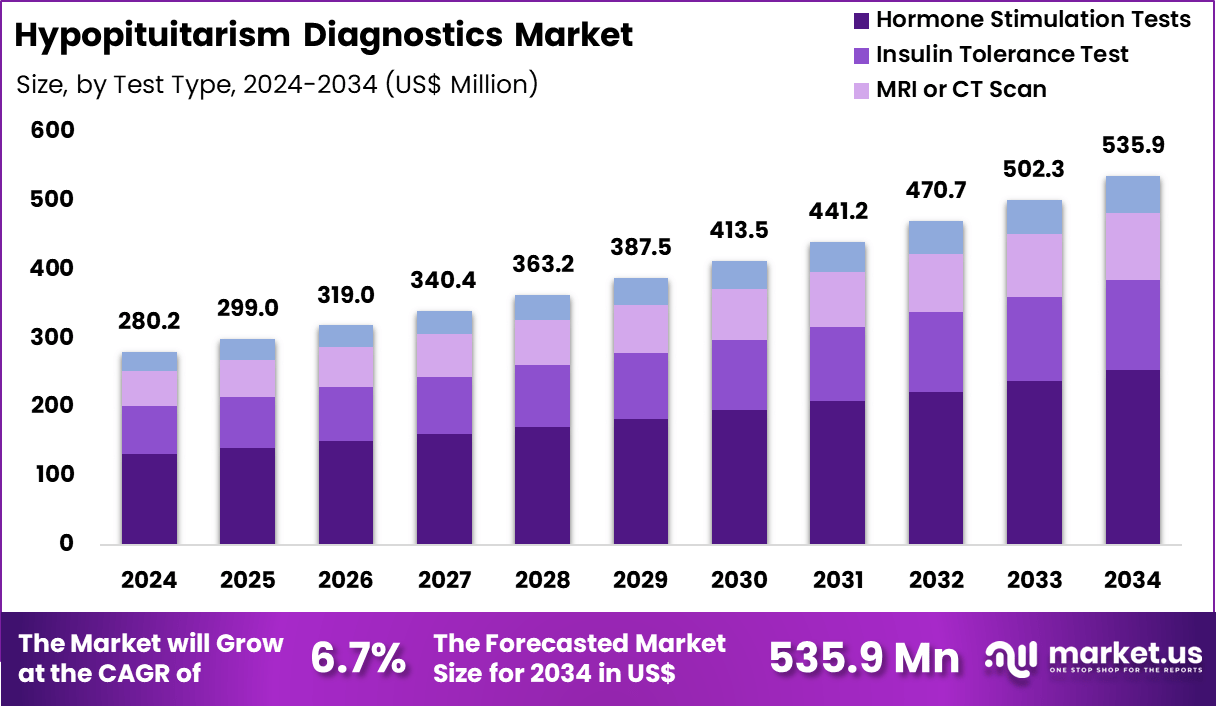
Key Takeaways
- In 2024, the Hypopituitarism Diagnostics Market generated revenue of US$ 280.2 million and is projected to grow at a CAGR of 6.7%, reaching approximately US$ 535.9 million by 2034.
- Based on test type, the market is segmented into hormone stimulation tests, insulin tolerance tests, MRI or CT scans, and visual field checks. Among these, hormone stimulation tests dominated the market in 2024, accounting for a 47.3% share.
- By end-user, the market is categorized into hospitals, specialty clinics, academic research institutes, and other healthcare facilities. Hospitals emerged as the leading segment in 2024, capturing a significant market share of 52.8%.
- Regionally, North America held the largest share of the Hypopituitarism Diagnostics Market in 2024, contributing 38.1% of the global market, supported by advanced healthcare infrastructure and increasing adoption of endocrine diagnostic technologies.
Statistical Information
- Global Incidence and Prevalence Indicate a Persistent Diagnostic Need: Hypopituitarism has a low population prevalence but remains an important endocrine disorder requiring regular diagnosis and monitoring. Epidemiological research estimates an annual incidence of approximately 4.2 cases per 100,000 individuals, with prevalence reported between 37.5 and 45.5 cases per 100,000 adults. Due to long-term hormone replacement requirements, patients frequently require repeated biochemical evaluations and endocrine follow-up.
- Pediatric Hypopituitarism Requires Early Detection and Hormone Assessment: Congenital forms of hypopituitarism represent an important pediatric diagnostic segment, with occurrence estimated at approximately 1 case per 4,000–10,000 live births. Multiple pituitary hormone deficiency (MPHD) is extremely uncommon, affecting fewer than 3 children per million annually, while childhood growth hormone deficiency has been reported at approximately 1 in 3,480 children, emphasizing the importance of early hormonal screening.
- Traumatic Brain Injury Expands the Hidden Diagnostic Population: Traumatic brain injury is increasingly recognized as an important cause of pituitary dysfunction. Clinical reviews indicate that approximately 30–70% of patients with traumatic brain injury may develop impaired pituitary hormone secretion. Reported incidence ranges from 12–42 new cases per million annually, while prevalence estimates reach approximately 300–455 cases per million, suggesting possible underdiagnosis.
- Rare Disease Status Drives Specialized Endocrine Care: The National Institutes of Health (NIH) categorizes hypopituitarism as a rare disorder affecting fewer than 200,000 people in the United States. Because diagnosis requires specialized hormone testing, stimulation procedures, and imaging assessments, healthcare delivery is concentrated within endocrinology centers equipped for complex pituitary evaluation and long-term patient monitoring.
- Pituitary Adenomas Increase the Need for Hypopituitarism Diagnostic Testing: Pituitary adenomas are a major cause of acquired hypopituitarism, with epidemiological studies estimating their prevalence at approximately 77–94 cases per 100,000 individuals. These tumors represent around 10–15% of all intracranial tumors and may cause deficiencies in ACTH, TSH, growth hormone, and gonadotropins, requiring hormone panels and MRI-based evaluation.
Regional Analysis
North America led the market by securing a market share of 38.1% in 2024.
North America accounted for 38.1% of the Hypopituitarism Diagnostics Market in 2024, supported by advanced endocrine care infrastructure, increasing pituitary disorder evaluations, and wider adoption of hormone testing and MRI-based diagnosis.
The region benefits from strong clinical research activity and specialized endocrinology centers. In the United States, the National Cancer Institute highlights pituitary tumors as important endocrine conditions requiring diagnostic evaluation, with pituitary tumors representing approximately 10–25% of all intracranial neoplasms.
Increased monitoring of pituitary hormone deficiencies, including ACTH, cortisol, TSH, LH, and FSH abnormalities, continues to support diagnostic demand across hospitals and laboratories. Asia Pacific is expected to experience significant growth in hypopituitarism diagnostics due to improving access to endocrinology services, expanding hospital infrastructure, and increasing awareness of pituitary-related hormonal disorders.
Japan’s Ministry of Health, Labour and Welfare conducts nationwide Patient Surveys to monitor disease patterns and healthcare utilization, supporting improved understanding of endocrine conditions. Growing investments in diagnostic laboratories, MRI facilities, and hormone assay technologies across countries such as Japan, China, and Southeast Asian nations are strengthening regional capabilities for pituitary disorder detection and long-term monitoring.
Emerging Trends
- Increasing Adoption of Multi-Hormone Diagnostic Panels: Hypopituitarism diagnosis is shifting toward comprehensive hormone profiling, where clinicians evaluate multiple pituitary axes instead of single biomarkers. Current guidelines recommend assessment of cortisol, thyroid hormones, GH, prolactin, LH, FSH, and ACTH. These multi-analyte approaches improve detection of complex hormone deficiencies and support personalized treatment decisions.
- Growth Hormone Stimulation Testing Gains Importance: Growth hormone deficiency diagnosis is increasingly focused on stimulation-based testing because random GH measurements are considered unreliable due to pulsatile hormone release. Clinical guidelines recommend GH stimulation tests for suspected deficiency, strengthening demand for specialized endocrine testing protocols. Growth hormone evaluation remains a key diagnostic area in both pediatric and adult hypopituitarism cases.
- Advanced MRI-Based Pituitary Evaluation Improves Detection: High-resolution MRI is becoming an important tool for identifying pituitary tumors, cysts, and structural abnormalities linked with hormone deficiencies. Recent research reviewed 34 MRI-based studies evaluating automated pituitary and adenoma segmentation technologies, with AI-based methods showing increasing potential for improving imaging accuracy and workflow efficiency.
- Rising Focus on Traumatic Brain Injury-Related Hypopituitarism: Healthcare providers are increasing screening efforts for pituitary dysfunction after traumatic brain injury (TBI), as studies indicate that approximately 30–70% of patients with brain injury may develop reduced pituitary hormone secretion. This trend is expanding diagnostic evaluation beyond traditional pituitary tumor cases and increasing demand for hormone assessment protocols.
- Growing Use of Biomarker-Based Personalized Endocrine Monitoring: Personalized endocrine care is emerging through improved hormone measurement techniques and regular monitoring of individual hormone profiles. Diagnostic evaluation increasingly relies on accurate measurements of free T4, cortisol, IGF-1, testosterone, LH, and FSH. These approaches support tailored hormone replacement strategies and long-term management of chronic pituitary disorders.
Use Cases
- Early Detection of Pituitary Hormone Deficiencies: Hypopituitarism diagnostics are widely used to identify deficiencies affecting adrenal, thyroid, reproductive, and growth hormone functions. Blood testing for cortisol, thyroid hormones, IGF-1, prolactin, LH, and FSH helps clinicians detect abnormalities early and prevent complications associated with untreated hormone imbalance.
- Monitoring Patients After Pituitary Surgery: Diagnostic testing plays an important role after pituitary tumor surgery because hormone production may change following treatment. Clinical guidelines recommend monitoring pituitary function after surgical procedures using hormone assays and imaging assessments to identify new or persistent deficiencies requiring replacement therapy.
- Evaluating Patients With Pituitary Tumors: Hypopituitarism diagnostics are commonly used in patients with pituitary tumors to assess gland function and identify hormone deficiencies. MRI evaluation helps visualize tumor size and location, while laboratory testing determines effects on ACTH, TSH, GH, and reproductive hormone pathways, supporting treatment planning.
- Screening Children With Growth Abnormalities: Pediatric endocrine diagnostics use hormone testing to evaluate children with unexplained growth delays. Growth hormone stimulation testing, IGF-1 measurement, and pituitary imaging help identify growth hormone deficiency and other pituitary disorders. Early diagnosis enables timely intervention during critical childhood development stages.
- Long-Term Follow-Up of Chronic Hypopituitarism Patients: Diagnostic technologies support lifelong monitoring of patients with hypopituitarism by tracking hormone replacement effectiveness and detecting changes in pituitary function. Regular assessment of cortisol, thyroid hormones, reproductive hormones, and growth hormone markers helps clinicians adjust therapies and reduce risks associated with hormone deficiencies.
Frequently Asked Questions on Hypopituitarism Diagnostics
- What are the major diagnostic tests used for hypopituitarism?
Common diagnostic tests include hormone blood tests, ACTH stimulation tests, insulin tolerance tests, growth hormone stimulation tests, MRI scans, and visual field examinations. These tests evaluate pituitary function and identify abnormalities affecting hormone production and gland structure. - Why is hormone testing important in hypopituitarism diagnosis?
Hormone testing helps identify deficiencies in important pituitary-controlled functions, including cortisol, thyroid hormones, growth hormone, and reproductive hormones. Measuring multiple biomarkers allows physicians to understand the severity of hormone imbalance and develop appropriate treatment strategies. - What factors are driving growth of the Hypopituitarism Diagnostics Market?
Market growth is supported by increasing diagnosis of pituitary disorders, rising awareness of endocrine diseases, advancements in hormone assay technologies, improved MRI capabilities, and growing demand for early detection of hormone deficiencies among high-risk patient populations. - Which test segment dominates hypopituitarism diagnostics?
Hormone stimulation tests represent a major diagnostic segment because they provide functional assessment of pituitary hormone activity. Tests such as ACTH stimulation and growth hormone stimulation help confirm deficiencies when routine hormone measurements provide uncertain or incomplete results. - How do pituitary tumors impact the demand for hypopituitarism diagnostics?
Pituitary tumors can damage normal gland function and cause multiple hormone deficiencies. Patients with pituitary adenomas often require MRI imaging and hormone evaluations to assess ACTH, thyroid, growth, and reproductive hormone abnormalities, increasing demand for diagnostic services. - Why is MRI important in hypopituitarism diagnosis?
MRI provides detailed visualization of the pituitary gland and helps identify tumors, cysts, and structural abnormalities. Imaging results combined with hormone testing allow clinicians to determine the cause of pituitary dysfunction and guide treatment decisions. - Who are the major end-users in the Hypopituitarism Diagnostics Market?
Hospitals, specialty endocrinology clinics, diagnostic laboratories, and academic research institutes are major end-users. Hospitals account for significant diagnostic activity because they provide advanced laboratory testing, imaging facilities, specialist consultations, and long-term monitoring services for patients. - Which regions show strong growth potential for hypopituitarism diagnostics?
North America remains a leading region due to advanced healthcare infrastructure and specialized endocrine services. Asia Pacific is expected to show strong growth potential due to expanding diagnostic facilities, increasing awareness of hormonal disorders, and improving access to healthcare technologies.
Conclusion
The Hypopituitarism Diagnostics Market is witnessing steady development due to increasing recognition of pituitary disorders, advancements in hormone testing technologies, and growing demand for early diagnosis. Rising cases of pituitary tumors, traumatic brain injuries, and treatment-related hormonal complications are strengthening the need for accurate diagnostic solutions.
Hormone stimulation tests, immunoassays, and MRI-based evaluations remain essential tools for identifying and monitoring hormone deficiencies. North America continues to lead due to advanced healthcare infrastructure, while Asia Pacific shows strong growth potential through expanding diagnostic capabilities. Continuous innovation in endocrine testing and personalized monitoring is expected to support future market expansion.
Discuss your needs with our analyst
Please share your requirements with more details so our analyst can check if they can solve your problem(s)




