


Overview
New York, NY – Sep 11, 2026 – The Global High Throughput Screening Market size is expected to reach around US$ 78.3 Billion by 2034, up from US$ 29.1 Billion in 2024, growing at a CAGR of 10.4% during the forecast period 2025 to 2034. In 2024, North America led the market, achieving over 38..6% share with a revenue of US$ 11.2 Billion.
The High Throughput Screening (HTS) Market is growing steadily as pharmaceutical companies, biotechnology firms, and research institutions adopt advanced automated technologies to accelerate drug discovery and development.
HTS enables researchers to evaluate thousands to millions of chemical compounds and biological samples quickly, helping identify potential drug candidates with improved speed and accuracy. The technology uses robotics, automated liquid handling systems, high-content imaging, and artificial intelligence-based data analysis to enhance research efficiency.
Increasing investment in pharmaceutical research is a major factor supporting market growth. According to the Pharmaceutical Research and Manufacturers of America (PhRMA), biopharmaceutical companies invested approximately US$ 101 billion in research and development in 2024, creating strong demand for advanced screening platforms.
The U.S. Food and Drug Administration (FDA) approved 50 novel drugs in 2024, reflecting continued growth in drug discovery pipelines. Additionally, the National Institutes of Health (NIH) received nearly US$ 48 billion in funding for 2024, supporting biomedical research activities involving advanced laboratory technologies.
Rising cases of chronic diseases are increasing the need for faster therapeutic development. The World Health Organization (WHO) reported approximately 20 million new cancer cases and 9.7 million cancer deaths globally in 2022, encouraging investments in innovative screening methods. Growing adoption of artificial intelligence, personalized medicine, genomics research, and cell-based assays is further enhancing HTS capabilities.
With expanding biotechnology research, increasing clinical innovation, and demand for efficient drug discovery solutions, the High Throughput Screening Market is expected to witness significant growth in the coming years.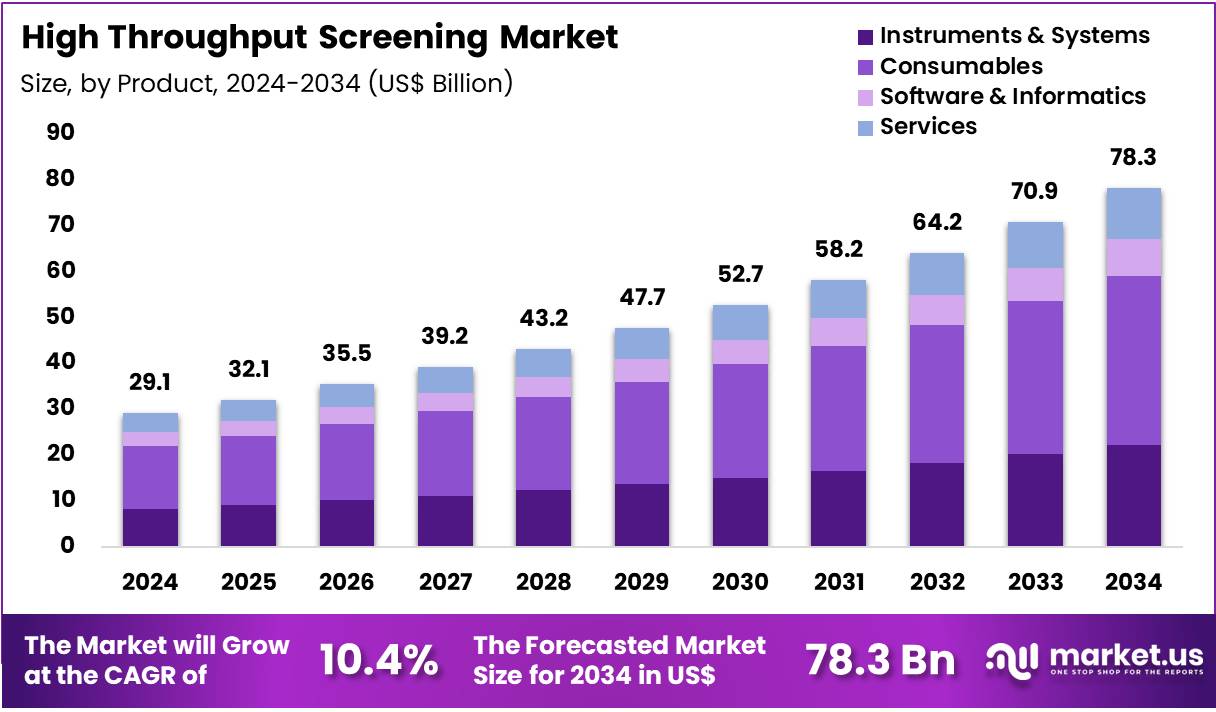
Key Takeaways
- In 2024, the High Throughput Screening Market generated revenue of US$ 29.1 billion and is projected to grow at a CAGR of 10.4%, reaching approximately US$ 78.3 billion by 2034.
- Based on product type, the market is categorized into instruments & systems, consumables, software & informatics, and services. Among these, the consumables segment dominated in 2024, accounting for a 47.0% market share.
- By technology, the market includes ultra-high throughput screening (uHTS), label-free screening technologies, cell-based screening technologies, and lab-on-a-chip technology (LOC). The cell-based screening technologies segment held a leading position, capturing a 43.7% share in 2024.
- Based on application, the market is segmented into early-stage drug discovery, drug repurposing screening, biological research, toxicology, and others. The early-stage drug discovery segment emerged as the largest contributor, holding a 51.2% revenue share.
- By end-user, the market is divided into pharmaceutical & biotechnology companies, academic & research institutes, contract research organizations (CROs), and others. The pharmaceutical & biotechnology companies segment led the market, with a 48.4% revenue share in 2024.
- Regionally, North America dominated the High Throughput Screening Market in 2024, accounting for a significant 38.6% market share due to strong pharmaceutical research activities, advanced laboratory infrastructure, and high investment in drug discovery technologies.
Market Segmentation Overview
- Product Analysis: The consumables segment accounted for 47.0% of the High Throughput Screening Market in 2024 and is expected to maintain dominance due to continuous demand for assay plates, reagents, probes, buffers, and detection kits. Increasing drug discovery activities, automated screening adoption, and demand for validated, ready-to-use formats support repeated consumable purchases across research laboratories and pharmaceutical pipelines.
- Technology Analysis: The cell-based screening technologies segment held a 43.7% market share in 2024 and is projected to lead due to its ability to provide biologically relevant insights into drug efficacy and toxicity. Growing adoption in oncology, immunology, and CNS research, along with advances in cell engineering, imaging systems, and 3D models, strengthens segment growth.
- Application Analysis: The early-stage drug discovery segment captured 51.2% revenue share in 2024 and is expected to remain dominant as pharmaceutical companies increasingly use HTS for target identification and compound screening. The technology helps analyze large compound libraries, improve hit selection, reduce discovery timelines, and support AI-based drug development strategies for faster therapeutic innovation.
- End-User Analysis: The pharmaceutical and biotechnology companies segment accounted for 48.4% market share in 2024 and is expected to dominate due to extensive drug discovery pipelines and high R&D investments. Increasing focus on oncology, rare diseases, and immunology therapies, along with demand for faster screening processes, drives adoption of HTS platforms among leading industry players.
Statistical Information
- Historical weekly HTS capacity growth in industry: A historical analysis of HTS evolution shows screening capacity rising from 800 compounds per week in early implementations to 1,440 per week by 1987 and 2,880 per week soon after, reaching a steady 7,200 compounds weekly by 1989 in major pharma labs. This quantifies how industrial throughput expanded almost nine‑fold within roughly a decade.
- Robotic HTS workstations enabling daily 50,000 compounds: A pharmaceutical HTS overview notes that robotics, automation, and miniaturization made it feasible to screen 50,000 compounds per day with complex workstations, and more than 100,000 samples daily using advanced detection like FRET and HTRF. Compared to manual approaches, this represents a several-order-of-magnitude increase in daily experimental throughput in early drug discovery.
- Cytiva Biacore 8K sample capacity and run size: Cytiva’s Biacore 8K SPR system accommodates up to four 96‑ or 384‑well microplates simultaneously. Product specifications describe maximum unattended run capacity of 1,536 samples in Biacore 8K and up to 4,608 samples in Biacore 8K+, increasing asset utilization by about 30% per week. These capacities quantify high‑throughput interaction screening in binding and kinetics studies.
- Biacore 8 series sample throughput in 24 hours: An analytica‑world product note states that a Biacore 8 series SPR system can screen about 2,300 samples in 24 hours using eight needles and 16 flow cells, handling four 96‑ or 384‑well microplates, including deep‑well formats. This numeric throughput demonstrates high‑capacity HTS‑style interaction screening for antibody, protein, or small‑molecule binding campaigns.
- Cytiva description of HTS compound screening ranges: Cytiva’s HTS overview states that high‑throughput screening allows evaluation of “thousands of compounds per day or week” and highlights parallel screening of 384 samples in less than six hours using Parallel Kinetics on Biacore 8 series systems. This concretely links HTS workflows to mid‑four‑figure compound sets and high‑density plate formats in routine industrial screening.
- HTS versus traditional screening numerical efficiency gains: Aragen’s technical overview contrasts HTS with traditional methods, noting HTS can screen between 10,000 and 100,000 compounds per day or week, while conventional screening typically handles only 20–50 compounds per week. This implies at least a 200‑fold to 5,000‑fold increase in screening throughput, quantifying efficiency gains that underpin demand for HTS platforms and services.
- Roche high‑throughput analyzer test volume per hour: Roche’s 2021 announcement for new high‑throughput configurations of its cobas pro integrated solutions states that the analyzer can deliver up to 4,400 tests per hour, doubling previous testing capacity. Over a 24‑hour continuous run, this equates to 105,600 tests, illustrating diagnostic‑sector demand for extremely high sample processing throughput akin to HTS capabilities.
- Historical HTS weekly capacity ramp‑up data: The origin and evolution analysis of HTS reports that early systems screened around 800 compounds per week, rising to 1,440 per week in 1987, 2,880 per week soon after, and stabilizing at 7,200 compounds weekly by 1989. This nearly nine‑fold throughput increase over a few years illustrates rapid scaling of HTS capacity in pioneering pharmaceutical laboratories.
- Vendor‑reported HTS compound screening acceleration factor: Aragen’s HTS overview quantifies acceleration relative to traditional screening: HTS can screen 10,000–100,000 compounds per day or week, whereas conventional methods typically handle only 20–50 compounds weekly. Numerically, this means HTS increases throughput by at least 200‑fold and potentially up to 5,000‑fold, underpinning strong economic rationale for HTS technology adoption in discovery programs.
Regional Analysis
North America led the market by securing a market share of 38.6% in 2024.
North America dominated the High Throughput Screening Market due to its advanced pharmaceutical research ecosystem, strong biotechnology presence, and extensive investment in drug discovery technologies. The region benefits from automated laboratory infrastructure, artificial intelligence integration, and government-supported biomedical research programs. The National Institutes of Health (NIH) received nearly US$48 billion in funding in 2024, supporting innovation in translational research and advanced screening platforms.
Major pharmaceutical and biotechnology companies increasingly adopt robotic screening systems, cell-based assays, and high-content analysis for faster therapeutic development. Asia Pacific is projected to experience significant growth due to expanding biotechnology capabilities, rising pharmaceutical investments, and increasing adoption of advanced research technologies.
Countries such as China, Japan, and South Korea are strengthening drug discovery infrastructure through automation, genomics, and precision medicine initiatives. Growing research activities in oncology, infectious diseases, and molecular biology are accelerating demand for high throughput screening solutions across the region.
Business Opportunities
The High Throughput Screening Market offers significant business opportunities driven by increasing demand for faster drug discovery, automation, and advanced biological research tools. Pharmaceutical and biotechnology companies are investing in robotic screening systems, AI-based analytics, and high-content imaging platforms to improve compound identification and reduce development timelines. Opportunities are expanding in consumables, including assay plates, reagents, and detection kits, due to continuous laboratory demand.
Contract research organizations (CROs) can benefit by providing specialized screening services, assay development, and data analysis solutions to companies seeking cost-effective research support. Growth in precision medicine, cell-based therapies, and oncology research is creating demand for advanced screening technologies such as 3D cell models and organoid-based assays. Additionally, collaborations between academic institutions, technology providers, and pharmaceutical companies are creating opportunities for innovative screening platforms and integrated software solutions.
Emerging Trends
- Artificial Intelligence Integration in High Throughput Screening: Artificial intelligence is transforming HTS by improving compound selection, image analysis, and prediction accuracy. Machine learning models help researchers analyze large biological datasets faster. AI-based screening approaches are increasingly used in drug discovery workflows to identify potential candidates from millions of molecular possibilities.
- Growth of Cell-Based and Phenotypic Screening Technologies: Cell-based screening is becoming more important because it provides real biological responses compared with traditional biochemical assays. NIH’s NCATS uses advanced cellular screening platforms for disease research, including automated assays and high-content analysis. These technologies support oncology, rare disease, and precision medicine programs.
- Increasing Adoption of Automated Robotic Screening Platforms: Automation is a major trend in HTS as laboratories require faster and more accurate testing. NIH NCATS operates robotic screening systems capable of handling large-scale experiments with automated liquid handling and data processing. These platforms improve efficiency by reducing manual laboratory operations.
- Rising Demand from Drug Discovery and Pharmaceutical Research: The growing number of new therapies is increasing demand for advanced screening methods. The FDA approved 50 novel drugs in 2024, showing continued pharmaceutical innovation. HTS helps companies evaluate large compound libraries and accelerate early-stage discovery before clinical development.
- Expansion of High-Content Screening and Advanced Imaging: High-content screening combines automated microscopy with computational analysis to evaluate multiple cellular features simultaneously. Artificial intelligence-based image analysis is improving cell classification, segmentation, and biological interpretation. These methods support complex disease models and improve accuracy in therapeutic research.
Use Cases
- Early-Stage Drug Discovery and Lead Identification: HTS is widely used by pharmaceutical companies to screen thousands to millions of compounds and identify potential drug candidates. The technology helps researchers find active molecules faster, optimize lead compounds, and reduce early discovery timelines for new therapies.
- Cancer Research and Oncology Drug Development: High throughput screening supports cancer research by testing compounds against tumor cells and identifying molecules that affect cancer pathways. WHO reported approximately 20 million new cancer cases and 9.7 million cancer deaths globally in 2022, increasing demand for faster oncology discovery tools.
- Drug Repurposing and Combination Screening: HTS platforms help researchers evaluate existing medicines for new therapeutic uses. NIH NCATS uses combination screening approaches to analyze multiple drug interactions, helping identify potential treatment options for complex diseases and improving efficiency of drug repurposing programs.
- Toxicology and Safety Assessment Applications: High-throughput screening is increasingly used for toxicity testing by evaluating how chemicals and compounds affect biological systems. NIH-supported Tox21 programs use automated screening approaches to analyze thousands of chemicals and identify possible safety concerns earlier in development.
- Precision Medicine and Personalized Therapy Research: HTS technologies support precision medicine by analyzing patient-derived cells, genetic pathways, and treatment responses. Researchers use advanced screening models to identify therapies suitable for specific biological characteristics, helping improve targeted treatment development for complex diseases.
Recent Development
- In May 2025, Thermo Fisher Scientific launched an integrated high throughput screening platform combining automated liquid handling with AI-driven data analysis, enhancing compound screening throughput and precision in pharmaceutical drug discovery workflows, targeting pharmaceutical and biotechnology company institutional buyers requiring accelerated lead identification and compound library screening capabilities.
- In February 2025, Danaher Corporation acquired a leading AI-driven data analytics company specializing in high throughput screening data interpretation, integrating advanced machine learning-powered screening data analysis capabilities into its life sciences automation portfolio to strengthen its position in pharmaceutical drug discovery and biologics screening service offerings.
- In 2025, PerkinElmer (Revvity) upgraded its cell-based imaging platform with AI-powered molecular analysis capabilities, enhancing high-content screening throughput and analytical depth for pharmaceutical drug discovery and cell biology research institutional buyers seeking improved compound activity profiling in 3D cell model and phenotypic screening applications.
- In 2024, Agilent Technologies introduced cloud-connected genomic screening solutions for precision medicine applications, integrating next-generation sequencing-based screening workflows with cloud data management platforms, targeting pharmaceutical genomics research and precision oncology drug discovery institutional buyers expanding genomic high throughput screening capabilities.
- In 2024, Tecan Group Ltd. launched advanced miniaturized assay automation systems for biologics research workflows, enabling high-density microplate-based screening at reduced reagent volumes and improved throughput, targeting pharmaceutical biologics discovery and academic research institute institutional buyers seeking cost-efficient automation solutions for large-scale compound and biologic screening programs.
- In July 2024, Agilent Technologies acquired a microfluidic instrument company to integrate next-generation sample preparation and handling capabilities into its high throughput screening systems, improving analytical performance and screening throughput for pharmaceutical and biotechnology company institutional buyers seeking enhanced miniaturized assay workflow integration within existing HTS laboratory infrastructure.
Frequently Asked Questions on High Throughput Screening
- Why are cell-based screening technologies important in HTS?
Cell-based screening technologies provide biologically relevant information by evaluating compound effects in living cells. They help researchers understand drug responses, toxicity, and therapeutic potential, making them valuable for oncology, immunology, neurological research, and precision medicine applications. - What is the role of artificial intelligence in High Throughput Screening?
Artificial intelligence improves HTS workflows by analyzing large datasets, predicting compound activity, identifying patterns, and supporting faster decision-making. AI-powered tools help researchers prioritize promising molecules and improve efficiency during early drug discovery processes. - Which application segment holds the largest share in the High Throughput Screening Market?
Early-stage drug discovery dominates the application segment because HTS enables rapid screening of large compound libraries. Pharmaceutical companies use these platforms to identify promising molecules, optimize drug candidates, and reduce research timelines before clinical development. - How do pharmaceutical companies use High Throughput Screening?
Pharmaceutical companies use HTS for target identification, lead discovery, compound testing, and drug optimization. The technology allows researchers to evaluate large numbers of molecules efficiently, helping companies develop innovative therapies for cancer, rare diseases, and other conditions. - What are the major end users of High Throughput Screening technology?
Major end users include pharmaceutical companies, biotechnology firms, academic research institutes, and contract research organizations. These organizations use HTS platforms for drug discovery, biological studies, toxicity testing, and development of advanced therapeutic solutions. - Why is North America leading the High Throughput Screening Market?
North America leads due to strong pharmaceutical infrastructure, advanced research facilities, government funding, and high adoption of automated laboratory technologies. The region benefits from significant investments in biotechnology, drug discovery programs, and artificial intelligence-based research platforms. - How is automation influencing the High Throughput Screening Market?
Automation is improving screening speed, accuracy, and laboratory productivity by reducing manual processes. Robotic liquid handlers, automated imaging systems, and digital analysis platforms enable researchers to conduct large-scale experiments with improved consistency and efficiency. - What is the future outlook for the High Throughput Screening Market?
The future of the High Throughput Screening Market is expected to focus on AI integration, advanced cellular models, personalized medicine, and automated discovery platforms. Increasing biotechnology innovation and demand for faster therapeutic development will continue supporting market expansion.
Conclusion
The High Throughput Screening Market is experiencing significant growth due to increasing demand for faster drug discovery, advanced automation, and AI-driven research solutions. Rising pharmaceutical R&D investments, growing adoption of cell-based screening technologies, and expanding applications in oncology, precision medicine, and biotechnology are strengthening market opportunities.
Consumables, early-stage drug discovery, and pharmaceutical companies remain key contributors to market development. North America continues to lead due to strong research infrastructure, while Asia Pacific shows promising growth potential. With continuous advancements in robotics, data analytics, and screening technologies, HTS is expected to play a crucial role in accelerating future therapeutic innovations.
Discuss your needs with our analyst
Please share your requirements with more details so our analyst can check if they can solve your problem(s)




