


Overview
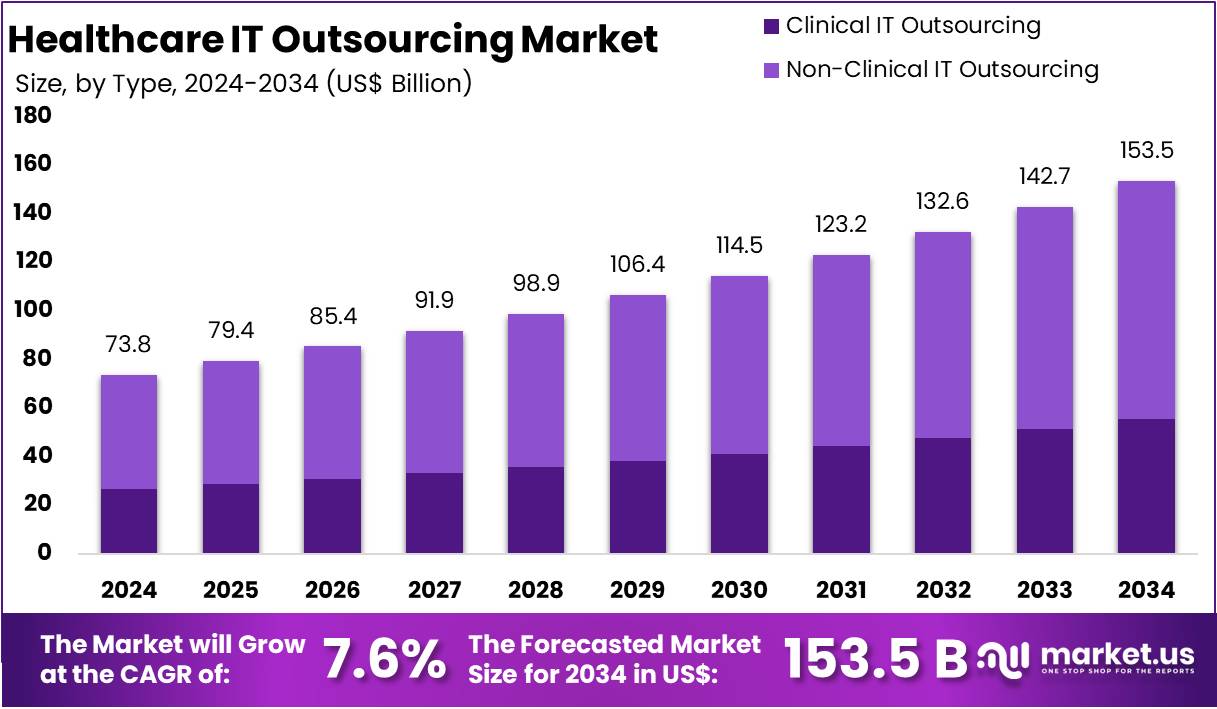
New York, NY – July 28, 2026 – The Global Healthcare IT Outsourcing Market Size is expected to be worth around US$ 153.3 Billion by 2034, from US$ 73.8 Billion in 2024, growing at a CAGR of 7.6% during the forecast period from 2025 to 2034. North America held a dominant market position, capturing more than a 39.5% share and holding a US$ 39.5 billion market value for the year.
The global healthcare IT outsourcing market is witnessing sustained growth, driven by accelerating digital transformation, regulatory mandates, and rising demand for cost-efficient, scalable IT solutions. Healthcare organizations are increasingly outsourcing services such as electronic health record (EHR) implementation, revenue cycle management, cybersecurity, cloud hosting, and telehealth integration to enhance operational efficiency and ensure compliance.
Adoption of national digital health strategies across more than 129 countries, as reported by the World Health Organization, is generating long-term outsourcing demand supported by multi-year government programs. In the United States, EHR adoption has reached 96% among hospitals and 78% among physicians, with 70% of hospitals actively exchanging health data, creating continuous requirements for integration and managed services.
Cybersecurity threats remain a critical driver, with ransomware accounting for 45% of healthcare cyber incidents in the EU and over 626 major breaches reported in the U.S., impacting 41.7 million individuals. Additionally, workforce shortages projected at 11.1 million globally by 2030 are prompting providers to rely on external IT partners for automation and system management.
Emerging frameworks such as TEFCA in the U.S. and large-scale programs like India’s ABDM and the European Health Data Space are further reinforcing outsourcing demand, particularly in interoperability, data exchange, and identity management solutions.
Key Takeaways
- The global healthcare IT outsourcing market is expected to expand from US$ 73.8 billion in 2024 to US$ 153.3 billion by 2034.
- The market is projected to register a CAGR of 7.6% during the forecast period from 2025 to 2034, supported by increasing digitalization and demand for cost optimization.
- In 2024, non-clinical IT outsourcing held a dominant position, accounting for more than 63.9% of the total market share.
- Healthcare providers emerged as the leading end-user segment in 2024, capturing over 37.1% of the overall market.
- North America led the global market in 2024, with a share exceeding 39.5%, corresponding to a market value of approximately US$ 39.5 billion.
Statistical Information
- Adoption of Healthcare IT Outsourcing by Hospitals: In a survey of health systems cited by Healthcare IT News (using Black Book data), 73% of health systems with more than 300 beds and 81% of providers with fewer than 300 beds reported shifting their focus to IT outsourcing for development and complex infrastructure services.
- Share of Hospital IT Services Outsourced to Managed Service Providers: Info-Tech Research Group reports that 43.9% of hospital IT services in 2023 were outsourced to MSPs, illustrating that nearly half of hospital IT workloads globally are handled through external providers rather than in‑house teams.
- Global Healthcare Data Volume Driving Outsourcing Demand: Industry Research (citing global healthcare data metrics) states that the global healthcare industry generated more than 2.3 zettabytes of medical data in 2024, with nearly 35% requiring real-time processing and analytics, which directly increases the need for scalable outsourced IT services.
- Regional Patterns in Healthcare IT Outsourcing: Info-Tech Research Group data shows North America as the largest market and Asia Pacific as the fastest-growing region for healthcare IT outsourcing over 2018–2033, based on a market size expansion from approximately USD 41.7 billion to USD 105.7 billion.
- OECD Electronic Health Record (EHR) Adoption and System Fragmentation: By 2024, average availability of online digital health services across OECD countries reached 82%, up from 79% in 2023, reflecting rapid expansion of digital front‑doors that often depend on outsourced hosting, application management and cybersecurity services.
- Health IT Investment and Potential Efficiency Gains in OECD Economies: The same study estimates that broad adoption of electronic health records could produce efficiency and safety savings of USD 142 billion in U.S. physician offices and USD 371 billion in U.S. hospitals over 15 years, a scale of potential savings that supports outsourcing of IT infrastructure, software and analytics to specialized vendors.
- Global Health Expenditure and Space for IT Outsourcing: WHO’s Global Health Expenditure Database covers 195 countries and territories from 2000 onwards, using official national statistics; many high‑income countries spend more than 10% of GDP on health, creating substantial headroom for digital and outsourced IT solutions in hospitals and public health agencies.
Regional Analysis
North America remained the leading region in 2024, contributing over 39.5% market share.
North America maintained a leading position in the Healthcare IT Outsourcing market in 2024, supported by advanced healthcare systems, high digital adoption, and strong demand for efficient technology solutions. The United States and Canada have witnessed rapid growth in electronic health records (EHR), cloud-based healthcare platforms, telehealth services, and data analytics solutions.
Healthcare organizations are increasingly outsourcing IT operations to improve efficiency, manage rising healthcare costs, and strengthen cybersecurity capabilities. Government programs promoting healthcare digitization and interoperability have further accelerated technology adoption across hospitals and clinics. The growing need for compliance with regulations such as patient data protection standards has encouraged providers to partner with specialized IT vendors.
Additionally, the expansion of artificial intelligence, remote patient monitoring, and value-based care models is creating new opportunities for outsourcing services. With continuous healthcare innovation and strong technology infrastructure, North America is expected to remain a key contributor to global Healthcare IT Outsourcing growth.
Emerging Trends
- Growing Adoption of Cloud-Based Healthcare IT Outsourcing: Healthcare organizations are increasingly outsourcing cloud services for electronic health records (EHR), data storage, and healthcare applications. Cloud solutions help reduce IT infrastructure costs, improve scalability, and support secure remote access. HHS highlights the importance of cloud computing in enabling secure healthcare data management while supporting HIPAA compliance.
- Rising Demand for AI-Powered Healthcare IT Services: Artificial intelligence is becoming a major trend in healthcare IT outsourcing, with providers seeking external partners for AI analytics, automation, and clinical decision-support systems. AI-based solutions help reduce administrative workload, improve operational efficiency, and support better healthcare decisions across hospitals and healthcare networks.
- Expansion of Telehealth and Remote Care Platforms: The increasing use of virtual healthcare services is driving demand for outsourced telehealth technology solutions. According to HHS, 95% of HRSA-funded health centers used telehealth services in 2024, increasing the need for external IT providers managing virtual consultations, remote monitoring, and digital patient engagement platforms.
- Increasing Healthcare Cybersecurity Outsourcing: Rising cyber threats and strict data protection requirements are encouraging healthcare organizations to outsource cybersecurity services. Managed security providers support threat monitoring, encryption, compliance management, and risk assessment. HHS continues promoting stronger cybersecurity practices to protect electronic health information and healthcare infrastructure.
- Growth of Healthcare Data Interoperability and Analytics Solutions: Healthcare providers are outsourcing data management and interoperability services to improve information exchange between healthcare systems. HHS reported that TEFCA-enabled networks facilitated nearly 500 million health records exchanges, highlighting the growing importance of connected healthcare data platforms.
Use Cases
- Electronic Health Record (EHR) Management: Hospitals outsource EHR implementation, maintenance, and optimization services to improve workflow efficiency and secure patient data handling. External IT providers support system integration, software updates, interoperability, and compliance requirements, allowing healthcare professionals to focus more on patient care activities.
- Revenue Cycle Management (RCM) Automation: Healthcare organizations use outsourced IT solutions for billing, claims processing, medical coding, and payment management. Automation-based RCM platforms help reduce administrative errors, improve reimbursement processes, and enhance financial performance by streamlining complex healthcare payment operations.
- Remote Patient Monitoring (RPM) Support: Outsourced remote monitoring solutions help healthcare providers manage connected medical devices, patient data collection, and real-time health tracking. These platforms support chronic disease management for conditions such as diabetes, heart disease, and respiratory disorders by enabling continuous patient monitoring.
- Healthcare Cybersecurity and Compliance Management: Healthcare institutions rely on outsourced cybersecurity providers to protect sensitive patient information. Services include data encryption, security monitoring, compliance audits, and incident response. These solutions help healthcare organizations address increasing cyber risks and maintain regulatory compliance.
- AI-Based Healthcare Analytics and Automation: Outsourcing AI-powered analytics enables healthcare providers to use predictive models, automation tools, and advanced data analysis. These technologies support clinical decision-making, operational improvement, and personalized healthcare delivery while helping organizations manage large volumes of healthcare data efficiently.
Frequently Asked Questions on Healthcare IT Outsourcing
- Why is Healthcare IT Outsourcing becoming important?
Healthcare IT Outsourcing is gaining importance due to rapid healthcare digitalization, increasing data management requirements, and growing cybersecurity challenges. Outsourcing enables hospitals and clinics to access advanced technologies, skilled IT experts, and flexible solutions without making large investments in internal technology infrastructure. - What services are included in Healthcare IT Outsourcing?
Healthcare IT Outsourcing services include electronic health record (EHR) management, cloud computing, revenue cycle management, cybersecurity, healthcare analytics, application development, infrastructure management, and telehealth technology support. These services help healthcare organizations improve efficiency, maintain secure systems, and enhance digital healthcare delivery. - How does Healthcare IT Outsourcing improve patient care?
Healthcare IT Outsourcing improves patient care by supporting faster access to medical information, efficient data management, and advanced digital healthcare platforms. Outsourced IT solutions enable telemedicine, remote monitoring, and analytics tools that help healthcare professionals provide accurate, timely, and personalized treatment. - What role does artificial intelligence play in Healthcare IT Outsourcing?
Artificial intelligence plays an important role in Healthcare IT Outsourcing by supporting automation, predictive analytics, clinical decision support, and intelligent data processing. Healthcare organizations are working with IT providers to implement AI solutions that improve workflow efficiency, reduce administrative workload, and enhance healthcare services. - How does Healthcare IT Outsourcing help with cybersecurity?
Healthcare IT Outsourcing strengthens cybersecurity through specialized services such as threat detection, data encryption, security monitoring, and compliance management. External IT providers help healthcare organizations protect sensitive patient information, reduce cyber risks, and maintain compliance with healthcare data protection regulations. - What are the benefits of outsourcing EHR management?
Outsourcing EHR management helps healthcare providers maintain secure electronic records, improve system interoperability, and manage technical updates efficiently. IT service providers offer expertise in healthcare software management, reducing operational challenges while ensuring reliable access to patient information and clinical data. - What is the future outlook of the Healthcare IT Outsourcing Market?
The Healthcare IT Outsourcing Market is expected to grow with increasing adoption of artificial intelligence, cloud computing, digital health platforms, and advanced cybersecurity solutions. Healthcare organizations will continue outsourcing IT operations to access scalable technologies, improve efficiency, and support future healthcare innovation.
Conclusion
The Healthcare IT Outsourcing market is experiencing strong growth due to increasing digital transformation, rising healthcare data volumes, and the need for cost-effective technology solutions. Healthcare organizations are adopting outsourced services such as cloud computing, electronic health records, cybersecurity, AI-based analytics, and telehealth platforms to improve operational efficiency and patient care.
Growing regulatory requirements and cybersecurity concerns are further encouraging partnerships with specialized IT providers. With continued advancements in artificial intelligence, remote healthcare, and data interoperability, outsourcing will remain a key strategy for healthcare providers. The market is expected to expand as organizations focus on scalable, secure, and innovative digital healthcare solutions.
Discuss your needs with our analyst
Please share your requirements with more details so our analyst can check if they can solve your problem(s)




