


Overview
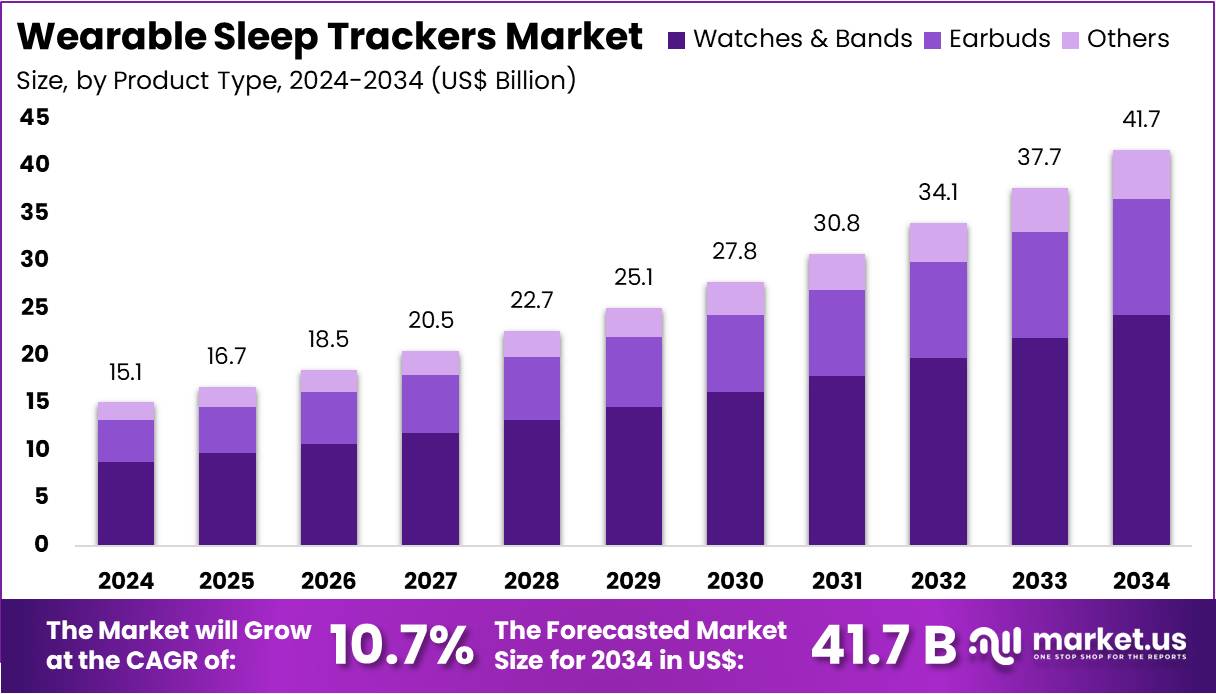
New York, NY – May 22, 2026 – The Wearable Sleep Trackers Market size is expected to be worth around US$ 41.7 billion by 2034 from US$ 15.1 billion in 2024, growing at a CAGR of 10.7% during the forecast period 2025 to 2034. North America held a dominant market position, capturing more than a 43.2% share and holds US$ 6.5 Billion market value for the year.
The global market for wearable sleep trackers has experienced substantial growth in recent years, driven by increasing consumer awareness regarding sleep health and the rising adoption of digital health monitoring devices. Wearable sleep trackers are smart electronic devices designed to monitor and analyze sleep patterns, duration, heart rate, breathing rate, and other physiological parameters during sleep. These devices are commonly integrated into smartwatches, fitness bands, rings, and specialized sleep-monitoring wearables.
The growing prevalence of sleep disorders, stress-related health conditions, and lifestyle-related diseases has significantly contributed to market demand. Consumers are increasingly seeking non-invasive and real-time health monitoring solutions that support preventive healthcare and wellness management. In addition, advancements in sensor technology, artificial intelligence (AI), and mobile health applications have improved the accuracy and functionality of wearable sleep tracking devices.
Healthcare professionals and wellness organizations are also recognizing the importance of sleep monitoring in maintaining overall physical and mental well-being. The integration of wearable sleep trackers with smartphone applications and cloud-based health platforms enables users to access personalized sleep insights and long-term health data.
Key Takeaways
- The global wearable sleep trackers market was valued at US$ 15.1 billion in 2024 and is projected to reach US$ 41.7 billion by 2034, expanding at a CAGR of 10.7% during the forecast period.
- Based on product type, the market is segmented into watches & bands, earbuds, and others. Among these, watches & bands dominated the market in 2024, accounting for a 58.2% share.
- By application, the market is categorized into insomnia, sleep apnea, and others. The insomnia segment held the largest market share of 52.3% in 2024.
- North America emerged as the leading regional market, capturing 43.2% of the global wearable sleep trackers market share in 2024.
Regional Analysis
North America dominated the wearable sleep trackers market, accounting for 43.2% of total revenue. The region’s leadership is primarily supported by rising health awareness and the growing prevalence of sleep disorders. According to the CDC, more than 70 million adults in the United States suffer from chronic sleep-related problems, increasing the demand for advanced sleep monitoring solutions. Consumer adoption has also accelerated, with the National Sleep Foundation reporting that 35% of Americans actively track their sleep patterns, compared to 28% in 2022. Continuous technological innovation by major companies such as Apple and Fitbit has further strengthened market growth through enhanced biometric and sleep analytics features.
Asia Pacific is projected to register the fastest CAGR during the forecast period due to increasing disposable incomes, rapid urbanization, and expanding digital healthcare initiatives. Governments across the region are actively supporting wearable healthcare technologies. Rising sleep disorder cases in countries such as China and growing investments in digital health infrastructure in India are contributing to market expansion. Additionally, strong demand for advanced wearable devices in Japan, South Korea, and Australia is expected to accelerate regional adoption of wearable sleep tracking technologies.
Emerging Trends
- Integration with Broader Health Platforms: Wearable sleep trackers are increasingly integrated with fitness apps, heart rate monitors, and wellness platforms. This integration combines sleep data with physical activity, nutrition, and health metrics, enabling users and healthcare providers to gain a more comprehensive understanding of overall health and lifestyle patterns.
- AI-Powered Sleep Insights: Artificial intelligence is enhancing wearable sleep trackers by providing personalized sleep analysis and recommendations. These devices evaluate long-term sleep patterns, stress levels, and daily activities to offer customized insights that help users improve sleep quality and maintain healthier sleep habits over time.
- Contactless and Non-Invasive Designs: Manufacturers are developing contactless and lightweight sleep tracking solutions, including smart rings, under-mattress sensors, and sleep-monitoring clothing. These products improve user comfort while still monitoring essential metrics such as heart rate, movement, breathing patterns, snoring, and body temperature during sleep.
- Focus on Mental Health and Stress Management: Modern sleep trackers now include stress management and mental wellness features such as guided breathing exercises, mindfulness tools, and mood monitoring. These additions help users understand the relationship between stress and sleep quality while supporting emotional balance and overall mental well-being.
- Real-Time Sleep Monitoring for Medical Use: Advanced wearable sleep trackers are increasingly used in healthcare settings for real-time patient monitoring. These devices assist healthcare professionals in tracking sleep disorders, sleep apnea, and heart-related conditions remotely, improving treatment planning, early diagnosis, and long-term patient care management.
- Personalized Alarms and Sleep Coaching: Wearable sleep trackers now offer smart alarms and personalized sleep coaching features. These systems wake users during lighter sleep stages and provide daily recommendations, bedtime reminders, and sleep improvement plans that encourage healthier routines and long-term behavioral changes for better sleep quality.
- Expansion in Emerging Markets: Demand for wearable sleep trackers is increasing across emerging economies due to growing health awareness and improving digital healthcare infrastructure. Companies are introducing affordable products with localized applications and language support to expand adoption in regions such as Asia, Latin America, and Africa.
Use Cases
- Monitoring Sleep Quality at Home: Consumers use wearable sleep trackers to monitor sleep duration, interruptions, and sleep quality from home. These devices help identify lifestyle habits affecting sleep, allowing users to improve bedtime routines, reduce disturbances, and maintain healthier sleeping patterns through regular data analysis.
- Managing Sleep Disorders Like Insomnia or Sleep Apnea: Individuals with insomnia or sleep apnea use wearable sleep trackers to monitor long-term sleep behavior and breathing irregularities. The collected data supports healthcare professionals in evaluating sleep conditions, adjusting treatment plans, and improving patient outcomes through continuous monitoring outside clinical settings.
- Enhancing Performance for Athletes and Fitness Enthusiasts: Athletes and fitness enthusiasts rely on wearable sleep trackers to measure recovery, sleep quality, and physical readiness. These insights help optimize training schedules, reduce the risk of overtraining, improve athletic performance, and support muscle recovery through proper sleep and rest management.
- Parental Use for Monitoring Children’s Sleep: Parents use wearable sleep trackers and connected monitoring devices to track children’s sleep schedules, movement, and nighttime awakenings. These tools support healthy sleep routines, provide peace of mind, and assist parents in discussing sleep-related concerns with pediatric healthcare professionals.
- Corporate Wellness Programs: Organizations are integrating wearable sleep trackers into employee wellness programs to encourage healthier sleep habits and reduce workplace stress. These programs improve employee productivity, support mental well-being, lower burnout risks, and promote healthier lifestyle choices through sleep awareness initiatives and coaching tools.
- Tracking Jet Lag and Sleep Shifts for Frequent Travelers: Frequent travelers use wearable sleep trackers to monitor sleep disruptions caused by changing time zones and irregular schedules. These devices provide sleep adjustment recommendations that help reduce jet lag, improve energy levels, maintain productivity, and support faster adaptation to travel-related sleep changes.
Frequently Asked Questions on Wearable Sleep Trackers
- What factors are driving the growth of the wearable sleep trackers market?
The market is primarily driven by increasing awareness regarding sleep health, rising cases of sleep disorders, growing adoption of wearable healthcare devices, and advancements in sensor technology, artificial intelligence, and mobile health applications across global consumer markets. - Which devices are commonly used for sleep tracking?
Sleep tracking features are commonly available in smartwatches, fitness bands, smart rings, and specialized wearable health devices. These products are designed to continuously collect sleep-related data and provide users with detailed reports through connected mobile applications. - Why is North America leading the wearable sleep trackers market?
North America leads the market due to high consumer awareness, strong adoption of digital healthcare technologies, increasing prevalence of sleep disorders, and the presence of major technology companies continuously developing advanced wearable sleep monitoring solutions. - Which region is expected to witness the fastest market growth?
Asia Pacific is expected to register the fastest growth during the forecast period owing to rising healthcare awareness, increasing disposable income, rapid urbanization, and growing government investments in digital healthcare and wearable technology infrastructure. - How do wearable sleep trackers benefit users?
Wearable sleep trackers help users improve sleep habits by providing insights into sleep quality, sleep duration, stress levels, and recovery patterns. These devices support preventive healthcare and encourage healthier lifestyle choices through continuous health monitoring. - What technologies are used in wearable sleep trackers?
Wearable sleep trackers utilize technologies such as biometric sensors, accelerometers, heart rate monitoring systems, artificial intelligence, and cloud-based analytics to collect, process, and analyze sleep-related health data with improved accuracy and efficiency. - Who are the major companies operating in the wearable sleep trackers market?
Key companies operating in the market include Apple, Fitbit, Samsung Electronics, Garmin, and Huawei, which continuously invest in product innovation and advanced sleep monitoring technologies.
Conclusion
The wearable sleep trackers market is witnessing strong growth due to increasing awareness regarding sleep health, rising prevalence of sleep disorders, and rapid adoption of digital healthcare technologies. Advancements in artificial intelligence, biometric sensors, and connected health platforms are improving device accuracy and user experience.
North America currently leads the market, while Asia Pacific is expected to witness the fastest growth during the forecast period. The expanding use of wearable sleep trackers across healthcare, fitness, wellness, and corporate sectors is further supporting market expansion. Continuous innovation by major companies is expected to create significant growth opportunities for the global wearable sleep trackers industry.
Discuss your needs with our analyst
Please share your requirements with more details so our analyst can check if they can solve your problem(s)




