


Overview
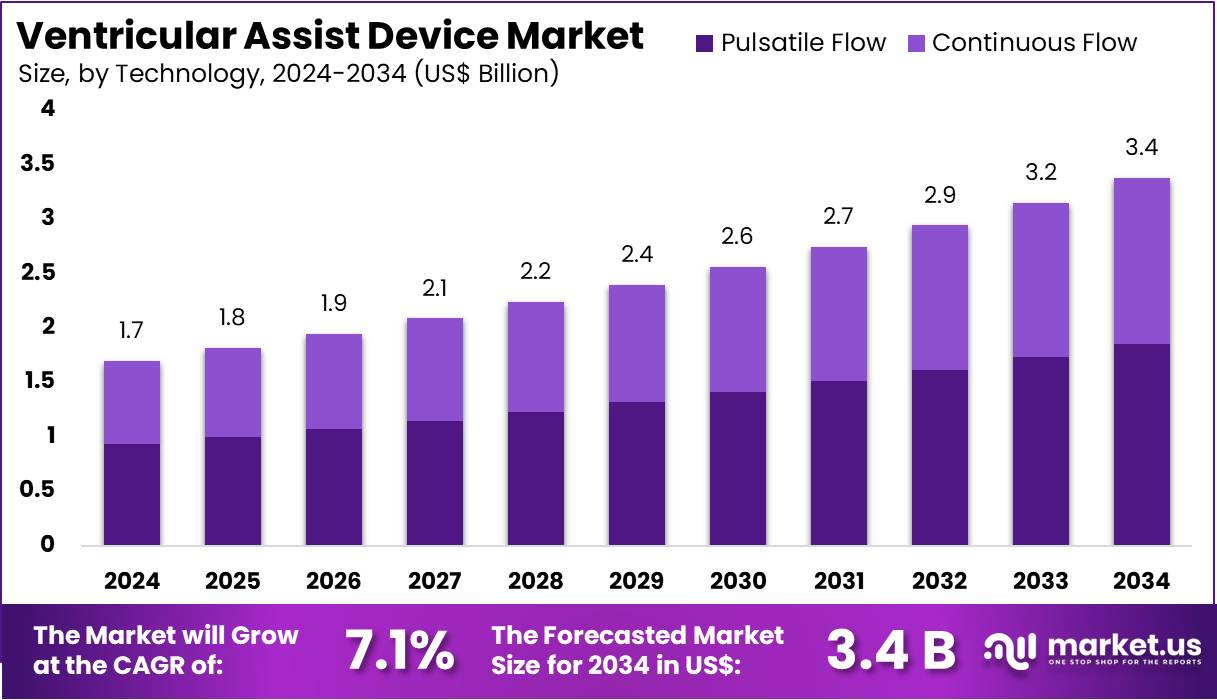
New York, NY – May 12, 2026 – The Ventricular Assist Device Market size is expected to be worth around US$ 3.4 Billion by 2034 from US$ 1.7 Billion in 2024, growing at a CAGR of 7.1% during the forecast period 2025 to 2034. North America held a dominant market position, capturing more than a 44.2% share and holds US$ 0.8 Billion market value for the year.
The Ventricular Assist Device (VAD) is an advanced mechanical pump designed to support heart function and maintain blood circulation in patients suffering from severe heart failure. These devices are primarily used when the heart is unable to pump sufficient blood to meet the body’s requirements. VADs are commonly implanted in patients awaiting heart transplantation, recovering from cardiac surgery, or requiring long-term cardiac support.
A VAD assists one or both lower chambers of the heart, known as ventricles. Depending on the patient’s condition, the device may function as a left ventricular assist device (LVAD), right ventricular assist device (RVAD), or biventricular assist device (BiVAD). The system generally consists of a pump implanted inside the body, a controller, and an external power source connected through a driveline.
The growing prevalence of cardiovascular diseases, increasing incidence of advanced heart failure, and rising demand for minimally invasive cardiac support technologies are contributing to the adoption of VADs globally. Technological advancements such as compact device design, improved battery life, and enhanced patient monitoring capabilities are further supporting market expansion. Additionally, increasing awareness regarding mechanical circulatory support therapies and improving healthcare infrastructure are expected to drive continued growth in the ventricular assist device market over the coming years.
Key Takeaways
- In 2023, the ventricular assist device market generated a revenue of US$ 1.7 billion and is projected to reach US$ 3.4 billion by 2033, expanding at a CAGR of 7.1% during the forecast period.
- Based on product type, the market is segmented into total artificial heart, right ventricular assist device, left ventricular assist device, and bi-ventricular assist device. Among these, the left ventricular assist device segment dominated the market in 2023, accounting for a 40% revenue share.
- By technology, the market is categorized into pulsatile flow and continuous flow. The pulsatile flow segment held the largest market share of 55% in 2023.
- In terms of application, the market is segmented into destination therapy, bridge to transplant, and others. The destination therapy segment emerged as the leading segment, capturing 50% of the market share in 2023.
- Based on end user, the market is divided into hospitals, specialty clinics, and others. The hospitals segment led the market with a revenue share of 60% in 2023.
- North America dominated the global ventricular assist device market in 2023, securing a market share of 44.2%.
Regional Analysis
North America dominated the ventricular assist device market in 2024, accounting for the largest revenue share of 44.2%. The regional market growth was primarily driven by the rising prevalence of cardiovascular diseases and heart failure, which increased the demand for advanced cardiac support solutions. Technological advancements, particularly the development of continuous-flow ventricular assist devices, improved patient outcomes and broadened the eligible patient base.
In addition, the growing aging population across the region significantly contributed to market expansion, as elderly individuals are more susceptible to chronic heart conditions. Favorable healthcare reimbursement policies and strong healthcare infrastructure further supported the adoption of ventricular assist devices. The presence of major medical device manufacturers, including Abbott Laboratories and Medtronic, also accelerated innovation and product availability in the region.
Meanwhile, the Asia Pacific region is expected to register the fastest CAGR during the forecast period. The market growth is attributed to the increasing burden of cardiovascular diseases, expanding geriatric population, improving healthcare infrastructure, and rising healthcare expenditure in countries such as China and India. Government healthcare initiatives and collaborations between global manufacturers and regional healthcare providers are further expected to support market growth.
Emerging Trends
- Miniaturization of Devices: Ventricular assist devices are becoming smaller, lighter, and easier to implant in patients with severe heart failure. These compact systems improve patient comfort, reduce surgical complications, support faster recovery, and allow greater mobility, making long-term cardiac support more convenient and lifestyle friendly.
- Shift from Pulsatile to Continuous-Flow Devices: The market is rapidly shifting from pulsatile ventricular assist devices to continuous-flow systems due to their smaller size, quieter operation, and improved durability. Continuous-flow devices provide stable blood circulation, reduce mechanical failures, and enhance patient survival rates and treatment outcomes significantly.
- Growing Focus on Battery Life and Mobility: Manufacturers are increasingly focusing on advanced battery technologies that improve mobility and independence for ventricular assist device patients. Longer battery life allows patients to travel, work, and perform daily activities comfortably while reducing dependence on continuous external power support systems.
- Increased Use in Destination Therapy: Ventricular assist devices are increasingly being used as destination therapy for patients who are not eligible for heart transplantation. This approach provides long-term cardiac support, improves quality of life, reduces hospitalization frequency, and increases survival rates among advanced heart failure patients.
- Integration with Smart Monitoring Systems: Advanced ventricular assist devices now incorporate wireless monitoring systems and cloud-based technologies for real-time patient tracking. These smart systems enable physicians to monitor device performance remotely, detect complications early, reduce hospital visits, and deliver more personalized cardiac care services.
- Rising Interest in Fully Implantable Devices: The development of fully implantable ventricular assist devices is gaining attention due to their potential to reduce infections and improve patient comfort. These systems eliminate external wires, allowing patients greater flexibility, improved appearance, and a more convenient long-term treatment experience.
- Expansion into Emerging Economies: Emerging economies are witnessing increased adoption of ventricular assist devices due to improving healthcare infrastructure and rising awareness about heart failure treatment. Manufacturers are introducing cost-effective systems to expand patient access and strengthen their presence across developing healthcare markets globally.
Use Cases
- Bridge to Heart Transplant: Ventricular assist devices are commonly used as a bridge to heart transplantation for patients waiting for donor hearts. These devices maintain blood circulation, support organ function, stabilize patient health, and improve survival chances until suitable transplant procedures become available successfully.
- Destination Therapy: For patients ineligible for heart transplantation, ventricular assist devices serve as destination therapy by providing permanent cardiac support. This treatment improves blood circulation, reduces heart failure symptoms, enhances physical activity levels, and helps patients maintain a better quality of life.
- Bridge to Recovery: Ventricular assist devices are used as bridge-to-recovery solutions in patients experiencing temporary heart failure caused by infections, surgery, or heart attacks. The device supports cardiac function while the heart heals naturally, potentially eliminating the need for transplantation or permanent support.
- Bridge to Decision: In uncertain clinical situations, ventricular assist devices are utilized as bridge-to-decision therapy to stabilize patients temporarily. This approach provides physicians additional time to evaluate treatment options, monitor patient recovery, and determine whether transplantation or long-term support is necessary.
- Pediatric Use Cases: Pediatric ventricular assist devices are specially designed to support children suffering from severe heart failure conditions. These systems help maintain blood circulation, stabilize organ function, and improve survival rates while young patients wait for heart transplantation or recover from cardiac procedures.
- Support After Cardiac Surgery: Following major cardiac surgeries, ventricular assist devices are often used to provide temporary circulatory support for weakened hearts. These devices improve blood flow, reduce post-surgical complications, accelerate recovery, and help patients regain stable cardiac function during critical recovery periods.
Frequently Asked Questions on Ventricular Assist Device
- Why are Ventricular Assist Devices used?
Ventricular Assist Devices are primarily used to improve blood flow in patients with advanced heart failure who cannot maintain adequate circulation naturally. These devices are often utilized as bridge-to-transplant, destination therapy, or temporary cardiac recovery support solutions. - What are the major types of Ventricular Assist Devices?
The major types of Ventricular Assist Devices include Left Ventricular Assist Devices, Right Ventricular Assist Devices, and Biventricular Assist Devices. Among these, Left Ventricular Assist Devices are most widely adopted due to the high prevalence of left-side heart failure conditions. - What are the benefits of Ventricular Assist Devices?
Ventricular Assist Devices improve blood circulation, enhance organ function, and increase survival rates in heart failure patients. These devices also improve patient mobility, quality of life, and physical activity levels while reducing hospital admissions associated with severe cardiac complications. - What is driving the growth of the Ventricular Assist Device market?
The growth of the Ventricular Assist Device market is driven by increasing prevalence of cardiovascular diseases, rising geriatric population, and growing incidence of heart failure globally. Technological advancements and improved reimbursement policies are also supporting market expansion significantly. - Which region dominates the Ventricular Assist Device market?
North America dominates the Ventricular Assist Device market due to advanced healthcare infrastructure, strong adoption of cardiac support technologies, and increasing heart failure cases. High healthcare spending and favorable regulatory frameworks further contribute to the region’s leading market position. - Which companies are leading in the Ventricular Assist Device market?
Leading companies operating in the Ventricular Assist Device market include Abbott Laboratories, Medtronic plc, and Berlin Heart GmbH. These companies focus on technological innovation, strategic partnerships, and product approvals to strengthen their competitive positions in the global market. - What is the future outlook for the Ventricular Assist Device market?
The future outlook for the Ventricular Assist Device market remains positive due to increasing investments in cardiac care technologies and continuous product innovation. Demand for minimally invasive devices, portable systems, and long-term heart support solutions is expected to rise steadily.
Conclusion
The ventricular assist device market is witnessing steady growth due to the rising prevalence of cardiovascular diseases, increasing geriatric population, and growing demand for advanced cardiac support solutions. Technological advancements, including miniaturized devices, continuous-flow systems, smart monitoring technologies, and fully implantable devices, are improving patient outcomes and expanding treatment applications.
North America continues to dominate the market, while Asia Pacific is expected to emerge as the fastest-growing region due to improving healthcare infrastructure and rising healthcare investments. With increasing adoption in destination therapy and bridge-to-transplant applications, the ventricular assist device market is expected to experience sustained expansion and innovation over the forecast period.
Discuss your needs with our analyst
Please share your requirements with more details so our analyst can check if they can solve your problem(s)




