


Overview
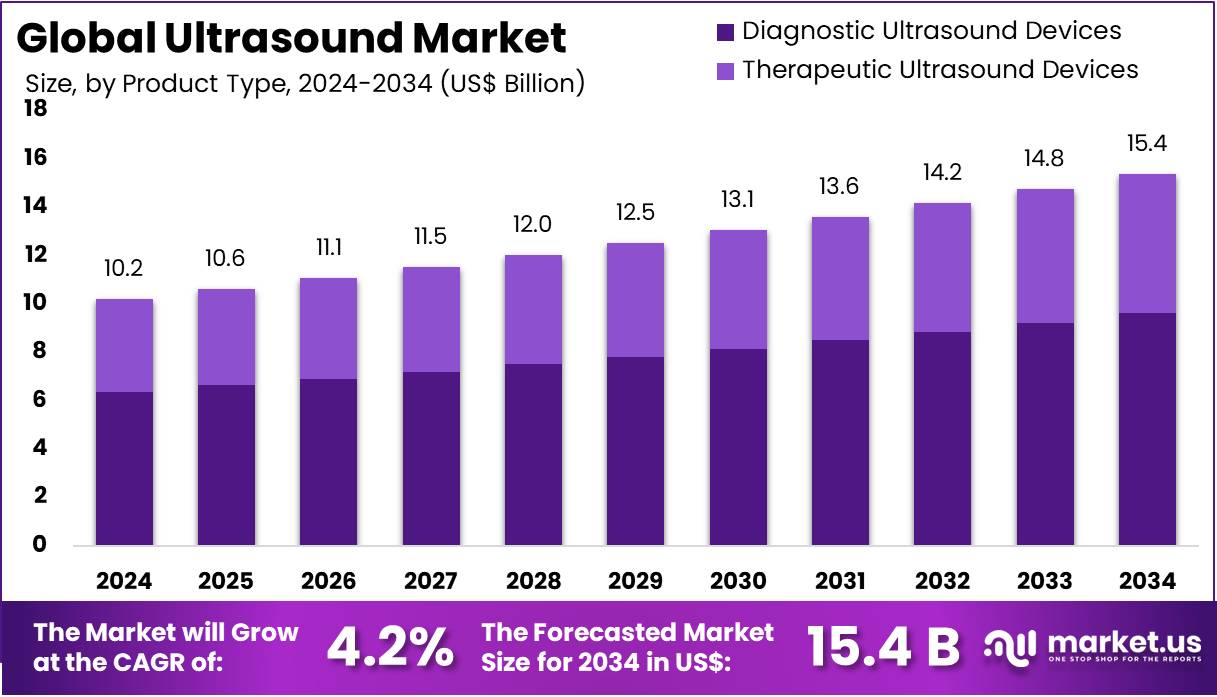
New York, NY – May 08, 2026 –The Ultrasound Market size is expected to be worth around US$ 15.4 billion by 2034 from US$ 10.2 billion in 2024, growing at a CAGR of 4.2% during the forecast period 2025 to 2034.
The global adoption of ultrasound technology has continued to expand across diagnostic imaging, point-of-care applications, and minimally invasive procedures due to its non-invasive nature, cost efficiency, and real-time imaging capabilities. Ultrasound systems utilize high-frequency sound waves to generate detailed internal body images, enabling healthcare professionals to assess organs, tissues, blood flow, and fetal development without exposure to ionizing radiation.
Ultrasound devices are widely used in radiology, cardiology, obstetrics and gynecology, urology, and emergency medicine. The increasing prevalence of chronic diseases, growing demand for early disease diagnosis, and rising preference for portable imaging solutions have supported market growth globally. Technological advancements such as 3D/4D imaging, Doppler ultrasound, handheld ultrasound devices, and artificial intelligence-integrated imaging systems have further enhanced diagnostic accuracy and workflow efficiency.
Healthcare facilities are increasingly adopting compact and portable ultrasound systems to improve patient accessibility and support bedside diagnostics. In addition, the expansion of healthcare infrastructure in emerging economies and rising investments in medical imaging technologies are expected to create significant growth opportunities for industry participants.
North America currently represents a major market due to advanced healthcare infrastructure and strong adoption of innovative diagnostic technologies, while Asia-Pacific is anticipated to witness rapid growth driven by increasing healthcare expenditure, expanding patient population, and improving access to medical imaging services.
Key Takeaways
- In 2024, the global ultrasound market was valued at US$ 10.2 billion and is projected to reach US$ 15.4 billion by 2034, expanding at a CAGR of 4.2% during the forecast period.
- Based on product type, the market is segmented into diagnostic ultrasound devices and therapeutic ultrasound devices. Diagnostic ultrasound devices dominated the market in 2024, accounting for a 62.4% revenue share.
- By portability, the market is categorized into cart/trolley, compact, and handheld ultrasound systems. Among these, the cart/trolley segment held the largest market share of 50.8% in 2024.
- In terms of application, the market is divided into cardiology, obstetrics/gynecology, orthopedic, radiology, and others. The radiology segment emerged as the leading application area, capturing a 48.9% revenue share in 2024.
- Based on end user, the market is segmented into hospitals, research centers, and imaging centers. Hospitals accounted for the largest share of 54.3% in the global ultrasound market.
- North America dominated the global ultrasound market in 2024, securing a market share of 37.4%.
Regional Analysis
North America accounted for the largest revenue share of 37.4% in the global ultrasound market due to the growing prevalence of chronic diseases, including cardiovascular disorders, cancer, and musculoskeletal conditions. The increasing demand for accurate and early-stage diagnostic imaging has significantly supported the adoption of ultrasound systems across the region.
Technological advancements in ultrasound devices, including portable and user-friendly systems, have further accelerated market growth by improving diagnostic efficiency and patient convenience. In addition, the rising preference for non-invasive diagnostic procedures and the presence of advanced healthcare infrastructure have strengthened market expansion in North America. High healthcare expenditure and strong access to medical imaging technologies have also contributed to the region’s leading market position.
Asia Pacific is anticipated to register the fastest CAGR during the forecast period owing to rapid healthcare development and a growing aging population. Increasing awareness regarding early disease diagnosis and preventive healthcare is expected to boost demand for ultrasound imaging systems across the region.
Rising incidences of respiratory and chronic diseases, particularly in countries such as China and India, are further supporting market growth. Additionally, favorable government initiatives to improve healthcare accessibility and ongoing investments in healthcare infrastructure are expected to create substantial growth opportunities for the ultrasound market in Asia Pacific.
Emerging Trends
- Smarter Ultrasound with AI: Artificial intelligence is improving ultrasound imaging by increasing speed and accuracy. AI helps detect diseases early, enhances image quality, reduces errors, and supports real-time clinical decisions in busy healthcare environments.
- Smaller and Portable Devices: Portable and handheld ultrasound devices are making diagnostics more accessible. These compact systems support bedside care, emergency response, rural healthcare, and home monitoring while reducing costs and improving treatment speed.
- New Ways to Use Ultrasound for Treatment: Ultrasound is increasingly used for therapeutic purposes, including tumor destruction, targeted drug delivery, and pain management. These non-invasive treatments reduce surgical risks, recovery time, and unwanted side effects for patients.
- Remote and Robot-Assisted Ultrasound: Robot-assisted and remote ultrasound systems allow specialists to examine patients from distant locations. This technology improves healthcare access, supports emergency care, reduces diagnostic errors, and enhances safety during outbreaks or travel restrictions.
Use Cases
- Pregnancy and Women’s Health: Ultrasound is widely used in pregnancy monitoring and women’s healthcare. It helps assess fetal development, detect complications early, and diagnose conditions such as fibroids, ovarian cysts, and ectopic pregnancies safely.
- Heart and Blood Flow Checks: Ultrasound imaging evaluates heart function and blood circulation in real time. Doppler technology helps detect blocked arteries, valve disorders, and blood flow abnormalities, supporting faster diagnosis and ongoing cardiovascular monitoring.
- Cancer Detection and Treatment: Ultrasound supports cancer diagnosis by identifying tumors and guiding biopsies accurately. Advanced focused ultrasound treatments can destroy cancer cells non-invasively, reducing recovery time and improving precision during therapeutic procedures.
- Brain and Nervous System Use: Ultrasound is being explored for neurological applications, including stroke assessment and brain blood flow monitoring. Focused ultrasound therapy also shows potential for treating mental health and neurological disorders without surgery.
Frequently Asked Questions on Ultrasound
- What are the major applications of ultrasound systems?
Ultrasound systems are extensively applied in radiology, cardiology, obstetrics, gynecology, urology, and emergency medicine. The technology supports disease diagnosis, pregnancy monitoring, organ assessment, and image-guided procedures, contributing significantly to improved patient care and treatment outcomes. - Which regions dominate the global ultrasound market?
North America currently dominates the global ultrasound market due to advanced healthcare infrastructure, high adoption of imaging technologies, and strong investment in research activities. Meanwhile, Asia-Pacific is witnessing rapid growth driven by healthcare modernization and increasing patient populations. - What are the latest technological trends in ultrasound imaging?
Major technological trends in ultrasound imaging include the integration of artificial intelligence, development of 3D and 4D imaging systems, wireless portable devices, and enhanced imaging software. These innovations are improving diagnostic accuracy, workflow efficiency, and patient experience. - How does artificial intelligence influence ultrasound systems?
Artificial intelligence is improving ultrasound systems by enabling automated image analysis, faster diagnostics, and enhanced workflow management. AI-based technologies also assist healthcare professionals in detecting abnormalities with greater accuracy, reducing diagnostic errors and supporting clinical decision-making processes. - Who are the major players in the ultrasound market?
The ultrasound market includes several prominent companies involved in product innovation and strategic expansion activities. Key participants focus on advanced imaging solutions, portable technologies, and AI-enabled systems to strengthen market presence and address evolving healthcare requirements globally. - What is the future outlook for the ultrasound market?
The future outlook for the ultrasound market remains positive due to continuous technological advancements, rising healthcare expenditures, and increasing awareness regarding early disease diagnosis. Demand for portable and AI-integrated imaging systems is expected to support sustained market expansion globally.
Conclusion
The global ultrasound market is expected to witness steady growth due to the rising demand for non-invasive, cost-effective, and real-time diagnostic imaging solutions. Technological advancements such as AI-integrated imaging systems, portable ultrasound devices, and 3D/4D imaging are improving diagnostic efficiency and expanding clinical applications.
Increasing prevalence of chronic diseases, growing healthcare investments, and expanding healthcare infrastructure in emerging economies are further supporting market expansion. North America continues to lead the market owing to advanced healthcare systems, while Asia-Pacific is projected to experience the fastest growth. Overall, continuous innovation and broader healthcare accessibility are expected to drive long-term development of the global ultrasound market.
Discuss your needs with our analyst
Please share your requirements with more details so our analyst can check if they can solve your problem(s)




