


Overview
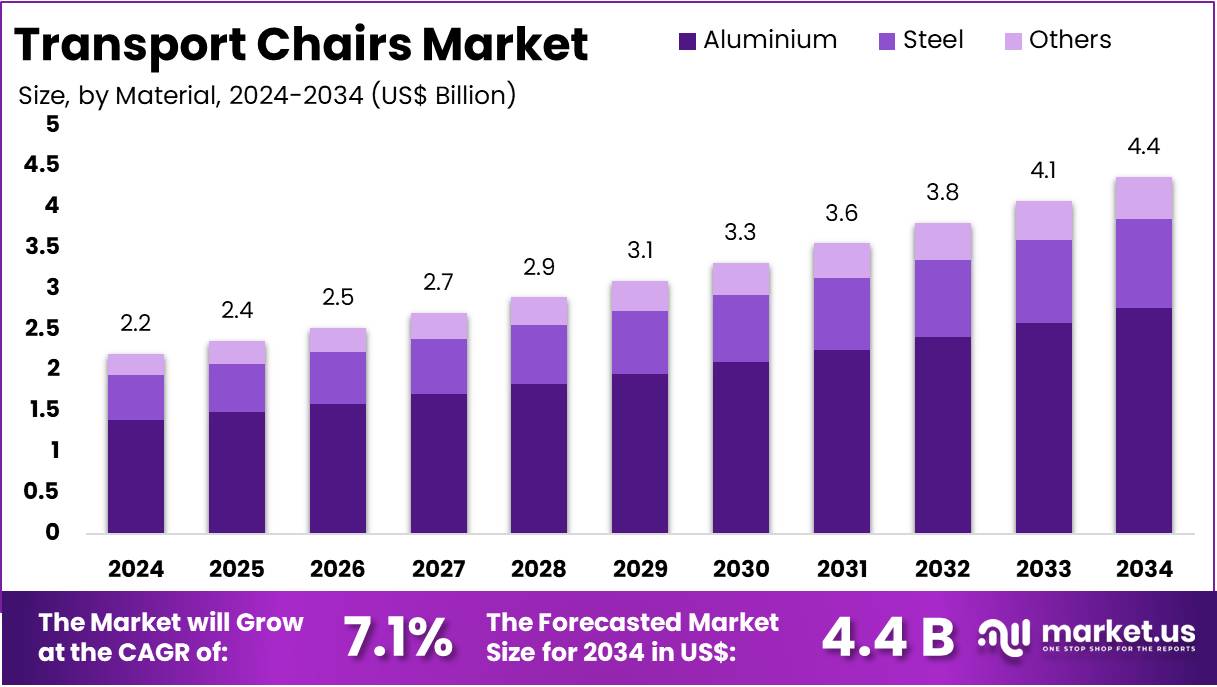
New York, NY – May 19, 2026 – The Global Transport Chairs Market Size is expected to be worth around US$ 4.4 Billion by 2034, from US$ 2.2 Billion in 2024, growing at a CAGR of 7.1% during the forecast period from 2025 to 2034. North America dominated the regional market, accounting for over 42.5% of the total share and achieving a market value of US$ 0.93 Billion.
The global transport chairs market is witnessing steady growth, driven by the increasing demand for patient mobility solutions across hospitals, ambulatory surgical centers, rehabilitation facilities, and home healthcare settings. Transport chairs are lightweight mobility devices designed to assist patients, elderly individuals, and people with limited mobility during short-distance movement within healthcare facilities or public spaces. These chairs are widely preferred due to their compact design, ease of handling, and enhanced patient comfort.
The rising geriatric population and growing prevalence of chronic diseases and mobility-related disorders are major factors contributing to market expansion. Additionally, the increasing number of surgical procedures and hospital admissions has accelerated the adoption of transport chairs in healthcare environments. Manufacturers are focusing on ergonomic designs, lightweight aluminum frames, foldable structures, and improved safety features such as locking brakes and adjustable footrests to enhance usability and convenience.
North America holds a significant share of the market owing to advanced healthcare infrastructure and high healthcare expenditure, while Asia-Pacific is expected to witness notable growth due to expanding healthcare facilities and rising awareness regarding patient mobility equipment.
Furthermore, the growing trend toward home healthcare and patient-centric care is expected to create additional opportunities for market participants. Continuous product innovation and increasing investments in healthcare infrastructure are anticipated to support the long-term growth of the transport chairs market.
Key Takeaways
- The global transport chairs market is anticipated to attain a value of approximately US$ 4.4 billion by 2034, expanding at a CAGR of 7.1% during the forecast period beginning in 2025.
- The market size was estimated at US$ 2.2 billion in 2024, establishing a robust foundation for future industry growth.
- Manual transport chairs represented more than 65.7% of total product sales in 2024, supported by their affordability, ease of use, and broad market acceptance.
- Aluminum accounted for over 63.2% of the material segment share in 2024, owing to its lightweight structure, durability, and cost efficiency.
- Clinics emerged as the leading end-user segment, holding above 56.3% of the market share in 2024 due to the rising utilization of mobility assistance devices in outpatient healthcare facilities.
- North America maintained its leading position in the global market in 2024, capturing more than 42.5% share and generating a market value of approximately US$ 0.93 billion.
Regional Analysis
In 2024, North America dominated the global transport chairs market, accounting for more than 42.5% of the total share and generating approximately US$ 0.93 billion in revenue. The region’s strong market presence was supported by advanced healthcare infrastructure, rising healthcare expenditure, and a rapidly growing elderly population. Increasing cases of age-related mobility limitations significantly boosted demand for transport chairs across hospitals, rehabilitation centers, nursing homes, and homecare environments.
The United States represented the largest contributor to the regional market due to favorable reimbursement policies, strong insurance coverage, and high adoption of mobility support equipment. Transport chairs gained widespread usage in elderly care, post-operative recovery, and temporary patient transportation. Continuous product innovations, including lightweight materials, foldable structures, and ergonomic designs, further improved convenience and expanded adoption among healthcare providers and homecare users.
Canada also contributed notably to market growth through government-supported healthcare and senior care programs. Rising awareness regarding mobility assistance devices and increasing orthopedic procedures supported product demand. Healthcare facilities across the country focused on improving patient mobility and safety standards, creating sustained market opportunities.
The regional market is expected to maintain steady growth during the forecast period, supported by technological advancements, expanding distribution channels, and increasing demand for elderly mobility solutions.
Emerging Trends
- Lightweight Materials Are Gaining Popularity: Manufacturers are increasingly using lightweight materials such as aluminum and carbon fiber in transport chairs. These materials improve portability, ease of storage, and user convenience. Lightweight designs reduce strain on caregivers and patients while supporting modern aesthetics, making them highly suitable for travel, home use, and compact living spaces.
- Rise in Demand for Foldable and Compact Designs: Foldable and compact transport chairs are witnessing strong demand due to their convenience and portability. These models are easy to store in small spaces and vehicle trunks, making them ideal for travel, hospital visits, and home care. Simple folding mechanisms further enhance user and caregiver convenience.
- Focus on Comfort and Ergonomics: Transport chair manufacturers are emphasizing comfort and ergonomic support through padded seating, adjustable armrests, and breathable materials. These features improve posture, reduce pressure sores, and enhance long-term sitting comfort. Advanced ergonomic designs are increasingly becoming standard offerings as consumers prioritize better mobility and user experience.
- Growth in Home Healthcare Usage: The expansion of home healthcare services is increasing demand for transport chairs designed for residential environments. Consumers prefer lightweight, compact, and easy-to-operate models that fit through narrow spaces. Aging populations and rising home-based patient care are encouraging manufacturers to develop more accessible and user-friendly mobility solutions.
- Customization and Add-On Features: Consumers increasingly prefer transport chairs with customizable features and practical accessories. Add-ons such as detachable footrests, storage bags, seat belts, and oxygen tank holders improve comfort, safety, and convenience. Manufacturers are focusing on personalized designs to meet varying medical and lifestyle needs while enhancing product differentiation in the market.
- Eco-Friendly Product Development: Sustainability is emerging as an important trend in the transport chair market. Manufacturers are adopting recyclable materials, eco-friendly packaging, and greener production practices to reduce environmental impact. Growing consumer awareness and regulatory support are encouraging companies to promote environmentally responsible products as a competitive market advantage.
- Technology Integration (Early Stages): Technology integration in transport chairs is gradually increasing with features such as GPS tracking, electronic braking systems, and app-based controls. Although still developing, these innovations improve safety, monitoring, and convenience for caregivers and users. Advancing affordability is expected to accelerate adoption of smart mobility solutions in the future.
Use Cases
- Hospitals and Clinics: Hospitals and clinics widely use transport chairs for moving patients between departments such as diagnostic centers, operating rooms, and recovery units. Their lightweight structure and maneuverability reduce physical strain on healthcare staff while ensuring patient comfort, safety, and efficient mobility within crowded hospital environments and narrow spaces.
- Airports and Travel Terminals: Airports and travel terminals use transport chairs to assist elderly passengers and individuals with limited mobility. These chairs support easier movement across long corridors, security checkpoints, and waiting areas. Dedicated staff improve passenger comfort, reduce travel fatigue, and ensure smoother mobility experiences in busy transportation facilities.
- Home Use for Elderly and Disabled People: Transport chairs are commonly used at home to assist elderly and disabled individuals with daily mobility. Their compact design allows smooth movement through narrow spaces and doorways. Families and caregivers benefit from easy folding, portability, and convenient transportation for medical visits, outdoor activities, and routine tasks.
- Nursing Homes and Assisted Living Facilities: Nursing homes and assisted living facilities use transport chairs to safely move residents to dining areas, activity rooms, and outdoor spaces. These chairs provide mobility support for individuals with limited strength or balance while helping caregivers improve efficiency, reduce physical strain, and maintain resident safety and independence.
- Post-Surgery or Short-Term Recovery: Patients recovering from surgery or injury often use transport chairs for safe short-distance mobility during rehabilitation. These chairs reduce physical stress on healing areas while minimizing fall risks. Caregivers can assist patients more easily, supporting recovery, comfort, and safer movement during temporary periods of weakness or fatigue.
- Emergency Services and Ambulance Use: Emergency response teams use transport chairs in confined areas where stretchers are difficult to maneuver. Their lightweight and foldable design enables rapid patient movement through staircases, narrow hallways, and elevators. Transport chairs improve emergency response efficiency while reducing injury risks for both patients and medical personnel.
- Rehabilitation Centers: Rehabilitation centers use transport chairs to support patients recovering from strokes, surgeries, and serious injuries. These chairs assist safe movement to therapy sessions, meal areas, and outdoor activities while reducing fall risks. They provide essential mobility support during physical recovery and gradual progression toward independent movement and stability.
Frequently Asked Questions on Transport Chairs
- What are transport chairs and how are they used?
Transport chairs are lightweight mobility devices designed to assist individuals with limited movement during short-distance travel. They are commonly used in hospitals, clinics, airports, and homecare settings to improve patient mobility, safety, and convenience during transportation. - What factors are driving the growth of the transport chairs market?
The transport chairs market is expanding due to the growing elderly population, rising mobility-related disorders, and increasing demand for patient handling equipment. Higher healthcare spending, expanding homecare services, and technological advancements in lightweight chair designs are also supporting market growth. - Why are manual transport chairs widely preferred in the market?
Manual transport chairs remain highly popular because they are cost-effective, easy to operate, and require minimal maintenance. Their lightweight construction and foldable designs make them suitable for healthcare facilities, caregivers, and individuals seeking practical short-distance mobility solutions. - Which material is most commonly used in transport chair manufacturing?
Aluminum is the most widely used material in transport chair production due to its lightweight, durable, and corrosion-resistant properties. It also enhances portability and ease of handling, making transport chairs more convenient for patients, caregivers, and healthcare professionals. - Which regions are leading the global transport chairs market?
North America currently leads the global transport chairs market owing to advanced healthcare infrastructure, high healthcare expenditure, and strong adoption of mobility support equipment. Asia-Pacific is also witnessing rapid growth due to expanding healthcare services and increasing elderly populations. - How are technological advancements influencing transport chair demand?
Technological developments such as ergonomic seating, foldable frames, enhanced braking systems, and lightweight materials are improving user comfort and safety. These innovations are increasing product adoption across hospitals, rehabilitation centers, and homecare settings worldwide. - What role does home healthcare play in the transport chairs market?
The growing preference for home healthcare services has significantly increased the demand for transport chairs. Patients recovering at home and elderly individuals require convenient mobility support, encouraging greater adoption of lightweight and user-friendly transport chair models.
Conclusion
The global transport chairs market is expected to witness sustained growth over the coming years, supported by the rising elderly population, increasing mobility-related disorders, and expanding demand for patient transportation solutions across healthcare and homecare settings. Technological advancements, lightweight materials, ergonomic designs, and foldable structures are improving product efficiency and user convenience.
North America continues to dominate the market, while Asia-Pacific is emerging as a high-growth region due to healthcare expansion and rising awareness. Additionally, the growing adoption of home healthcare services and continuous product innovation are expected to create significant long-term opportunities for manufacturers operating in the transport chairs industry.
Discuss your needs with our analyst
Please share your requirements with more details so our analyst can check if they can solve your problem(s)




